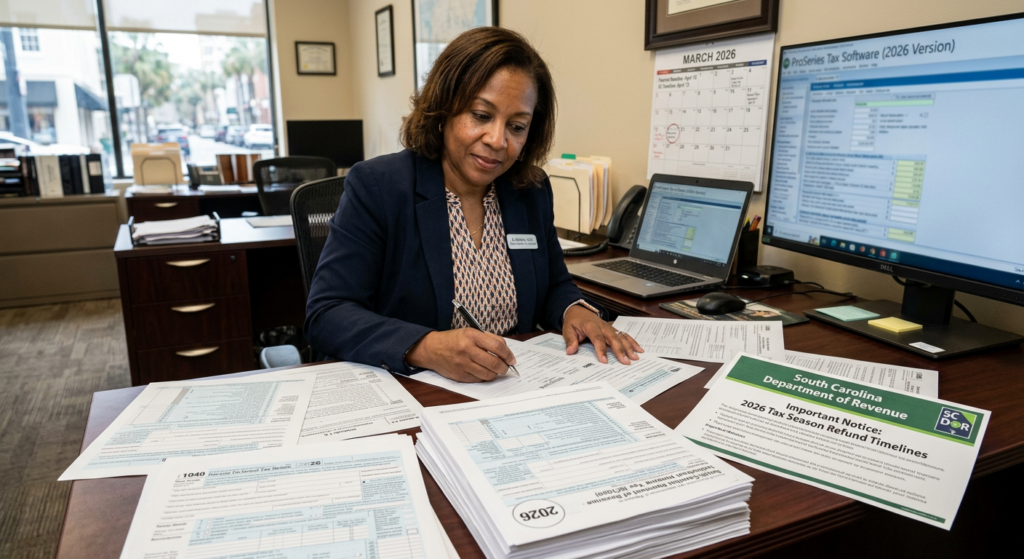
2026 Tax Changes in South Carolina: What You Need to Know About State Non-Conformity
If you’re filing taxes as a South Carolina resident in 2026, understanding the critical 2026 tax changes south carolina is essential to avoid costly mistakes and significant refund delays. Unlike most states, South Carolina refuses to conform to the federal One Big Beautiful Bill Act (OBBBA) passed in July 2025. This means residents claiming new federal tax breaks—including deductions for overtime, tips, and senior deductions—face flagged returns and extended processing timelines that could delay refunds by several weeks or more. The average federal refund for 2026 is up over 10% nationwide, but South Carolina taxpayers must navigate a complex state-federal mismatch that could cost them thousands in potential federal tax savings or create unnecessary delays.
Table of Contents
- Key Takeaways
- Why South Carolina Doesn’t Conform to 2026 Federal Tax Changes
- Which Federal Tax Breaks Don’t Apply in South Carolina?
- 2026 South Carolina Refund Processing Delays: What to Expect
- How Does South Carolina Non-Conformity Affect Self-Employed Filers?
- Federal vs. State Tax Returns: How to File Correctly Without Double Deductions
- 5 Critical Mistakes to Avoid When Filing Your 2026 South Carolina Return
- Uncle Kam in Action: Real South Carolina Taxpayer Case Study
- Next Steps
- Frequently Asked Questions
Key Takeaways
- South Carolina refuses to implement new OBBBA federal tax breaks: overtime deductions, tips deductions, and senior deductions are NOT recognized for state tax purposes.
- Processing delays: Most error-free returns take up to 8 weeks to process due to manual add-backs required by the South Carolina Department of Revenue.
- Your federal refund remains: You can still claim these new deductions on your federal return filed in 2026; delays only affect your state refund.
- File electronically: Electronic filing through official IRS and South Carolina DOR channels reduces errors and speeds state processing.
- Consult professionals: Tax complexity has increased—working with a CPA ensures you claim federal benefits while correctly reporting state income.
Why South Carolina Doesn’t Conform to 2026 Federal Tax Changes
Quick Answer: South Carolina has chosen not to adopt the One Big Beautiful Bill Act (OBBBA) federal tax changes signed into law on July 4, 2025, because state lawmakers did not conform to the new provisions. This decision leaves South Carolina taxing income that federal law exempts, creating a mismatch between federal and state tax treatment.
Understanding 2026 tax changes south carolina begins with understanding why the state made this decision. On July 4, 2025, President Trump signed the One Big Beautiful Bill Act (OBBBA) into law, ushering in sweeping federal tax changes affecting individuals and businesses. The law introduced several major provisions:
- Deduction for qualified tips (up to $25,000)
- Deduction for overtime income (premium portion only)
- Enhanced deduction for seniors age 65+ (up to $6,000 per individual, $12,000 for joint filers)
- SALT deduction cap increase from $10,000 to $40,000 for married couples filing jointly
- Expansion of the Qualified Business Income (QBI) deduction to 20% permanently
Most states automatically conform to major federal tax law changes because it’s administratively simpler and reduces tax code complexity for residents. However, South Carolina lawmakers decided the state would not conform to these specific provisions. The South Carolina Department of Revenue website explicitly states that 2026 tax return processing is taking longer than usual because the state does not currently conform to the OBBBA.
The Financial Impact on South Carolina
South Carolina’s decision to remain non-conforming stems from revenue concerns. State lawmakers projected that adopting these federal tax breaks would reduce state revenue significantly. Without knowing the exact estimate, it’s clear the state prioritized maintaining tax revenue over providing taxpayers with additional deductions. This creates a unique situation where federal law provides a tax benefit, but South Carolina taxes that same income, effectively eliminating the federal advantage for residents at the state level.
This non-conformity affects approximately 2.1 million individual tax filers in the state annually, according to state tax filing data. For residents earning substantial overtime or tips income, this mismatch can mean reduced overall tax savings compared to residents in conforming states.
How This Differs from Other Non-Conforming States
South Carolina is not alone in refusing OBBBA conformity. Washington, D.C., also refused to implement the changes, projecting a $600 million revenue loss. However, Congress overrode D.C.’s decision, and President Trump signed legislation on February 18, 2026, requiring D.C. conformity. South Carolina’s situation remains unchanged—the state continues to refuse conformity as of March 2026.
Pro Tip: Monitor the South Carolina legislature for any conformity bills. If lawmakers vote to conform mid-year, the rules could change for your 2026 return. Check the South Carolina Department of Revenue website regularly during tax season.
Which Federal Tax Breaks Don’t Apply in South Carolina?
Quick Answer: Three major federal deductions from the OBBBA do not apply to your South Carolina state return: (1) No Tax on Overtime deduction, (2) No Tax on Tips deduction, and (3) Enhanced Senior deduction. You can claim these on your federal return, but South Carolina will add them back as income on your state return.
For the 2026 tax year, understanding exactly which deductions are disallowed in South Carolina is critical. The South Carolina Department of Revenue will not recognize three specific federal tax breaks on state returns:
1. No Tax on Overtime (Premium Portion Only)
Under federal law, W-2 employees can deduct the premium portion of qualified overtime wages up to $25,000 annually using Schedule 1-A. The premium is calculated as the extra pay above the employee’s regular hourly rate. For example, if you earn $20 per hour for regular work but receive $30 per hour for overtime, the $10 premium is the deductible amount. South Carolina refuses to allow this deduction on state returns, meaning residents must report full W-2 wages as South Carolina income. This is particularly impactful for healthcare workers, factory employees, and essential workers who regularly work overtime.
2. No Tax on Tips (Qualified Tips Only)
Federal law allows service industry workers to deduct qualified tips up to $25,000 annually. This includes tips from restaurants, hotels, bars, spas, and other service occupations. While all tip income remains taxable federally (you must report all tips), you can deduct the amount using Schedule 1-A on your federal return. South Carolina taxes all tip income without any deduction, eliminating the federal benefit for state purposes. For servers, bartenders, and hospitality workers in South Carolina, this means tips face both federal and state taxation.
3. Enhanced Senior Deduction (Age 65+)
Taxpayers age 65 and over can claim an additional deduction of up to $6,000 on their federal return ($12,000 for married couples filing jointly), subject to income limitations. This deduction applies to all seniors, not just those claiming Social Security. South Carolina does not recognize this deduction for state tax purposes, adding it back as income. Seniors with significant income from pensions, investments, or continued work face a state tax penalty for this federal benefit.
What Federal Tax Breaks DO Apply in South Carolina
Important: South Carolina DOES conform to the SALT deduction cap increase ($40,000 for MFJ) and other standard federal deductions. The non-conformity is limited to the three new OBBBA deductions listed above. You can still claim your standard deduction, dependent exemptions, mortgage interest, property taxes, charitable contributions, and other traditional deductions on both federal and South Carolina returns.
2026 South Carolina Refund Processing Delays: What to Expect
Quick Answer: Most error-free South Carolina returns will be processed within 8 weeks due to manual adjustments required by non-conformity. Expect your refund timeline to be significantly longer than the 21-day federal standard, potentially 10-12 weeks for some filers.
Understanding the refund timeline is crucial for 2026 tax planning in South Carolina. The South Carolina Department of Revenue website explicitly warns taxpayers that processing is taking longer than usual. Here’s what to expect:
| Processing Scenario | Expected Timeline | Notes |
|---|---|---|
| Electronic filing (Federal + SC), no OBBBA deductions | 3-4 weeks | Standard processing; unaffected by non-conformity |
| Electronic filing with OBBBA deductions claimed | 8-12 weeks | Manual review required; SC adds back disallowed deductions |
| Paper filing (any scenario) | 10-16 weeks | Paper returns face additional delays; e-file strongly recommended |
| Return with errors or discrepancies | 12+ weeks | Additional review required; may require amended return |
The primary reason for the delay is that South Carolina’s tax processing system must manually add back the disallowed OBBBA deductions as income. When a return comes in showing a Tips deduction or Senior deduction, the DOR system flags it for manual processing. Staff members then verify the amount claimed and adjust the taxable income accordingly, effectively negating the federal deduction for state purposes.
When Will You Get Your Federal Refund vs. State Refund?
Here’s critical information for 2026 filers: Your federal refund and South Carolina state refund are processed separately. The federal refund is processed by the IRS and typically arrives within 21 days for e-filers choosing direct deposit. The South Carolina refund is processed separately by the South Carolina Department of Revenue and faces the 8-12 week delay mentioned above. You’ll receive your federal refund first, usually by early to mid-February if you e-file in January. Your state refund arrives weeks or months later.
Pro Tip: If you need your refund quickly, request federal direct deposit and expect your state refund 8-10 weeks after filing. Don’t depend on your state refund for immediate cash needs. Plan your 2026 budget conservatively if you’re expecting a South Carolina state refund.
How Does South Carolina Non-Conformity Affect Self-Employed Filers?
Quick Answer: Self-employed 1099 contractors cannot claim tip or overtime deductions on their federal Schedule C or business income. However, self-employed individuals age 65+ can claim the Senior deduction if eligible. Use our Self-Employment Tax Calculator to estimate 2026 self-employment tax liability.
Self-employed and 1099 filers face different rules for the new OBBBA deductions. Unlike W-2 employees, self-employed individuals cannot claim the Tips deduction or Overtime deduction because these provisions apply only to wages received on W-2 forms. This is an important distinction for contractors, gig workers, and business owners in South Carolina.
However, self-employed individuals age 65+ CAN claim the Enhanced Senior deduction if they meet income limitations. The deduction is calculated as a percentage of business income and is subject to phase-out thresholds. Self-employed taxpayers claiming the Senior deduction on federal returns will face the same South Carolina non-conformity issue: the deduction will be added back as income for South Carolina state tax purposes.
To understand your specific 2026 self-employment tax situation and estimated liability given South Carolina non-conformity, you can use our Self-Employment Tax Calculator to model various business income scenarios and see the federal-state mismatch impact.
Gig Economy Workers and 1099 Income
Uber drivers, DoorDash delivery contractors, Fiverr freelancers, and other gig economy workers file 1099 forms and are classified as self-employed. Tips received in the gig economy are NOT eligible for the federal No Tax on Tips deduction because the deduction applies only to wages on W-2 forms reported to employers. Gig tips received through apps are business income on Schedule C, not W-2 wages, so this federal deduction does not help gig workers.
 Free Tax Write-Off Finder
Federal vs. State Tax Returns: How to File Correctly Without Double Deductions
Quick Answer: Claim all eligible OBBBA deductions on your federal return using Schedule 1-A. On your South Carolina return, report full income without these deductions. The South Carolina DOR will verify your federal return and make automatic adjustments.
The most important strategy for 2026 South Carolina filers is understanding that your federal and state returns flow through a coordination system. Federal taxable income is the starting point for calculating South Carolina state taxable income. Here’s how the process works:
- You file your federal return showing all income and deductions, including the new OBBBA deductions (Tips, Overtime, Senior).
- You file your South Carolina return with the same income reported federally but without claiming the three non-conforming deductions.
- The South Carolina DOR receives your federal return information electronically and verifies your state return against it.
- If the DOR detects a Tips, Overtime, or Senior deduction on your state return, it flags your return for manual review.
- Staff manually add those deductions back as income, recalculating your South Carolina tax liability.
- Your refund is processed with the corrected amount, typically after 8+ weeks.
Avoiding the Processing Loop: Critical Filing Tips
To avoid contributing to processing delays and to reduce the likelihood of errors, follow these filing guidelines:
- Use 2026-compliant tax software: Ensure your software is updated to the latest version with South Carolina conformity rules built in. TurboTax, H&R Block, and TaxAct have all issued 2026 updates addressing South Carolina non-conformity.
- File electronically, not by paper: Paper returns take significantly longer to process. The South Carolina DOR cannot electronically match paper returns to federal forms as quickly.
- Consult a professional for non-standard deductions: If you claim Tips, Overtime, or Senior deductions on your federal return, work with a CPA or EA to ensure your South Carolina return is filed correctly without these disallowed items.
- Keep detailed records: Maintain paystubs showing overtime amounts, tip reports from your employer, and age verification for senior deduction eligibility. The DOR may request these during manual review.
5 Critical Mistakes to Avoid When Filing Your 2026 South Carolina Return
Quick Answer: The five most common mistakes are: claiming OBBBA deductions on SC returns, using outdated tax software, filing paper returns, not reconciling federal-state differences, and missing income adjustments. Each can trigger manual review and delay your refund.
Based on tax professional reports and South Carolina DOR communications, here are the critical mistakes 2026 filers are making:
Mistake #1: Automatically Copying Federal Deductions to Your State Return
The most common error: Many taxpayers use tax software that automatically flows federal income to the state return. If you claim a Tips deduction or Senior deduction on your federal Schedule 1-A, the software defaults to including the same deductions on your SC return. You must manually remove these before submitting your South Carolina return. Failure to do this triggers automatic flags and manual review.
Mistake #2: Filing with 2025 Tax Software or Older Versions
Using last year’s tax software or an old version without 2026 South Carolina conformity rules can cause automatic errors. Tax software companies issued critical updates in January 2026 specifically addressing South Carolina non-conformity. If your software is not updated, you risk filing incorrectly.
Mistake #3: Filing Paper Returns Instead of E-Filing
Paper returns face 10-16 week delays versus 8-12 week delays for electronic returns. The South Carolina DOR processes paper returns manually because they cannot electronically match them to federal forms, making coordination impossible. This processing delay means waiting until May or June for your state refund when e-filing would deliver it by March.
Mistake #4: Not Understanding the Federal-State Mismatch
Some taxpayers believe that if they claim a deduction on their federal return, they should claim it on their state return too. This misunderstanding causes significant errors in South Carolina. Federal law and South Carolina state law are different. You must report different income to each jurisdiction, and that’s legal and required.
Mistake #5: Failing to Report All Income on Both Returns
While you may deduct Tips or Overtime on your federal return, all income must be reported on both returns. W-2 income, 1099 income, tips, and all other compensation must appear as gross income on both federal and South Carolina returns. The deduction is taken at the federal level only. Some taxpayers try to exclude income from the SC return, which is incorrect and will be caught during verification.

Uncle Kam in Action: Real South Carolina Taxpayer Case Study
Client Profile: Marcus is a 34-year-old self-employed landscaping contractor and part-time restaurant server in Charleston, South Carolina. He has Schedule C business income of $45,000 and W-2 wages from restaurant work of $28,000. His W-2 wages include $8,000 in tips (claimed through his employer) and $3,200 in overtime premium wages. He has no dependents and files as single.
The Problem: Marcus used TurboTax’s default settings, which automatically applied the federal No Tax on Tips deduction ($8,000) and the No Tax on Overtime deduction ($3,200) to both his federal and South Carolina returns. His federal return correctly showed these deductions, reducing his federal taxable income. However, his South Carolina return was filed with the same deductions, which is not allowed under South Carolina non-conformity rules.
The Impact: Marcus filed his return on February 10, 2026. He received his federal refund by February 26 ($1,850). However, the South Carolina DOR flagged his return due to the disallowed Tips and Overtime deductions. During manual review, staff added $11,200 back to his South Carolina taxable income, recalculating his state tax from $1,200 to $1,840—a $640 reduction in his expected state refund. Combined with his federal benefit, the non-conformity cost Marcus approximately $400 in additional South Carolina taxes.
Timeline: Marcus’s return was not processed until April 15, 2026—2 months after filing. This delayed his state refund by 8 weeks compared to the typical 3-4 week timeline.
The Solution: Had Marcus consulted Uncle Kam’s tax strategy advisors before filing, we would have ensured his South Carolina return excluded the disallowed deductions while his federal return properly claimed them. This would have avoided the 8-week delay and the manual review flag. He would have received his state refund by mid-March instead of mid-April.
Key Lesson: South Carolina non-conformity requires understanding the federal-state mismatch. Default software settings don’t account for state-specific non-conformity rules. Professional guidance is essential for 2026 filers claiming new federal deductions.
Next Steps
Understanding the 2026 tax changes south carolina is only the first step. Here’s what to do right now to protect your refund and avoid delays:
- Gather your 2025 income documents: W-2s, 1099s, paystubs showing overtime, and tip reports. You’ll need these to accurately report income on both federal and South Carolina returns.
- Update your tax software: If you plan to file using tax software, ensure it’s the 2026 version with the latest South Carolina conformity rules. Download updates from TurboTax, H&R Block, or TaxAct before filing.
- Consult a tax professional: If you claim Tips, Overtime, or Senior deductions, work with a CPA or EA. The tax strategy advisors at Uncle Kam specialize in federal-state mismatches and can ensure your returns are filed correctly.
- Plan your filing timeline: File early (January-February) for the fastest processing. Paper filing should be avoided entirely; e-file through official channels only.
- Track both refunds separately: Plan your 2026 budget assuming your federal refund arrives by mid-February and your South Carolina refund arrives by late March or April. Don’t depend on state refund timing.
Frequently Asked Questions
Can I claim the 2026 Tips deduction on my South Carolina return?
No. South Carolina does not conform to the federal No Tax on Tips deduction. You can claim the deduction on your federal return, but you must report all tips as income on your South Carolina return. The South Carolina DOR will add any tips deduction claimed on your state return back as income, reducing or eliminating the deduction benefit for state purposes.
Will my federal refund be delayed due to South Carolina non-conformity?
No. Your federal refund is processed by the IRS independently of your South Carolina return. Federal refunds for e-filed returns typically arrive within 21 days. Your South Carolina refund is processed separately by the South Carolina DOR and may take 8-12 weeks. These are two separate refunds with different processing timelines.
I’m a senior age 65+. Can I claim the Enhanced Senior deduction in South Carolina?
You can claim the deduction on your federal return, but not on your South Carolina return. South Carolina does not recognize the Enhanced Senior deduction. Claiming it on your SC return will trigger manual review and add-back, negating the state benefit. You receive the federal tax benefit only, not the state benefit.
What if I claimed OBBBA deductions on my South Carolina return by mistake?
Your return will be flagged during manual processing, and the South Carolina DOR will add the disallowed deductions back as income, increasing your state tax liability or reducing your refund. This is automatic and will be adjusted without your action. However, it will delay your refund by 8+ weeks. To avoid this in the future, file an amended return or consult a tax professional before filing your next return.
Should I file my federal and South Carolina returns separately or together?
You should file them in one session using tax software (either e-filed together or via the IRS Free File system), but they must show different numbers if you’re claiming OBBBA deductions. The software can be configured to file both returns simultaneously while automatically excluding disallowed deductions from your South Carolina return. Most modern tax software platforms offer this functionality.
Is South Carolina likely to conform to the OBBBA before the end of the 2026 tax year?
As of March 11, 2026, there is no indication that South Carolina will conform mid-year. Legislative action would be required, and South Carolina lawmakers have shown no urgency in addressing this issue. Monitor the South Carolina Department of Revenue website and state legislature website for any surprise conformity legislation, but plan your 2026 taxes assuming non-conformity.
Can I file an amended return if I made a mistake with OBBBA deductions?
Yes. If you file your South Carolina return with disallowed OBBBA deductions, you can file an amended Form SC1040-X to correct the error. However, filing an amended return may trigger additional manual review and could further delay your refund. It’s better to file correctly the first time.
How does the SALT deduction increase impact my South Carolina return?
South Carolina DOES conform to the SALT deduction cap increase, meaning you can claim up to $40,000 in state and local taxes on your federal return (up from $10,000 in 2025). This benefit applies to both federal and South Carolina returns, so it doesn’t create the same mismatch as the Tips/Overtime/Senior deductions. Claim your SALT deduction on both returns without worry.
This information is current as of March 11, 2026. Tax laws change frequently. Verify updates with the IRS or South Carolina Department of Revenue if reading this later.
Related Resources
- 2026 Tax Strategy Services
- Professional Tax Preparation and Filing Services
- Self-Employed and 1099 Tax Planning
- South Carolina Department of Revenue Official Website
- IRS Official Announcements and Guidance
Last updated: March, 2026

