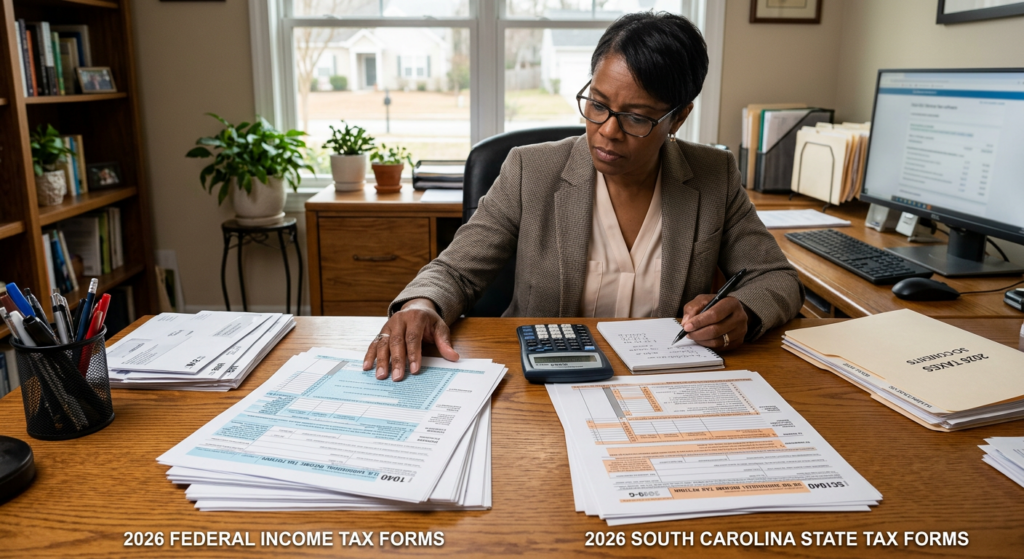
2026 Tax Changes South Carolina: Federal vs. State Deductions Explained
Understanding 2026 tax changes South Carolina is critical for residents filing this year, especially since the state refuses to conform to Trump’s new federal tax breaks. For the 2026 tax year, South Carolina is not adopting federal deductions for overtime income, qualified tips, and the senior deduction—creating a potentially costly mismatch that could delay your refund by weeks or even months. This guide walks you through exactly what changed federally, what South Carolina still doesn’t allow, and the specific steps you must take to avoid filing errors.
Table of Contents
- Key Takeaways
- What Federal Tax Changes Happened in 2026?
- Why South Carolina Refuses to Conform to Federal Tax Law
- Which Federal Deductions Does South Carolina Not Allow?
- How South Carolina Non-Conformity Delays Your Refund
- How Do South Carolina Tax Changes Affect Hourly Workers?
- How Do Service Workers and Tipped Employees File Correctly?
- How Do South Carolina Tax Changes Affect Seniors?
- How Do South Carolina Tax Changes Affect Small Business Owners?
- Next Steps
- Frequently Asked Questions
Key Takeaways
- South Carolina does NOT allow federal deductions for overtime, tips, or senior taxpayers for 2026—federal law and state law conflict.
- Federal average refunds are up 10.6% ($3,742 average) due to new tax breaks, but SC filers risk delays if they claim federal-only deductions on state returns.
- File electronically to avoid weeks of processing delays; paper returns face significant backlogs.
- Manually remove overtime, tips, and senior deductions from your South Carolina return, even if claimed federally.
- Expect SC processing to take up to eight weeks for error-free returns; flagged returns face additional review delays.
What Federal Tax Changes Happened in 2026?
Quick Answer: The One Big, Beautiful Bill Act (July 2025) created new federal deductions for overtime income, qualified tips, and a bonus senior deduction. The SALT deduction cap also quadrupled to $40,000 for married couples. However, these changes only apply to federal returns—not South Carolina state returns.
On the federal level, the 2026 tax year brings significant new deductions and expanded credits under the One Big, Beautiful Bill Act. These changes took effect on January 1, 2025, and apply to returns filed during the 2026 filing season.
First, qualified overtime workers can now deduct a portion of their overtime income from federal taxable income. Workers earning wages subject to Fair Labor Standards Act requirements can claim deductions on the additional “half” of time-and-a-half pay, subject to income limitations and a maximum of 250 hours annually.
Second, service workers and hospitality employees can now deduct up to $25,000 in qualified tips from federal taxable income. This applies to workers in food service, hotels, bars, and similar industries earning under $150,000 annually. The key requirement is that the tips must be documented and earned in industries traditionally dependent on tip income.
Third, taxpayers aged 65 and older can claim an additional $6,000 deduction (or $12,000 for married couples filing jointly) on their federal returns. This senior deduction applies to filers with modified adjusted gross income below $75,000 (single) or $150,000 (married filing jointly).
Additionally, the State and Local Tax (SALT) deduction cap increased from $10,000 to $40,000 for married couples filing jointly ($20,000 for married filing separately, $20,000 for single filers). This allows itemizing taxpayers to deduct more state and local income taxes and property taxes from their federal taxable income.
The Child Tax Credit expanded, and the Earned Income Tax Credit became more generous. Average federal refunds have increased by 10.6%, reaching $3,742 per return as of late February 2026.
Why South Carolina Refuses to Conform to Federal Tax Law?
Quick Answer: South Carolina prioritizes state revenue over federal conformity. Adopting the new federal deductions would cost the state significant tax revenue, so state policymakers deliberately chose non-conformity to preserve existing tax collections.
Unlike most states that automatically conform to federal tax law changes, South Carolina has explicitly refused to adopt the 2026 federal deductions for overtime, tips, and senior taxpayers. This decision reflects fiscal and political considerations at the state level.
State-level tax policy is separate from federal law. States have the authority to choose whether to follow federal tax rules or establish their own deductions, credits, and income definitions. In 2026, South Carolina joined Washington DC, New York, Idaho, and Oregon in refusing to implement Trump’s new federal tax breaks.
The South Carolina Department of Revenue posted a message on its official website acknowledging that 2025 return processing is taking longer than usual “because South Carolina does not currently conform to OBBBA (One Big, Beautiful Bill Act).” The state’s position is deliberate: conforming to these new federal deductions would reduce state tax revenue significantly. Rather than lose tax dollars, South Carolina opted to maintain its existing tax structure.
This creates a two-tier tax system where South Carolina residents may owe less federal income tax but more state income tax than residents in conforming states. Business owners and employees must navigate two different deduction systems simultaneously.
Pro Tip: If you move from South Carolina to a conforming state or vice versa, your tax situation changes significantly. Midwest and Northeast states have been faster to conform. Southern states like South Carolina have generally resisted.
Which Federal Deductions Does South Carolina Not Allow?
Quick Answer: South Carolina does not allow deductions for overtime income, qualified tips, or the bonus senior deduction. These deductions are exclusively federal and cannot be claimed on South Carolina state returns.
The specific federal deductions that South Carolina refuses to recognize in 2026 are:
Overtime Income Deduction
Federal law allows qualified workers to deduct a portion of overtime income. Specifically, workers who are required to receive time-and-a-half pay under the Fair Labor Standards Act can deduct the “additional half” portion of that overtime. This deduction is limited to 250 hours per year and is subject to income limits. However, South Carolina does not recognize this deduction on state returns.
Qualified Tips Deduction
Federal law now allows service workers to deduct up to $25,000 in qualified tip income annually if they earn under $150,000. This applies to workers in food service, hospitality, gaming, transportation, and personal services where tips are customary. The deduction reduces taxable income dollar-for-dollar at your marginal tax rate. For example, if you’re in the 22% federal bracket, a $25,000 tips deduction saves approximately $5,500 in federal taxes. South Carolina does not allow this deduction on state returns.
Bonus Senior Deduction
Taxpayers aged 65 and older can claim an additional $6,000 deduction on their federal returns (or $12,000 if married filing jointly). This applies to single filers with modified adjusted gross income under $75,000 and married couples with income under $150,000. Unlike the standard deduction, which increases with age, this is an additional above-the-line deduction. South Carolina does not recognize this deduction on state returns.
The critical issue is that tax software typically starts with federal taxable income and applies state-specific adjustments. If you claim these federal deductions on your federal return using tax software, the software may inadvertently include them on your South Carolina return as well—creating an error that triggers state review and processing delays.
How South Carolina Non-Conformity Delays Your Refund?
Quick Answer: South Carolina’s Department of Revenue must manually review returns claiming federal-only deductions, adding 4-8 weeks of processing time. Flagged returns may face additional correspondence and delay payments further.
The refund delay mechanism works like this: Most tax filers use software that starts with federal taxable income as the starting point for state returns. If you claim overtime, tips, or senior deductions on your federal return, tax software may automatically include those same deductions on your South Carolina return. When your return is submitted, the South Carolina Department of Revenue system flags it because South Carolina’s rules don’t allow these deductions.
The state must then manually add back those deductions as income on your return, effectively removing them from your South Carolina taxable income. This manual review process adds significant processing time. According to the South Carolina Department of Revenue, most error-free returns will be processed in up to eight weeks. However, returns flagged for deduction mismatches take considerably longer.
Critically, the processing delays affect primarily paper-filed returns. The South Carolina Department of Revenue strongly advises residents to file electronically to bypass these bottlenecks. Electronic filing allows returns to be processed more quickly, though state review of federal-only deductions still occurs.
Once your return is corrected (deductions removed), you may receive correspondence from the state explaining the adjustment. If your federal refund was applied to your state liability, this adjustment could change the amount you receive or owe.
Pro Tip: Even if your federal return is accepted and processed quickly, your South Carolina refund may take 2-3 months longer. Plan your cash flow accordingly and don’t count on immediate state refunds if you claim these federal deductions.
How Do South Carolina Tax Changes Affect Hourly Workers?
Quick Answer: Hourly workers claiming overtime deductions on their federal returns must remove those deductions from their South Carolina returns to avoid processing delays and potential state assessment notices.
Hourly workers, particularly those in manufacturing, construction, utilities, emergency services, and transportation, often work significant overtime. Under federal law, they can deduct a portion of that overtime income. However, in South Carolina, that same overtime income is fully taxable at the state level.
Scenario: Manufacturing Worker with Overtime
Let’s say you’re a plant manager in Greenville, South Carolina earning $55,000 in regular wages and $8,000 in qualified overtime. On your federal return, you can deduct $5,000 of that overtime (the “additional half” on 250 hours at your wage rate), reducing your federal taxable income to $58,000. In the 22% federal bracket, this saves you approximately $1,100 in federal taxes.
However, on your South Carolina return, that entire $8,000 of overtime is fully taxable. South Carolina income tax in the top bracket is 7%, so you owe $560 on that overtime income at the state level. Your software may have automatically included the $5,000 federal deduction on your SC return, reducing your state income by $5,000. At 7%, this means you underpaid your South Carolina taxes by $350.
When the state reviews your return, it will identify this mismatch. You’ll owe the $350 plus potential interest, and your refund will be delayed while this is sorted out.
What Hourly Workers Should Do
- File your federal return normally, claiming the overtime deduction allowed.
- When filing your South Carolina return, do NOT transfer the federal overtime deduction to your state return.
- Report all overtime income as fully taxable for South Carolina purposes.
- Use professional tax software with state-specific rules, or consult a tax professional for your state return.
- File electronically to speed up state processing.
 Free Tax Write-Off Finder
How Do Service Workers and Tipped Employees File Correctly?
Quick Answer: Service workers with tips income must carefully separate federal deductions from state income reporting. South Carolina fully taxes tips at the state level, even though federal law allows up to $25,000 in deductions.
Tipped employees in hospitality, restaurants, bars, gaming, and personal services face a similar challenge. Federal law now allows up to $25,000 in qualified tips to be deducted from taxable income for those earning under $150,000. This can provide substantial tax relief for workers in tip-dependent industries.
However, South Carolina does not recognize the tips deduction. This means your $20,000 in annual tips, which might generate a $4,000 federal deduction at the 20% marginal rate, is still fully taxable in South Carolina. At 7% state income tax, that’s $1,400 in state taxes owed on tip income that received federal deduction benefits.
Tips Calculation Example
Suppose you’re a server in Charleston earning $18,000 in wages and $22,000 in tips (total $40,000 income). On your federal return, you can deduct $22,000 in tips (under the $25,000 annual limit), reducing your federal taxable income to $18,000. At the 12% federal bracket, this saves approximately $2,640 in federal taxes.
On your South Carolina return, however, your income is $40,000 (wages plus tips). South Carolina income tax at 7% means you owe $2,800 in state taxes. You receive federal benefits ($2,640 refund from deductions) but owe state taxes you didn’t anticipate.
Tips Filing Requirements
- Maintain detailed records of daily tips for the entire year (not required by IRS but essential for documentation).
- Report all tips on your federal return, including those under $20 per shift if you have multiple employers.
- Claim the federal tips deduction (up to $25,000 if eligible).
- On your South Carolina return, include all tips as income—do NOT subtract the federal deduction.
- Plan for additional state tax liability that won’t be covered by federal deductions.
- Consider increasing withholding throughout the year to avoid surprises at tax time.
How Do South Carolina Tax Changes Affect Seniors?
Quick Answer: Seniors aged 65+ can claim a $6,000 federal deduction ($12,000 for married couples), but South Carolina does not recognize this deduction on state returns, creating a significant state tax liability.
For retirees and seniors, the new federal senior deduction provides meaningful tax relief. Taxpayers aged 65 and older can claim an additional $6,000 deduction on their federal returns (or $12,000 for married couples filing jointly), provided their modified adjusted gross income is below $75,000 (single) or $150,000 (married).
This is particularly valuable for seniors living on fixed incomes from pensions, Social Security, and retirement account distributions. A $6,000 federal deduction in the 12% bracket saves $720 in federal taxes. For seniors on tight budgets, this matters significantly.
However, South Carolina does not recognize the bonus senior deduction. This creates a situation where your federal tax liability is reduced but your South Carolina tax liability is not.
Scenario: Retired Couple in South Carolina
Let’s say you and your spouse are both over 65, receiving $40,000 in combined Social Security (not fully taxable) and $30,000 in pension income, totaling $70,000 in gross income. Your modified adjusted gross income qualifies for the full senior deduction.
On your federal return, you claim the $12,000 joint senior deduction, reducing your federal taxable income. At the 12% bracket, this saves $1,440 in federal taxes.
On your South Carolina return, you report the full $70,000 income (no senior deduction allowed). At the 7% rate, you owe $4,900 in state taxes. You’ve received a federal benefit ($1,440 refund from the senior deduction) but face undiminished state tax obligations.
Seniors’ Action Steps
- Verify you’re eligible: Age 65+, modified adjusted gross income below $75,000 (single) or $150,000 (married filing jointly).
- Claim the full senior deduction on your federal return ($6,000 single or $12,000 married).
- On your South Carolina return, do NOT claim the senior deduction—report all income as normal.
- Use tax preparation software designed for state-specific differences or work with a tax professional.
- File electronically to minimize processing delays.
- Plan for the full South Carolina tax liability (don’t assume the federal deduction applies at the state level).
How Do South Carolina Tax Changes Affect Small Business Owners?
Quick Answer: Self-employed business owners, particularly those with employees working overtime or in tip-dependent businesses, face complexity managing federal deductions that South Carolina doesn’t recognize.
Small business owners who employ hourly workers with overtime or operate tip-based businesses (restaurants, bars, salons) face additional complexity in 2026. If you have employees working overtime, they may claim the federal overtime deduction. If you run a tip-based business, your employees claim the federal tips deduction. However, these deductions are not allowed for South Carolina purposes.
Additionally, self-employed business owners must handle their own overtime and tips if applicable. A self-employed consultant earning overtime or a self-employed stylist receiving tips must navigate the federal deduction rules while understanding they don’t apply at the state level.
Small business owners in South Carolina should use our Small Business Tax Calculator for Nashville to estimate federal versus state tax liability impacts. This helps plan for the gap between federal deductions allowed and state taxes owed.
For business owners, the key is separate accounting: federal deductions on Schedule C (or Form 1040-SE for self-employed) work one way, but South Carolina state returns require different income reporting. Many business owners benefit from professional tax preparation to ensure they file correctly on both fronts.

Uncle Kam in Action: Managing State Tax Conformity Issues
Client Profile: Sarah is a 34-year-old manufacturing shift supervisor in Spartanburg, South Carolina. She earns $52,000 in base wages and approximately $10,000 in overtime during peak production months. She’s also started a side consulting business, earning an additional $8,000 in 2025, some of which came from project work during weekends (potentially qualifying as overtime for federal purposes if properly structured).
Sarah’s Challenge: When Sarah filed her 2025 return using popular tax software, she claimed $8,000 in overtime deduction on both her federal and South Carolina returns. The software automatically carried federal numbers to the state form. Her federal refund was calculated assuming the deduction, reducing her federal tax liability by approximately $1,760 (at the 22% bracket). However, her South Carolina return was flagged by the Department of Revenue for the disallowed deduction.
The Outcome: Uncle Kam’s tax strategist identified the issue before Sarah filed. We prepared separate federal and South Carolina returns, correctly claiming the $8,000 overtime deduction federally but reporting full income to South Carolina. Sarah’s federal refund was still $1,760 (from the federal deduction), but she owed an additional $560 in South Carolina taxes (at 7% on the $8,000). This net benefit of $1,200 was far better than facing a processing delay, state correspondence, and potential interest charges on unpaid state taxes.
Lesson: Proper planning and state-specific tax filing prevented delays and maximized Sarah’s overall benefit from the federal overtime deduction while properly accounting for South Carolina’s non-conformity.
Next Steps
- Identify your situation: Do you work overtime, receive tips, or are you over 65? These are the specific scenarios affected by South Carolina’s non-conformity with 2026 tax changes in South Carolina.
- File electronically: Paper returns face significant processing delays in South Carolina this year. Electron filing minimizes bottlenecks.
- Use professional tax software with state-specific rules: Ensure your tax preparation software or tax professional accounts for South Carolina’s non-conformity, not just federal deductions.
- Review our tax strategy resources for multi-state planning: If you work or do business in multiple states, federal-state coordination becomes critical.
- Consult a tax professional: Don’t rely on software defaults alone. A tax advisor can help you navigate the federal-state deduction mismatch and plan your 2026 taxes strategically.
Frequently Asked Questions
Will South Carolina adopt these federal deductions in 2026?
As of March 2026, South Carolina has not indicated plans to conform. The state’s position is firm: non-conformity preserves state revenue. Change would require legislative action, which hasn’t been proposed. Don’t expect conformity in 2026. Plan for the current rules: federal deductions do not apply at the South Carolina state level.
If I claim federal deductions on my state return, what happens?
The South Carolina Department of Revenue will flag your return during processing. The state will add back the disallowed deductions, increasing your South Carolina taxable income. If you overpaid state taxes, you’ll receive a reduced refund or owe additional taxes plus potential interest. Processing delays of 4-12 weeks are common. You may receive correspondence from the state explaining the adjustment.
Are other states also non-conforming?
Yes. As of 2026, four states plus Washington DC are non-conforming: New York, Idaho, Oregon, South Carolina, and DC. Other states have already conformed to the 2025 federal changes. If you work in multiple states or moved between states, tax rules vary significantly. Consult a tax professional about your specific situation.
Do I lose the federal deduction benefit if South Carolina doesn’t recognize it?
No. You still receive the full federal tax benefit. You save taxes federally but owe full state taxes. For example, if you claim $25,000 in tips, your federal tax drops by perhaps $5,000 (depending on your bracket), but you pay full South Carolina state taxes on that $25,000. Your overall tax savings is positive, just less than it would be in a conforming state.
How long will my South Carolina refund take?
The state says “up to eight weeks” for error-free returns. However, returns claiming federal-only deductions take longer because they require manual review. Expect 8-16 weeks if your return is flagged. Electronic filing speeds up the process compared to paper filing. Your federal refund may arrive in 21 days while you wait 12+ weeks for your state refund—don’t assume they’ll arrive together.
What if I made a mistake on my 2025 return?
If you already filed claiming federal deductions on your 2025 return and the state hasn’t processed it yet, you can request an amended return before the state processes the original. If the state has already processed your return and adjusted it, you have limited recourse unless you can prove legitimate state-specific adjustments. If you’ve already received correspondence from the state, respond promptly with documentation.
Can I deduct state taxes I paid due to non-conformity on my federal return?
Yes, under the SALT deduction. The federal SALT deduction cap is $40,000 for married couples filing jointly (for 2026 through 2029). South Carolina income taxes you pay are deductible on your federal return (if you itemize). However, this provides partial offset only. A $560 South Carolina tax bill reduces your SALT deduction, providing a benefit only if you itemize and have room under the $40,000 cap.
Where can I find more information about South Carolina’s non-conformity position?
The South Carolina Department of Revenue website has official guidance. You can also contact the IRS at 1-800-829-1040 for federal deduction guidance. For state-specific help, South Carolina’s Department of Revenue tax professional resources provide official policy details.
Should I file an extension if I’m claiming these federal deductions?
A filing extension buys time to prepare accurate returns with proper federal-state separation. If you’re uncertain about your deductibility or expect processing delays, filing by April 15 but requesting a six-month extension (until October 15) gives you time to work with a tax professional and ensure accuracy. However, any taxes owed must still be paid by April 15 to avoid penalties and interest.
What’s the best way to avoid this problem for 2026?
Work with a tax professional familiar with South Carolina’s non-conformity. Use tax preparation software designed for state-specific compliance, not just generic federal-state software. Separate your federal and state return preparation: file federal deductions correctly, then specifically identify what cannot be claimed at the state level. File electronically to speed processing. Most importantly, don’t assume federal rules apply to South Carolina—they don’t for these specific 2026 deductions.
Related Resources
- Professional tax preparation services for 2026 returns
- South Carolina Department of Revenue official website
- Tax strategies for business owners navigating multi-state compliance
Last updated: March, 2026

