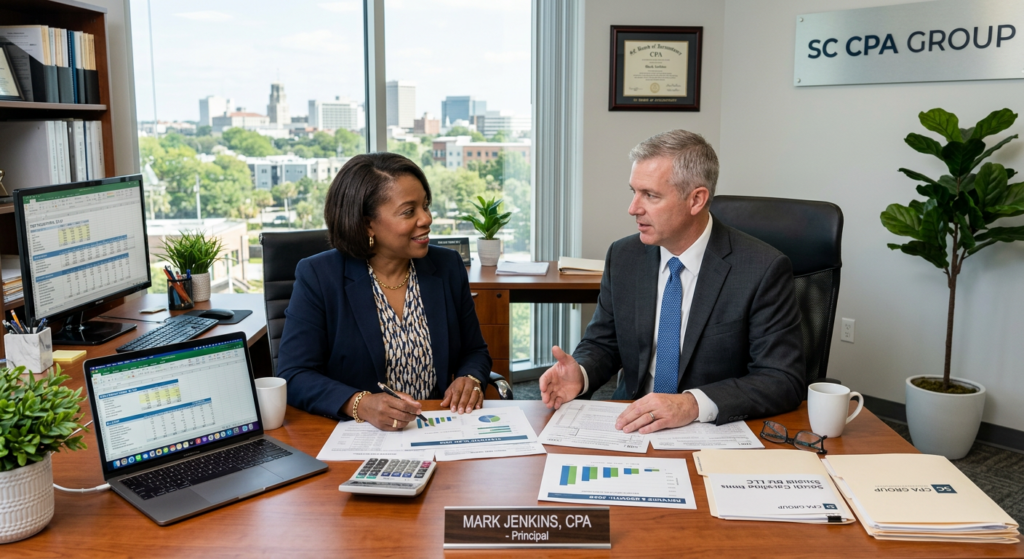
2026 Small Business CPA Cost in South Carolina: Complete Pricing Guide
For 2026, understanding the cost of hiring a certified public accountant in South Carolina has become essential for business owners navigating new federal tax laws. The average South Carolina small business CPA cost varies significantly based on company size, complexity, and services required. With the implementation of the One Big Beautiful Bill Act in 2025, tax planning opportunities and compliance requirements have shifted dramatically—making professional guidance more valuable than ever.
Table of Contents
- Key Takeaways
- How Much Does a CPA Cost for a South Carolina Small Business?
- What Factors Affect CPA Fees in South Carolina?
- What Is the Real Value of Hiring a CPA for Your SC Business?
- Which 2026 Tax Deductions Can a CPA Help You Maximize?
- When Should You Hire a CPA for Your Small Business?
- CPA vs. Bookkeeper vs. DIY: Which Option Saves the Most?
- Uncle Kam in Action
- Next Steps
- Frequently Asked Questions
Key Takeaways
- South Carolina small business CPA costs range from $1,500–$5,000+ annually depending on business complexity and entity type.
- The 20% Qualified Business Income (QBI) deduction is now permanent, saving eligible businesses thousands of dollars.
- 100% bonus depreciation for equipment purchases creates immediate write-off opportunities worth significant tax savings.
- A qualified CPA typically delivers 2–5x ROI in tax savings and compliance protection in the first year alone.
- South Carolina has not yet conformed to new federal tax breaks, creating unique planning opportunities and filing complexities.
How Much Does a CPA Cost for a South Carolina Small Business?
Quick Answer: South Carolina small business CPA costs typically range from $1,500 to $5,000+ annually for tax preparation and basic accounting, with hourly rates between $150–$400 depending on experience and complexity.
The cost of hiring a CPA for a small business in South Carolina in 2026 depends on multiple factors. Most firms charge either a flat fee for standard tax preparation or an hourly rate for more complex services. For a straightforward sole proprietorship with annual revenue under $100,000, expect to pay $1,500–$2,500 annually. As business complexity increases—multiple entities, employees, payroll, rental properties—costs rise proportionally.
Many South Carolina CPA firms now offer tiered service packages ranging from basic tax prep ($1,500–$3,000) to comprehensive advisory ($5,000–$15,000+). The distinction matters because 2026 brought unprecedented opportunities through the One Big Beautiful Bill Act, signed into law July 4, 2025. CPAs who understand these new rules can save clients far more than the cost of engagement.
Hourly Rates vs. Flat-Fee Arrangements
South Carolina CPA hourly rates vary widely. Junior accountants typically bill $100–$150 per hour, while senior CPAs charge $200–$400 per hour for complex strategy work. Flat-fee arrangements are increasingly popular because they provide budget certainty. A flat fee for business tax return preparation ($2,000–$4,000) is often better than hourly billing, which can extend if unexpected issues arise.
Calculate your likely CPA cost using our Small Business Tax Calculator to estimate your 2026 tax liability and potential savings through strategic planning.
| Business Type | Typical Annual CPA Cost | Services Included |
|---|---|---|
| Sole Proprietorship (<$50K revenue) | $1,200–$2,000 | Tax prep, basic bookkeeping |
| LLC/S-Corp ($50K–$250K revenue) | $2,500–$4,500 | Tax prep, payroll setup, entity strategy |
| Multi-Entity Business ($250K+) | $5,000–$10,000+ | Tax strategy, quarterly planning, audit support |
| Real Estate/Rental Income | $3,000–$6,000 | Depreciation optimization, 1031 exchange support |
What Factors Affect CPA Fees in South Carolina?
Quick Answer: Revenue size, entity structure, number of employees, multiple states, rental property involvement, and new 2026 tax compliance requirements directly impact CPA pricing.
Business Revenue and Complexity
The primary cost driver is business revenue. A $50,000 annual revenue business requires far less work than a $500,000 operation. More revenue typically means more transactions, more tax planning opportunities, and greater audit risk. CPAs charge accordingly based on time investment.
Entity Structure Impact
Your business structure significantly affects costs. A sole proprietorship is simplest (lowest cost). An S-Corporation requires more complex tax planning but unlocks the 20% Qualified Business Income deduction (now permanent under the One Big Beautiful Bill Act). An LLC taxed as an S-Corp offers flexibility but increases accounting complexity and cost.
The 20% QBI deduction is permanent for 2026 and beyond, making S-Corp election a strategic decision worth evaluating with a qualified CPA.
Payroll and Employee Management
Once you hire your first employee, payroll complexity demands CPA or bookkeeper support. Payroll setup, tax withholding, quarterly filings (941), year-end W-2 processing, and state unemployment insurance add $500–$2,000 annually to your CPA bill. South Carolina has specific payroll tax requirements that differ from federal rules, requiring localized expertise.
The moment you plan to hire your first employee, budget for professional payroll and tax support immediately.
South Carolina Tax Conformity Issues
As of 2026, South Carolina has not conformed to new federal tax breaks introduced by the One Big Beautiful Bill Act. This means overtime income, tips deductions, and other new federal breaks require manual adjustment on South Carolina returns. This creates additional complexity—and justifies the investment in professional guidance.
Pro Tip: South Carolina’s refusal to conform to federal tax changes means your state return differs from federal—creating filing delays for many. A proactive CPA navigates this complexity, preventing costly errors.
What Is the Real Value of Hiring a CPA for Your SC Business?
Quick Answer: A qualified CPA typically delivers 2–5x ROI in first-year tax savings alone, plus ongoing compliance protection, business growth guidance, and strategic planning aligned with your profit goals.
Evaluating CPA cost in isolation misses the real value. Consider this: The 20% Qualified Business Income deduction is now permanent. For a business generating $200,000 in qualified income, the QBI deduction saves roughly $8,000–$10,000 annually in federal taxes (depending on your tax bracket). A South Carolina small business CPA charging $3,000–$4,000 pays for itself through QBI optimization alone, then delivers additional savings.
Tax Savings Through Strategic Planning
A skilled CPA identifies deductions you’d miss filing solo. This includes 100% bonus depreciation on equipment purchases (permanent under the One Big Beautiful Bill Act), home office deductions, business vehicle deductions, education expenses, and strategy adjustments for your specific entity type.
Example: A South Carolina consultant invests $50,000 in computer equipment for business use. Under 2026 rules, they can deduct the entire $50,000 immediately through bonus depreciation. A DIY filer might miss this opportunity, paying tax on phantom profits. Your CPA ensures full compliance and maximum deduction claims.
Compliance and Audit Protection
The IRS randomly audits small businesses. A CPA-prepared return, supported by proper documentation, significantly reduces audit risk. If an audit occurs, a professional standing beside you saves time, stress, and money. IRS penalties for improper deductions, late filings, or misclassification of workers can exceed your annual CPA investment within hours.
Which 2026 Tax Deductions Can a CPA Help You Maximize?
Quick Answer: The permanent 20% QBI deduction, 100% bonus depreciation, home office deductions, business vehicle expenses, and retirement plan contributions are the top deductions a CPA optimizes for 2026.
The One Big Beautiful Bill Act (signed July 4, 2025) fundamentally reshaped 2026 tax planning. Two provisions stand out for South Carolina small business owners:
- Permanent 20% QBI Deduction: Pass-through entities (LLCs, S-Corps, sole proprietors) deduct 20% of qualified business income. This deduction was set to expire but is now permanent. For a $200,000 profitable business, this saves $8,000–$10,000+ annually.
- 100% Bonus Depreciation (Permanent): Write off the full cost of equipment, machinery, and qualifying assets in year one. This was phasing down to 40% but is now restored permanently. For a business investing $100,000 in equipment, this saves $20,000–$25,000 in year-one taxes.
Home Office and Vehicle Deductions
Many South Carolina business owners underutilize home office deductions. The simplified method allows $5 per square foot (max 300 sq ft = $1,500/year) with no documentation. The regular method deducts actual expenses (utilities, rent, insurance) proportional to office space. A CPA evaluates which approach maximizes your deduction.
Business vehicle deductions work similarly. Standard mileage rate (2026 rate) or actual expenses? A CPA tracks this optimally, potentially saving $2,000–$5,000 annually for high-mileage businesses.
Retirement Contributions and Tax Planning
South Carolina small business owners can contribute to SEP-IRAs, Solo 401(k)s, or SIMPLE IRAs. For 2026, 401(k) limits are $24,500 per person ($32,000 with catch-up at age 50+). These contributions reduce business taxable income dollar-for-dollar, creating significant tax savings. A CPA coordinates retirement strategy with business structure optimization.
 Free Tax Write-Off Finder
When Should You Hire a CPA for Your Small Business?
Quick Answer: Hire a CPA immediately when you start payroll, plan to hire employees, exceed $100,000 in revenue, or have multiple income streams (rentals, investments, side businesses).
The best time to engage a CPA is before you need one. Early intervention prevents costly errors. Here are key triggers for South Carolina business owners:
- Planning to hire your first employee: Payroll complexity, tax withholding, workers’ compensation, and state unemployment insurance require professional setup.
- Revenue exceeding $100,000: At this level, entity structure becomes financially meaningful, and quarterly tax planning prevents surprises.
- Multiple income streams: Combining W-2 wages with 1099 contractor income, rental properties, or investments creates complexity warranting professional guidance.
- Investment in equipment or property: Large asset purchases trigger depreciation planning. The permanent 100% bonus depreciation rule makes this timely and valuable.
Don’t wait until tax time. A proactive CPA helps you structure decisions strategically throughout the year, capturing 2026’s unprecedented tax benefits.
Pro Tip: Schedule a CPA consultation before year-end or Q4. Planning deductions, entity structure, and depreciation strategies in advance is far more valuable than filing retroactively.
CPA vs. Bookkeeper vs. DIY: Which Option Saves the Most?
Quick Answer: A CPA costs more upfront ($2,500–$5,000+) but delivers tax savings (2–5x ROI) and compliance protection. Bookkeepers cost less ($500–$1,500) but don’t provide tax strategy. DIY saves money short-term but risks costly errors.
Many South Carolina business owners mistakenly think hiring a CPA is purely a cost center. Let’s compare the realistic economics:
| Option | Annual Cost | Tax Savings Potential | Net ROI |
|---|---|---|---|
| DIY (Software/No Pro) | $100–$500 | $0–$2,000 (risk of missing deductions) | Low (high error risk) |
| Bookkeeper Only | $500–$1,500 | $2,000–$4,000 | 2–3x return (basic compliance) |
| CPA | $2,500–$5,000 | $5,000–$15,000 | 2–5x return (maximum savings + audit protection) |
The Hidden Cost of DIY Tax Preparation
DIY tax software (TurboTax, TaxAct) costs $100–$500. But if you miss the permanent 20% QBI deduction, you’ll overpay $8,000–$10,000 in taxes. Missing 100% bonus depreciation on a $50,000 equipment purchase costs $10,000+ in unnecessary taxes. These aren’t theoretical—they’re common mistakes among businesses without professional guidance.
Why a Bookkeeper Alone Isn’t Enough
A bookkeeper tracks expenses and manages day-to-day accounting. They’re excellent for financial reporting. But bookkeepers typically cannot provide tax strategy, entity optimization, or represent you before the IRS. For 2026 tax changes, you need a CPA’s strategic insight.

Uncle Kam in Action: How a South Carolina Business Owner Saved $17,000 in One Year
Client Profile: Sarah is a consulting LLC owner in Charleston, South Carolina, generating $280,000 in annual revenue with one part-time contractor. She previously filed taxes using DIY software, spending roughly $300 annually and wondering if this was wise.
The Challenge: Sarah wasn’t aware of the permanent 20% QBI deduction or the 2026 bonus depreciation rules. She’d purchased $60,000 in computer equipment for her consulting practice but depreciated it over five years using traditional methods. She also had no entity strategy discussion—her LLC could have been optimized as an S-Corp to unlock additional tax benefits.
Uncle Kam’s Solution: Our team evaluated Sarah’s business and implemented three immediate strategies:
- QBI Deduction Optimization: Applied the permanent 20% qualified business income deduction to $280,000 qualified income = $56,000 deduction, saving $11,200 in federal tax (at 20% combined rate).
- Bonus Depreciation Acceleration: Deducted the entire $60,000 equipment purchase in 2026 (versus spread over five years), creating an immediate $12,000 tax savings through depreciation deduction and reduced taxable income.
- S-Corp Election Planning: Recommended LLC taxed as S-Corp for future years, enabling reasonable salary/distribution planning for additional self-employment tax savings.
The Results: First-year tax savings totaled $17,000+. Sarah’s CPA fee: $3,500. First-year ROI: 486%. Beyond year one, ongoing tax savings and audit protection deliver cumulative value far exceeding the CPA investment.
Sarah’s story is not unique. Hundreds of South Carolina business owners miss thousands in tax savings because they haven’t engaged professional guidance. Connect with a qualified CPA to evaluate your specific business structure and 2026 tax opportunities.
Next Steps
Don’t leave thousands in tax savings on the table. The 2026 tax year presents unprecedented opportunities for South Carolina small business owners through permanent QBI deductions and bonus depreciation. Here’s what you should do now:
- Schedule a CPA consultation: Discuss your 2026 tax position, entity structure, and deduction optimization before year-end or Q1 2026 tax season rush.
- Evaluate your business structure: Sole proprietorship, LLC, S-Corp—each has different tax implications. A CPA helps you choose optimally.
- Document all equipment and asset purchases: For 100% bonus depreciation claims, proper documentation is essential. Start organizing records now.
- Request a cost-benefit analysis: Ask your CPA for a detailed breakdown showing potential tax savings versus their fee. Most qualified firms will provide this projection.
- Explore South Carolina tax preparation services from experienced firms: Look for CPAs with small business specialization and demonstrated 2026 tax law expertise.
Frequently Asked Questions
How much does a CPA cost for a small business in South Carolina?
Costs range from $1,500–$5,000+ annually depending on business complexity. Flat-fee arrangements ($2,000–$4,000) are common for basic tax prep and entity-level accounting. Hourly rates typically run $150–$400 per hour. Most South Carolina CPAs offer tiered packages matching service levels to business needs and budget.
Is hiring a CPA worth the cost?
Yes, absolutely. A typical CPA engagement delivers 2–5x ROI in first-year tax savings alone through QBI deduction optimization, bonus depreciation, and retirement plan strategies. Add audit protection and ongoing compliance, and the value far exceeds the cost for most businesses earning above $100,000 annually.
What’s the difference between an hourly CPA and a flat-fee arrangement?
Hourly billing charges per hour of work—useful for one-off consulting but budget-uncertain for tax return preparation. Flat-fee arrangements provide cost certainty and often incentivize efficiency. For ongoing relationship, flat-fee retainers are preferable because they clarify expectations and budget planning.
Can I use DIY tax software instead of hiring a CPA?
DIY software ($100–$500) works for straightforward returns but misses strategic opportunities. With the permanent 20% QBI deduction and 100% bonus depreciation available for 2026, missing these provisions costs thousands. DIY makes sense for very simple sole proprietors under $50,000 revenue with no employees or complex assets. Above that, professional guidance typically pays for itself.
What should I look for when choosing a CPA in South Carolina?
Look for: (1) CPA license (not just EA or bookkeeper), (2) experience with your industry/entity type, (3) demonstrated knowledge of 2026 tax laws and OBBBA benefits, (4) clear fee structure, (5) willingness to do quarterly planning (not just year-end filing), and (6) proactive communication. Request references from other small business clients.
Is it better to file an S-Corp or LLC for my South Carolina business?
Both are pass-through entities eligible for the permanent 20% QBI deduction in 2026. An S-Corp offers additional self-employment tax savings if you pay yourself a reasonable salary and distribute remaining profits—but requires more paperwork and cost. An LLC is simpler but may not optimize salary/distribution strategy. Your CPA evaluates your specific income level and profit distribution to recommend the best choice for tax savings.
When do I need to hire a CPA—before my business is profitable?
Yes, absolutely. Even unprofitable businesses file tax returns. A CPA helps structure your startup properly, establish entity classification, and document losses for carry-forward deductions. Early guidance prevents costly restructuring later. As soon as you decide to start a business, consult a CPA about formation strategy.
How does the permanent QBI deduction affect my CPA costs?
The permanent 20% QBI deduction (confirmed through 2026 and beyond by the One Big Beautiful Bill Act) makes CPA planning more valuable, not more expensive. A CPA ensures you claim this deduction correctly and identifies any limitations or phase-outs based on your specific income. This creates tax savings far exceeding the CPA’s fee.
What’s the benefit of quarterly CPA reviews versus annual tax filing only?
Quarterly reviews allow for proactive tax planning, not reactive year-end filing. Your CPA can recommend mid-year strategies like retirement contributions, equipment depreciation timing, or entity elections. Annual filing catches problems after they’ve cost you money. Quarterly planning costs more upfront but saves far more through strategic adjustments throughout the year.
Related Resources
- Small Business Tax Strategy for Business Owners
- LLC vs S-Corp: Entity Structuring Guide
- 2026 Tax Strategy and Planning
- Tax Preparation and Filing Services
- Uncle Kam Client Results and Success Stories
Last updated: March, 2026
This information is current as of 3/11/2026. Tax laws change frequently. Verify updates with the IRS or a qualified South Carolina CPA if reading this later.

