2026 Restaurant Tip Credit: Complete Guide to FLSA Rules, Legal Compliance, and Tipping Culture Impact
For the 2026 tax year, understanding the restaurant tip credit has become essential for restaurant owners navigating a complex legal landscape, rising labor costs, and unprecedented consumer backlash against tipping culture. This comprehensive guide explains the Fair Labor Standards Act (FLSA) tip credit provisions, recent federal court rulings exposing common compliance pitfalls, state-by-state variations, and how consumer sentiment is reshaping your restaurant’s wage strategy.
Table of Contents
- Key Takeaways
- What Is the Restaurant Tip Credit and How Does It Work?
- How Does the Tip Credit Work Under FLSA?
- What Are the Legal Risks and Recent Case Law?
- How Do State Tip Credit Laws Differ From Federal Rules?
- How Is Consumer Tipping Fatigue Affecting the Restaurant Industry?
- Uncle Kam in Action
- Next Steps
- Frequently Asked Questions
Key Takeaways
- The federal tip credit allows employers to pay tipped employees $2.13 per hour if tips bring them to the federal minimum wage of $7.25/hour (these rates have remained unchanged since 2009).
- Recent 2026 federal court cases (N.D. Tex.) reveal that improper tip pooling, kickbacks, and excessive non-tipped work expose restaurants to back pay, liquidated damages, and attorney fees.
- A 2026 WalletHub survey found that 87-89% of Americans believe tipping culture is “out of control,” directly impacting tip volumes and customer behavior.
- Denver’s 2026 tourism report highlights a 50-55% increase in labor costs since 2019, reigniting debates over minimum tipped wage rates.
- Many states have eliminated or significantly increased their tipped minimum wage, creating compliance complexity for multi-state restaurant operators.
What Is the Restaurant Tip Credit and How Does It Work?
Quick Answer: The restaurant tip credit is a federal provision allowing employers to count employee tips toward minimum wage obligations. The employer may pay as little as $2.13/hour if tips bring the employee to $7.25/hour, but this provision is heavily regulated and frequently misapplied.
The restaurant tip credit, established under the Fair Labor Standards Act (FLSA), permits employers in tip-earning industries to satisfy their minimum wage obligation through a combination of base wages and employee tips. This provision was designed to allow restaurants to maintain lower labor costs while workers earned additional income through customer gratuities.
Under federal law, the Department of Labor (DOL) defines a tipped employee as someone who regularly receives more than $30 per month in tips. For 2026, the federal tipped minimum wage remains $2.13 per hour, unchanged since 2009. The “tip credit” amount is $5.12 per hour—the difference between the tipped minimum wage and the standard federal minimum wage of $7.25 per hour.
How the Tip Credit Calculation Works
If an employee earns $2.13/hour in base wages plus $4.50 in tips, their total hourly compensation is $6.63, which falls short of the $7.25 federal minimum wage. The employer must make up the $0.62 shortfall. This employer responsibility is fundamental to tip credit compliance.
The problem arises when employers fail to track tip income properly, misallocate tips in tip pools, or take improper deductions from tips. Courts have consistently ruled that employers bear the burden of proving they complied with tip credit requirements.
Who Qualifies as a Tipped Employee?
Not all restaurant workers are tipped employees. The DOL defines tipped employees as those who regularly receive $30 or more per month in tips. This classification affects who can be paid the lower tipped minimum wage. Common tipped positions include servers, bartenders, bussers, and delivery drivers, but certain roles like managers, cooks, and dishwashers generally cannot be classified as tipped employees under federal law.
How Does the Tip Credit Work Under FLSA?
Quick Answer: Under FLSA, employers must provide written notice of tip credit use, maintain detailed records of tip income, exclude ineligible positions from tip pools, limit non-tipped work to 20% of a shift, and ensure tips bring employees to minimum wage.
The Fair Labor Standards Act imposes strict requirements on restaurants using the tip credit. Failure to comply with even one provision can invalidate the entire tip credit and expose employers to back pay claims, liquidated damages (double the unpaid wages), and attorney fees.
The Five Core FLSA Tip Credit Requirements
Courts and the DOL have identified five critical requirements for valid tip credit application. Restaurant operators must understand and implement each requirement carefully:
- Written notice: Employers must provide written notice informing tipped employees of the tip credit amount, the requirement that tips be pooled (if applicable), and conditions for tip credit application.
- Tip pooling restrictions: If tips are pooled, only customarily tipped employees can participate. Managers, owners, cooks, and dishwashers must be excluded from mandatory tip pools.
- No improper deductions: Employers cannot deduct credit card processing fees, breakage, shortages, or other expenses from employee tips.
- Non-tipped work limits: Employees cannot spend more than 20% of their shift performing non-tipped duties (like cleaning, prep work, or waiting for customers) while earning the tipped minimum wage.
- Minimum wage guarantee: If tips don’t bring the employee to $7.25/hour, the employer must make up the difference.
Restaurant owners in Nashville and other Tennessee markets can use our Self-Employment Tax Calculator for Nashville to estimate how tip deductions impact self-employed income for 2026.
The “Dual Jobs” Rule and Non-Tipped Work
The DOL enforces a strict “80/20” rule: tipped employees can perform non-tipped duties (like setup, cleaning, or inventory) for no more than 20% of their shift. If this threshold is exceeded, the employer may owe minimum wage for those entire hours, not just the excess time. This rule has been cited repeatedly in recent litigation against restaurants.
Pro Tip: Track the percentage of time tipped employees spend on non-tipped activities using a simple time-log system. This documentation becomes critical during DOL audits or wage-hour litigation. A 4-hour shift should not exceed 48 minutes of non-tipped work.
 Free Tax Write-Off Finder
What Are the Legal Risks and Recent Case Law?
Quick Answer: A March 2026 federal court case (N.D. Tex.) awarded summary judgment to restaurant servers for FLSA violations, finding the employer took improper $1 per-shift kickbacks from tips, failed to maintain lawful tip pools, and couldn’t prove minimum wage compliance.
Recent litigation has exposed widespread tip credit compliance failures in the restaurant industry. In March 2026, a Texas federal district court granted servers’ motion for partial summary judgment against Reservoir Restaurant Inc, finding the restaurant violated multiple FLSA provisions. This case illustrates the types of violations that courts are currently punishing with significant damage awards.
Common Compliance Pitfalls Exposed by 2026 Case Law
The Reservoir Restaurant case exposed four critical compliance failures that courts are now aggressively penalizing:
- Improper tip deductions: Taking fees from tips for “business expenses” (such as credit card processing or breakage) violates the FLSA and results in back pay plus liquidated damages.
- Unlawful tip pools: Including managers or back-of-house staff in mandatory tip pools destroys the tip credit for all affected employees.
- Inadequate minimum wage documentation: Employers must prove tips brought workers to minimum wage; failure to track this creates liability for the full shortfall.
- Excessive non-tipped work: When servers spend more than 20% of their shift on prep, cleaning, or waiting for customers, the tip credit becomes invalid for those hours.
What “Damages” Mean in Tip Credit Cases
If a court finds FLSA violations, the liability extends far beyond unpaid wages. Courts award “liquidated damages,” which doubles the amount of unpaid wages owed. Additionally, the restaurant must pay the plaintiff’s attorney fees. In the Reservoir Restaurant case, this meant exposure to six-figure liability for a relatively small group of servers.
| Violation Type | Employer Liability | Example: $5,000 Unpaid Wages |
|---|---|---|
| Unpaid minimum wage | Base wages owed + liquidated damages | $5,000 + $5,000 = $10,000 |
| Attorney fees | 100% paid by employer | $2,000–$10,000+ (depending on complexity) |
| Penalties | DOL civil penalties | $500–$5,000 per violation |
This damage structure means that a small compliance error can result in liability far exceeding the actual wages owed. A restaurant with 10 servers and $2,000 in combined unpaid wages could face $14,000–$30,000 in total liability when attorney fees are included.
How Do State Tip Credit Laws Differ From Federal Rules?
Quick Answer: Many states have eliminated the tip credit entirely or set tipped minimum wage higher than federal rules. Multi-state restaurant operators must comply with the highest applicable standard in each jurisdiction.
While the federal tip credit allows employers to pay $2.13/hour if tips bring workers to $7.25/hour, individual states have enacted stricter rules. For restaurant operators with locations in multiple states, compliance becomes exponentially more complex. The governing principle is simple: employers must follow whichever standard—federal or state—is more favorable to the employee.
State-by-State Tip Credit Landscape
For 2026, state tipped minimum wage rules vary significantly. Here’s how major restaurant markets compare:
| State | 2026 Tipped Minimum Wage | Tip Credit Allowed? |
|---|---|---|
| Federal minimum | $2.13/hour (unchanged since 2009) | Yes, up to $5.12 credit |
| California | $16.50/hour (same as standard minimum) | No tip credit allowed |
| New York (NYC) | $17.00/hour (same as standard minimum) | No tip credit allowed |
| Colorado | $14.42/hour (same as standard minimum) | No tip credit allowed |
| Texas | $7.25/hour (federal minimum) | Yes, up to $5.12 credit |
| Tennessee | $7.25/hour (federal minimum) | Yes, up to $5.12 credit |
The implications are profound. A multi-unit restaurant operator managing locations in California and Texas must pay California servers $16.50/hour (no tip credit) while Texas servers can be paid $2.13/hour base plus tips. This disparity affects labor cost planning, pricing strategies, and competitive positioning in each market.
Denver’s 2026 Tipped Wage Debate
In March 2026, Denver’s tourism board released a report reigniting the tipped minimum wage debate, citing a 50-55% increase in labor costs since 2019. The report recommends reducing Denver’s tipped minimum wage from $16.27 to the state minimum of $12.14, framing wage reduction as necessary for restaurant survival. This proposal remains controversial, with some owner welcoming relief while others argue living wages are essential for worker retention and service quality.
How Is Consumer Tipping Fatigue Affecting the Restaurant Industry?
Quick Answer: A 2026 WalletHub survey shows 87-89% of Americans believe tipping culture is “out of control,” creating real economic pressure as customers reduce tip amounts and avoid certain categories of service.
The economics of the restaurant industry are being reshaped by unprecedented consumer dissatisfaction with tipping norms. According to the 2026 WalletHub survey, nearly 9 in 10 Americans say tipping culture is completely “out of control”, a sentiment that directly impacts tip volumes and creates pressure on owners to find alternative compensation models.
The Economic Impact of Tipping Fatigue
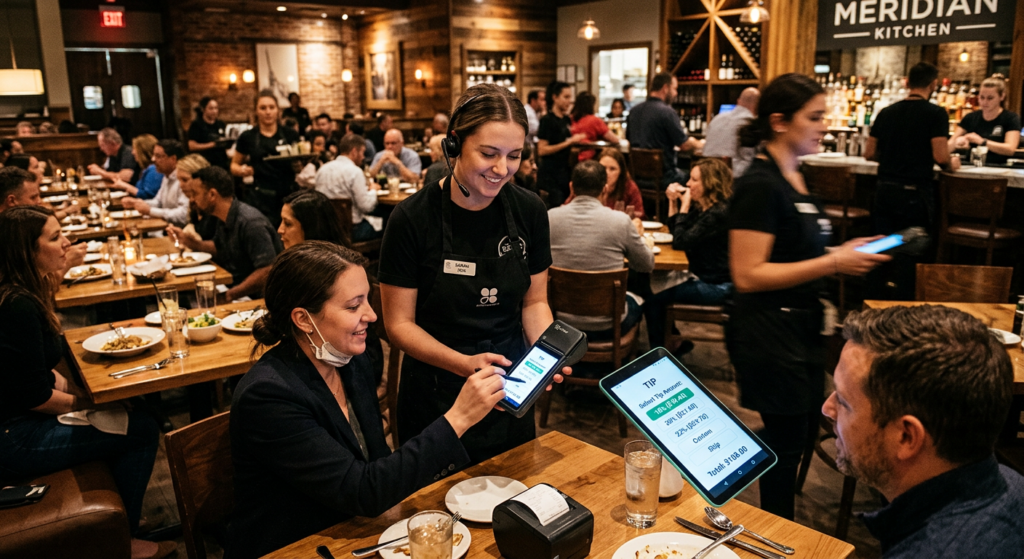
Tipping fatigue manifests in several measurable ways that affect restaurant economics. When consumers feel pressured to tip for counter service, delivery, and even non-traditional categories, they respond by reducing discretionary visits to restaurants or lowering tip percentages. Digital payment systems with preset tip options of 18%, 20%, or 25% are viewed as manipulative by customers, creating social friction at checkout and potentially damaging brand loyalty.
For restaurants relying heavily on tip credit labor models, this creates a compounding problem: employee income becomes less stable because tips decline, yet owners cannot reduce base wages without violating FLSA minimums or state requirements. The solution many owners are exploring includes service charge models, no-tip pricing with higher menu prices, or transitioning to full living wages.
Did You Know? Research shows that 83% of American consumers support banning automatic service charges, yet 60% believe businesses are replacing employee salaries with customer tips. This paradox puts restaurant owners in an impossible position: customers don’t want to tip, but they expect workers to be paid fairly.
Alternative Compensation Models Gaining Traction
In response to tipping fatigue and legal pressure, several restaurant models are emerging in 2026. Some establishments are implementing automatic service charges (which legally must be paid directly to employees and cannot be deducted), while others are raising menu prices 15-20% and eliminating tipping entirely. These models have shown mixed results: some restaurants report improved staff satisfaction and reduced turnover, while others see customer pushback against higher prices.
The restaurant FICA tip credit and overall tipping framework are being reconsidered at both state and federal levels as this cultural and economic tension intensifies.

Uncle Kam in Action: How One Denver Restaurant Owner Avoided $50,000 in Tip Credit Liability
The Client: Maria Rodriguez owned a 30-seat independent restaurant in Denver with 8 full-time servers. After 12 years of using the federal tip credit model, she faced rising pressure from labor costs and tipping culture backlash but had never formalized her tip credit procedures.
The Problem: After the 2026 Denver tourism report highlighted wage pressures, Maria realized her restaurant had multiple compliance gaps. She had no written tip credit notice, didn’t track tip pool distributions, didn’t monitor non-tipped work percentages, and occasionally deducted credit card fees from tips. When a former server inquired about a Department of Labor wage-hour investigation, she realized she was exposed to potential back pay liability across her entire staff.
The Uncle Kam Solution: Uncle Kam’s tax strategy team worked with Maria to implement a complete tip credit audit and remediation plan. We documented all tip income, calculated potential shortfalls over 3 years ($8,500 in unpaid wages), negotiated a settlement payment to affected employees, and established new systems: (1) written tip credit notice for all servers; (2) monthly tip pool tracking sheets; (3) digital time logs monitoring non-tipped work; (4) elimination of all deductions from tips; (5) a quarterly minimum wage reconciliation process.
The Results: Maria paid $12,500 in total liability ($8,500 unpaid wages + $4,000 for future compliance systems and legal review). Without intervention, the same violation could have resulted in $25,000–$50,000+ in liability if discovered through litigation (unpaid wages plus liquidated damages plus attorney fees plus DOL penalties). Additionally, with improved systems in place, Maria reduced her labor cost anxiety and gained confidence that her tip credit application would withstand DOL or private action scrutiny. She also discovered that Denver’s alternative wage proposal (reducing tipped minimum to state minimum) would actually allow her to lower server base pay from $3.14 to $2.13 if implemented, creating potential long-term savings. Review more Uncle Kam client success stories to see how we help restaurant owners optimize labor compliance and wage strategy.
Next Steps
Restaurant owners should take immediate action to verify tip credit compliance. Start with an internal audit: document your written tip credit notice (or create one if missing), review tip pool policies, track the percentage of non-tipped work for each employee, and identify any improper tip deductions. If you’re a multi-location operator, verify that each location complies with applicable state law—federal minimums apply only where state law doesn’t impose a higher standard. Consider consulting with an employment attorney to review your practices before a DOL investigation occurs. Finally, evaluate whether your current compensation model aligns with changing consumer attitudes about tipping. Many successful restaurants are proactively shifting toward service charge or higher-wage models before customer demand forces the change.
For tax planning related to restaurant tip income and deductions, explore Uncle Kam’s tax strategy services to ensure your compensation model is optimized for both compliance and tax efficiency.
Frequently Asked Questions
What is the federal minimum wage for tipped employees in 2026?
The federal tipped minimum wage is $2.13 per hour, unchanged since 2009. Employers can take a tip credit of up to $5.12 per hour, meaning if an employee’s tips don’t bring their total compensation to the federal minimum wage of $7.25/hour, the employer must make up the difference. However, many states require higher tipped minimum wages or eliminate the tip credit entirely.
Can employers deduct credit card processing fees from employee tips?
No. Under FLSA, all tips belong to the employee. Employers cannot deduct credit card processing fees, cash register shortages, breakage, or other business expenses from tips. The 2026 federal court case (Reservoir Restaurant) specifically awarded damages to servers for improper $1-per-shift deductions, establishing that any tip deduction is unlawful. If you’ve been making such deductions, consult an employment attorney immediately to assess your liability.
What is the “80/20 rule” for tipped employees?
The DOL’s “80/20 rule” limits tipped employees to performing no more than 20% of their shift on non-tipped duties (like prep, cleaning, or side work). If an employee spends more than 20% of their time on non-tipped work, the employer owes them minimum wage for the entire shift (not just the excess time). This rule is heavily enforced in current litigation and is a frequent source of compliance violations.
Can managers or kitchen staff be included in a mandatory tip pool?
No. Under FLSA, only employees who regularly receive tips can participate in mandatory tip pools. Managers, supervisors, kitchen staff, and dishwashers cannot receive tips from pools. Including ineligible employees in a tip pool can invalidate the entire tip credit for all affected employees and expose the employer to significant liability. Some states have additional restrictions on who can participate in tip pools.
What happens if tips don’t bring an employee to minimum wage?
Employers must make up the shortfall. If an employee earns $2.13/hour base plus $4.00 in tips, totaling $6.13/hour, the employer must pay an additional $1.12/hour to bring the employee to the federal minimum wage of $7.25/hour. Employers must track and verify that tips actually bring employees to minimum wage; failure to do so creates back pay liability. This is a fundamental principle of tip credit law and is strictly enforced by courts.
How has the 2026 WalletHub survey on tipping affected restaurant operations?
The 2026 WalletHub survey showing that 87-89% of Americans view tipping as “out of control” is driving real economic changes. Restaurants are reporting slight declines in tip percentages (averaging 18-20% vs prior years’ 20-22%), increased customer friction at digital checkouts with preset tip options, and slower growth in counter-service tip income. This pressure is accelerating interest in alternative compensation models like service charges or no-tip pricing, particularly among younger restaurants and chains seeking to modernize their labor strategy.
Are states eliminating the tip credit entirely?
Many states have already eliminated the tip credit, requiring employers to pay the full state minimum wage regardless of tips. California, New York, Colorado, and others mandate equal wages for all employees. In 2026, there is active debate in several states (including Denver/Colorado and New York) about further raising tipped minimum wages or eliminating the credit entirely. Multi-state restaurant operators must track these changes carefully, as violations can result in significant liability.
What should restaurants do to ensure 2026 compliance?
Immediately: (1) Create or update written tip credit notices and provide to all tipped employees; (2) Implement digital time-tracking to monitor non-tipped work percentages; (3) Eliminate any deductions from tips; (4) Audit tip pool policies to ensure only customarily tipped employees participate; (5) Perform a 3-year back-pay audit to identify any unpaid minimum wage liability. Long-term: (6) Establish a quarterly minimum wage reconciliation process; (7) Consult with an employment attorney to review your practices; (8) Monitor your state’s wage law changes; (9) Evaluate alternative compensation models such as service charges or higher base wages to align with changing consumer and regulatory expectations.
Related Resources
- Tax Strategy Services for Restaurant Owners
- Business Owner Tax Planning and Compliance
- Self-Employment Tax Resources for 1099 Workers
- Client Success Stories and Case Studies
- Restaurant FICA Tip Credit and Tax Deductions
Last updated: March, 2026
This information is current as of 3/10/2026. Tax laws and wage regulations change frequently. Verify updates with the IRS, Department of Labor, or your state’s labor department if reading this after March 2026.

