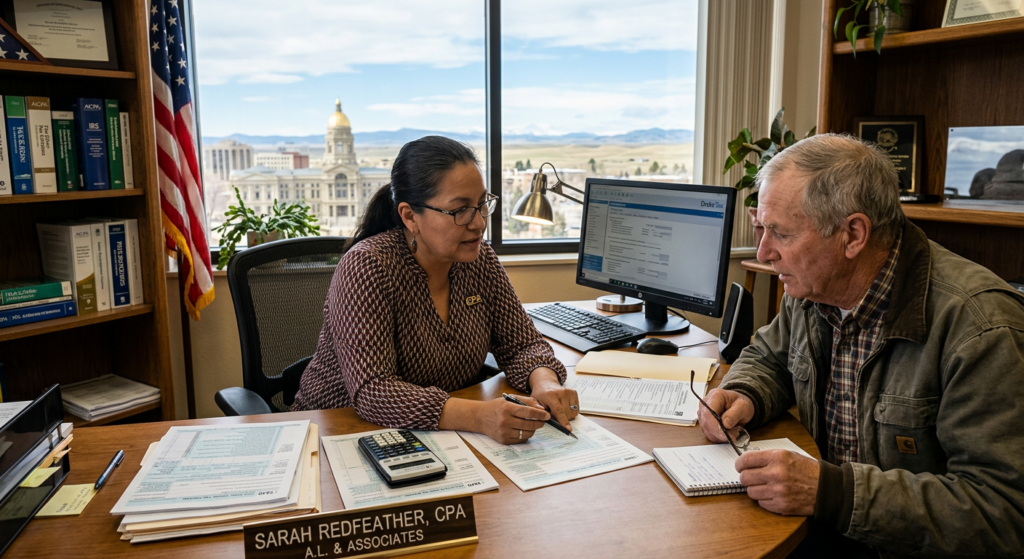
How Much Is a Tax Preparer in Cheyenne, Wyoming? 2026 Pricing Guide
Finding the right tax preparer in Cheyenne, Wyoming is essential for managing your federal tax obligations efficiently. For the 2026 tax year, expect to pay between $200 and $400 for a straightforward individual tax return, with business returns running $400 to $800 or more depending on complexity. Wyoming’s unique tax environment—featuring zero state income tax—simplifies some filing requirements but doesn’t eliminate the need for professional guidance.
Table of Contents
- Key Takeaways
- Average Cost of Tax Preparation in Cheyenne
- What Affects the Cost of a Tax Preparer in Cheyenne?
- DIY Software vs Local Tax Preparer vs CPA Firm
- How Wyoming’s Tax Environment Impacts Your Prep Needs
- How to Choose a Reliable Tax Preparer in Cheyenne
- Next Steps
- Frequently Asked Questions
Key Takeaways
- Individual tax returns in Cheyenne typically cost $200-$400 for 2026, while business returns range from $400-$800 or more.
- Wyoming’s zero state income tax simplifies filing but doesn’t eliminate complexity for business owners or investors.
- Professional preparers save time and reduce audit risk compared to DIY software costing $40-$70 annually.
- Return complexity, income sources, and business structure significantly impact total preparation costs.
What Is the Average Cost of Tax Preparation in Cheyenne?
Quick Answer: Plan to spend between $200 and $400 for a straightforward individual return in Cheyenne for 2026. Business returns typically range from $400 to $800 or higher.
For the 2026 tax year, Cheyenne tax preparers charge competitively with national averages. A W-2 employee with minimal deductions and no side business can expect to pay around $250 for professional preparation. This fee covers analysis of your income, documentation review, and filing your complete federal return electronically.
When you have a more complicated situation—such as a second job, investment income, or rental properties—costs increase accordingly. Many preparers base fees on hourly rates ($150-$300 per hour) or flat-fee structures depending on return complexity.
Typical Price Ranges for Individual Tax Returns
Cheyenne residents filing individual returns in 2026 can reference these pricing expectations:
- Single filer, W-2 only, standard deduction: $200-$275
- Married filing jointly, W-2 income, standard deduction: $250-$350
- Return with itemized deductions (Schedule A): Add $75-$150
- Return with investment income (dividends, capital gains): Add $100-$200
- Return with rental property income: Add $150-$300
Pricing for Small Business and LLC/S-Corp Returns
Business owners in Cheyenne face higher preparation costs due to added complexity. For 2026, expect these general ranges:
- LLC taxed as sole proprietorship (Schedule C): $400-$600
- S-Corporation (Form 1120-S with payroll): $800-$1,500
- Partnership returns: $1,000-$2,000+
- Multiple business entities: Costs multiply per entity
These figures reflect the complexity of Schedule C preparation, estimated quarterly payment tracking, depreciation calculations, and entity compliance requirements that businesses must manage for the 2026 tax year.
What Affects the Cost of a Tax Preparer in Cheyenne?
Quick Answer: Return complexity, income sources, number of dependents, deductions, and business structure are the primary cost drivers for tax preparation in 2026.
Several factors significantly impact how much you’ll pay for professional tax preparation in Cheyenne. Understanding these variables helps you budget accurately and avoid surprise fees when you meet with a preparer.
Return Complexity and Types of Income
The foundation of any tax preparation fee is return complexity. A straightforward W-2 return costs far less than one involving multiple income sources. Cheyenne preparers track complexity by counting the number of forms and schedules required to complete your 2026 federal return.
For 2026, the IRS added new deductions for qualified tips, overtime compensation, and vehicle loan interest under the One Big, Beautiful Bill Act. These new provisions require extra attention during preparation, potentially increasing costs by $50-$100 if your situation involves any of these income types.
Multiple W-2s from different employers, freelance 1099 income, and gig economy earnings all add preparation time. Each income stream requires verification, appropriate withholding review, and potential estimated tax calculation for 2026.
Itemized Deductions, Rental Properties, and Side Businesses
Itemizing deductions instead of taking the standard deduction creates significant extra work for your preparer. For 2026, tracking charitable contributions, medical expenses, and the expanded state and local tax (SALT) deduction up to $40,000 for married filing jointly requires detailed documentation review.
Rental property ownership drives costs substantially upward. Your preparer must prepare Schedule E, calculate depreciation, track rental expenses, determine if passive activity loss rules apply, and evaluate whether Form 4562 depreciation schedules are needed. A single rental property typically adds $150-$300 to your preparation cost for 2026.
Side businesses or independent contractor income requires Schedule C preparation. Even a modest side business earning $15,000 annually adds $200-$400 to your total preparation fee. Using our LLC vs S-Corp Tax Calculator can help you evaluate whether converting to a more tax-efficient structure might save money despite higher preparation costs.
Entity Type and Business Structure
Your business structure dramatically impacts 2026 preparation costs. A sole proprietor preparing a Schedule C costs significantly less than an S-Corporation owner dealing with Form 1120-S, corporate payroll tracking, and reasonable salary documentation.
S-Corp owners must prove they paid themselves a reasonable salary for their work. Preparers spend extra time analyzing compensation patterns and providing documentation to support the salary amount used for 2026 tax filings. This complexity justifies the $800-$1,500 range for S-Corp preparation.
Wyoming has no state income tax, which simplifies filing compared to most states. However, this advantage doesn’t reduce federal complexity for Cheyenne business owners.
 Free Tax Write-Off Finder
How Do DIY Software, Local Tax Preparers, and CPA Firms Compare in Cost?
Quick Answer: DIY software costs $40-$70, local preparers charge $200-$600, and CPA firms typically bill $300-$1,000+ depending on complexity.
Cheyenne residents have three primary options for handling their 2026 tax preparation. Each approach offers different trade-offs regarding cost, accuracy, and peace of mind.
Cost Comparison Table
| Option | 2026 Cost | Best For | Key Drawback |
|---|---|---|---|
| DIY Tax Software | $40-$70 | Simple W-2 only returns | Limited deduction optimization, error risk |
| Local Tax Preparer | $200-$600 | Moderate complexity, personal service | Credential verification needed |
| CPA Firm | $300-$1,500+ | Complex business returns, planning | Higher cost, less personal relationship |
When Does Paying More Actually Save You Money?
Professional tax preparation often pays for itself through deduction optimization and audit reduction. Consider these scenarios where higher preparation costs deliver genuine ROI for 2026:
Business owners: A $500 investment in professional preparation might uncover $3,000 in missed deductions. The $600 difference represents legitimate value.
Rental property investors: Proper depreciation scheduling and passive activity loss management can save $1,000+ annually. Professional guidance at $300-$400 cost creates immediate payback.
High-income professionals: Complex itemization of deductions, estimated quarterly payments, and partnership income requires expertise that avoids costly mistakes or audit exposure.
Pro Tip: Request fee estimates upfront and ask preparers to identify specific deductions or strategies they expect to find. This transparency helps you evaluate whether the cost aligns with likely benefits for your 2026 return.
How Does Wyoming’s Tax Environment Impact Your Tax Prep Needs?
Quick Answer: Wyoming’s zero state income tax simplifies filings compared to other states, but federal complexity remains unchanged for business owners and investors.
Cheyenne’s location in Wyoming provides a significant tax advantage that affects your overall tax burden strategy. Wyoming is one of only nine states with no state income tax, meaning your 2026 tax preparer doesn’t need to file state returns for W-2 employees with income earned solely from Wyoming employment.
This advantage simplifies the filing process and reduces total preparation time compared to residents of high-tax states. However, Wyoming residents with out-of-state income, remote employment for companies in other states, or multi-state business operations must still file in those other jurisdictions.
Wyoming recently updated its sales tax law to include use tax provisions, which may affect business owners who buy out-of-state goods. For 2026, ensure your preparer accounts for any use tax reporting obligations if you operate a business.
The state’s gig worker benefit legislation, effective 2026, allows companies to contribute to portable benefits accounts without reclassifying workers as employees. This creates unique tax situations that your preparer should understand when handling 1099 income from gig platforms.
Cheyenne’s diverse economy includes oil and gas workers, ranchers, small business owners, and remote professionals. Each group faces distinct tax preparation needs and costs, regardless of Wyoming’s favorable income tax status.
How Can You Choose a Reliable Tax Preparer in Cheyenne?
Quick Answer: Look for CPAs, Enrolled Agents, or NATE-certified preparers with experience in your specific return type and local references.
Not all tax preparers are created equal. The IRS found that nearly 60% of unenrolled preparers make significant errors. For 2026, choosing wisely protects your refund and reduces audit risk.
Essential Credentials to Look For
- CPA (Certified Public Accountant): Requires passing the Uniform CPA Exam and meeting education/experience requirements. Highest credential standard.
- Enrolled Agent (EA): Requires passing the IRS Special Enrollment Exam. Authorized to represent clients before the IRS.
- NATE Certification: National Association of Tax Experts certification for tax professionals. Indicates continuing education commitment.
- PTIN (Preparer Tax Identification Number): All paid preparers must have a PTIN. Ask to verify it on the IRS website.
Many Cheyenne business owners prefer CPAs for complex situations. Enrolled Agents often provide excellent service at lower cost for standard individual returns. Verify any preparer’s credentials through the IRS Tax Professional Directory before committing.
Red Flags and Scams to Avoid
- Preparers who offer unusually large refunds without detailed explanation
- Unwillingness to sign your 2026 return as the preparer
- Requesting payment in cash only
- No written fee estimate provided before preparation begins
- Pressure to claim personal expenses as business deductions
- Refusal to provide copies of your completed return before filing
Interview multiple preparers for your 2026 return. Ask about their specific experience with your type of return, references from similar clients, and their approach to staying current with 2026 tax law changes.

Uncle Kam in Action: Sarah’s Small Business Tax Optimization
Sarah operates a consulting business in Cheyenne with $120,000 in annual revenue. For years, she filed her own taxes using DIY software at $60 annually. Her business earned decent income, but she always felt uncertain about deductions.
For her 2025 tax year (filing in 2026), Sarah hired an Uncle Kam tax professional in Cheyenne and paid $550 for comprehensive preparation. The professional identified several missed deductions from prior years:
- Home office deduction: $3,200 annually (retroactive)
- Professional development courses: $1,500
- Business vehicle mileage (previously untracked): $2,400
- Software subscriptions and tools: $900
Total identified deductions: $8,000. On her tax bracket, this translated to approximately $2,000 in tax savings on her 2026 return alone. The preparer also evaluated whether converting to an S-Corp would benefit Sarah in future years.
Sarah’s investment of $550 in professional tax preparation created a 364% first-year return on investment. Beyond the immediate savings, she now has professional guidance for 2026 planning, confidence in her filings, and reduced audit risk. She plans to continue with professional preparation for her growing business.
Next Steps
Now that you understand tax preparer pricing in Cheyenne for 2026, take action to find your ideal professional:
- Request recommendations from local business owners and friends
- Contact at least three preparers for fee quotes and credential verification
- Ask each preparer about their experience with your specific situation
- Schedule a consultation before committing to prepare your 2026 return
- Contact Uncle Kam’s Cheyenne tax preparation team for a free strategy review of your specific tax situation
Frequently Asked Questions
How Much Does a Tax Preparer Cost in Cheyenne for a Simple Return?
A simple individual return—W-2 income only, standard deduction, no dependents—costs $200-$275 for professional preparation in Cheyenne for 2026. This compares to $40-$70 for DIY software. The difference reflects time spent on documentation review, accuracy verification, and IRS representation if needed.
Do I Still Need a Tax Preparer if Wyoming Has No State Income Tax?
Yes. Wyoming’s lack of state income tax simplifies filing compared to other states, but federal complexity remains unchanged. If you have investment income, business activity, or itemized deductions, professional guidance delivers value. Even simple returns benefit from preparer expertise in identifying deductions you might miss.
What’s the Cost Difference Between an Enrolled Agent and a CPA in Cheyenne?
Enrolled Agents typically charge 20-30% less than CPAs for standard individual returns in 2026. For simple returns, the difference might be $150-$200. For complex business returns, CPAs may charge $100-$200 more hourly due to broader expertise and liability insurance. Interview both to determine which offers better value for your situation.
How Much Extra Does It Cost to File a Business Return with a Rental Property?
Adding one rental property to your return increases preparation costs by $150-$300 for 2026. Your preparer must prepare Schedule E, calculate depreciation using Form 4562, track rental expenses, and evaluate passive activity loss rules. Multiple properties increase costs proportionally.
Can I Deduct My Tax Preparation Fees?
For 2026, tax preparation fees for business returns are deductible as business expenses on Schedule C. Fees for personal tax return preparation are generally not deductible. However, fees directly allocable to preparing Schedule C or business-related schedules can be deducted as business expenses.
What Questions Should I Ask Before Hiring a Tax Preparer?
Ask these critical questions when interviewing Cheyenne tax preparers for 2026:
- What are your credentials and PTIN number?
- How many clients with situations like mine do you prepare annually?
- What is your fee structure and estimated cost for my return?
- Will you represent me if the IRS has questions about my return?
- How do you stay current with 2026 tax law changes?
- Can you provide references from recent clients?
- What documentation will you need from me before we start?
Related Resources
- Uncle Kam Cheyenne Tax Preparation Services
- IRS Tax Professional Directory and Verification
- Tax Strategy for Business Owners
- Self-Employed Tax Planning Guide
- 2026 Tax Calculators and Planning Tools
Last updated: March, 2026
This information is current as of 3/9/2026. Tax laws change frequently. Verify updates with the IRS or Wyoming Department of Revenue if reading this later in the year.

