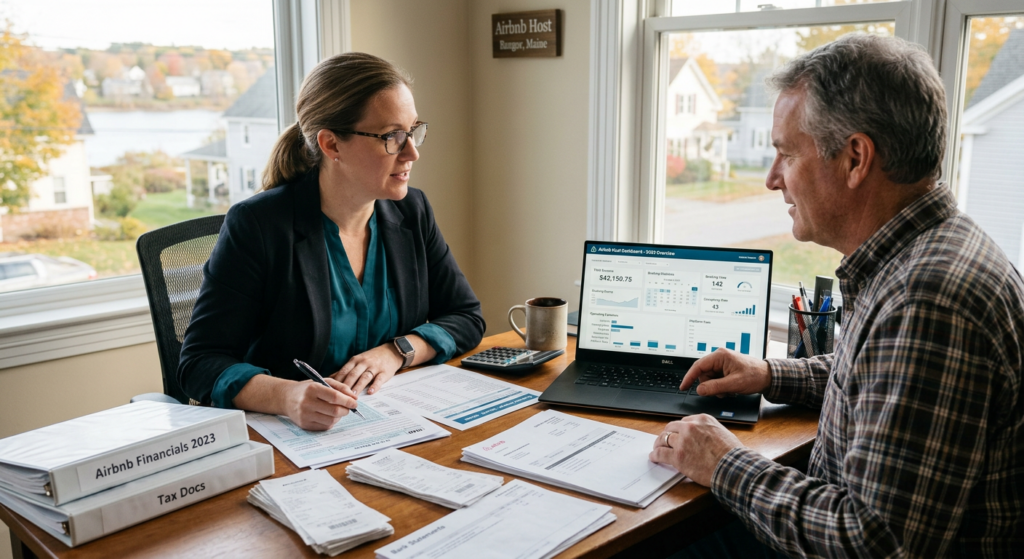
Bangor Airbnb Taxes 2026: Complete Guide for Short-Term Rental Hosts
If you’re hosting guests through Airbnb in Bangor, Maine, understanding your Bangor Airbnb taxes is critical for staying compliant and maximizing deductions. For the 2026 tax year, hosts face specific federal reporting requirements, Maine state obligations, and potential local lodging taxes that can significantly impact your bottom line. This comprehensive guide walks you through every tax consideration facing Bangor short-term rental hosts, from income reporting to expense deductions to self-employment tax calculations.
Table of Contents
- Key Takeaways
- How Should You Report Airbnb Income on Federal Taxes?
- Schedule E vs Schedule C: Which Should You Use for Airbnb?
- How Do Self-Employment Taxes Apply to Airbnb Hosting?
- What Maine State Taxes Apply to Airbnb Hosts?
- Do You Need to Collect Bangor Lodging Tax?
- What Airbnb Host Deductions Can You Claim in 2026?
- How to Stay Tax Compliant as a Bangor Airbnb Host
- Uncle Kam in Action
- Next Steps
- Frequently Asked Questions
Key Takeaways
- For 2026, all Airbnb income in Bangor must be reported on your federal return using either Schedule E (rental) or Schedule C (business).
- Self-employment tax (15.3% combined rate) applies if your Airbnb hosting is treated as a business rather than passive rental activity.
- Maine state income tax applies to all rental income, with Maine having no special exemption for short-term rentals.
- Bangor may require local registration and lodging tax collection depending on your rental frequency and property type.
- Common deductions include mortgage interest, property taxes, insurance, utilities, cleaning, repairs, and depreciation.
How Should You Report Airbnb Income on Federal Taxes?
Quick Answer: Report all Airbnb income on your federal return. Use Schedule E for passive rental activity or Schedule C if you actively manage the property as a business.
The IRS requires you to report every dollar of Airbnb income you earn from hosting in Bangor, Maine. The form you use depends on whether your rental activity qualifies as passive rental income or active business income.
When Airbnb hosts earn income, they must provide accurate documentation to the IRS. Starting with the 2026 tax year, you should track all income from guest bookings. Airbnb typically sends hosts a Form 1099-NEC or Schedule for reporting purposes, though this may vary based on your income level and host account status.
The critical distinction is whether your hosting activity is passive (you own the property and collect rent with minimal involvement) or active (you provide services like cleaning, frequent guest turnover, or marketing). This determination affects which tax form you file and whether self-employment tax applies.
Federal Income Tax Filing Deadline
For the 2026 tax year, your federal return is due by April 15, 2027. If you need additional time, you can request a six-month extension, which moves your deadline to October 15, 2027. However, any taxes owed must still be paid by April 15 to avoid penalties and interest charges.
1099-NEC and Income Reporting Requirements
If you earn $600 or more from Airbnb in a calendar year, the platform should issue a Form 1099-NEC reporting your income. This form is sent to you and the IRS, so the agency knows about your hosting income. Even if you don’t receive a 1099-NEC, you must still report all income earned, regardless of the amount.
Underreporting income is a common audit trigger. The IRS matches 1099 forms with tax returns and investigates discrepancies. As a Bangor Airbnb host, maintaining accurate records of all bookings, payments received, and fees paid to Airbnb protects you during any IRS examination.
Schedule E vs Schedule C: Which Should You Use for Airbnb?
Quick Answer: Use Schedule E for passive rental income. Use Schedule C if you actively manage the property, provide substantial services, or your hosting qualifies as a business.
Choosing between Schedule E and Schedule C has major implications for your 2026 tax liability, particularly regarding self-employment tax. Understanding the distinction is essential for Bangor Airbnb hosts.
When to Use Schedule E (Rental Real Estate Income)
Schedule E is the standard form for reporting rental property income and expenses. You report your gross rental income and deductible expenses, with the net profit or loss flowing to your Form 1040. Schedule E is appropriate when:
- You own the property and rent it out with minimal active management.
- You don’t provide substantial services like housekeeping or daily guest interaction.
- Your involvement is passive (you hire a property manager or Airbnb handles guest interactions).
- You rent out a portion of your primary residence or a second property.
A major benefit of Schedule E is that it doesn’t trigger self-employment tax. Your net rental income is only subject to regular federal income tax, not the additional 15.3% self-employment tax that applies to business income.
When to Use Schedule C (Business Income)
Schedule C is used for business income and expenses. You report gross income and deductible business expenses, with the bottom line representing your net business profit, which is then subject to self-employment tax. Schedule C applies when:
- You actively manage the property, handle guest interactions, or provide services like cleaning.
- You advertise your property, set pricing, and actively fill bookings.
- You provide substantial services beyond just renting out the space.
- You rent out multiple properties or operate your hosting as a formal business.
- The IRS characterizes your activity as operating a rental service business rather than being a passive landlord.
Schedule C allows more aggressive expense deductions than Schedule E, but it also triggers self-employment tax, which can significantly increase your overall tax bill.
Pro Tip: If you’re hovering on the edge of Schedule E vs C status, document your level of involvement carefully. The IRS looks at how much time you spend managing the property, handling marketing, and providing guest services. Keep records showing active involvement to support your Schedule C election if challenged.
How Do Self-Employment Taxes Apply to Airbnb Hosting?
Quick Answer: Self-employment tax applies if you use Schedule C for business income. The rate is 15.3% (12.4% Social Security + 2.9% Medicare) on your net profit.
Self-employment tax is one of the largest tax liabilities facing Airbnb hosts who classify their activity as business income. This tax funds Social Security and Medicare on your self-employment earnings.
For 2026, if your Schedule C net profit exceeds $400, you owe self-employment tax. The tax is calculated on net business income after deducting business expenses. For example, if you earn $50,000 in Airbnb income and deduct $15,000 in expenses, your net profit is $35,000, and self-employment tax applies to that $35,000.
Bangor Airbnb hosts using our self-employment tax calculator for Bangor can estimate exactly how much self-employment tax will apply to their 2026 hosting income. This allows you to set aside funds and avoid surprise tax bills in April 2027.
Calculating Self-Employment Tax
Self-employment tax calculation involves several steps. First, take your net profit from Schedule C. Multiply that amount by 92.35% (this accounts for the employer portion deduction). The result is your net self-employment income.
Next, multiply net self-employment income by 15.3% to get your self-employment tax. You can deduct half of this amount as a deduction from your adjusted gross income. For example, if your Schedule C profit is $40,000:
- $40,000 × 92.35% = $36,940
- $36,940 × 15.3% = $5,653
- Deduct half: $5,653 ÷ 2 = $2,826 deduction from AGI
Quarterly Estimated Tax Payments
If you expect to owe $1,000 or more in federal tax for 2026 (including self-employment tax), the IRS requires you to make quarterly estimated tax payments. Bangor Airbnb hosts should make payments by April 15, June 15, September 15, 2026, and January 15, 2027.
Failing to make quarterly payments can result in underpayment penalties, even if you ultimately owe no tax or will receive a refund. The IRS wants to receive tax payments throughout the year, not in one lump sum in April.
 Free Tax Write-Off Finder
What Maine State Taxes Apply to Airbnb Hosts?
Quick Answer: Maine income tax applies to all Airbnb hosting income. Maine has no special exemption or reduced rate for short-term rental income.
Maine imposes state income tax on all income earned by residents, including Airbnb hosting income. Unlike some states that exempt short-term rentals or provide preferential treatment, Maine taxes hosting income at regular income tax rates.
Maine’s state income tax rates for 2026 range from 5.8% to 7.15% depending on your total income bracket. This means your Airbnb hosting income will be stacked on top of any other income you earn, potentially pushing you into a higher tax bracket.
Bangor Airbnb hosts should report all hosting income on Maine’s resident income tax return (Form 1040-ME). You can deduct the same business expenses allowed on your federal return, reducing your Maine taxable income.
Maine Estimated Tax Payments
Similar to federal estimated taxes, Maine may require quarterly estimated tax payments if you expect to owe $400 or more in state tax. The Maine Revenue Services office allows you to make these payments electronically throughout the year.
Do You Need to Collect Bangor Lodging Tax?
Quick Answer: Bangor may require registration and lodging tax collection. You must check current local ordinances to determine obligations.
Local lodging taxes are a critical consideration for Bangor Airbnb hosts. Many municipalities, including areas in Maine, are implementing registration requirements and lodging tax collection obligations for short-term rental hosts.
Before you list your property on Airbnb, contact the City of Bangor Planning Department or Community Development office to determine whether your property requires registration and whether you must collect lodging taxes. The regulations vary significantly by locality and may depend on factors like the number of rental days per year or the percentage of the year your property is rented.
Local Registration Requirements
Bangor may require short-term rental hosts to register their properties with the city. Registration typically involves providing your property address, owner information, and confirmation that the property complies with local zoning and safety standards. Registration fees vary but are often modest (typically $50-$150 annually).
Failing to register can result in fines and potential enforcement action. The city may require Airbnb to remove unregistered listings or prevent you from operating in the municipality.
Lodging Tax Collection and Remittance
If Bangor requires lodging tax collection, you must add the applicable percentage to guest bills and remit collected taxes to the city. This is a separate obligation from federal and state income tax. Lodging taxes are typically collected monthly or quarterly.
Airbnb may automatically handle lodging tax collection in jurisdictions where it’s required, simplifying your compliance. However, verify this with Airbnb’s host portal and your local regulations to ensure you’re meeting all obligations.
What Airbnb Host Deductions Can You Claim in 2026?
Quick Answer: Common deductions include mortgage interest, property taxes, insurance, utilities, cleaning, repairs, advertising, and depreciation.
One of the greatest advantages of hosting on Airbnb is the substantial tax deductions available to offset your income. Properly tracking and documenting these expenses can significantly reduce your tax liability.
Deductible expenses fall into several categories. These deductions reduce your taxable income, whether you report on Schedule E or Schedule C. For Bangor Airbnb hosts, understanding which expenses qualify is essential.
Mortgage Interest and Property Taxes
If you have a mortgage on your Airbnb property, you can deduct the interest portion of your monthly payments. Principal payments are not deductible. Property taxes paid to Bangor and Cumberland County are fully deductible on your rental property.
Note that the federal SALT deduction cap of $40,000 for married filing jointly (2026) may limit your state and local tax deduction if combined with other state/local taxes. Consult a tax professional about how SALT limits apply to your situation.
Operating Expenses
Day-to-day operating expenses are fully deductible. These include cleaning costs, linens, toiletries, guest supplies, utilities (electricity, water, gas), internet service, and trash removal. Keep receipts for all operating expenses.
Repairs and Maintenance
Ordinary repairs to keep your property in good condition are deductible. This includes painting, fixing appliances, repairing plumbing, and general maintenance. However, improvements that add value (like a new roof or kitchen remodel) are capital improvements and must be depreciated rather than immediately deducted.
Insurance and Professional Services
Homeowners insurance for your rental property is deductible. Additionally, professional services like accounting fees, legal consultation, and property management fees are deductible business expenses.
Depreciation
Depreciation is one of the most valuable deductions for Airbnb hosts. Under 2026 tax law, you can deduct 100% bonus depreciation on certain property improvements, thanks to the One Big Beautiful Bill Act that made bonus depreciation permanent.
Residential rental property is typically depreciated over 27.5 years. You can depreciate the building value (not the land) using straight-line depreciation. For example, if your rental property building is worth $300,000, your annual depreciation deduction would be approximately $10,909 ($300,000 ÷ 27.5 years).
Pro Tip: Depreciation creates a “paper loss” on your tax return that reduces taxable income without requiring actual cash outlay. However, when you sell the property, you must recapture depreciation at a 25% tax rate. Track depreciation carefully from year one.
How to Stay Tax Compliant as a Bangor Airbnb Host
Quick Answer: Maintain detailed records of income and expenses, register with local authorities, and file all required federal, state, and local tax returns by their deadlines.
Staying tax compliant protects you from IRS audits, penalties, and enforcement action by the City of Bangor. Following a systematic approach ensures you capture all deductions while meeting filing obligations.
Record-Keeping Checklist for Airbnb Hosts
- Keep all Airbnb income statements and payment records for at least 3 years (IRS audit period).
- Maintain receipts for all rental-related expenses, including mortgage statements, property tax bills, and repair invoices.
- Document the date, description, and business purpose of each expense.
- Keep a log of rental days vs. personal use days (critical for hobby loss rules and depreciation).
- Track mileage for property-related travel using a mileage log.
- Maintain proof of registration with the City of Bangor and any local licensing.
- Keep records of lodging taxes collected and remitted to the municipality.
Tax Compliance Timeline for 2026
| Date | Deadline/Action |
|---|---|
| April 15, 2026 | First estimated tax payment for 2026 due (if required) |
| June 15, 2026 | Second estimated tax payment due |
| September 15, 2026 | Third estimated tax payment due |
| December 31, 2026 | End of tax year; finalize records and organize documents |
| January 15, 2027 | Fourth estimated tax payment due |
| March 16, 2027 | If operating as S Corp, partnership, or business: file 2026 return |
| April 15, 2027 | 2026 individual federal return due (or October 15 with extension) |

Uncle Kam in Action: Sarah’s Bangor Airbnb Tax Optimization
Client Profile: Sarah, a Bangor homeowner who purchased a second property to rent on Airbnb, earns approximately $36,000 annually from hosting.
The Challenge: Sarah was confused about whether to report her hosting income on Schedule E or Schedule C. She wasn’t tracking deductions systematically and worried about self-employment taxes eating into her hosting profits. Additionally, she wasn’t certain about Bangor’s local registration and tax requirements.
The Uncle Kam Solution: We analyzed Sarah’s situation and determined her activity qualified as passive rental income (she used a property manager and didn’t provide direct services). We advised Schedule E reporting, which avoided self-employment tax entirely. We then implemented a comprehensive expense-tracking system that identified $12,000 in deductions she had missed: mortgage interest ($7,500), property taxes ($2,200), insurance ($1,800), and maintenance ($800).
We also coordinated with the City of Bangor to ensure Sarah was registered and compliant with local short-term rental ordinances, preventing future penalties or enforcement action.
The Results: Sarah’s taxable income from Airbnb dropped from $36,000 to just $24,000 after deductions. By avoiding Schedule C and self-employment tax, she saved approximately $3,600 in SE tax alone. Combined with the federal and state income tax savings from additional deductions, Sarah’s 2026 tax bill decreased by approximately $5,200 compared to what she would have owed without professional guidance. The Uncle Kam fee for this optimization was $1,200, making it a 4.3x return on investment in her first year alone.
Pro Tip: Sarah’s case illustrates why Bangor Airbnb hosts should seek professional tax guidance. The difference between Schedule E and Schedule C, combined with optimized deductions, can save thousands annually.
Next Steps
Ready to optimize your Bangor Airbnb taxes for 2026? Here’s your action plan:
- Contact the City of Bangor Planning Department to verify local registration and tax requirements.
- Implement a system to track all rental income and expenses throughout 2026.
- Determine whether your activity qualifies as Schedule E (rental) or Schedule C (business).
- Calculate estimated tax obligations and set aside funds for quarterly payments.
- Work with a tax professional who understands short-term rental taxation in Maine.
If you’re a Bangor Airbnb host seeking personalized tax planning, Uncle Kam’s Bangor tax preparation service specializes in helping hosts like you optimize deductions and comply with federal, state, and local requirements.
Frequently Asked Questions
Do I have to report Airbnb income if I made less than $600?
Yes. The $600 threshold only determines whether Airbnb sends you a Form 1099-NEC. You must report all income to the IRS, regardless of amount. Failing to report income is tax fraud, even if the amount is modest.
Can I deduct losses from my Airbnb hosting activity?
If you operate your hosting as a business (Schedule C), yes, losses offset other income. However, the “hobby loss rule” (Section 280A) limits losses from activities that don’t show profit for at least 3 of the last 5 years. If your activity is deemed a hobby, losses are disallowed.
What if I rent out a room in my primary residence?
Renting a room in your primary home creates unique tax situations. You can deduct expenses attributable to the rental portion (mortgage interest on that portion, utilities, etc.). However, you cannot deduct real estate taxes or depreciation for the primary residence portion. Consult a tax professional about your specific situation.
How long should I keep Airbnb records?
Keep all records related to your Airbnb activity for at least 7 years. The IRS standard audit period is 3 years, but if your income is substantially underreported (25%+ understatement), the IRS can audit 6 years back. For records related to depreciation or property acquisitions, retain them indefinitely.
Can I deduct credit card fees and Airbnb service fees?
Yes. Airbnb’s service fees, payment processing fees, and credit card processing fees paid by you are deductible business expenses. Include them in your operating expenses on Schedule E or Schedule C.
What about Maine occupancy tax on Airbnb stays?
In addition to potential local Bangor lodging taxes, Maine may impose sales tax on short-term rental stays. You may be required to register for a Maine sales tax license and remit taxes quarterly. Contact Maine Revenue Services for specific requirements in your situation.
How is the 1099-NEC calculated by Airbnb?
Airbnb reports gross income paid to you on Form 1099-NEC. This is the total amount Airbnb sent to your bank account, before Airbnb’s service fees and payments to third parties (like property managers). You then deduct these amounts as business expenses on your tax return.
What if Airbnb never sent me a 1099?
If you earned $600 or more and didn’t receive a 1099-NEC, contact Airbnb’s host support to request one. You can still file your return reporting the income even if you don’t have the form. The IRS matches 1099s to tax returns, so missing documentation could trigger questions during an audit.
This information is current as of 3/9/2026. Tax laws change frequently. Verify updates with the IRS or Maine Revenue Services if reading this later.
Related Resources
- Bangor Tax Preparation Services for Short-Term Rental Hosts
- Real Estate Investment Tax Planning
- Bookkeeping and Income Tracking Solutions
- IRS Publication 527: Rental Income and Expenses
- Maine Revenue Services: Income Tax Information
Last updated: March, 2026

