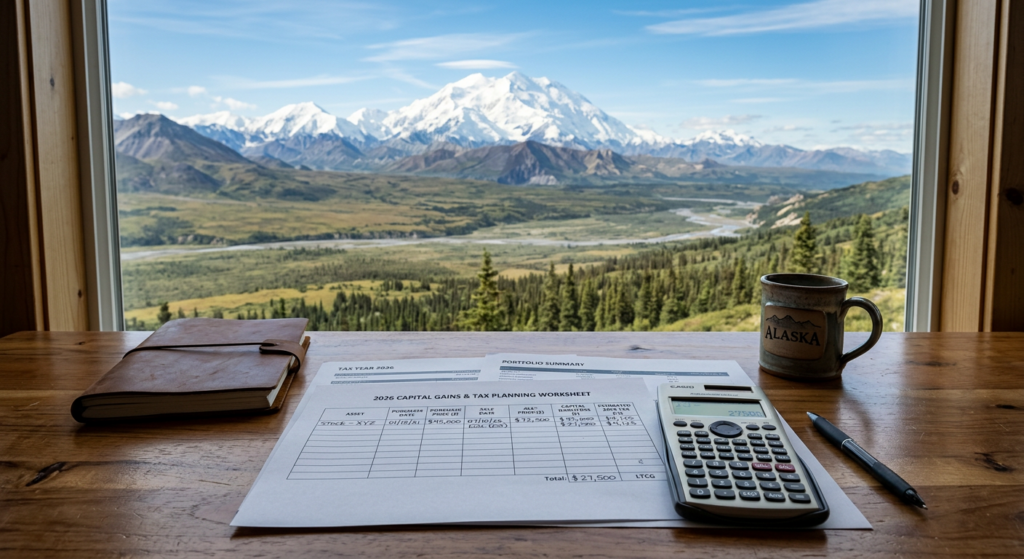
Alaska Capital Gains Taxes: Complete 2026 Guide for Residents and Investors
Alaska residents enjoy a significant tax advantage: there is no state capital gains tax on investment income. This Alaska capital gains taxes advantage stems from Alaska’s status as one of only nine states with no personal income tax. However, federal capital gains taxes and the 3.8% net investment income tax still apply to all Alaska residents, making 2026 tax planning essential. Alaska-based investors and business owners need specialized guidance to navigate federal obligations and maximize after-tax returns on their investments.
Table of Contents
- Key Takeaways
- What Are Capital Gains?
- Does Alaska Have a State Capital Gains Tax?
- How Federal Capital Gains Taxes Apply to Alaska Residents
- Special Situations for Alaska Capital Gains
- Capital Gains Planning Strategies for Alaska Residents
- How to Report Capital Gains When You Live in Alaska
- Frequently Asked Questions
- Next Steps
Key Takeaways
- Alaska has zero state capital gains tax for 2026, giving residents a major tax advantage over high-tax states.
- Federal capital gains rates are 0%, 15%, and 20% for 2026, depending on income and filing status.
- High earners must pay the 3.8% net investment income tax on capital gains exceeding income thresholds.
- Tax-loss harvesting, holding periods, and strategic timing are critical planning tools for Alaska residents.
- Home sale exclusions protect up to $250,000 (single) or $500,000 (married) from federal capital gains tax.
What Are Capital Gains?
Quick Answer: Capital gains are profits earned when you sell an asset for more than you paid. They include stocks, real estate, cryptocurrency, and business interests.
A capital gain is the profit you realize when you sell an asset at a price higher than your original purchase price. The Internal Revenue Service classifies capital gains into two categories: long-term and short-term. Understanding this distinction is critical for 2026 tax planning because the federal tax rates differ significantly between categories.
Long-Term vs. Short-Term Capital Gains
Long-term capital gains apply to assets held for more than one year. Short-term capital gains apply to assets held for one year or less. This distinction matters tremendously for your tax bill. Long-term gains receive preferential federal tax treatment with rates of 0%, 15%, or 20% for 2026. Short-term gains are taxed as ordinary income, ranging from 10% to 37% depending on your federal tax bracket.
For example, if you’re in the 32% federal tax bracket and sell stock after holding it for 11 months, your short-term gain is taxed at 32%. If you hold that same stock for 13 months and sell, your long-term gain is taxed at 15% for 2026. This single-month difference can save thousands in federal taxes on significant gains.
Types of Capital Gains Assets
- Stocks and mutual funds from investment accounts
- Real estate including rental properties and vacation homes
- Cryptocurrency and digital assets (Bitcoin, Ethereum, etc.)
- Business interests and partnership ownership stakes
- Precious metals and collectibles
- Oil and gas interests (especially relevant for Alaska residents)
Does Alaska Have a State Capital Gains Tax?
Quick Answer: No. Alaska has had no state income tax or capital gains tax for 2026. Alaska residents are not required to file state tax returns or pay any state tax on capital gains.
Alaska is one of only nine states with no personal income tax whatsoever. This means no state capital gains tax exists in Alaska for 2026. While this is fantastic news for investors, it’s important to understand what this does and does not eliminate. Alaska residents still owe federal capital gains taxes. You still must file a federal tax return and report all capital gains to the IRS. The Alaska advantage applies only to state-level taxation, which is completely eliminated.
Alaska vs. High-Tax States Comparison
| State | State Capital Gains Tax (2026) | Top Federal + State Rate |
|---|---|---|
| Alaska | 0% | 20% (federal only) |
| California | 13.3% | 33.3% |
| New York | 10.9% | 30.9% |
| Massachusetts | 5% | 25% |
This comparison illustrates Alaska’s competitive advantage. An Alaska resident selling a $100,000 long-term capital gain pays approximately $20,000 in federal taxes (at the 20% rate). A California resident with identical income would pay approximately $33,300 in combined federal and state taxes. That $13,300 difference underscores why Alaska’s no-income-tax status matters significantly.
Pro Tip: Alaska residents who move to high-tax states should time asset sales strategically. Selling assets before relocating preserves the Alaska tax advantage on those gains, even if you report them from a new state later.

Free Tax Write-Off Finder
How Federal Capital Gains Taxes Apply to Alaska Residents
Quick Answer: Federal capital gains taxes are 0%, 15%, or 20% for long-term gains in 2026. Rates depend on your filing status and total taxable income. Alaska has no state tax, but federal rules still apply.
While Alaska eliminates state capital gains taxes entirely, the federal government still claims its share through IRS-published capital gains rates and income thresholds. For 2026, long-term capital gains receive preferential treatment with three possible rates: 0%, 15%, and 20%. Your applicable rate depends on your filing status and total taxable income.
2026 Long-Term Capital Gains Tax Rates by Filing Status
Understanding your capital gains bracket is essential for planning sales and managing tax liability. The 0% rate offers significant planning opportunities for lower-income taxpayers. Many successful business owners use this bracket to strategically realize gains while staying in the 0% zone.
| Filing Status | 0% Rate Limit | 15% Rate | 20% Rate (Over) |
|---|---|---|---|
| Single | $47,025 | $47,025-$518,900 | $518,900+ |
| Married Filing Jointly | $94,050 | $94,050-$583,750 | $583,750+ |
| Head of Household | $62,975 | $62,975-$551,350 | $551,350+ |
The Net Investment Income Tax (NIIT)
High-earning Alaska residents must also account for the 3.8% net investment income tax. This additional tax applies to capital gains when your modified adjusted gross income exceeds specific thresholds. For 2026, NIIT thresholds are $200,000 for married couples filing jointly and $125,000 for single filers. This means high-net-worth Alaska residents may owe up to 23.8% total on their long-term capital gains (20% federal plus 3.8% NIIT).
Special Situations for Alaska Capital Gains
Quick Answer: Alaska residents face unique scenarios including oil & gas interests, primary home sales, and business sales. Each receives specific federal tax treatment.
Primary Residence Sales and the Section 121 Exclusion
One of the most valuable tax breaks available to all Americans, including Alaska residents, is the primary residence exclusion. When you sell your primary home, you can exclude up to $250,000 (single) or $500,000 (married filing jointly) of capital gains from federal taxation. This exclusion applies regardless of how long you owned the home, as long as you meet the ownership and use tests.
To qualify for 2026, you must have owned the home and lived in it as your primary residence for at least two of the last five years before the sale. Alaska families can use this exclusion once every two years. For example, an Alaska couple selling their home for a $600,000 gain excludes $500,000 and pays federal tax only on the $100,000 excess gain.
Alaska Oil & Gas Capital Gains
Alaska residents with oil and gas interests face unique capital gains situations. Selling mineral rights, working interests, or royalty interests generates capital gains subject to federal tax. The holding period and basis calculation become critical because Alaska has no state tax to offset federal liability. Oil and gas gains are treated as long-term capital gains if held over one year, qualifying for preferential 15% or 20% federal rates.
Business Sale and Section 1202 Exclusion
Alaska entrepreneurs who sell qualified small business stock can potentially exclude 100% of the gain from federal taxation under Section 1202. This provision is one of the most valuable tax breaks for business owners. To qualify, you must have held the stock for more than five years. For Alaska residents, this means selling a business can generate zero federal tax liability on the entire gain, not just the gain amount.
Pro Tip: Alaska business owners selling their companies should verify Section 1202 eligibility months before closing. Proper planning can eliminate all federal tax on gain amounts up to $10 million.
Capital Gains Planning Strategies for Alaska Residents
Quick Answer: Tax-loss harvesting, holding period management, and strategic timing minimize capital gains taxes. Alaska’s no-state-tax status allows you to focus purely on federal optimization.
Smart tax planning separates successful investors from average ones. Since Alaska has zero state capital gains tax, your planning focuses entirely on federal optimization. By implementing these proven strategies, Alaska residents can significantly reduce their total capital gains tax burden. Use our business tax optimization calculator to estimate your 2026 capital gains liability and plan accordingly.
Tax-Loss Harvesting Strategies
Tax-loss harvesting involves deliberately selling losing investments to offset capital gains. The IRS allows you to deduct net capital losses against your ordinary income up to $3,000 per year for 2026. Excess losses carry forward indefinitely to future years. This strategy works exceptionally well for Alaska residents because you have no state tax to worry about, allowing pure focus on federal optimization.
For example, if you have a $50,000 long-term capital gain and a $20,000 long-term capital loss, you net to a $30,000 taxable gain. This saves you approximately $4,500 in federal taxes at the 15% rate. The key is immediately reinvesting the proceeds to maintain portfolio exposure while capturing the tax benefit.
Holding Period Optimization
The difference between short-term and long-term capital gains treatment is substantial. Consider timing your sales to achieve long-term status whenever possible. If you’re considering selling an appreciated stock held for 11 months, waiting just one month to reach the one-year threshold could save you 17 percentage points in federal tax (the difference between ordinary income rates and the 15% long-term rate).
Qualified Opportunity Fund Investments
Qualified opportunity funds offer Alaska residents a powerful strategy to defer and potentially eliminate capital gains tax. When you invest capital gains into a qualified opportunity fund, you defer the tax on those gains. If you hold the investment for 10+ years, the gains from the fund investment become tax-free. This allows you to invest your gain dollars at work while deferring and reducing your tax liability.
How to Report Capital Gains When You Live in Alaska
Quick Answer: File federal Form 1040 with Schedule D. Alaska residents do not file state returns. Report all capital gains on your federal return by April 15, 2026.
Alaska residents have a tremendous advantage when reporting capital gains: you file only a federal tax return. There is no Alaska state income tax return to file, no state forms to complete, and no state deadline to meet. Your focus is entirely on federal compliance. All capital gains must be reported on your federal Form 1040 and Schedule D.
Step-by-Step Reporting Process
- Collect all 1099-B forms from brokers reporting asset sales (stocks, bonds, etc.)
- Gather 1099-S forms for real estate sales from title companies or closing agents
- Complete Form 8949 (Sales of Capital Assets) to list each transaction individually
- Transfer totals from Form 8949 to Schedule D (Capital Gains and Losses)
- Transfer Schedule D totals to Form 1040 to calculate your total tax
- File your federal return by April 15, 2026 to avoid penalties
Basis Calculation and Documentation
Your cost basis is the original purchase price adjusted for splits and distributions. Accurate basis documentation is essential because the IRS compares 1099-B reported gains with your reported amounts. Discrepancies trigger IRS notices and potential penalties. Keep detailed records including purchase confirmations, dividend reinvestment statements, and commission documentation. For real estate, basis includes the purchase price plus capital improvements, not repairs or maintenance.
Pro Tip: Keep a separate file with all transaction documentation for at least six years. The IRS can audit capital gains for this period, and documentation substantiates your reported basis and holding periods.

Uncle Kam in Action: Alaska Real Estate Investor Saves $35,000
Sarah, an Alaska-based real estate investor, purchased a rental property in 2015 for $200,000. In 2026, she sold it for $450,000, generating a $250,000 long-term capital gain. Without tax planning, Sarah faced a federal capital gains tax of $50,000 (20% at her income level) plus the 3.8% NIIT of $9,500, totaling $59,500 in federal liability.
Uncle Kam implemented a strategic plan: First, we accelerated $30,000 of capital losses from other investments scheduled for 2027 into 2026, reducing her gain to $220,000. Second, we structured a property exchange using Section 1031, deferring $180,000 of gain into a replacement property. The remaining $40,000 gain resulted in only $7,600 in federal tax (15% rate + prorated NIIT), achieving a total tax of $7,600 instead of $59,500.
Results: Sarah saved $51,900 in federal taxes in 2026 alone. Her investment paid for Uncle Kam’s planning services twice over. By leveraging Alaska’s zero-state-tax status and strategic federal planning, she preserved $51,900 to reinvest in her portfolio, accelerating wealth building by years.
Next Steps
Take action today to minimize your 2026 capital gains tax burden. First, inventory all assets you plan to sell in 2026 and calculate approximate gains. Identify which gains qualify for preferential federal rates based on holding periods. Third, assess any capital losses you can harvest before year-end to offset gains. Finally, contact an Alaska tax specialist to model various scenarios and implement your optimal strategy before you sell.
Frequently Asked Questions
Does Alaska tax capital gains at all?
No. Alaska has had no state income tax or capital gains tax since 1980. Alaska residents pay zero state tax on any capital gains. However, federal capital gains taxes still apply. You must file a federal return and report all gains to the IRS. The Alaska advantage is purely at the state level, eliminating state taxation while federal obligations remain.
What is the federal capital gains tax rate for Alaska residents in 2026?
Federal long-term capital gains rates for 2026 are 0%, 15%, or 20%, depending on your filing status and total taxable income. Single filers qualify for the 0% rate on gains up to $47,025. Married couples filing jointly qualify up to $94,050. Gains above these thresholds are taxed at 15% until the next threshold. High earners exceeding $518,900 (single) or $583,750 (MFJ) pay 20% plus the 3.8% NIIT.
Do I pay capital gains tax if I sell an Alaska property but live elsewhere?
Federal capital gains tax applies to all U.S. residents regardless of where the property is located. If you sold an Alaska property but now live in California, you owe both federal tax and California state tax on your gain. However, if you remain an Alaska resident, you owe only federal tax. Your state of residence at the time of sale determines state tax liability, not the property location.
What is the Alaska Permanent Fund Dividend and does it affect capital gains taxes?
The Permanent Fund Dividend is Alaska’s annual distribution from the state investment fund. While often confused with capital gains, the PFD is ordinary income subject to federal (but not Alaska state) taxation. You must include PFD amounts in your gross income on your federal return. PFD payments do not affect capital gains taxation directly but do increase your adjusted gross income, potentially pushing you into higher tax brackets on capital gains.
Are there any Alaska-specific capital gains incentives or breaks?
Alaska offers no additional capital gains tax breaks beyond the absence of state tax. The primary Alaska advantage is the zero state capital gains tax rate. Federal breaks like the Section 121 home sale exclusion, Section 1202 small business stock exclusion, and Section 1031 like-kind exchanges apply to Alaska residents the same as all other Americans. Your tax planning focuses on federal optimization rather than state strategies.
How long must I hold an asset to qualify for long-term capital gains rates?
For 2026, you must hold an asset for more than one year to qualify for long-term capital gains rates. Technically, if you buy a stock on January 15, 2025 and sell it on January 16, 2026, it qualifies as long-term. This seemingly small distinction between one year and one year plus one day can save thousands in federal taxes. Always review holding periods before making sale decisions, especially on appreciat assets nearing the one-year threshold.
What happens to capital gains if I inherit assets in Alaska?
Inherited assets receive a “step-up in basis” to fair market value on the date of death. This is one of the most valuable estate planning concepts. If you inherit an Alaska property worth $500,000 that originally cost your grandfather $100,000, your new cost basis is $500,000. If you immediately sell, you realize zero gain. This step-up applies equally to all states, but Alaska’s lack of state tax makes this strategy even more valuable since you owe zero total tax on the basis adjustment gain.
When is the 2026 capital gains tax deadline for Alaska residents?
The federal tax filing deadline for 2026 is April 15, 2027 (you file your 2026 return in early 2027). Alaska has no state deadline since there is no state return. If you need more time, you can request a six-month extension (until October 15, 2027), but taxes owed must still be paid by the April deadline to avoid penalties and interest charges.
This information is current as of March 9, 2026. Tax laws change frequently. Verify updates with the IRS or consult a tax professional if reading this later in 2026.
Related Resources
- 2026 Tax Strategy Planning for Business Owners and Investors
- Tax Planning Strategies for Real Estate Investors
- Advanced Tax Planning for High-Net-Worth Individuals
- Complete Tax Guides and Resources
- Tax Optimization for Alaska Business Owners
Last updated: March, 2026

