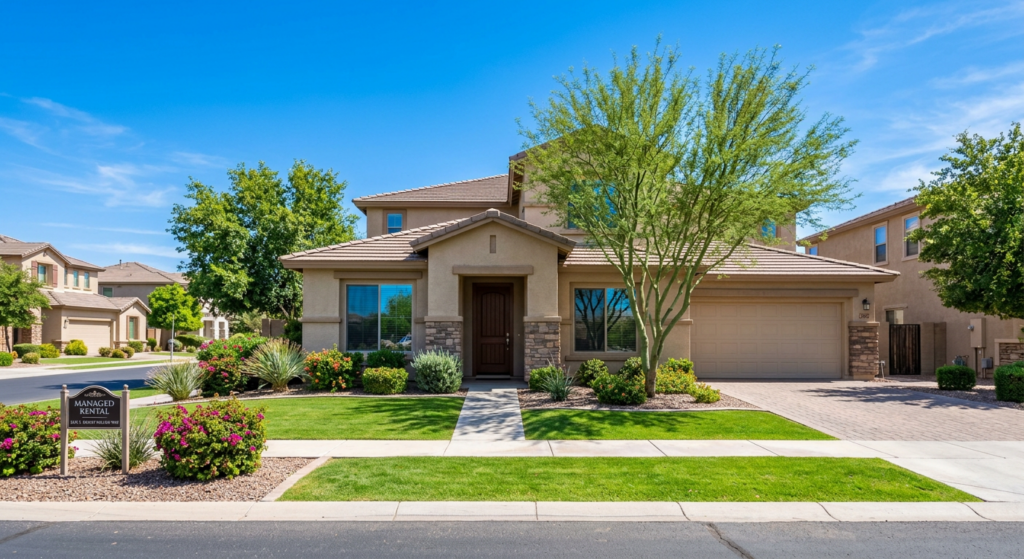
Chandler Rental Property Taxes 2026: Complete Guide to Deductions, Credits & Tax Strategies
For 2026, chandler rental property taxes have become significantly more favorable for investors thanks to landmark changes from the One Big Beautiful Bill Act. The expanded state and local tax (SALT) deduction cap—increased from $10,000 to $40,000 for most filers—means Arizona rental property owners can now deduct higher property taxes and mortgage interest. Combined with Arizona’s business-friendly tax environment and federal depreciation benefits, Chandler rental property investors have exceptional opportunities to minimize tax liability while building long-term wealth through real estate.
Table of Contents
- Key Takeaways
- What Is the SALT Deduction and How Does It Benefit Rental Property Owners?
- Which Rental Expenses Are Deductible for Chandler Properties?
- How Does Depreciation Work for Rental Properties in Arizona?
- What Are Arizona’s Tax Advantages for Rental Property Investors?
- How Do Passive Activity Rules Affect Your Rental Income?
- What Tax Credits Are Available to Chandler Rental Property Owners?
- Uncle Kam in Action
- Next Steps
- Frequently Asked Questions
Key Takeaways
- The 2026 SALT deduction cap is $40,000 (increased from $10,000), enabling higher property tax deductions for Chandler rental property owners.
- Arizona’s effective property tax rate of 0.44% is among the lowest in the nation, saving rental investors thousands annually.
- Depreciation deductions allow you to recover the building’s cost over 27.5 years, providing significant annual tax deductions.
- Mortgage interest, property taxes, repairs, maintenance, and insurance are all fully deductible rental expenses.
- Passive activity loss limitations may restrict deductions if your income exceeds $150,000-$200,000.
What Is the SALT Deduction and How Does It Benefit Rental Property Owners?
Quick Answer: The SALT deduction allows you to deduct state and local property taxes up to $40,000 for the 2026 tax year, significantly benefiting Chandler rental property owners who itemize deductions.
The state and local tax (SALT) deduction is one of the most valuable tax benefits available to rental property investors. For the 2026 tax year, the One Big Beautiful Bill Act increased the SALT deduction cap from $10,000 to $40,000, providing a substantial advantage to property owners. This temporary increase—effective through 2029 with inflation adjustments—allows you to deduct property taxes and mortgage interest at much higher levels than previously possible.
For Chandler rental property investors, this means you can now deduct up to $40,000 in combined state and local property taxes, real estate taxes, and certain mortgage-related expenses. If your property taxes exceed $40,000, you cannot deduct the excess. This temporary expansion significantly reduces taxable income for investors with multiple properties or high-value properties.
How the 2026 SALT Deduction Works for Your Chandler Rentals
To claim the SALT deduction on your 2026 return, you must itemize deductions on Schedule A. This means your total deductions must exceed the standard deduction of $31,500 for married couples or $15,750 for single filers. For most rental property owners with multiple properties, itemizing makes sense because rental property taxes, mortgage interest, and insurance combine to exceed standard deduction thresholds.
Here’s a practical example: Sarah owns two rental properties in Chandler with combined property taxes of $6,200 per year and mortgage interest of $28,000. Her total SALT-deductible expenses equal $34,200. Since this exceeds her $31,500 standard deduction as a married filer, itemizing saves her approximately $3,060 in federal taxes at a 28% tax bracket. Over a 10-year period through 2029 when the increased cap expires, this adds up to significant savings.
Pro Tip: The SALT deduction cap of $40,000 is temporary and sunsets in 2030 unless Congress extends it. Plan now to maximize deductions before the cap reverts to $10,000. Consider accelerating property improvements or refinancing to lock in deductions.
SALT Deduction Phase-Out for High-Income Investors
If your modified adjusted gross income (MAGI) exceeds certain thresholds, your SALT deduction begins to phase out. For married couples filing jointly, the phase-out threshold is significantly higher than for individual filers. Your tax professional should calculate your exact phase-out to ensure maximum deduction benefits. Many high-income Chandler investors qualify for the full $40,000 deduction in 2026.
Which Rental Expenses Are Deductible for Chandler Properties?
Quick Answer: Nearly all operating expenses for rental properties are deductible, including mortgage interest, property taxes, insurance, utilities, repairs, maintenance, property management fees, and advertising for tenants.
The IRS allows you to deduct all ordinary and necessary expenses incurred in operating a rental property. For Chandler rental properties, this includes a broad range of business expenses. Understanding what qualifies as deductible is crucial to minimizing your tax liability while staying compliant with IRS requirements.
| Expense Category | Deductible in 2026? | Notes |
|---|---|---|
| Mortgage Interest | YES | Interest only, not principal payments |
| Property Taxes | YES (up to $40,000) | Subject to SALT deduction cap |
| Insurance Premiums | YES | Landlord and liability coverage |
| Repairs & Maintenance | YES | Current year maintenance costs |
| Capital Improvements | NO (Depreciate) | Deducted over useful life via depreciation |
| Utilities (if paid by owner) | YES | Water, electricity, gas, trash |
| Property Management Fees | YES | If using a property management company |
| Advertising for Tenants | YES | Marketing and listing costs |
| HOA Fees | YES | If applicable in Chandler community |
Repairs vs. Improvements: Understanding the Critical Distinction
The difference between a repair and a capital improvement is crucial for tax purposes. Repairs restore a property to its current condition and are fully deductible in the year incurred. Improvements add value, prolong useful life, or adapt the property to new use—these must be depreciated over many years.
For example, fixing a broken roof is a repair; replacing the entire roof is an improvement. Patching drywall is a repair; adding a new room is an improvement. The IRS closely scrutinizes these classifications, so maintain detailed documentation of all property work. This distinction can save or cost thousands in annual tax deductions.

Free Tax Write-Off Finder
How Does Depreciation Work for Rental Properties in Arizona?
Quick Answer: Residential rental properties depreciate over 27.5 years, allowing you to deduct approximately 3.6% of the building’s value annually, even if the property appreciates in value.
Depreciation is the most powerful tax deduction available to rental property investors. The IRS allows you to recover the cost of buildings over their useful lives through annual deductions. For residential rental properties, including Chandler rentals, the recovery period is 27.5 years. This means you divide the building’s value by 27.5 to determine your annual depreciation deduction.
Here’s the powerful part: you can deduct depreciation regardless of whether your property appreciates or depreciates in market value. This deduction comes directly off your rental income. For a $300,000 building, annual depreciation equals approximately $10,909. This substantial deduction flows through on Schedule E of your tax return.
The Basis Allocation Challenge for Arizona Rental Properties
To calculate depreciation correctly, you must allocate your purchase price between land and building. Only the building depreciates; land never depreciates. For a $400,000 Chandler property purchase, you might allocate $320,000 to the building and $80,000 to land. A professional property tax assessment or appraisal helps establish this split. A higher building allocation increases annual depreciation deductions, so proper allocation is critical.
Professional guidance ensures your allocation withstands IRS scrutiny. Many Chandler investors work with their CPA to use county assessor data to support basis allocation. This foundation protects your depreciation deductions during audit situations.
What Are Arizona’s Tax Advantages for Rental Property Investors?
Quick Answer: Arizona offers a flat 2.5% state income tax rate and low effective property tax rate of 0.44%, among the most investor-friendly tax environments in America.
Arizona is consistently ranked as one of the best states for real estate investors due to its favorable tax treatment. The state imposes a flat 2.5% income tax rate on all residents, regardless of income level. This is dramatically lower than neighboring California, which reaches 13.3% for high earners. For Chandler rental investors earning substantial income, this difference translates to hundreds of thousands in state tax savings over a career.
Additionally, Arizona’s effective property tax rate of 0.44% ranks among the nation’s lowest. Compared to California’s 0.70%, an Arizona investor with a $1 million property saves approximately $2,600 annually in property taxes. Over a 10-property portfolio, this compounds to $26,000 in annual savings. Business owners looking to relocate or expand understand this advantage.
Arizona Capital Gains Treatment and Long-Term Holding Strategy
Arizona does not impose a separate capital gains tax. When you sell a Chandler rental property at a profit, you pay only federal capital gains tax, not an additional state tax. This creates a significant advantage compared to states with state-level capital gains taxes. Property held longer than one year qualifies for long-term capital gains treatment, taxed at favorable federal rates of 0% or 15%, versus ordinary income rates up to 37%.
Pro Tip: For 2026, ensure you hold rental property for at least 366 days (the day after purchase through disposition date the following year) to qualify for long-term capital gains treatment. A sale on January 2, 2026, of property purchased January 1, 2025, qualifies; January 1, 2026, does not.
How Do Passive Activity Rules Affect Your Rental Income?
Quick Answer: Passive activity loss limitations may prevent you from deducting rental losses against other income if your adjusted gross income exceeds $150,000-$200,000, with phase-out between those thresholds.
Rental property income and losses are generally classified as passive activity by the IRS. This classification creates restrictions on how you can use rental losses to offset other income. If you have more rental deductions than rental income, resulting in a loss, the passive activity loss rules limit your ability to deduct those losses.
The $150,000 income threshold is critical for Chandler investors. If your modified adjusted gross income (MAGI) is $150,000 or less, you can deduct up to $25,000 in passive rental losses against your other income. However, if your MAGI exceeds $150,000, this deduction phases out $1 for every $2 of income above $150,000, eliminating the deduction entirely at $200,000 MAGI.
Real Estate Professional Exception Strategy
If you qualify as a real estate professional, the passive activity loss limitations don’t apply, and you can deduct all rental losses against your other income. To qualify, you must spend more than 750 hours on real estate activities during the year and spend more time in real estate than any other profession. Many Chandler investors with multiple properties structure their business to obtain real estate professional status.
What Tax Credits Are Available to Chandler Rental Property Owners?
Quick Answer: The Low-Income Housing Tax Credit provides substantial federal credits for properties meeting affordability requirements, with certain Chandler properties potentially qualifying.
While most rental property owners focus on deductions, tax credits offer direct reductions in tax liability. Unlike deductions, which reduce taxable income, credits reduce your actual tax bill dollar-for-dollar. For Chandler investors, the primary available credit is the Low-Income Housing Tax Credit, though it requires meeting specific affordability criteria.
The Low-Income Housing Tax Credit provides federal tax credits equal to a percentage of your qualified rehabilitation or construction expenditures. Properties must be offered to low-income tenants at below-market rents. While this credit has limitations, qualifying properties can generate 4% to 9% annual credits for 10 years, providing significant tax benefits.
Energy Efficiency Credits for Arizona Properties
Certain energy-efficient improvements to rental properties qualify for federal credits. If you invest in solar installations, energy-efficient windows, or HVAC upgrades for your Chandler rental property, you may qualify for credits equal to a portion of the cost. These credits complement depreciation deductions, making energy improvements especially attractive financially.

Uncle Kam in Action: The Chandler Investor Who Saved $34,700 in Federal Taxes
Client Profile: Marcus, a married real estate investor in Chandler, owned three single-family rental properties totaling $1.2 million in value. His annual rental income was $54,000. He had been taking the standard deduction and treating his properties too casually for tax purposes, leaving thousands on the table.
The Challenge: Marcus realized his rental income wasn’t flowing through properly to his return, and he suspected he was missing significant deductions. He had purchased one property the previous year and made substantial improvements, but he wasn’t sure how to account for them. His previous accountant just took the standard deduction without analyzing whether itemizing made sense.
The Uncle Kam Solution: We implemented a comprehensive strategy leveraging the 2026 tax law changes. First, we switched Marcus to itemizing deductions to capture his $8,400 in annual property taxes and $18,600 in mortgage interest—totaling $27,000 in SALT-deductible expenses. This exceeded his standard deduction by $12,900 in 2026. Second, we properly allocated his new property purchase basis, establishing a building value of $920,000. This generated a depreciation deduction of $33,455 for 2026. Third, we documented all operating expenses: repairs ($3,200), maintenance ($2,100), insurance ($2,800), property management fees ($5,400), and utilities ($1,800)—totaling $15,300.
The Results: Marcus’s total deductions increased from $31,500 (standard) to approximately $76,755 through itemization and depreciation. His taxable rental income dropped from $54,000 to negative $22,755 (a loss that was fully deductible under the $150,000 income threshold). At his 28% federal tax bracket, this $98,255 swing in deductions generated approximately $27,512 in federal tax savings. State tax savings in Arizona added another $7,188 at the 2.5% rate. Marcus’s first-year federal and state tax savings totaled $34,700—representing an immediate 289% return on his professional tax planning investment.
Next Steps
- Calculate your basis allocation for each Chandler property to determine depreciation deductions.
- Itemize deductions for 2026 using the $40,000 SALT cap to compare against your standard deduction.
- Document all operating expenses and repairs systematically throughout the year.
- Work with Arizona tax professionals to ensure your rental property structure maximizes deductions and minimizes liability.
Frequently Asked Questions
Can I deduct utilities if my tenant pays them directly?
No. You can only deduct utilities that you pay directly. If your lease agreement requires tenants to pay utilities, you cannot deduct those costs. However, if you pay utilities as part of the rental arrangement, those costs are fully deductible. Keep clear records showing who paid what.
What happens to my SALT deduction after 2029?
The expanded $40,000 SALT deduction cap is temporary and scheduled to expire after 2029 unless Congress extends it. Starting in 2030, the cap reverts to $10,000 unless legislative action occurs. Plan your property acquisitions and improvements accordingly before this sunset.
Can I depreciate land improvements like driveways and landscaping?
Land itself never depreciates, but certain land improvements depreciate over different periods. Driveways and parking areas depreciate over 15 years. Landscaping and sidewalks depreciate over 15 years. Your accountant should properly categorize these improvements separately from building depreciation.
What if I have a loss on my rental property—can I deduct it against my job income?
Only if your modified adjusted gross income is $150,000 or less can you deduct up to $25,000 in passive rental losses against other income. For income between $150,000 and $200,000, the deduction phases out. Above $200,000, you cannot deduct rental losses. Suspended losses carry forward to offset future rental income or gains.
Does Arizona have a state capital gains tax on property sales?
No. Arizona does not impose a state-level capital gains tax. When you sell your Chandler rental property, you pay federal capital gains tax only. This is a significant advantage compared to states like California and New York. Long-term gains (property held over one year) receive preferential federal rates of 0%, 15%, or 20% depending on income.
This information is current as of 3/3/2026. Tax laws change frequently. Verify updates with the IRS or a tax professional if reading this later.
Related Resources
- Real Estate Investor Tax Strategies
- Comprehensive Tax Planning Strategies
- Optimal Entity Structure for Rental Properties
- 2026 Tax Preparation and Filing
Last updated: March, 2026

