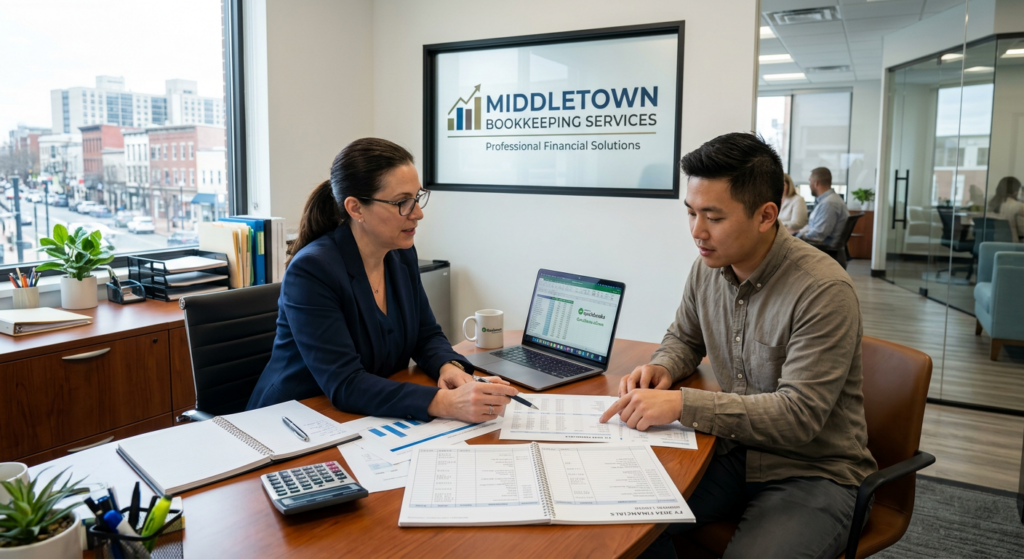
Middletown Bookkeeping Services: Complete Guide for Small Business Owners in 2026
If you’re running a small business in Middletown, accurate financial records are non-negotiable. Professional middletown bookkeeping services help you track income and expenses, stay tax-compliant, and make smarter business decisions. In 2026, with the One Big Beautiful Bill Act bringing new tax breaks and increased IRS scrutiny, having reliable bookkeeping is more critical than ever. Whether you’re a sole proprietor, contractor, or small business owner, this guide walks you through everything you need to know about professional bookkeeping, costs, and how to find the right partner for your business.
Table of Contents
- Key Takeaways
- What Is Bookkeeping and Why It Matters for Middletown Businesses
- Types of Bookkeeping Services Available in Middletown
- How Much Do Middletown Bookkeeping Services Cost?
- DIY vs. Professional Bookkeeping: Which Is Right for You?
- How to Choose the Right Middletown Bookkeeper
- Uncle Kam in Action: Middletown Business Success
- Next Steps
- Frequently Asked Questions
Key Takeaways
- Professional bookkeeping ensures accurate financial records, tax compliance, and better business decisions for 2026.
- Middletown bookkeeping costs range from $500-$2,500+ monthly depending on business complexity and transaction volume.
- DIY bookkeeping with software is cheaper but requires time and expertise; professional services save errors and penalties.
- Self-employed business owners face a 15.3% self-employment tax rate, making accurate income tracking essential.
- Choosing a bookkeeper with QuickBooks ProAdvisor status and local knowledge maximizes your tax savings.
What Is Bookkeeping and Why It Matters for Middletown Businesses
Quick Answer: Bookkeeping is the process of recording, organizing, and maintaining financial transactions. It’s the foundation for accurate tax filing and informed business decisions.
Bookkeeping is the systematic recording of all financial transactions—income, expenses, purchases, and sales. For Middletown business owners, accurate bookkeeping provides a clear picture of business health, supports tax compliance, and enables strategic planning. Whether you’re a freelancer, contractor, or small business operator, bookkeeping forms the backbone of financial management.
Unlike accounting, which interprets financial data and provides tax strategy, bookkeeping focuses on data entry and organization. However, professional bookkeepers often work closely with accountants to ensure all records support proper tax filing and business compliance.
Why Bookkeeping Is Critical in 2026
In 2026, the IRS workforce has shrunk 27%, creating a backlog in processing returns and amendments. This means errors are harder to fix and take longer to resolve. Accurate bookkeeping upfront prevents costly mistakes. Additionally, under the One Big Beautiful Bill Act, new tax deductions for tips, overtime, and vehicle loan interest require careful documentation. Your bookkeeper must understand these 2026 changes to capture every available deduction.
For self-employed business owners, the 15.3% self-employment tax rate (combining 12.4% Social Security and 2.9% Medicare) means every dollar of income impacts your tax liability. Precise expense tracking directly reduces your taxable income and tax burden.
Pro Tip: Keep all receipts, invoices, and bank statements for at least seven years. The IRS can audit returns from prior years, and documentation proves deduction legitimacy.

Free Tax Write-Off Finder
Who Benefits Most from Middletown Bookkeeping Services
- Freelancers and 1099 contractors managing variable income and multiple deductions.
- Small business owners with employees, payroll, and sales tax obligations.
- Service-based businesses needing invoice tracking and client payment management.
- Real estate investors with rental income, depreciation, and property expenses.
- Any business owner with more than $50,000 in annual revenue.
Types of Bookkeeping Services Available in Middletown
Quick Answer: Middletown bookkeeping services include monthly transaction entry, catch-up bookkeeping, payroll processing, sales tax filing, and financial reporting.
1. Basic Monthly Bookkeeping
This is the most common service. Your bookkeeper receives bank statements and receipts, enters transactions into QuickBooks or another accounting software, and reconciles accounts monthly. This service ensures your financial records are current and accurate for tax planning throughout the year.
Monthly bookkeeping typically includes invoice tracking, expense categorization, bank reconciliation, and monthly financial reports. For small Middletown businesses, this foundation prevents year-end scrambles and ensures accurate quarterly estimated tax payments.
2. Catch-Up and Cleanup Bookkeeping
If you’ve been managing books yourself or with limited accuracy, catch-up bookkeeping brings records into compliance. Your bookkeeper reviews prior months or years, organizes scattered receipts, corrects categorization errors, and reconciles all accounts. This service is especially valuable before tax time or when transitioning to professional management.
Catch-up bookkeeping may cost more upfront but saves accountants time at tax filing, reducing overall tax prep fees and ensuring you don’t miss deductions or face compliance penalties.
3. Payroll, Sales Tax, and Financial Reporting
Many professional bookkeepers offer expanded services including payroll processing (calculating, withholding, and filing employee taxes), sales tax calculation and filing, and custom financial reporting. These services ensure compliance with state and federal requirements while providing insights into your business performance.
For Middletown business owners with employees, payroll bookkeeping is essential. Your bookkeeper calculates gross wages, withholds federal and state income taxes, and handles quarterly filings—eliminating payroll errors and penalties.
How Much Do Middletown Bookkeeping Services Cost?
Quick Answer: Middletown bookkeeping services typically range from $500 to $2,500+ per month, depending on business complexity, transaction volume, and service scope.
Bookkeeping costs vary based on several factors. Understanding pricing models helps you budget and compare Middletown providers effectively. Here’s a breakdown of typical cost structures for 2026:
| Service Type | Typical Monthly Cost | Best For |
|---|---|---|
| Basic Monthly Bookkeeping | $500-$1,000 | Freelancers, solo contractors, simple businesses |
| Monthly + Payroll Processing | $1,200-$1,800 | Businesses with 1-5 employees |
| Monthly + Payroll + Sales Tax | $1,500-$2,500 | Growing businesses with employees and sales tax |
| Catch-Up Bookkeeping (project) | $1,500-$5,000+ | Fixing prior year records or large catch-ups |
Factors That Impact Middletown Bookkeeping Costs
- Transaction Volume: More invoices and expenses mean more data entry time.
- Business Complexity: Multiple revenue streams or locations increase bookkeeping requirements.
- Record Organization: Disorganized prior records require more time to sort and reconcile.
- Additional Services: Payroll, sales tax, or financial reporting add to base costs.
- Software Platforms: Advanced systems or cloud-based tools may increase fees.
Calculating Your ROI on Bookkeeping Services
While bookkeeping costs $500-$2,500 monthly, the investment pays dividends. Professional bookkeeping typically saves business owners thousands in tax deductions captured. For example, if a bookkeeper identifies $10,000 in missed deductions, that could save $2,200-$3,700 in federal taxes (depending on your tax bracket). Additionally, accurate records reduce audit risk and the costs of fixing IRS errors. Our self-employment tax calculator helps you estimate how accurate income tracking impacts your 2026 tax liability.
Did You Know? IRS statistics show that well-organized bookkeeping reduces audit rates by up to 40%. The investment in professional services is an investment in business protection.
DIY vs. Professional Bookkeeping: Which Is Right for You?
Quick Answer: DIY bookkeeping is cheaper but requires significant time and expertise. Professional services reduce errors and let you focus on growing your business.
Deciding between DIY and professional bookkeeping depends on your business size, complexity, available time, and comfort with numbers. Let’s examine both approaches for Middletown business owners:
DIY Bookkeeping Pros and Cons
Pros: You save money on bookkeeping fees ($500+ monthly). You maintain complete control over your financial records and understand every transaction. Popular software like QuickBooks, Xero, and Wave offer affordable monthly subscriptions ($15-$80 monthly) with user-friendly interfaces.
Cons: DIY bookkeeping requires 5-10 hours weekly—time away from core business growth. Categorization errors are common and hard to catch, leading to incorrect tax filings and missed deductions. Poor organization creates chaos at tax time, increasing accountant fees. Misunderstanding tax rules costs more in penalties than professional bookkeeping would have cost.
Professional Bookkeeping Advantages
Professional bookkeepers bring expertise, accuracy, and time savings. They understand the 2026 tax landscape—including new deductions under the One Big Beautiful Bill Act—and ensure your records capture every opportunity. Their work integrates seamlessly with accountants, reducing tax prep time and costs. For business owners earning over $75,000 annually, professional bookkeeping typically pays for itself through tax savings and efficiency gains.
Professional services also provide monthly financial reports, cash flow analysis, and insights to guide business decisions. This strategic value extends beyond simple record-keeping.
Pro Tip: Consider a hybrid approach: use cloud-based software like QuickBooks Online for basic data entry, then hire a professional bookkeeper monthly for review, correction, and strategic insights.
How to Choose the Right Middletown Bookkeeper
Quick Answer: Choose a bookkeeper with QuickBooks ProAdvisor certification, local Middletown experience, and clear communication about their service scope and pricing.
Finding the right Middletown bookkeeper requires evaluating credentials, experience, communication style, and pricing. Here’s a step-by-step process:
Step 1: Verify Credentials and Expertise
- QuickBooks ProAdvisor certification (demonstrates expertise in the leading software).
- CPA (Certified Public Accountant) or EA (Enrolled Agent) designation if you need tax strategy.
- Bookkeeper certification (IPA, NABET, or similar) shows formal training.
- Experience with your industry (retail, services, real estate, etc.).
- Familiarity with 2026 tax changes and new deductions under OBBB.
Step 2: Ask Key Questions
- How do you stay current with 2026 tax law changes?
- What software do you use, and can you integrate with my existing accounts?
- How frequently will we communicate (weekly, monthly, as-needed)?
- Do you provide monthly financial reports and analysis?
- Can you identify tax-saving opportunities and deductions?
- What is your service scope, and are there additional fees for extra services?
Step 3: Check References and Reviews
Ask for references from local Middletown business owners. Read online reviews on Google and industry sites. Look for consistent feedback on responsiveness, accuracy, and value. A quality bookkeeper will have glowing testimonials from satisfied clients willing to vouch for their work.
Verify that the bookkeeper understands your specific business type and has handled similar complexity. Experience with businesses your size matters—a bookkeeper accustomed to $500K revenue companies may struggle with $5M operations.
Step 4: Discuss Pricing and Service Agreements
Get a detailed written proposal outlining monthly fees, service scope, and payment terms. Clarify whether fees are flat-rate, hourly, or transaction-based. Understand what’s included and what costs extra. A clear agreement prevents surprises and misunderstandings.
Compare prices among 3-4 Middletown providers, but don’t choose based on lowest cost alone. A cheap bookkeeper who misses deductions or makes errors costs far more in tax penalties and accountant corrections.

Uncle Kam in Action: Middletown Business Success
Client: Sarah, a Middletown-based marketing consultant operating as a sole proprietor. She had been handling her own bookkeeping for three years using a basic spreadsheet—disorganized, incomplete, and stressful.
Challenge: Sarah’s annual revenue averaged $120,000. She struggled to track client invoices, business expenses, and deductions. At tax time each year, she scrambled to organize receipts, often missing or misremembering deductions. As a 1099 contractor, she faced the 15.3% self-employment tax rate, making every deduction critical. Her accountant was spending extra hours fixing her records, inflating tax prep costs to $2,000+.
Solution: Sarah hired Uncle Kam’s professional bookkeeping service. Our team set up QuickBooks Online, reviewed her prior year records, and established monthly bookkeeping. We categorized all expenses correctly, tracked business meals, home office deductions, and professional services—areas Sarah had previously overlooked or misclassified.
Results: In 2026, Sarah’s improved bookkeeping identified an additional $8,500 in legitimate business deductions she had been missing. At her effective tax bracket (22%), that translated to $1,870 in tax savings annually. With professional monthly bookkeeping at $800, her first-year return on investment was 234%—and the savings continue every year.
Beyond tax savings, Sarah now has real-time visibility into her business finances. Monthly reports show which clients are most profitable, where she’s overspending, and how her business is growing. This clarity enabled her to raise rates strategically and reduce low-margin work. She sleeps better knowing her records are accurate and audit-ready. Learn more about client success stories here.
Next Steps
Ready to transform your Middletown business finances? Here’s your action plan:
- Assess Your Current Situation: Review your bookkeeping system. Are records organized, categorized correctly, and up-to-date? If not, it’s time for professional help.
- Define Your Needs: What services matter most—monthly bookkeeping, payroll, sales tax, or financial reporting? This determines your cost and provider search.
- Request Quotes: Contact 3-4 local Middletown bookkeeping firms. Ask for detailed proposals including service scope, fees, and implementation timeline.
- Schedule a Consultation: Contact our Middletown tax preparation team for a free consultation. We’ll review your current records, identify gaps, and recommend the right bookkeeping solution for your business.
- Implement and Monitor: Once you select a bookkeeper, establish clear communication and monthly check-ins. Review reports, ask questions, and refine the process over the first three months.
Frequently Asked Questions
What’s the difference between a bookkeeper and an accountant?
Bookkeepers record and organize financial transactions (data entry and categorization). Accountants interpret that data, provide tax strategy, file tax returns, and offer business advisory services. Many small Middletown businesses benefit from both: a professional bookkeeper for day-to-day financial organization and an accountant for tax planning and annual returns. In 2026, this partnership ensures you capture new tax deductions while maintaining accurate, compliant records.
Can a bookkeeper help me save taxes?
Yes, indirectly. A professional bookkeeper ensures all legitimate business expenses are properly categorized and documented. This maximizes the deductions your accountant can claim on your tax return, directly reducing your taxable income and tax liability. Experienced bookkeepers also understand 2026 tax changes—like new deductions for tips, overtime, and vehicle loan interest—and flag opportunities your accountant might otherwise miss.
How often should my books be updated?
For most Middletown businesses, monthly bookkeeping is the standard. This means all transactions are recorded and accounts reconciled by the end of each month. Monthly frequency enables real-time financial visibility, accurate quarterly estimated tax payments (due quarterly for self-employed business owners), and quick identification of issues. Some high-volume businesses update weekly; small, simple operations might update quarterly if cash flow allows.
What if I have back bookkeeping I need to catch up on?
Catch-up bookkeeping services can organize and categorize months or even years of financial records. The process involves sorting receipts, matching transactions to bank statements, correcting categorization errors, and reconciling accounts. Catch-up projects typically cost $1,500-$5,000+ depending on how far back you go and how disorganized records are. While more expensive upfront, catch-up bookkeeping prevents bigger problems at tax time and enables accurate financial reporting moving forward.
Should I use QuickBooks or another bookkeeping software?
QuickBooks is the industry standard, especially in professional tax strategy circles. It’s versatile, integrates with payroll and tax software, and most accountants know it well. Other solid options include Xero (user-friendly, great for UK businesses), Wave (free for basic bookkeeping), and FreshBooks (invoice-focused). Your choice depends on your business type, transaction volume, and budget. A professional bookkeeper can recommend the best fit and handle implementation.
What records do I need to keep for tax purposes?
The IRS requires you to keep all financial records supporting your tax return for at least three years, though seven years is safer for audit protection. This includes bank statements, credit card statements, invoices, receipts, payroll records, and expense documentation. For 2026, make sure your bookkeeper maintains organized digital records—cloud-based storage ensures accessibility and security. When in doubt, keep it; the cost of storage is minimal compared to the penalty of missing records during an audit.
What are estimated quarterly tax payments?
Self-employed business owners and those not having taxes withheld must pay estimated quarterly taxes to the IRS. For 2026, quarterly payment due dates are April 15, June 17, September 15, and January 15 (for the following year). Your bookkeeper helps estimate quarterly liability based on income and deductions, and your accountant determines payment amounts. Accurate bookkeeping throughout the year makes quarterly calculations easy and prevents underpayment penalties.
How does bookkeeping help with business loans?
Banks and lenders require financial statements (balance sheets, income statements) when evaluating business loan applications. Professional bookkeeping produces accurate, organized financial records that strengthen loan applications. Clean books demonstrate financial responsibility, making lenders confident in your ability to repay. Additionally, your business solutions partner can help present financials in the most favorable light for lending purposes.
This information is current as of March 3, 2026. Tax laws change frequently. Verify updates with the IRS or a tax professional if reading this later.
Related Resources
- Comprehensive Tax Strategy for Small Businesses
- Business Solutions Including Bookkeeping and Payroll
- Complete Guide to Self-Employed Tax Strategies
- 2026 Tax Preparation and Filing Services
- Client Success Stories and Tax Savings Results
Last updated: March, 2026

