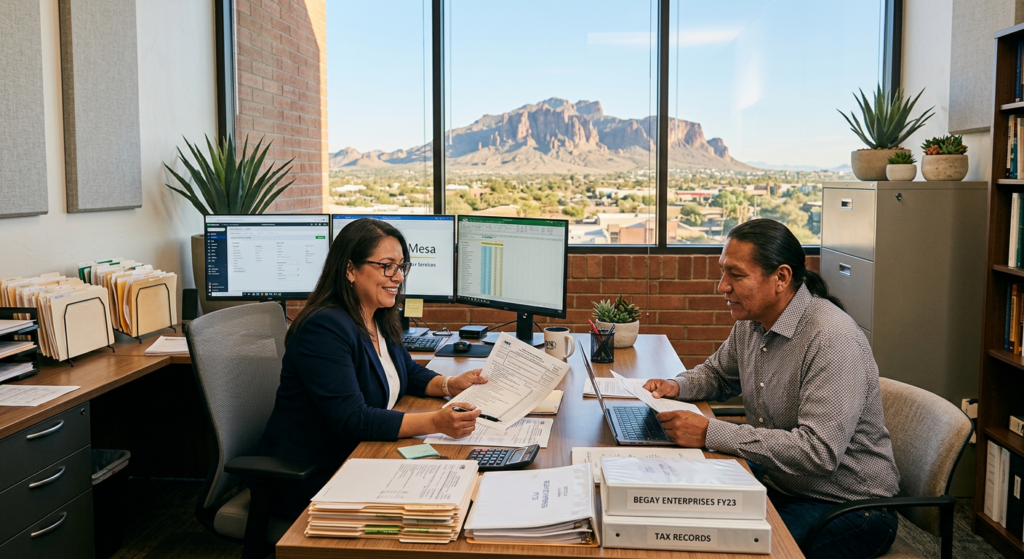
How to Find the Best Tax Preparer in Mesa in 2026: A Complete Guide for Business Owners and Self-Employed Professionals
Finding the best tax preparer in Mesa means understanding what makes a preparer qualified and how to identify professionals who can help you navigate 2026 tax changes. For business owners, 1099 contractors, and real estate investors in the Phoenix metro area, the right tax preparer does more than file returns—they help you maximize deductions, reduce your tax burden, and plan strategically for growth. With new 2026 tax breaks worth thousands in potential savings, Mesa residents need to work with credentialed professionals who understand these opportunities. This comprehensive guide explains how to evaluate tax preparers, understand their credentials, and find someone who fits your specific business needs.
Table of Contents
- What Credentials Matter When Choosing a Tax Preparer?
- Understanding Different Types of Tax Preparers in Mesa
- Red Flags and Quality Signs When Evaluating Preparers
- What 2026 Tax Breaks Should Your Preparer Know About?
- How to Find and Vet Tax Preparers in the Mesa Area
- Essential Questions to Ask Before Hiring a Tax Preparer
- Uncle Kam in Action: How a Mesa Business Owner Found Tax Savings
- Next Steps
- Frequently Asked Questions
Key Takeaways
- Credentialed preparers (CPAs, EAs, tax attorneys) provide oversight, continuing education, and IRS accountability that unenrolled preparers lack.
- In 2026, new tax breaks include senior deductions up to $6,000, tips deductions to $12,500, and SALT cap increases to $40,000—your preparer must know these.
- IRS staffing cuts mean errors take years to fix; choosing an accurate, credentialed preparer reduces your risk of costly audits.
- Mesa business owners working with strategic tax advisors save significantly through entity planning, deduction optimization, and year-round strategies.
- Ask about continuing education, industry experience, and proactive tax planning—not just return filing—when evaluating preparers.
What Credentials Matter When Choosing a Tax Preparer?
Quick Answer: CPAs, Enrolled Agents, and tax attorneys have IRS credentials and are subject to continuing education and professional standards. Unenrolled preparers lack these safeguards, which exposes you to higher error risk and audit vulnerability.
The best tax preparer in Mesa holds professional credentials that signal competency and accountability. The IRS distinguishes between two categories of paid tax preparers, and this distinction is critical to your decision.
Credentialed Preparers: CPA, EA, and Tax Attorneys
Credentialed tax preparers hold professional licenses issued by either the IRS or state boards. These include Certified Public Accountants (CPAs), Enrolled Agents (EAs), and tax attorneys. What makes them different? All credentialed preparers are subject to IRS regulation, testing, and continuing education requirements. They must renew credentials periodically and maintain professional standards. CPAs in Arizona must meet specific state licensing requirements and complete annual continuing professional education hours. Enrolled Agents must pass the IRS Special Enrollment Examination or have prior IRS experience, and must complete 24 hours of continuing education every three years.
For Mesa business owners, working with a credentialed preparer means the professional has skin in the game. Their license can be revoked if they underperform or violate standards. This accountability creates a strong incentive for accuracy and ethical practice.
Unenrolled Preparers: The Accountability Gap
Unenrolled tax preparers are individuals who have no formal IRS credentials or state licensing. While they must obtain a Preparer Tax Identification Number (PTIN) and sign returns they prepare, they are NOT required to undergo testing or continuing education. According to a recent Government Accountability Office report, this gap creates serious problems. “Unqualified preparers can make serious errors that cause taxpayers to lose out on benefits or subject them to audits or penalties,” the report noted. These errors can lead to billions in improper payments.
Many unenrolled preparers are software users who follow the software’s prompts without understanding underlying tax law. For complex situations—business structures, rental property losses, multi-state operations—this approach fails.
Understanding Different Types of Tax Preparers in Mesa
Quick Answer: Mesa preparers range from boutique CPA firms specializing in business taxes to large national chains. The best choice depends on your business complexity, service level needs, and whether you want ongoing strategic planning or just annual filing.
In Mesa, you’ll encounter several types of tax preparation providers, each with different business models and service levels.
Local CPA Firms and Solo Practitioners
Independent CPAs and small CPA firms dominate the Mesa market. These professionals often specialize in specific industries (construction, real estate, professional services) and build deep relationships with clients. Solo practitioners and small firms typically charge $150–$500 per hour for tax work, depending on complexity. The advantage? Personalized attention, direct access to the professional handling your return, and the ability to ask questions throughout the year.
According to recent industry data, experienced practitioners report clients increasingly seeking knowledgeable, credentialed professionals. “I am getting more people finding me. People are looking for knowledgeable people who are credentialed,” notes one Arizona-based preparer.
Mid-Size Accounting Firms Offering Tax Advisory
Mid-size firms employ multiple CPAs and offer not just filing but strategic tax planning. These firms often provide bookkeeping, payroll, entity structuring advice, and quarterly planning. Costs are higher—typically $2,000–$5,000+ annually—but you gain access to multiple specialists and comprehensive business advisory.
DIY Software vs. Preparer Services
TurboTax and similar platforms offer “Expert Assist” services that combine self-preparation with limited professional review. While these products cost $150–$400 and provide some professional oversight, they’re best suited for simple returns. For business owners with multiple income streams, employees, or complex deductions, expert assistance through software lacks the depth and ongoing relationship that accountants provide.

Free Tax Write-Off Finder
Red Flags and Quality Signs When Evaluating Preparers
Quick Answer: Red flags include no stated credentials, fixed fees regardless of complexity, pressure to file before understanding your situation, and absence of continuing education claims. Quality signs include transparent pricing, ongoing communication, and proactive tax planning suggestions.
As you evaluate the best tax preparer in Mesa for your business, watch for these indicators:
Critical Red Flags
- No CPA, EA, or attorney credentials mentioned on website or materials
- Charges the same flat fee for all returns regardless of business complexity
- Provides returns without asking detailed questions about your income, deductions, and business structure
- Cannot explain new 2026 tax breaks or specific deductions available to your business
- No mention of continuing education, professional memberships, or industry specialization
- Guarantees a specific refund amount or promises “audit protection” without understanding your situation
- Cannot represent you before the IRS if issues arise
Green Flags: Signs of a Quality Preparer
- Displays CPA, EA, or tax attorney credentials prominently and explains what they mean
- Performs a thorough intake process—asking about income sources, business structure, dependents, real estate, and prior-year returns
- References 2026 tax law changes and asks whether you might qualify for new deductions
- Mentions continuing education, professional certifications, or industry specializations
- Offers year-round communication and quarterly planning—not just once-a-year filing
- Asks about your business goals and mentions entity restructuring opportunities
- Has a documented process for addressing errors and handling IRS correspondence
Pro Tip: Ask the preparer directly: “What continuing education did you complete in 2026?” and “Have you helped other clients with [your industry/situation]?” Their answers reveal whether they’re staying current with tax law and whether they have relevant experience.
What 2026 Tax Breaks Should Your Preparer Know About?
Quick Answer: The One Big Beautiful Bill Act introduced major 2026 tax breaks including higher standard deductions ($31,500 for joint filers), senior deductions up to $6,000, tips deductions up to $12,500, and SALT cap increases to $40,000. Your preparer must ask whether you qualify.
The best tax preparer in Mesa understands 2026 tax law changes and proactively identifies which breaks apply to your situation. Here are the key deductions and credits your preparer should discuss:
Higher Standard Deduction (Effective 2026)
The standard deduction for the 2026 tax year increased significantly:
| Filing Status | 2026 Standard Deduction | Savings at 22% Tax Rate |
|---|---|---|
| Single | $15,750 | Up to $3,465 in tax savings |
| Married Filing Jointly | $31,500 | Up to $6,930 in tax savings |
| Head of Household | $23,625 | Up to $5,198 in tax savings |
A quality preparer should ask: “Are you itemizing or taking the standard deduction?” If your itemized deductions (mortgage interest, property taxes, charitable gifts) don’t exceed these thresholds, taking the standard deduction saves taxes.
New Deductions for Seniors, Tips, and Overtime
For qualifying taxpayers, the One Big Beautiful Bill Act introduced new deductions:
- Senior Deduction: If you’re 65 or older, claim an additional $6,000 deduction (up to $12,000 if married and both over 65). This is available whether you itemize or take the standard deduction.
- Tips Deduction: Credit card tips up to $12,500 (single) or $25,000 (MFJ) are not taxed.
- Overtime Deduction: Wages earned from overtime work can be deducted up to $12,500 (single) or $25,000 (MFJ).
Your Mesa tax preparer should specifically ask if you received tips or overtime income to apply these breaks.
Expanded SALT Deduction Cap
The State and Local Tax (SALT) deduction cap increased from $10,000 to $40,000 for 2026. This benefits homeowners, business owners paying self-employment tax, and anyone with substantial state income tax obligations. For Mesa residents paying Arizona property taxes and those with rental properties across states, this deduction can save thousands.
How to Find and Vet Tax Preparers in the Mesa Area
Quick Answer: Search the IRS Enrolled Agent directory, check Arizona Society of CPAs members, read online reviews on Google and Better Business Bureau, and ask other business owners for referrals. Conduct initial consultations with 2–3 candidates before deciding.
Finding a qualified tax preparer in Mesa requires a systematic approach. Here’s how to identify and vet candidates:
Use Official Directories
The IRS Find a Tax Professional directory lists credentialed preparers—CPAs, EAs, and tax attorneys. You can search by location (Mesa, Arizona) and specialty. The Arizona Society of CPAs also maintains a member directory. Both are reliable sources that filter for credentials.
Check Online Reviews and Ratings
Look up preparers on Google Reviews, the Better Business Bureau (BBB), and Yelp. Read both positive and critical reviews—they reveal common patterns. What do clients praise? Reliability, clear communication, and proactive suggestions. What do they criticize? Slow responses, surprise bills, and missing deadlines.
Ask Local Businesses for Referrals
Mesa’s business community is active. Ask at chambers of commerce meetings, networking events, or through referrals from business advisors. Owners of similar businesses (contractors, real estate agents, medical professionals) often have vetted recommendations.
Schedule Consultations
Most preparers offer free or low-cost initial consultations. Meet with 2–3 candidates. During these meetings, assess not just their qualifications but whether you feel heard and understood. A quality preparer listens more than they talk during an initial meeting.
Essential Questions to Ask Before Hiring a Tax Preparer
Quick Answer: Ask about credentials, 2026 tax law knowledge, fee structure, availability for year-round planning, experience with your business type, and their process for handling IRS issues.
Prepare these questions before your consultation:
- “What are your credentials (CPA, EA, tax attorney)? How long have you been in practice?” Look for at least 5 years of experience.
- “What’s your experience with [your business type]?” If you’re an S-Corp owner, ask how many S-Corp clients they serve. If you’re a real estate investor, ask about cost segregation analysis.
- “How do you stay current with tax law changes like the 2026 breaks we discussed?” They should reference specific continuing education or professional memberships.
- “What’s your fee structure?” Ask if it’s hourly, flat fee, or percentage-based. Understand what’s included in the base fee and what costs extra.
- “Are you available for quarterly planning or only at tax time?” The best preparers work year-round with clients.
- “If I get audited, how do you handle IRS correspondence?” Ask whether they’ll represent you and what that costs.
- “Have you helped other clients reduce their tax burden through entity restructuring or deduction planning?” Look for examples of proactive planning, not just filing.
Pro Tip: A quality preparer will turn these questions around and ask you about your business, goals, and pain points. If they only answer your questions without probing deeper, they’re likely more focused on compliance than strategy.

Uncle Kam in Action: How a Mesa Business Owner Found Tax Savings Through Strategic Preparer Selection
Marcus, a Mesa-based construction contractor, had used an unenrolled preparer for four years. The preparer filed his 1099 income each April but never asked about business structure, equipment deductions, or growth strategies. Marcus paid roughly $18,000 annually in federal taxes on $120,000 in net business income.
In 2025, Marcus switched to a credentialed CPA specializing in construction businesses. During his first year, the CPA discovered three critical opportunities: (1) Marcus could elect S-Corp status and save on self-employment tax by paying himself a $60,000 reasonable salary and taking $60,000 in distributions—saving roughly $4,500 annually in SE tax. (2) Marcus had been underutilizing depreciation deductions on tools and equipment, missing $8,000 in deductions annually. (3) Marcus’s 2026 tax plan included the new senior deduction once he turned 65 in three years.
First-year cost to Uncle Kam: $2,400 for strategic planning and filing. First-year tax savings: $4,500 (SE tax) + $1,800 (depreciation deduction value at 22% tax rate) = $6,300 in first-year savings. Return on investment: 162% in year one. Beyond year one, Marcus saves $4,500+ annually through the S-Corp structure alone—making the relationship worth thousands over time.
Marcus also gained access to quarterly tax planning, helping him manage estimated payments, plan for business expansion, and stay informed of new tax law changes. When his business grew to $250,000 in revenue, the CPA advised on equipment financing and entity restructuring to minimize multi-state tax exposure. This level of strategic advice is unavailable from unenrolled preparers or software-only solutions.
Next Steps
Finding the best tax preparer in Mesa requires intentional effort but pays dividends through tax savings and strategic business guidance. Here’s your action plan for 2026:
- Search the IRS Enrolled Agent directory and Arizona CPA society for credentialed preparers in Mesa specializing in your business type.
- Check online reviews and gather 3–5 referral candidates with strong credentials and local presence.
- Schedule initial consultations and ask the critical questions outlined in this guide—especially about 2026 tax law knowledge and year-round availability.
- Discuss your business goals and ask specifically whether they see opportunities for tax optimization through entity structuring, deduction planning, or strategic timing.
- Compare fee structures and ensure you understand what’s included in their base service and what costs extra for tax planning or IRS representation.
- Choose a preparer who demonstrates both technical knowledge and genuine interest in your business success—not just return filing.
Frequently Asked Questions
Should I use a local Mesa preparer or an online service?
If your tax situation is simple (W-2 income, basic deductions), online services may suffice. For business owners, self-employed professionals, and real estate investors, a local relationship with a credentialed preparer is invaluable. Local preparers can meet in person, handle IRS issues directly, and provide ongoing strategic guidance that online services cannot match.
What’s a reasonable fee for a tax preparer in Mesa?
For a simple 1040, expect $200–$500. For a Schedule C business, $600–$1,500. For multi-entity structures (S-Corp with rental properties), $2,000–$5,000+. Hourly rates typically range $150–$500/hour depending on credentials and complexity. Don’t choose based on price alone—credentialed preparers charge more because they provide greater value and accuracy.
How early should I contact a tax preparer for 2026 taxes?
Ideally, by late fall 2026 to plan for year-end strategies (retirement contributions, charitable gifts, equipment purchases). If you’ve never worked with a preparer, don’t wait until March when everyone is swamped. Start the search now (March 2026) to secure an appointment before the April 15, 2027 deadline for 2026 returns.
What’s the difference between a CPA and an Enrolled Agent?
Both are credentialed and subject to IRS oversight. CPAs must complete a rigorous four-year education, pass a uniform exam, and meet continuing education requirements. Enrolled Agents specialize in tax and can represent you before the IRS but don’t require accounting degrees. Both are excellent choices; select based on experience with your industry and communication style.
Can a tax preparer represent me in an IRS audit?
Yes, if they’re a CPA, EA, or tax attorney. Unenrolled preparers cannot represent you before the IRS. Ask your preparer directly about audit representation and whether it’s included in their fees or costs extra. This is another reason credentialed preparers are worth the investment.
How do I verify a preparer’s credentials?
Ask to see their CPA license, EA enrollment certificate, or bar card. CPAs are licensed by Arizona’s Board of Accountancy and credentials are public. Enrolled Agents are listed in the IRS directory. Never work with a preparer who can’t produce credentials or who insists on cash-only payments.
What should I prepare before meeting with a tax preparer?
Bring all 2025 tax documents: 1099s, W-2s, K-1s, property tax statements, mortgage interest statements, business income/expense records, charitable receipts, and prior-year tax returns. Organize by category (income, deductions, investments) to make the preparer’s job easier. The better organized you are, the more efficiently they can work and the less you’ll pay in fees.
Last updated: March, 2026

