
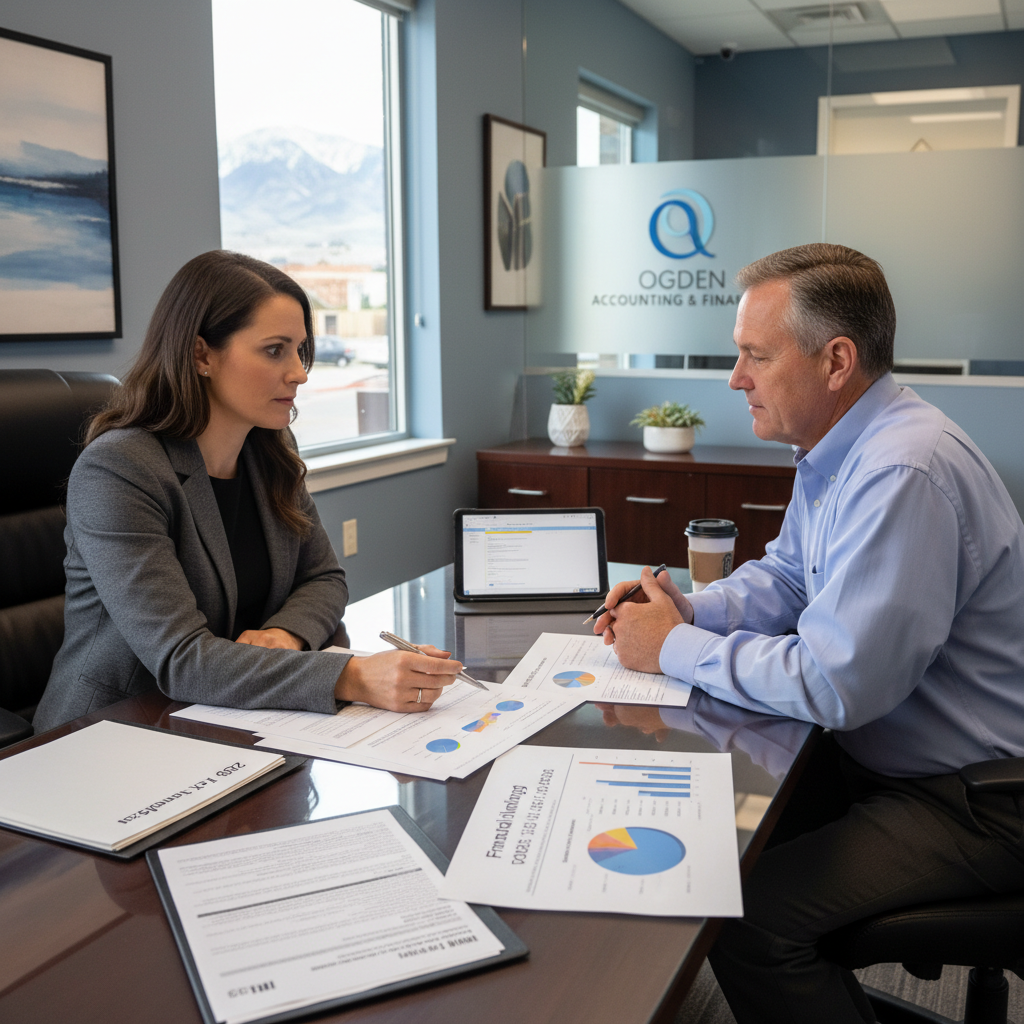
Ogden Cost of Hiring a CPA in 2026: Complete Pricing Guide for Utah Business Owners
Understanding the Ogden cost of hiring a CPA is essential for business owners and self-employed professionals managing their 2026 tax obligations. In Ogden, Utah, professional accounting services have become increasingly valuable as tax law complexity grows and compliance requirements tighten. This guide breaks down CPA pricing models, service costs, and strategic considerations to help you make an informed investment decision.
Table of Contents
- Key Takeaways
- What Factors Determine CPA Costs?
- How Much Should You Budget for CPA Services?
- What Pricing Models Do Ogden CPAs Use?
- How Do 2026 Tax Changes Affect CPA Costs?
- What Does a CPA Cost for Self-Employed Professionals?
- How Can You Maximize ROI on CPA Investment?
- Uncle Kam in Action
- Next Steps
- Frequently Asked Questions
Key Takeaways
- The Ogden cost of hiring a CPA ranges from $1,500 to $5,000+ annually depending on complexity and business size.
- 2026 tax law changes, including permanent QBI deductions, may increase CPA engagement as owners seek optimization strategies.
- Professional CPA services typically deliver 3-5x ROI through deductions, credits, and tax planning strategies.
- Hourly, flat-fee, and project-based pricing models each offer distinct advantages for different business types.
- Self-employed professionals should expect to invest $2,000-$4,000 annually for comprehensive tax preparation and planning.
What Factors Determine CPA Costs in Ogden?
Quick Answer: The Ogden cost of hiring a CPA depends on business structure, annual revenue, transaction complexity, entity type, and industry-specific compliance requirements.
Several critical variables impact the final price of professional CPA services in Ogden. Understanding these factors helps you budget accurately and evaluate whether a particular provider offers competitive pricing for your specific situation.
Business Complexity and Organizational Structure
The complexity of your business operations directly correlates with CPA engagement costs. A sole proprietor with straightforward income and minimal deductions will pay substantially less than a business owner operating multiple revenue streams, rental properties, or corporate entities.
For example, a sole proprietor filing Schedule C tax returns typically costs $1,500-$2,500 annually. A partnership or S-Corporation requiring multi-shareholder filings, allocation schedules, and reasonable compensation documentation could cost $3,000-$6,000+. C-Corporations with additional compliance obligations may reach $5,000-$10,000 or higher.
- Sole Proprietorship: $1,500-$2,500 (basic return, minimal complexity)
- LLC (taxed as partnership): $2,500-$4,000 (multi-member structures cost more)
- S-Corporation: $3,500-$6,000 (includes payroll considerations)
- C-Corporation: $4,000-$8,000+ (corporate tax return complexity)
Annual Revenue and Income Level
Gross revenue directly impacts the time investment required from your CPA. Higher-revenue businesses typically require more detailed accounting, substantiation, and audit-ready documentation.
Many CPAs use revenue thresholds as pricing anchors. A business generating $100,000 in annual revenue may be quoted differently than one generating $500,000 or $2,000,000. The pricing often reflects administrative burden—more transactions mean more entries, more reconciliations, and more time invested.
Pro Tip: For the 2026 tax year, business owners should ask CPAs about flat-fee pricing tiers based on revenue brackets. This eliminates surprise bills and provides predictable annual budgeting for accounting services.
Deduction Count and Documentation Needs
The number of deductions your business claims significantly influences CPA costs. Businesses with well-documented, straightforward deductions (basic office rent, employee wages, standard supplies) cost less to process than businesses with complex deductions like vehicle depreciation, home office allocations, or itemized mixed-use asset categories.
Real estate investors, landlords, and business owners with multiple asset bases should expect to pay premium rates because tax optimization requires detailed cost segregation analysis, depreciation schedules, and expense allocation documentation.
How Much Should You Budget for CPA Services?
Quick Answer: Budget $1,500-$5,000 annually for basic CPA services in Ogden, with comprehensive tax planning and business advisory services reaching $5,000-$15,000+ depending on business size.
Creating a realistic budget for the Ogden cost of hiring a CPA requires understanding the typical pricing ranges by business type and service level. The following benchmarks reflect 2026 market conditions in Utah.
| Business Type | Annual Revenue | Basic Tax Prep | w/ Bookkeeping |
|---|---|---|---|
| Sole Proprietor | $25K-$100K | $1,200-$2,000 | $2,500-$4,000 |
| LLC (Single Member) | $50K-$250K | $1,500-$2,500 | $3,000-$5,000 |
| S-Corporation | $100K-$500K | $2,500-$4,000 | $4,500-$7,000 |
| Real Estate Investor | $50K-$300K Rental Income | $2,000-$3,500 | $3,500-$6,000 |
Monthly Retainer vs. One-Time Annual Costs
Many Ogden CPAs offer flexible payment structures. Some charge annual flat fees paid upfront or in quarterly installments. Others utilize monthly retainers for ongoing bookkeeping and advisory services, with additional fees for tax preparation.
Monthly retainers for business owners typically range from $150-$500 monthly depending on service scope. This translates to $1,800-$6,000 annually for ongoing bookkeeping and quarterly planning. Tax preparation fees are often billed separately as a project fee during filing season.
For self-employed professionals, monthly retainers commonly range from $100-$300 monthly, with quarterly tax planning consultations included. This ongoing engagement helps optimize tax positions throughout the year rather than making corrections after year-end.
Did You Know? The average tax refund for the 2026 tax year is $2,548, up 13.1% from 2025. Strategic CPA engagement often converts these refunds into proactive tax savings through planning rather than overpayment corrections.
What Pricing Models Do Ogden CPAs Use?
Quick Answer: CPAs use hourly billing, flat fees, project-based pricing, and value-based models. Each offers distinct advantages depending on your business predictability and engagement style.
Understanding CPA pricing models helps you evaluate proposals and negotiate fair rates. Different models suit different business situations.
Hourly Billing Model
In Ogden, hourly rates for CPAs typically range from $150-$350 per hour depending on experience level, firm size, and service complexity. Senior partners may charge $250-$350+, while staff accountants may bill at $100-$200 per hour.
Hourly billing benefits clients with unpredictable engagement needs. You pay only for services rendered. However, this model creates uncertainty about final costs, particularly during complex tax situations that require more time than initially estimated.
Flat-Fee Pricing
Most Ogden CPAs prefer flat-fee models because they provide cost certainty for clients and allow the firm to manage profitability effectively. Flat fees typically apply to standardized services like basic tax return preparation.
A CPA might quote $2,500 flat fee for S-Corporation tax return preparation, regardless of whether the engagement takes 20 hours or 40 hours. This incentivizes the CPA to work efficiently while giving you budgeting certainty.
Project-Based Pricing
For specific tax planning projects—such as business entity restructuring or investment property analysis—CPAs typically quote project fees combining estimated hours and complexity. A business restructuring engagement might be quoted at $3,500-$5,000 as a single project fee.
How Do 2026 Tax Changes Affect CPA Costs?
Quick Answer: The permanent QBI deduction, new vehicle loan interest deductions, and other 2026 tax law changes may increase CPA time investment, potentially raising engagement costs by 10-20%.
The One Big Beautiful Bill Act, which took effect in July 2025, introduced several provisions affecting the 2026 tax year. These changes create both opportunities and complexities that impact the Ogden cost of hiring a CPA.
Permanent QBI Deduction—20% Business Income Tax Savings
The Qualified Business Income (QBI) deduction, allowing business owners to deduct up to 20% of qualified business income, is now permanent starting in 2026. Previously, this deduction was scheduled to expire after the 2025 tax year, but new legislation made it permanent.
This change means your CPA will need to perform ongoing QBI analysis to ensure you’re claiming the maximum available deduction. A new $400 minimum deduction applies for taxpayers with at least $1,000 in QBI from a business in which they materially participate.
For a self-employed professional generating $100,000 in net business income, the potential tax savings from proper QBI deduction implementation reaches $20,000 (20% × $100,000). Professional CPA guidance ensuring proper QBI classification and documentation easily justifies the engagement cost.
New Vehicle Loan Interest Deduction
For the 2026 tax year through 2028, a new deduction allows taxpayers to deduct up to $10,000 annually for interest paid on qualifying vehicle loans. The deduction phases out for taxpayers with modified adjusted gross income exceeding $100,000 (single) or $200,000 (married filing jointly).
This new deduction requires CPA awareness of loan documentation, date-of-origination verification, and income threshold calculations. Your CPA may add time to tax preparation to properly claim this benefit, potentially increasing 2026 costs by $200-$500 depending on whether you have qualifying vehicle loans.
Increased Standard Deductions
For the 2026 tax year, standard deductions increased significantly. Married filing jointly taxpayers now claim $27,100, up from $23,500 in 2025. These higher deductions affect whether itemization makes sense for individual taxpayers, which impacts CPA analysis of tax return strategies.
Pro Tip: Business owners should discuss standard deduction implications with their CPA during 2026 planning. Higher deductions may reduce itemization incentives, affecting charitable contribution strategies and business-related expense documentation requirements.
What Does a CPA Cost for Self-Employed Professionals?
Quick Answer: Self-employed professionals in Ogden should budget $2,000-$4,000 annually for comprehensive CPA services including tax preparation, quarterly planning, and self-employment tax optimization.
Freelancers, independent contractors, and gig workers face unique tax obligations. The self-employment tax rate remains 15.3% on net self-employment income, making proper business deduction documentation critical for tax savings.
Understanding Self-Employment Tax Obligations
Self-employed professionals must pay both employee and employer Social Security and Medicare taxes. The Social Security maximum taxable earnings for 2026 increases to $184,500, meaning high-income self-employed professionals pay Social Security taxes on earnings up to this threshold.
A self-employed professional earning $100,000 in net income pays approximately $15,300 in self-employment taxes. Strategic business deductions and entity structure optimization can reduce this liability significantly. This tax planning opportunity easily justifies CPA investment for self-employed professionals.
Using the Self-Employment Tax Calculator for Salt Lake City helps self-employed professionals estimate quarterly tax obligations and plan accordingly throughout the year.
Quarterly Estimated Tax Planning
Self-employed professionals must pay quarterly estimated taxes. A CPA’s quarterly tax planning service ensures you remit appropriate estimated payments, avoiding underpayment penalties while maintaining cash flow.
Many CPAs charge self-employed professionals $100-$200 per quarterly consultation, or include quarterly planning in a monthly retainer. This ongoing engagement optimizes tax positions throughout the year and prevents year-end surprises.
Deduction Optimization for Maximum Savings
Self-employed professionals often leave significant deduction opportunities unclaimed. Home office deductions, vehicle depreciation, equipment purchases, and professional development expenses all reduce self-employment tax liability when properly documented.
A CPA working with a self-employed professional generating $80,000 annual income might identify $15,000-$20,000 in deductible business expenses. At the 15.3% self-employment tax rate, these deductions produce $2,295-$3,060 in immediate tax savings, typically exceeding the CPA’s annual fee by multiples.
How Can You Maximize ROI on CPA Investment?
Quick Answer: Maximize CPA ROI by maintaining organized records, communicating proactively throughout the year, implementing strategic tax planning recommendations, and scheduling quarterly tax planning sessions.
Professional CPA engagement typically delivers 3-5x return on investment through tax savings, optimized deductions, and compliance risk reduction. However, maximizing this ROI requires strategic engagement on your part.
Establish Strong Documentation and Record-Keeping Systems
The most valuable use of CPA time is tax planning and strategy, not digging through disorganized receipts and records. When you maintain clean bookkeeping, categorized expenses, and documented deductions throughout the year, your CPA can focus on optimization rather than remediation.
Cloud-based accounting software like QuickBooks or Xero allows real-time expense tracking and categorization. When your CPA accesses organized financial records, engagement time drops 30-40%, reducing your annual costs while improving tax analysis quality.
- Implement cloud-based bookkeeping for real-time financial visibility
- Categorize all business expenses consistently throughout the year
- Maintain receipts and supporting documentation for all deductions
- Track vehicle mileage, home office allocation, and other mixed-use assets
- Document business purpose for all expenses exceeding $500
Schedule Quarterly Tax Planning Meetings
Rather than waiting until March when the CPA is overwhelmed with tax season, strategic business owners schedule quarterly planning meetings. These meetings allow your CPA to identify tax-saving opportunities while implementation remains possible.
A mid-year tax planning review might reveal that accelerating a $10,000 equipment purchase saves $2,000+ in taxes. This recommendation only works if discovered in July—not March. Quarterly engagement creates this strategic advantage.
Actively Request Tax Planning Guidance
Professional CPAs offer tax planning recommendations only when asked. If you want strategic guidance beyond basic compliance, explicitly request tax planning discussions. Ask about business structure optimization, entity election strategies, estimated tax calculation methods, and deduction maximization tactics.
Many CPAs charge slightly higher fees for businesses requesting comprehensive tax planning. However, the tax savings typically exceed the additional fee multiple times over.

Uncle Kam in Action: How Sarah Saved $8,400 With CPA Optimization
Sarah, a 42-year-old independent consultant based in Ogden, earned $120,000 in consulting income during 2025. She had been filing simple tax returns without professional CPA guidance, primarily using online tax software. Her annual federal and self-employment tax liability was approximately $32,000.
In January 2026, Sarah hired a CPA for comprehensive tax planning. The engagement included a 2025 tax return review and optimization recommendation development. Total engagement cost: $3,200.
The CPA’s analysis revealed several optimization opportunities:
- Home office deduction: $4,800 (utilizing IRS simplified method for 200 sq ft office)
- Vehicle depreciation: $8,200 (business-use automobile properly classified)
- Professional development and continuing education: $2,100
- Business meals and entertainment (50% deductible): $3,400
- Total identified deductions: $18,500
At the combined 25% federal and self-employment tax rate, these $18,500 in additional deductions produced $4,625 in immediate tax savings. Beyond 2025, the CPA recommended optimizing Sarah’s 2026 structure through S-Corporation election, projected to deliver an additional $8,400 in annual self-employment tax savings.
Sarah’s CPA fee of $3,200 delivered $4,625 in first-year savings, plus projected $8,400 in ongoing annual savings through structural optimization. The ROI: 144% in year one, with permanent benefits continuing.
For additional guidance on business structure optimization, explore Uncle Kam’s entity structuring services designed to maximize tax efficiency for business owners in Utah.
Next Steps to Hire Your Ogden CPA
- Gather Financial Records: Compile 2025 income statements, expense records, and tax documentation before scheduling CPA consultations. Organized information accelerates the evaluation process.
- Request Consultation Proposals: Contact 3-4 local Ogden CPAs requesting fee proposals and service scope details. Compare flat-fee structures, hourly rates, and value-added services.
- Ask Strategic Questions: Inquire about 2026 tax law experience, QBI deduction optimization, and business entity restructuring expertise. Evaluate whether the CPA offers proactive planning or reactive compliance.
- Evaluate Tax Planning Focus: Ask each CPA candidate about quarterly planning availability, estimated tax calculation methodology, and optimization recommendations frequency. Strategic engagement matters.
- For comprehensive strategic planning beyond basic tax preparation, consider Uncle Kam’s tax strategy services to optimize your overall business structure and tax position.
Frequently Asked Questions
What’s included in typical CPA tax preparation services?
Standard CPA tax preparation includes gathering financial records, organizing income and expenses, completing the primary tax return (Form 1040, 1120-S, 1065, etc.), calculating and filing required schedules, identifying deductible expenses, and responding to basic follow-up questions. More comprehensive engagements add quarterly tax planning, bookkeeping services, and strategic business advisory.
Should I choose hourly billing or flat-fee pricing?
Flat-fee pricing benefits business owners with predictable needs and well-organized records. Hourly billing works better for complex, unpredictable situations. For 2026, ask CPAs to structure proposals using flat fees for standard services with hourly rates for additional advisory services. This hybrid approach provides cost certainty for core services while maintaining flexibility for extra engagement.
How much tax savings should I expect from CPA engagement?
Conservative estimates suggest professional CPA engagement delivers 3-5x return on investment through identified deductions and tax optimization. A business paying $2,500 in CPA fees should identify at minimum $7,500-$12,500 in tax savings or optimization opportunities. Many successful engagements deliver significantly higher returns, particularly for businesses with structural optimization potential.
Can I change CPAs between tax years?
Yes, you can change CPAs at any time. However, mid-year changes complicate planning. If you’re unsatisfied with your current CPA, send a formal engagement termination letter and authorize transcript requests to your new CPA. The new CPA will request prior-year returns from your previous accountant to maintain documentation continuity. Timing changes for the start of a new tax year when possible to streamline transitions.
Are CPA fees tax deductible?
For business owners and self-employed professionals, CPA fees are typically deductible as ordinary and necessary business expenses, reducing your self-employment tax further. For example, a $3,000 CPA fee deducts against 15.3% self-employment tax, producing an additional $459 in tax savings beyond the direct engagement benefits. This deductibility effectively reduces your net CPA cost by 20-40%.
What’s the ideal timing to hire a CPA for 2026 tax planning?
The ideal timing is Q4 of the current year (October-December 2026) to develop 2026 year-end planning strategies. However, engaging a CPA by February 2026 still allows meaningful tax planning for the remainder of the year. For maximum tax savings, engage your CPA before mid-year when implementation deadlines for depreciation elections, entity conversions, and business purchases remain achievable.
How do I verify a CPA’s credentials in Utah?
Utah CPAs must be licensed by the Utah State Board of Accountancy. Verify credentials at the Utah Board of Accountancy website or request the CPA’s license number during initial consultations. Licensed CPAs have completed extensive education, training, and examination requirements, ensuring professional competency. Always verify credentials before engaging professional tax services.
Related Resources
- Tax Strategy Solutions for Utah Business Owners
- Self-Employment Tax Planning for Freelancers and 1099 Contractors
- Professional Tax Preparation and Filing Services
- Business Entity Structuring and Optimization
- Comprehensive Tax Strategy and Planning Services
Last updated: February, 2026
This information is current as of 2/23/2026. Tax laws change frequently. Verify updates with the IRS or consult with a qualified tax professional if reading this later.

