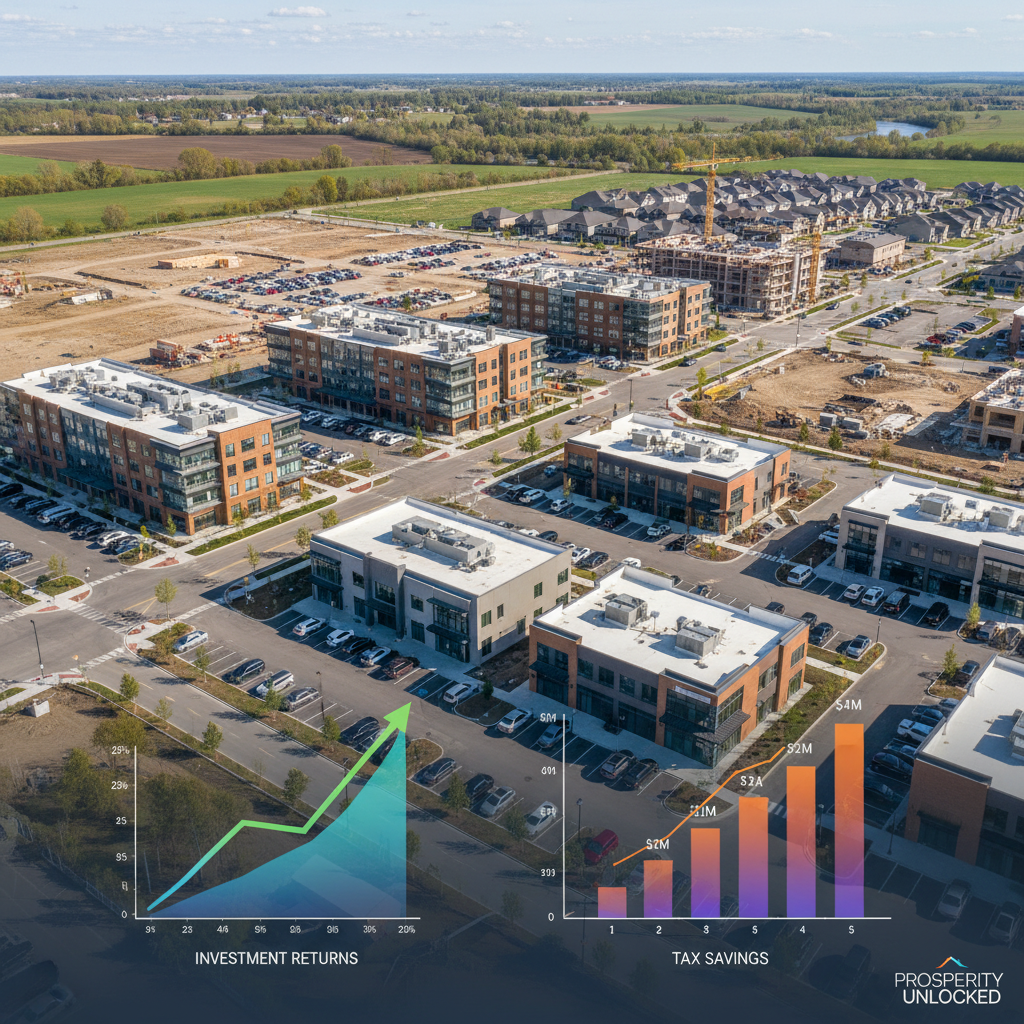
Norman Opportunity Zone Investment: 2026 Tax Strategy Guide for Real Estate Investors
For the 2026 tax year, real estate investors have unprecedented access to one of the most powerful tax incentive programs available: the norman opportunity zone investment framework. Enhanced by Opportunity Zone 2.0 legislation, which takes effect January 1, 2027, the new program introduces a game-changing 30% basis step-up for rural zone investments—double the 10% available for non-rural zones. Combined with reduced development thresholds, simplified compliance rules, and strategic incentive stacking, norman opportunity zone investment now offers what tax professionals call “free money to investors.” This comprehensive guide breaks down how to identify qualifying zones, structure investments, and implement tax strategies that can dramatically increase your returns while supporting rural economic development.
Table of Contents
- Key Takeaways
- What Is a Norman Opportunity Zone Investment?
- How Did Opportunity Zone 2.0 Change the 2026 Rules?
- What Are the Basis Step-Up Benefits?
- How Do You Maximize Returns Through Incentive Stacking?
- How to Identify Eligible Norman Opportunity Zone Tracts
- What Is the Timeline for New Zone Designations?
- Uncle Kam in Action
- Next Steps
- Frequently Asked Questions
Key Takeaways
- Norman opportunity zone investment under 2026 rules delivers a 30% basis step-up for rural investments after five years—triple the traditional 10% rate.
- The substantial improvement threshold for rural projects dropped from 100% to 50% effective July 4, 2025, making development easier.
- 100% bonus depreciation is now permanent under the One Big Beautiful Bill, eliminating depreciation recapture within 10-year QOF holdings.
- Opportunity Zone 2.0 designation begins mid-2026, effective January 1, 2027, requiring proactive preparation and stakeholder engagement.
- Strategic incentive stacking—layering federal OZ benefits with state and local incentives—can create “crazy good returns” on rural projects.
What Is a Norman Opportunity Zone Investment?
Quick Answer: A norman opportunity zone investment is a real estate or business investment made within a federally designated economically distressed area, allowing investors to defer capital gains taxes and receive basis step-ups (tax reductions) if held through a Qualified Opportunity Fund for specified periods.
Opportunity Zones were created under the Tax Cuts and Jobs Act to stimulate economic development in low-income rural and urban communities. Under 2026 rules, when you make a norman opportunity zone investment, you can defer paying taxes on prior capital gains if those gains are invested into a Qualified Opportunity Fund (QOF). The fund then invests the capital in qualifying properties or businesses within designated opportunity zones.
What makes norman opportunity zone investment particularly attractive for the 2026 tax year is the enhanced treatment for rural zones. Unlike non-rural OZ investments, rural zone investments now receive a 30% basis step-up after five years (starting in 2027), meaning your tax basis increases by 30% of your original investment without any additional payment. This translates directly to lower capital gains taxes when you eventually sell the investment.
The Three-Tax-Benefit Structure
Every norman opportunity zone investment offers three distinct tax advantages when held through a QOF for the required periods:
- Capital gains deferral: Original gains are deferred until December 31, 2026, or when the investment is sold, whichever comes first.
- Step-up benefits: A 10% basis step-up after five years (non-rural) or 30% after five years (rural, effective 2027).
- Complete gain exclusion: If held for 10+ years, the appreciation gained after the investment is made faces zero federal capital gains tax.
How Did Opportunity Zone 2.0 Change the 2026 Rules?
Quick Answer: Opportunity Zone 2.0, effective January 1, 2027, enhances rural zone incentives with a 30% basis step-up (vs. 10% non-rural), reduces development requirements from 100% to 50%, and introduces updated designation procedures with mid-2026 applications.
Congress significantly reformed the Opportunity Zone program recognizing that only about 9% of original OZ 1.0 investments went to rural areas despite rural zones making up a much larger share of designations. To address this imbalance, the One Big Beautiful Bill (signed July 4, 2025) introduced sweeping changes now reflected in 2026 operations.
Key Regulatory Changes Effective 2026
The most significant change for norman opportunity zone investment in 2026 is the reduced substantial improvement threshold. Under prior rules, developers investing in rural properties had to improve the property by 100% of acquisition cost before the investment could qualify. The 2026 threshold dropped to just 50% effective July 4, 2025. This change is critical because many rural OZ projects involve acquiring bare land where substantial improvement rules previously posed barriers.
Simultaneously, 100% bonus depreciation was made permanent under the OBBB. For manufacturing facilities, fixtures, and equipment placed in service after January 19, 2025, investors can deduct the full cost in the year acquired. Within a QOF held for 10+ years, this creates an extraordinary advantage: investors receive 100% depreciation deductions without the typical recapture requirement upon sale, since the basis step-up at the 10-year mark wipes out recapture liability.
| Feature | OZ 1.0 (Pre-2026) | OZ 2.0 (2026+) |
|---|---|---|
| Rural Basis Step-Up (5 years) | 10% | 30% |
| Substantial Improvement Threshold | 100% of acquisition | 50% of acquisition |
| Bonus Depreciation Recapture (10+ years) | Yes, recapture due | No recapture (basis step-up) |
| Designation Round | First round (2018-2020) | Second round (mid-2026 to Sept 2026) |
What Are the Basis Step-Up Benefits for Norman Opportunity Zone Investment?
Quick Answer: A 30% basis step-up on rural norman opportunity zone investment means your tax basis increases by 30% of invested capital after five years, reducing your taxable gain by that percentage when you eventually sell.
The basis step-up is widely considered the most meaningful rural benefit in Opportunity Zone 2.0. Here’s how it works: if you invest $1,000,000 in a rural norman opportunity zone investment through a QOF, after holding it for five years, your tax basis automatically increases to $1,300,000 (a 30% step-up). If the property has appreciated to $1,500,000 by that point, your taxable gain is only $200,000 instead of $500,000—a $300,000 reduction in gains subject to capital gains tax.
Comparing 10% vs. 30% Step-Ups
Non-rural opportunity zones offer a 10% basis step-up. The additional 20-point difference between rural (30%) and non-rural (10%) is substantial. On a $5,000,000 investment, the difference equals $1,000,000 in additional basis step-up—or approximately $200,000 to $370,000 in federal tax savings (depending on your income bracket and the long-term capital gains rate).
This dramatic advantage explains why tax professionals now view rural zone investments as “free money to investors” when properly structured. The 30% step-up essentially provides a guaranteed return of roughly 6% annually for five years (30% divided by 5 years), independent of the underlying property’s performance.
Pro Tip: Plan your norman opportunity zone investment timing strategically. Hold the investment for at least five years to capture the 30% basis step-up, and consider holding for 10+ years to also receive the complete exclusion on post-investment appreciation gains.
 Free Tax Write-Off Finder
How Do You Maximize Returns Through Incentive Stacking?
Quick Answer: Incentive stacking layers federal norman opportunity zone investment benefits with state and local incentives—grants, tax credits, system development charge waivers, and loan guarantees—to dramatically amplify total project returns.
One of the most powerful strategies for 2026 is combining federal Opportunity Zone benefits with state and local economic development incentives. Real-world case studies demonstrate this approach can transform project economics entirely. A 1,200-acre rural development project in Burns, Oregon exemplifies this: developers stacked over $10 million in infrastructure incentives, including rural urban renewal funding, 7% cashback on new home sales, state loan guarantees up to 90%, and additional state grants. When layered with 100% bonus depreciation on manufacturing facilities and the 30% OZ basis step-up, this created returns that development professionals describe as “crazy good.”
The Incentive Stacking Framework
When evaluating a norman opportunity zone investment opportunity, ask this critical question: “How can I stack a group of incentives to make my project more successful?” For each location, the answer varies, but the typical stacking layers include:
- Federal: 30% OZ basis step-up (rural), capital gains deferral, 100% bonus depreciation on manufacturing.
- State: Tax credits, grants, system development charge (SDC) waivers, job creation credits.
- Local: Urban renewal funding, infrastructure improvements, housing-related incentives, workforce development grants.
- Specialized: Tribal partnerships, disadvantaged business grants, women-owned business incentives, affordable housing credits.
The practical challenge is identifying which incentives apply to your specific project. This requires proactive outreach to state economic development departments and local government officials. Our small business tax calculator for Utah can help model the impact of these layered incentives on your specific investment returns for 2026.
Many developers overlook this step entirely, leaving significant tax savings on the table. The investment in understanding what Coni Rathbone, an experienced Opportunity Zone attorney, calls the “buffet of incentives” is one of the highest ROI activities in OZ project planning.
How to Identify Eligible Norman Opportunity Zone Tracts
Quick Answer: Use IRS and Census Bureau mapping tools to identify designated opportunity zones, then coordinate with local economic development offices to understand which census tracts are likely to receive new designations in the 2026 round.
The process of finding suitable norman opportunity zone investment opportunities has become more sophisticated for 2026. Unlike the first OZ round when “governors and economic development departments were kind of guessing” at which areas to nominate, the second round benefits from more education, better data, and coordinated industry engagement.
Step 1: Map Current and Prospective Zones
Begin by studying available maps showing currently designated OZ tracts. The U.S. Census Bureau provides comprehensive mapping tools identifying all OZ 1.0 designations by county and tract. For 2026, also identify likely candidates for OZ 2.0 designation by analyzing census data on poverty rates, income levels, and population trends in your target region.
Step 2: Identify Areas with Real Development Potential
Not every designated opportunity zone is suitable for investment. Focus on tracts with genuine development potential: proximity to growing markets, available workforce, supportive local government, existing infrastructure, or clear market demand (housing, commercial, industrial). A tract in a declining community with no economic anchor may not generate adequate returns despite tax benefits.
Step 3: Engage with Stakeholders
Before finalizing your norman opportunity zone investment thesis, contact state economic development departments, county commissioners, city planners, and commercial real estate brokers. Ask explicitly for the “buffet of incentives” available in your target area. Many developers report that early engagement with these stakeholders reveals opportunities invisible from initial market analysis.
What Is the Timeline for New Norman Opportunity Zone Designations?
Quick Answer: The OZ 2.0 nomination period runs from mid-2026 through September 2026, with new zones effective January 1, 2027. Developers should begin tract identification and stakeholder outreach immediately in early 2026.
For investors planning 2026 norman opportunity zone investment activities, understanding the designation timeline is critical. The current window of opportunity closes quickly. Here’s the critical timeline:
- February-May 2026: Developers and communities should identify likely eligible census tracts and begin stakeholder engagement with state governors’ offices and economic development departments.
- Mid-2026 (June): Official nomination period opens. Governors’ offices accept tract nominations from economic development departments and qualified organizations.
- September 2026: Nomination period closes. Treasury Department and IRS begin review of submitted tracts.
- January 1, 2027: New OZ 2.0 map takes effect. All newly designated zones become eligible for 30% basis step-up and other enhanced benefits.
This timeline reveals why immediate action is essential. Investors who wait until mid-2026 to identify tracts will miss critical preparation and stakeholder relationship-building opportunities. Forward-thinking developers are already studying census tracts and preparing pitch decks for state decision-makers.

Uncle Kam in Action: Rural Development Norman Opportunity Zone Investment
Client Profile: A family office managing $150 million in real estate holdings seeks to diversify from traditional coastal investments into rural economic development with superior tax efficiency. The principals have $8 million in capital gains from recent asset sales scheduled to be triggered in Q2 2026.
The Challenge: Without strategic tax planning, the family office would owe approximately $2.4 million in federal capital gains taxes (assuming 20% LTCG rate plus net investment income tax) on the $8 million gain. Additionally, standard real estate investments offered only modest returns in current market conditions, and the family sought meaningful community impact alongside financial returns.
The Uncle Kam Solution: We structured an $8 million entity structure where the capital gains were reinvested into a Qualified Opportunity Fund focused on rural residential development in a designated OZ tract with strong demographic tailwinds. The investment was layered with state housing credits, local infrastructure grants, and system development charge waivers totaling $1.2 million in additional benefits. The development plan included 100% bonus depreciation on site infrastructure, creating first-year deductions of $2.1 million.
The Results: The capital gains were deferred until 2026 (later extended), reducing immediate tax burden. The QOF structure entitled the family office to a 30% basis step-up on the $8 million after five years (effective 2027), increasing their tax basis by $2.4 million. The project generated $2.1 million in accelerated depreciation deductions in year one, sheltering other portfolio income. State tax credits provided an additional $320,000 in direct tax reductions. Across year one through year five, the tax-efficient structure created approximately $1.2 million in cumulative tax savings while the underlying project appreciated by 8% annually (modest but steady).
Year-One Tax Impact: Without planning, federal taxes owed = $2,400,000. With Uncle Kam’s integrated strategy combining OZ deferral, accelerated depreciation, state credits, and incentive stacking = $840,000. First-year tax savings: $1,560,000. Effective ROI on tax planning: 19.5% return before considering property appreciation.
Next Steps
- Conduct a Capital Gains Assessment: Identify which prior gains you have available to invest in a norman opportunity zone investment. If you hold appreciated securities, real property, or business interests, those gains are candidates for OZ deferral strategy.
- Study OZ Mapping Tools: Visit the Census Bureau’s OZ mapping portal and identify designated and prospective zones in your target geography. Focus on rural tracts with development potential.
- Engage Economic Development Officials: Contact your state economic development department and ask for available incentives. Request introductions to business owners and developers active in OZ project development.
- Build Your Pitch Deck: If nominating a tract for OZ 2.0 designation, prepare materials demonstrating projected job creation, tax base growth, and property value increases. Engage your state governor’s office by mid-2026.
- Consult a Tax Professional: Work with experienced tax strategists to model your specific scenario, calculate expected basis step-ups, and structure incentive stacking optimally for your situation.
Frequently Asked Questions
Can I invest in Opportunity Zones outside my home state for norman opportunity zone investment purposes?
Yes, absolutely. Opportunity Zone designations are federal, not state-specific. You can invest capital gains into QOFs that operate anywhere in the country, including remote rural zones with strong development potential and generous incentive packages. Many sophisticated investors identify opportunities in states with the most favorable tax credit and grant environments.
What happens if my property doesn’t appreciate? Do I still benefit from the basis step-up?
Yes, the basis step-up is independent of property appreciation. Even if your $1 million investment appreciates to only $1.1 million after five years, your tax basis automatically increases to $1.3 million (the 30% step-up). This creates a “loss position” on paper that can offset other gains. While the property underperformance is disappointing, the tax benefit remains.
How does the 2026 capital gains deferral deadline affect my planning?
Under original OZ rules, deferred gains had to be recognized by December 31, 2026. However, recent legislation has extended this deadline. Confirm current deadlines with your tax advisor, as rules continue evolving. The extension provides more time to structure sophisticated investments, but procrastination remains risky.
What is the difference between holding 5 years vs. 10 years in a norman opportunity zone investment?
At five years, you receive the basis step-up (30% for rural, 10% for non-rural) but remain liable for deferred gains tax. At 10 years, you receive the full basis step-up AND complete exclusion of all post-investment appreciation from federal capital gains tax. This creates a two-step benefit structure: the five-year step-up provides immediate tax relief, while the 10-year hold locks in complete appreciation exclusion. For long-term development projects, the 10-year strategy delivers exponentially greater tax savings.
Can I use norman opportunity zone investment to defer gains on business sale proceeds?
Yes. If you sell a business and realize significant capital gains, those proceeds can be reinvested into a QOF within specific timeframes. Many self-employed business owners and high-net-worth individuals use OZ investment precisely for this purpose—deferring business sale gains while repositioning capital into strategic real estate investments with enhanced tax efficiency.
Is there a minimum investment amount for norman opportunity zone investment?
There is no federal minimum stated in the tax code. However, practical considerations matter. The expenses of forming a QOF and conducting due diligence suggest a minimum of $500,000 to $1 million is typical. Some QOFs accept smaller investments, but tax efficiency improves dramatically with larger capital commitments.
How are 100% bonus depreciation and OZ benefits coordinated?
This is where Opportunity Zone 2.0 becomes extraordinarily valuable. Under prior rules, 100% bonus depreciation created recapture when the property was sold. But within a QOF held 10+ years, the full basis step-up at year 10 eliminates depreciation recapture entirely. This means you capture both the accelerated depreciation benefit AND avoid the recapture tax—a combination unavailable outside OZ structures. This is why manufacturing and industrial projects are particularly attractive for OZ investment.
What due diligence should I conduct on a Qualified Opportunity Fund before committing capital?
Essential due diligence includes: (1) Verify QOF status with the IRS, (2) Review fund manager’s track record and qualifications, (3) Analyze proposed projects for development risk and return assumptions, (4) Understand management fees and expense structures, (5) Review governance and investor protections, (6) Assess the fund’s legal documentation for compliance with OZ requirements. Many sophisticated investors retain independent advisors to conduct this due diligence given the substantial capital commitments involved.
This information is current as of 2/23/2026. Tax laws change frequently. Verify updates with the IRS or a qualified tax professional if reading this later.
Last updated: February, 2026

