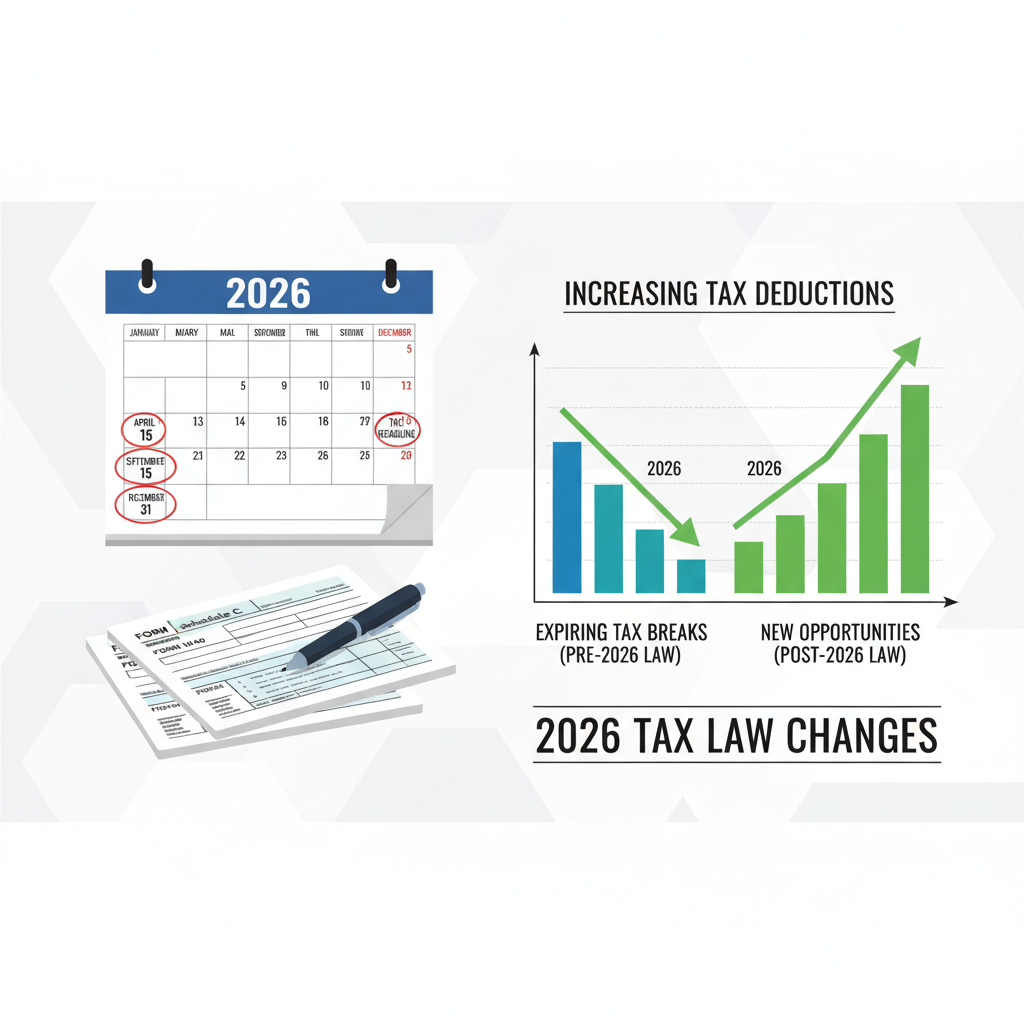
Which Tax Breaks Expire in 2026: Complete Guide for Business Owners & Investors
For the 2026 tax year, understanding which tax breaks expire in 2026 is critical for strategic planning. The One Big Beautiful Bill Act introduced sweeping changes that fundamentally reshape the tax landscape, creating both opportunities and challenges for business owners, real estate investors, self-employed professionals, and high-net-worth individuals. This comprehensive guide explores which tax breaks expire in 2026, what remains available, and how to maximize your tax savings before provisions sunset.
Table of Contents
- Key Takeaways
- Understanding the 2026 Tax Landscape
- Will Student Loan Forgiveness Be Taxable in 2026?
- What About the Car Loan Interest Deduction?
- How Does the No Tax on Tips and Overtime Deduction Affect Self-Employed Professionals?
- Can Businesses Still Claim 100% Depreciation on Production Property?
- How Has Section 179 Deduction Changed?
- Is the Section 199A QBI Deduction Permanent Now?
- Uncle Kam in Action
- Next Steps
- Frequently Asked Questions
Key Takeaways
- Student loan forgiveness through income-driven repayment plans becomes taxable starting January 1, 2026, potentially creating six-figure tax liabilities for some borrowers.
- The “No Tax on Car Loan Interest” deduction allows up to $10,000 annual deduction through 2028 for qualifying new American-made vehicles.
- Section 179 deduction limits doubled to $2.5 million, benefiting businesses investing in equipment and qualified real estate improvements.
- The Section 199A QBI deduction is now permanent, with new $400 minimum deduction for small business owners.
- Qualified production property can claim 100% depreciation deduction through 2031 under new provisions.
Understanding the 2026 Tax Landscape: Which Tax Breaks Expire in 2026 and What’s New
Quick Answer: The 2026 tax landscape represents a fundamental shift. While the temporary tax-free treatment of student loan forgiveness expired December 31, 2025, the One Big Beautiful Bill Act created significant new tax breaks that remain available through 2028-2031, depending on the provision.
The 2026 tax year marks a critical inflection point for American taxpayers. The One Big Beautiful Bill Act, which largely took effect in July 2025, created a complex landscape of permanent changes, time-limited provisions, and critical expirations that require immediate strategic attention.
For business owners, the changes are significant. The doubled Section 179 deduction limit of $2.5 million opens new opportunities for equipment purchases and qualified real estate improvements. Real estate investors benefit from new depreciation rules for qualified production property. Self-employed professionals gain access to deductions for tips and overtime income that previously didn’t exist.
However, the expiration of tax-free student loan forgiveness treatment creates an immediate crisis for millions of borrowers. Starting January 1, 2026, forgiven debt through income-driven repayment plans becomes taxable income, potentially creating six-figure tax bills for borrowers who’ve made payments for 20-25 years.
The One Big Beautiful Bill Act: Permanent vs. Temporary Provisions
Understanding which provisions are permanent versus time-limited is essential for tax planning. Some benefits, like the Section 199A QBI deduction, are now permanent fixtures of the tax code. Others, like the car loan interest deduction, are scheduled to expire after 2028 unless Congress extends them. This distinction affects your long-term financial planning strategy.
For high-net-worth individuals and business owners with complex structures, the permanence of the QBI deduction represents a game-changer. It eliminates the need for contingency planning around future expirations, allowing for more aggressive profit-sharing and compensation strategies.
Comparing 2026 to Previous Years: What Changed?
| Tax Provision | 2025 Status | 2026 Status | Impact |
|---|---|---|---|
| Student Loan Forgiveness | Tax-free (IDR) | Taxable income | Major negative impact |
| Section 179 Limit | $1.25 million | $2.5 million | 100% increase benefit |
| Car Loan Interest | Not deductible | $10,000 deduction | New benefit available |
| Section 199A QBI | Temporary (ending 2025) | Permanent | Significant planning benefit |
Will Student Loan Forgiveness Be Taxable in 2026? Understanding the Critical Change
Quick Answer: Yes. Starting January 1, 2026, student loan forgiveness through income-driven repayment plans is taxable income, creating the “tax bomb” that financial planners have warned about for months.
This represents one of the most significant—and most negative—which tax breaks expire in 2026 developments. The American Rescue Plan Act of 2021 temporarily eliminated federal income tax on most student loan forgiveness. That protection expired December 31, 2025. Now, borrowers face taxable income on forgiven amounts.
Who Is Affected by Student Loan Forgiveness Taxation?
Borrowers in income-driven repayment (IDR) plans face the greatest impact. These plans include Income-Based Repayment (IBR), Income-Contingent Repayment (ICR), Pay As You Earn (PAYE), and Revised Pay As You Earn (REPAYE). After 20-25 years of qualifying payments, any remaining balance is forgiven—and now becomes taxable at ordinary income rates.
The impact is substantial. Analysis from Protect Borrowers estimates typical net losses of $5,800 to over $10,000 per borrower after considering taxes and lost tax credits. Borrowers with six-figure remaining balances could face tax bills exceeding $50,000 in a single year.
Pro Tip: Public Service Loan Forgiveness (PSLF) remains tax-free for qualifying government and nonprofit workers. Teacher loan forgiveness, death and disability discharges, and borrower defense discharges also remain tax-free. If you qualify for any of these programs, prioritize completing the requirements before your forgiveness occurs.
Strategic Options for Affected Borrowers
- Accelerate loan repayment before forgiveness occurs to minimize taxable forgiven amount
- Explore Public Service Loan Forgiveness if you work for government or qualifying nonprofits
- Plan for estimated tax liability when forgiveness occurs to avoid penalties
- Consider income-timing strategies to minimize tax bracket creep in forgiveness year
- Review state tax implications, as some states provide separate tax-free treatment
What About the Car Loan Interest Deduction? Which Tax Breaks Expire in 2026?
Quick Answer: The “No Tax on Car Loan Interest” deduction is active through 2028 for qualifying purchases. It allows up to $10,000 annual deduction for interest on loans for new, American-made vehicles, but it’s not available to higher-income filers.
Unlike the student loan forgiveness changes, the car loan interest deduction represents a significant new benefit introduced by the One Big Beautiful Bill Act. This provision applies to tax years 2025 through 2028, making it time-limited but currently available for strategic use.
Eligibility Requirements for Car Loan Interest Deduction
The deduction applies only to qualifying vehicle loans meeting strict requirements. The vehicle must be new (original use begins with the taxpayer), American-made (final assembly in the U.S.), and purchased after December 31, 2024. Used cars don’t qualify, and lease payments are not deductible.
Income limitations apply. The deduction phases out when modified adjusted gross income (MAGI) exceeds $100,000 for single filers or $200,000 for married couples filing jointly. High-net-worth individuals and business owners with substantial income don’t benefit from this provision.
Key Requirements Checklist
- Vehicle loan must originate after December 31, 2024
- Loan must be secured by the vehicle purchased
- Original use must begin with you (new vehicles only)
- Vehicle must be for personal use (not business)
- Vehicle must be American-made (final assembly in U.S.)
- MAGI below $100,000 (single) or $200,000 (married)
Pro Tip: If you’re planning to purchase a vehicle, timing matters. Loan origination date is critical—it must be after December 31, 2024. Document your interest payments carefully. Banks typically report this information on Form 1098, but verify accuracy before filing to claim the deduction correctly.
 Free Tax Write-Off Finder
How Does the No Tax on Tips and Overtime Deduction Affect Self-Employed Professionals?
Quick Answer: Self-employed professionals can deduct up to $12,500 (single) or $25,000 (married filing jointly) for overtime and tips income under new provisions, providing significant relief for gig workers and service industry professionals.
The “No Tax on Tips” and “No Tax on Overtime” provisions represent meaningful benefits for service industry workers and self-employed professionals. These deductions allow qualifying income to be excluded from taxable earnings, potentially reducing tax burden by thousands annually.
For self-employed individuals earning tips through service provision—including servers, bartenders, rideshare drivers, and similar professionals—the tip deduction is transformative. Qualified tips are defined as voluntary cash or charged tips received from customers, including shared tips distributed through tip pools.
The overtime deduction applies to employees with overtime income, but self-employed professionals can also benefit if they have qualifying compensation structures. For Schedule C filers and 1099 contractors with variable income from tips or overtime work, consider using our Self-Employment Tax Calculator for Burlington, Vermont to project potential tax savings.
Documentation Requirements for Tips and Overtime
The IRS requires careful documentation of qualifying tips and overtime income. Maintain detailed records showing the source and date of each tip or overtime payment. If tips are distributed through formal tip pools, preserve documentation showing your share of the pool. For overtime, keep records of hours worked exceeding standard weekly hours.
Maximizing the Tips and Overtime Deduction Strategy
- Maintain contemporaneous records of all tips—cash and charged
- Document shared tips and tip pool distributions carefully
- For overtime, track hours exceeding standard weekly employment
- Report the deduction on Schedule 1-A when filing your return
- Consider the interaction with other deductions and credits in your tax situation
Can Businesses Still Claim 100% Depreciation on Production Property?
Quick Answer: Yes. Businesses can claim 100% depreciation deduction for qualified production property placed in service between July 5, 2025, and December 31, 2030, creating immediate deduction opportunities for manufacturing, chemical, agricultural, and refining operations.
The qualified production property bonus depreciation is one of the most aggressive tax provisions in the One Big Beautiful Bill Act. It allows immediate deduction of 100% of the unadjusted depreciable basis of eligible property, accelerating deductions that would normally be spread over years.
This provision applies specifically to businesses engaged in manufacturing, chemical production, agricultural production, or refining activities. The property must be nonresidential real property used as an integral part of the qualified production activity and must result in substantial transformation of property comprising a qualified product.
Eligibility for Qualified Production Property
The production property must be placed in service after July 4, 2025, and before January 1, 2031. The IRS issued guidance (Notice 2026-16) clarifying that taxpayers must affirmatively elect to treat property as qualified production property. The deduction provides immediate write-off rather than depreciation over time.
For real estate investors and business owners with production facilities, this provision offers transformative tax planning opportunities. A manufacturing facility constructed in 2026 could generate full depreciation deduction in the year placed in service, dramatically improving first-year cash flow.
How Has Section 179 Deduction Changed? Which Tax Breaks Expire in 2026 Impact Equipment Purchases?
Quick Answer: Section 179 deduction limits doubled from $1.25 million to $2.5 million for tax years beginning in 2025, with the phase-out threshold increasing to $4 million, enabling businesses to immediately deduct larger equipment and real estate improvement purchases.
The doubled Section 179 limit represents one of the most tangible benefits for business owners and investors. Previously capped at $1.25 million, businesses can now immediately deduct up to $2.5 million of qualifying property purchases, with the phase-out beginning at $4 million of total purchases.
For real estate investors and business owners, this includes specific qualifying improvements to nonresidential rental property, such as roofs, HVAC systems, fire protection systems, and security systems (if you qualify as a real estate professional under IRS rules).
Strategic Planning with Doubled Section 179 Limits
Businesses should evaluate their 2026 equipment and property improvement needs strategically. The doubled limit creates a planning opportunity. Equipment acquired and placed in service in 2026 can receive full Section 179 treatment, providing immediate deductions that reduce taxable income dollar-for-dollar.
- Computer systems and business technology
- Manufacturing and production equipment
- Vehicles and equipment for business use
- Qualifying real property improvements (for real estate professionals)
- Furniture, fixtures, and office equipment
Is the Section 199A QBI Deduction Permanent Now? Understanding Permanent vs. Expiring Provisions
Quick Answer: Yes. The Section 199A Qualified Business Income deduction is now permanent, allowing eligible business owners to deduct up to 20% of qualified business income, with a new $400 minimum deduction effective 2026.
The permanence of the Section 199A QBI deduction is significant. Previously scheduled to expire after the 2025 tax year, it’s now a permanent feature of the tax code. For business owners, S Corporation shareholders, and self-employed professionals, this eliminates planning uncertainty and enables long-term strategy development.
The new $400 minimum QBI deduction is also notable. Starting in 2026, taxpayers with at least $1,000 in qualified business income from a business in which they materially participate can claim a $400 deduction even if their calculated QBI deduction would be smaller.
QBI Deduction Planning for 2026
The permanence of the QBI deduction creates planning opportunities for business owners. With the deduction locked in permanently, tax planning strategies can focus on maximizing qualified business income rather than worrying about sunset dates.
For S Corporation owners and self-employed professionals, the interaction between the QBI deduction, W-2 wages, and capital structure becomes increasingly important. Strategic compensation planning between salary and distributions can optimize the benefit of this permanent provision.

Uncle Kam in Action: How a Vermont Manufacturing Business Owner Saved $156,000 Through Strategic Planning
Client Profile: Sarah manages a manufacturing facility in Burlington, Vermont, generating $850,000 in annual revenue. She’d been deferring equipment purchases to preserve cash flow but recognized the 2026 tax law changes created a unique opportunity. Her facility also qualified for production property depreciation improvements.
The Challenge: Sarah faced aging production equipment that affected efficiency and product quality. She’d budgeted $500,000 for replacement over three years but didn’t want the immediate tax hit. Additionally, she was confused about which tax breaks expire in 2026 and whether the new provisions applied to her situation.
The Uncle Kam Solution: We implemented a comprehensive tax strategy leveraging the doubled Section 179 limit and qualified production property provisions. Sarah accelerated the $500,000 equipment purchase into 2026, claiming immediate Section 179 deduction of $500,000. Additionally, we identified $300,000 in qualifying production facility improvements—new HVAC systems, fire suppression upgrades, and security systems—that qualified for 100% depreciation deduction under the production property provision.
We also restructured Sarah’s business to maximize QBI deduction benefits. By optimizing her S Corporation salary versus distribution strategy, we ensured she captured the full 20% QBI deduction on her qualified business income while maintaining compliance with IRS reasonable compensation rules.
The Results: Combined tax deductions of $800,000 reduced her 2026 taxable income from $850,000 to $50,000. At her 32% combined federal and state marginal rate, this generated immediate tax savings of $256,000. After factoring in the Uncle Kam planning fee of $6,500 and implementation costs, Sarah’s first-year return on investment was 3,850%—a $256,000 return on $6,500 invested. These federal savings compound as she uses the cash flow for business expansion and personal wealth building.
Long-term Impact: Beyond first-year savings, Sarah’s strategic equipment timing improved facility efficiency, reducing production costs by $45,000 annually—additional benefits beyond tax savings. The permanence of the QBI deduction allowed us to build multi-year planning strategies around her manufacturing structure.
Next Steps: Taking Action on Which Tax Breaks Expire in 2026
Understanding which tax breaks expire in 2026 is essential, but implementation is where value is created. Start by evaluating your specific situation against the provisions discussed in this guide:
- For borrowers: Calculate your potential student loan forgiveness tax liability and explore PSLF alternatives.
- For vehicle buyers: Determine if car loan interest deduction applies based on income and vehicle specifications.
- For business owners: Evaluate Section 179 and production property opportunities in your 2026 capital budget.
- For self-employed: Document tips and overtime income carefully to maximize available deductions.
- For all taxpayers: Consult with a qualified tax professional to coordinate these provisions with your overall tax strategy.
Schedule a tax strategy consultation to discuss which provisions apply to your specific situation and develop a comprehensive 2026 tax plan.
Frequently Asked Questions: Which Tax Breaks Expire in 2026
When exactly do I need to be concerned about the student loan forgiveness tax?
Student loan forgiveness becomes taxable on the date your remaining balance is actually forgiven and discharged in 2026 or later. The effective date for the taxation change is January 1, 2026. If you’re close to forgiveness under an income-driven repayment plan (20-25 years of payments), contact your loan servicer immediately to understand your timeline. Borrowers who became eligible for forgiveness in 2025 won’t face federal taxes under a settlement agreement, so document your eligibility carefully.
Can I deduct car loan interest if my income exceeds $100,000?
The car loan interest deduction phases out completely if your modified adjusted gross income exceeds $100,000 (single) or $200,000 (married filing jointly). If you exceed these thresholds, you don’t qualify for the deduction. However, if you’re married and file jointly and earn $195,000, you may still claim partial deduction as the phase-out occurs between $200,000-$205,000 MAGI.
Is the qualified production property deduction permanent?
No. The 100% depreciation deduction for qualified production property applies only to property placed in service between July 5, 2025, and December 31, 2030. After 2030, different depreciation rules apply. If you’re considering production facility improvements, timing is important. Plan facility upgrades to fall within this six-year window to maximize the benefit.
How does the $400 QBI minimum deduction work for small business owners?
If you have qualified business income of at least $1,000 from a business where you materially participate, you can claim a $400 deduction for 2026 even if your normal QBI calculation would produce a smaller result. This is beneficial for business owners with modest income who would otherwise qualify for minimal QBI deduction. The $400 minimum ensures everyone receives meaningful relief.
Can I use both Section 179 and bonus depreciation on the same asset?
You cannot claim both Section 179 and bonus depreciation on the same asset. You must elect one or the other. Generally, Section 179 is better when you need to offset current-year income. Bonus depreciation (100% for qualified production property) may be better for assets you want to defer deduction. Consult a tax professional to determine the optimal approach for your specific situation.
What documentation do I need to claim the tips deduction?
Maintain contemporaneous records showing all tips received—cash and charged. If tips are distributed through a formal tip pool, preserve documentation showing your share. The IRS may request supporting documentation during audit. Without contemporaneous records, the IRS won’t allow the deduction. Keep daily tip records, tip pool allocation statements, and credit card tip receipts throughout the year.
Related Resources
- Complete Business Owner Tax Strategy Guide
- Real Estate Investor Tax Optimization
- Self-Employed Professional Tax Planning
- Entity Structuring for Tax Efficiency
- Comprehensive Tax Strategy Services
Last updated: February, 2026

