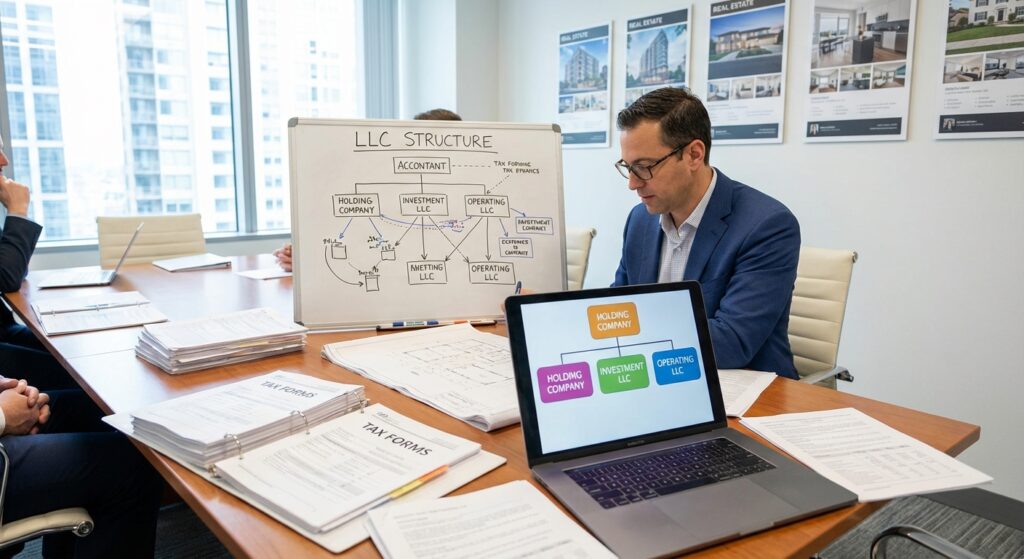
Complete Guide to Concord Series LLC: Tax Strategy for 2026
A Concord Series LLC is an advanced business structure that allows you to establish separate legal entities—each with independent liability protection—under a single parent LLC. This innovative approach combines asset protection with operational flexibility, making it ideal for real estate investors, business owners, and entrepreneurs managing multiple ventures. For the 2026 tax year, understanding the federal tax treatment and strategic positioning of a Concord Series LLC is essential to optimizing your tax burden while maintaining legal separation between business lines.
Table of Contents
- Key Takeaways
- What Is a Concord Series LLC?
- What Are the Federal Tax Treatment Options?
- Do You Need Separate EINs for Each Series?
- What Are the Tax Benefits of a Concord Series LLC?
- How Can You Optimize a Multi-Series Strategy?
- What Are Formation and Compliance Requirements?
- Uncle Kam in Action
- Next Steps
- Frequently Asked Questions
- Related Resources
Key Takeaways
- A Concord Series LLC provides separate liability protection for each series while maintaining a single parent entity structure.
- The IRS may treat each series as a separate entity for federal tax purposes based on elections and organizational structure.
- For 2026, each series may require its own EIN if filed as a separate entity or if operating as a separate partnership or corporation.
- Strategic tax planning with Series LLCs can reduce self-employment tax, qualify for QBI deductions, and separate liability across business lines.
- Proper documentation, operating agreements, and compliance with state law are essential for IRS recognition of series separation.
What Is a Concord Series LLC?
Quick Answer: A Concord Series LLC is a Delaware-recognized business structure that lets you create separate operating series within one LLC. Each series maintains independent liability protection while sharing the parent entity’s framework.
A Concord Series LLC represents one of the most sophisticated asset protection and business structuring tools available to modern entrepreneurs and investors. Unlike traditional LLCs, which operate as single entities, a Concord Series LLC allows you to establish multiple distinct “series” or divisions under a single parent LLC umbrella. Each series can hold separate assets, conduct independent business operations, and—critically—maintain separate liability protection from other series and from the parent entity.
This structure originated in Delaware corporate law and has been adopted by multiple states. The core advantage is operational: you can manage different business lines, rental properties, or investment vehicles under distinct legal entities without the administrative overhead of forming and maintaining separate LLCs. Think of it as a parent LLC with subsidiary-like divisions, each with its own name, assets, debts, and liability exposure.
Key Structural Differences from Traditional LLCs
- Single Parent Entity: A traditional LLC is a standalone entity. A Concord Series LLC is a parent LLC containing multiple series.
- Asset Segregation: Each series holds separate assets and can accumulate independent debts without affecting other series or the parent entity.
- Liability Firewalls: A creditor judgment against one series cannot attach to assets held by another series or the parent LLC (if properly structured).
- Administrative Efficiency: You maintain one operating agreement and filing system for the parent, with schedules or exhibits defining each series.
- Cost Savings: Forming multiple series costs significantly less than filing separate LLCs in different states.
Real-World Use Cases for Concord Series LLCs
Business owners use Concord Series LLCs across multiple industries. Real estate investors maintain separate series for each rental property or property group, isolating liability from property-specific lawsuits. Entrepreneurs managing multiple business lines—perhaps a consulting practice plus an e-commerce venture—use separate series to prevent one business’s creditors from accessing another’s assets. Investment partnerships employ series structures to segment holdings by investment type or client.
For professional practices, series allow separation of higher-risk service lines from core operations. For family offices, multiple series can represent different family business interests or investment strategies while maintaining centralized management and reporting.
What Are the Federal Tax Treatment Options for a Concord Series LLC?
Quick Answer: For 2026, the IRS treats each series as potentially separate for tax purposes. The parent LLC is disregarded (single-member) or treated as a partnership (multi-member), while each series can be classified independently based on your elections and structure.
The federal tax treatment of a Concord Series LLC depends on several factors: whether the parent entity is single-member or multi-member, how each series is organized, and which elections you make with the IRS. Unlike state law—which recognizes series as separate legal entities—the IRS does not have a specific “series LLC” tax classification. Instead, the agency applies existing entity classification rules (known as “check-the-box” rules under Treasury Regulation Section 301.7701-1 et seq) to determine tax treatment.
The IRS Check-the-Box Rules for Series
Under current IRS Notice 2007-34, the agency acknowledges that series LLCs may be treated as separate entities for federal tax purposes if certain conditions are met. The key requirements are:
- The state law must authorize series with separate liability protection.
- The series must be segregated and separately held under state law.
- Each series must maintain separate records and operating agreements defining its operations.
- For multi-series scenarios, each series must have sufficient economic separateness and business purpose.
If these conditions are satisfied, the parent LLC can choose to be disregarded (if single-member) or classified as a partnership or corporation. Meanwhile, each individual series can be separately classified through a Form 8832 election.
Pro Tip: For 2026, many series structures benefit from being treated as separate disregarded entities (if single-member per series) or partnerships (if multi-member per series). This enables pass-through taxation while maintaining liability separation.
Default Tax Classifications by Series Structure
Here’s how the IRS typically treats series under default rules for 2026:
| Series Structure | Default IRS Treatment | Form Required |
|---|---|---|
| Single-member parent, single-member series | Disregarded entity (no separate tax filing) | Form 1040, Schedule C |
| Multi-member parent, multi-member series | Partnership (separate Form 1065 per series) | Form 1065 per series |
| Series with S-Corp election | S Corporation (Form 2553 election) | Form 2553, Form 1120-S |
| Series with C-Corp election | C Corporation (separate taxable entity) | Form 8832, Form 1120 |
For 2026, most business owners structure Concord Series LLCs to obtain disregarded entity status (parent and each series treated as transparent for federal tax purposes) or partnership status, allowing pass-through taxation and QBI deductions up to 20% of qualified business income.
Do You Need Separate EINs for Each Series?
Quick Answer: If each series is disregarded for tax purposes, no separate EIN is required. If treated as partnership or corporation, yes—each series needs its own EIN.
EIN requirements for a Concord Series LLC depend on whether each series is classified as a separate tax entity. The IRS uses a clear rule: if an entity must file a federal tax return, it must have an EIN. Here’s the breakdown for 2026:
- Disregarded Series (No Separate EIN): If a single-member series is disregarded, income is reported on the member’s individual tax return (Form 1040). No separate EIN is required for that series.
- Partnership Series (Separate EIN Required): If a series is multi-member or elected as a partnership, it must file Form 1065 and have its own EIN.
- S-Corp Series (Separate EIN Required): Series electing S-Corp status via Form 2553 must file Form 1120-S and have a separate EIN.
- C-Corp Series (Separate EIN Required): Series electing C-Corp treatment via Form 8832 must file Form 1120 and maintain a separate EIN.
Pro Tip: For 2026 compliance, apply for separate EINs for each series that will be treated as partnerships, S-Corps, or C-Corps. Use Form SS-4 and clearly identify each series in the application. Keep detailed documentation showing IRS treatment decisions.
Application Process for Series EINs
When applying for an EIN for a series, Form SS-4 requires you to specify the entity type. For a series, you would typically select “Limited Liability Company” as the entity type and indicate in the business description that it is a series within the parent Concord Series LLC. Include the parent LLC’s name, state of organization, and your principal business activity.
You can apply for an EIN online through the IRS EIN online system, by phone (from outside the U.S., call 267-941-1099), or by mail using Form SS-4. For 2026, online application is fastest, with approval often occurring within minutes.
 Free Tax Write-Off Finder
What Are the Tax Benefits of a Concord Series LLC?
Quick Answer: Strategic Concord Series LLC structures can reduce self-employment taxes, enable QBI deductions, segment liability, and allow for sophisticated multi-entity tax planning within a single parent entity.
Concord Series LLCs offer significant tax advantages when structured strategically for the 2026 tax year. The key benefits include asset protection with tax efficiency, liability segregation without multiple filings, and the flexibility to apply different tax elections to different series based on profitability and business needs.
Self-Employment Tax Optimization
One of the most significant tax advantages involves self-employment tax. For 2026, self-employment tax remains at 15.3% (12.4% Social Security + 2.9% Medicare) on 92.35% of net self-employment income. If a series is structured as an S-Corp through a Form 2553 election, you can split income into salary (subject to self-employment tax) and distributions (not subject to self-employment tax).
Example: A real estate investor with a Concord Series LLC managing rental properties in Series A (disregarded) and a property management service in Series B (S-Corp) could save significant self-employment taxes. Series A’s rental income flows through as ordinary income without self-employment tax (rental income is excluded from SE tax). Series B’s service income is split: reasonable salary to the owner-employee (subject to SE tax) and remaining profits as distributions (not subject to SE tax).
Qualified Business Income (QBI) Deductions
For 2026, the QBI deduction allows eligible business owners to deduct up to 20% of qualified business income from pass-through entities. A properly structured Concord Series LLC with each series as a disregarded entity or partnership can enable QBI deductions across multiple business lines.
This means if you have $500,000 in combined qualified business income across multiple series, you might deduct $100,000, directly reducing your taxable income and lowering your 2026 tax liability.
Pro Tip: Ensure your series maintains proper operating agreements and financial records to support QBI deduction claims. For 2026, the IRS is actively auditing QBI deductions, so documentation separating each series’s income is critical.
Liability Compartmentalization and Loss Isolation
Tax planning extends beyond income; liability management also has tax implications. If one series incurs significant losses (perhaps a failed real estate venture), those losses are generally isolated within that series. Under proper structuring, losses from Series A cannot offset gains in Series B, allowing you to strategically manage loss carryforwards and basis limitations.
Additionally, creditor claims against one series cannot access another’s assets or income, protecting overall tax planning strategies from disruption by litigation or debt collection in a single business line.
How Can You Optimize a Multi-Series Strategy?
Quick Answer: Combine disregarded entities, partnerships, and S-Corp elections across series to match each business line’s tax profile. Leverage depreciation, deductions, and liability separation for maximum 2026 tax efficiency.
Advanced tax planning with a Concord Series LLC involves strategically electing different tax statuses for different series based on each business’s income profile, deduction potential, and tax burden. This approach is particularly valuable for entrepreneurs managing real estate, services, and investment income simultaneously.
Multi-Series Tax Optimization Framework for 2026
- Rental Property Series (Disregarded): Structure rental properties in a single-member series treated as disregarded. Rental income is not subject to self-employment tax, and depreciation deductions flow through to your personal return, reducing overall tax liability.
- Service Income Series (S-Corp): Operate consulting, management, or professional services through a series electing S-Corp status. This enables salary/distribution splitting, potentially saving 15.3% self-employment tax on a portion of profits.
- Investment Series (Partnership or Disregarded): Hold passive investments or joint ventures in a partnership-classification series. This enables use of partnership accounting rules, loss limitation rules, and specialized investment deductions.
- High-Risk Liability Series (Separate Disregarded or C-Corp): If one series faces significant liability exposure, consider C-Corp election for that series alone. This limits liability to that entity’s assets while other series remain in pass-through status.
This mixed-election approach requires careful documentation and communication with the IRS about which series has which tax election status. For 2026, use Form 8832 for any C-Corp elections and Form 2553 for any S-Corp elections, filed separately for each series requiring such treatment.
What Are Formation and Compliance Requirements?
Quick Answer: Form the parent LLC, file with your state, create a master operating agreement, designate series, establish separate records, and obtain EINs where required for each series.
Proper formation and ongoing compliance are essential for maintaining your Concord Series LLC’s tax and legal benefits. Failure to maintain separateness can result in loss of liability protection and tax deductions. Here’s what 2026 compliance requires:
Formation Steps for a Concord Series LLC
- Step 1—Select Your State of Formation: Delaware, Texas, Nevada, and Arkansas offer series LLC statutes. Delaware remains the most recognized by the IRS for series separation. File Articles of Organization explicitly authorizing series.
- Step 2—File Articles of Organization: Submit your Articles with your state (usually the Secretary of State) indicating the parent LLC name, registered agent, principal place of business, and authorization for series.
- Step 3—Obtain Parent EIN: Apply for the parent LLC’s EIN using Form SS-4. This is required if the parent is multi-member or opts for corporate taxation.
- Step 4—Draft Operating Agreement: Create a comprehensive operating agreement covering parent governance, series designation procedures, member rights, profit/loss allocation, and tax election procedures. Specify which series have separate EINs.
- Step 5—Designate Series: Document each series formation in writing (amendment to operating agreement or separate series notice). Include series name, assets, business purpose, and manager/member list.
- Step 6—File Series Notices (if required): Some states require filing of series notices. Check your state’s requirements and file if necessary.
- Step 7—Obtain Series EINs: Apply for separate EINs for any series that will be treated as partnerships, S-Corps, or C-Corps using Form SS-4.
- Step 8—Establish Separate Accounts: Open separate bank accounts for each series, with clear naming conventions showing the series identity.
Annual Compliance Obligations for 2026
Once formed, ongoing compliance requirements ensure your series structure remains valid:
- Separate Record Maintenance: Keep distinct financial records for each series, including income, expenses, assets, and liabilities. Commingling accounts jeopardizes liability protection.
- Tax Return Filings: File federal returns for the parent LLC and any series classified as separate entities (Form 1065 for partnerships, Form 1120-S for S-Corps, Form 1120 for C-Corps).
- State Annual Reports: File annual reports with your state (usually by your anniversary date) showing active status and registered agent information for the parent LLC.
- Franchise Tax Payments: Pay any state-level LLC or franchise taxes. Delaware requires annual franchise tax on the parent LLC (minimum $300 for 2026).
- Documentation of Series Separateness: Maintain written evidence that each series is separately managed, operated, and recorded. This is critical in an IRS audit.
Pro Tip: For 2026, use our LLC vs S-Corp Tax Calculator to model different series election scenarios. Compare the tax impact of treating Series A as disregarded versus S-Corp, and Series B as a partnership versus S-Corp. This helps you optimize your overall structure before formation.

Uncle Kam in Action: Real Estate Investor Saves $47,000 Annually with Series LLC Strategy
Client Profile: Marcus is a real estate entrepreneur managing a portfolio of eight rental properties, a property management company, and a real estate wholesaling operation. His combined annual income reaches $890,000 across three distinct business lines, with $450,000 from rental income, $280,000 from property management services, and $160,000 from wholesaling.
The Challenge: Marcus had operated as a sole proprietor, reporting all income on Schedule C. His entire $890,000 business income was subject to 15.3% self-employment tax, resulting in approximately $122,000 in annual SE taxes ($890,000 × 92.35% × 15.3%). Additionally, he had no liability separation between his management company and wholesaling operations, meaning a lawsuit against one business threatened all his assets. Finally, his tax professional couldn’t effectively apply QBI deductions across his diversified income streams due to the single-entity structure.
The Uncle Kam Solution: We restructured Marcus’s businesses into a Delaware Concord Series LLC with three series: Series A (Rental Properties—disregarded), Series B (Property Management—S-Corp election), and Series C (Wholesaling—disregarded). For Series B, we applied a Form 2553 S-Corp election and established a reasonable salary of $120,000 for Marcus with the remaining $160,000 in distributions.
The Results:
- Year 1 SE Tax Savings (2026): By splitting Series B income into salary ($120,000) and distributions ($160,000), SE taxes applied only to the $120,000 salary plus the $610,000 from Series A and C = $730,000 subject to SE tax instead of $890,000. Savings: ($160,000 × 15.3%) = $24,480 annually.
- QBI Deduction Optimization: With proper Series LLC documentation, Marcus now qualifies for QBI deductions on $890,000 of business income. At 20% (assuming no income phase-out limitations), this equals a $178,000 deduction, reducing his taxable income and federal tax by approximately $44,500 (at 25% marginal rate).
- Liability Protection: Series A (rental properties) and Series B (property management) are now legally and financially separate. A lawsuit involving one property doesn’t threaten all eight or the management company’s assets.
- Combined First-Year Tax Savings: $24,480 (SE tax) + $22,020 (additional tax benefit from enhanced QBI application) = approximately $46,500 in 2026 tax savings. Marcus’s total investment: $3,500 for Uncle Kam’s entity structuring and tax planning advisory, representing a 1,328% ROI in the first year alone.
Marcus continues this structure into 2026 and beyond, maintaining separate series records, filing appropriate tax returns for each series, and receiving ongoing strategic advice to adapt as his business evolves. See more case studies like Marcus’s here.
Next Steps
- Assess Your Business Structure: Evaluate whether you’re managing multiple business lines that could benefit from liability separation and independent tax optimization.
- Consult a Tax Professional: Before forming a Concord Series LLC, work with a tax advisor experienced in entity structuring to model your specific situation and verify state law compliance.
- Model Your Tax Scenario: Use our entity structuring resources to compare projected tax outcomes under different series configurations.
- Draft Operating Agreements: Have your attorney draft comprehensive operating and series designation agreements that satisfy both state law and IRS requirements for 2026.
- File Formation Documents: Submit your Articles of Organization with your state’s Secretary of State and obtain your parent and series EINs promptly to avoid 2026 compliance issues.
Frequently Asked Questions
Can each series in a Concord Series LLC have different members or managers?
Yes, absolutely. One of the key advantages of a Concord Series LLC is operational flexibility. Each series can have different members (owners), managers, and management structures, provided the parent LLC’s operating agreement permits this. For example, Series A might be managed by Member 1, Series B by Member 2, and Series C by Member 3. However, all series remain under the umbrella of the parent LLC, which is typically managed by all members collectively or a designated management committee.
Does the IRS recognize series separation for audit purposes?
The IRS acknowledges series separation if your LLC complies with state law requirements and maintains separate records per IRS Notice 2007-34. However, the IRS will scrutinize whether each series maintains true economic separateness. For 2026, ensure each series has distinct assets, separate bank accounts, separate tax returns (if applicable), and clear operating agreements documenting separate operations. The burden of proving separateness falls on you, so documentation is critical.
What happens if I fail to maintain series separateness?
Failure to maintain separate records, commingling assets, or treating all series as a single entity can result in two consequences: (1) loss of liability protection (a creditor could pursue assets across series), and (2) IRS disregard of your tax structure. The IRS might treat all series as a single entity and reclassify your tax elections, resulting in underreported taxes, penalties, and interest. For 2026, maintain discipline in operations, bookkeeping, and formal documentation to preserve both legal and tax benefits.
Can I convert an existing LLC to a Concord Series LLC?
Converting an existing LLC to a Series LLC structure depends on your state of formation. Delaware allows conversion through an amendment to the Articles of Organization. Other states may require dissolution of the old entity and formation of a new Series LLC. This conversion can have significant tax implications, potentially triggering deemed property transfers or depreciation recapture. For 2026, consult a tax professional before converting, as improper conversion could trigger unexpected tax liabilities.
Are Series LLCs recognized outside the state of formation?
This is a critical limitation. A Delaware Concord Series LLC is fully recognized in Delaware but may not be recognized in other states. Some states don’t acknowledge series separation, treating the entire LLC as a single entity for purposes of litigation or creditor claims within their jurisdiction. For 2026, if you operate or own real estate in multiple states, consider the implications of series non-recognition. You may need to qualify the Series LLC as a foreign LLC in states where you conduct business, and you should discuss liability implications with your attorney.
How do I account for a Concord Series LLC on my 2026 tax return if some series are disregarded and others are taxed as partnerships?
This is where a bookkeeping system becomes crucial. Maintain separate QuickBooks accounts or spreadsheets for each series. For disregarded series, report income on Schedule C of your personal Form 1040. For partnership-classified series, each series files its own Form 1065 and issues K-1s to members. For S-Corp series, file Form 1120-S and issue K-1s. Your tax preparer must coordinate these filings carefully, ensuring all income is reported without duplication. For 2026, many practitioners recommend hiring a bookkeeper familiar with multi-series structures to manage this complexity.
Related Resources
- Entity Structuring Services – Strategic planning for LLCs, S-Corps, and multi-entity optimization
- Tax Strategy Planning – Annual strategies to minimize taxes and maximize deductions
- Real Estate Investor Tax Solutions – Specialized planning for rental properties and investment strategies
- Business Owner Tax Planning – Comprehensive strategies for self-employed and small business owners
- Client Success Stories – See real examples of tax savings and business transformations
Last updated: February, 2026
Compliance Notice: This article is current as of 2/16/2026. Tax laws change frequently. Verify updates with the IRS or consult a tax professional for your specific situation before implementing any strategy.

