
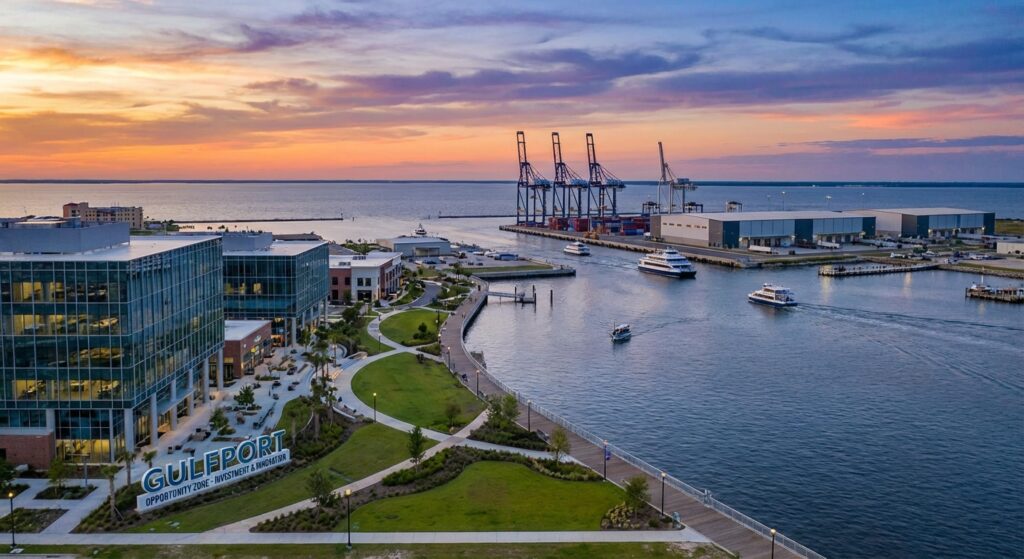
GulfPort Opportunity Zone Tax Deferral: 2026 Investor’s Complete Guide
For 2026, the gulfport opportunity zone tax deferral offers investors a powerful strategy to defer capital gains taxes while building long-term wealth in designated community development zones. As Mississippi’s primary opportunity zone hub, GulfPort presents unique advantages for real estate investors, business owners, and high-net-worth individuals seeking to reinvest gains with significant tax benefits. This comprehensive guide explains how to leverage these incentives before critical 2026 deadlines pass.
Table of Contents
- Key Takeaways
- What Is the GulfPort Opportunity Zone?
- What Are the Tax Benefits of GulfPort Opportunity Zone Investment?
- Who Is Eligible for GulfPort Opportunity Zone Tax Deferral?
- How Do You Execute GulfPort Opportunity Zone Investments?
- What Are the Required Holding Periods for GulfPort Zone Investments?
- What Are the Critical 2026 Deadlines for GulfPort Opportunity Zone Investments?
- Uncle Kam in Action
- Next Steps
- Frequently Asked Questions
Key Takeaways
- GulfPort opportunity zone investments defer capital gains taxes, allowing tax-free growth for specified periods in 2026.
- Qualified investors gain step-up in basis after holding periods (1, 7, and 10 years), potentially eliminating all federal capital gains tax.
- The 180-day reinvestment window is critical; gains must be reinvested within this period to qualify for deferral status.
- Real estate, business property, and qualified opportunity funds (QOFs) are eligible investment vehicles for 2026.
- No income limits apply; high-net-worth investors and business owners benefit equally from GulfPort zone tax incentives.
What Is the GulfPort Opportunity Zone?
Quick Answer: GulfPort’s opportunity zone is a federally designated community development area offering tax incentives for capital gains reinvestment, with enhanced benefits for long-term investors.
The GulfPort opportunity zone represents a strategic investment area within Harrison County, Mississippi, designated under the Tax Cuts and Jobs Act of 2017. This federal program creates incentives for private investment in economically distressed communities by allowing investors to defer, reduce, or potentially eliminate capital gains taxes through qualified investments. For 2026, GulfPort has emerged as one of the most attractive opportunity zones in the Gulf Coast region, driven by industrial growth and real estate development expansion.
How GulfPort Zone Status Benefits Community Development
The GulfPort opportunity zone designation creates a symbiotic relationship between investor tax incentives and community economic growth. When you invest in GulfPort through qualified opportunity funds or direct real estate purchases, your capital directly funds local projects: manufacturing facilities, residential developments, infrastructure improvements, and small business expansion. In 2026, GulfPort’s industrial sector experienced a 22% project growth increase compared to the previous year, demonstrating that tax incentive-driven investment translates to measurable economic activity and job creation.
Current GulfPort Zone Investment Activity for 2026
As of 2026, GulfPort opportunity zone investments span multiple sectors: maritime logistics, advanced manufacturing, real estate development, and hospitality. The zone encompasses specific census tracts within Harrison County, with particular concentration in downtown GulfPort and surrounding industrial parks. For investors evaluating GulfPort opportunity zone tax deferral opportunities, understanding the current investment landscape matters—active project pipelines signal lower risk and more predictable returns compared to zones with minimal activity.
More information about opportunity zone designations and current projects is available through the IRS opportunity zones FAQ page, which provides comprehensive guidance on eligibility and compliance requirements for 2026.
What Are the Tax Benefits of GulfPort Opportunity Zone Investment?
Quick Answer: GulfPort opportunity zone investors defer capital gains taxes, receive step-up in basis for long-term holdings, and potentially exclude all gains from federal taxation if held 10+ years.
The GulfPort opportunity zone tax deferral framework operates through three distinct mechanisms: tax deferral, basis step-up, and potential gain exclusion. These stacked incentives create extraordinary wealth-building potential when structured correctly for 2026 investments. Understanding each component helps investors maximize after-tax returns on reinvested capital gains.
Tax Deferral: The Immediate Benefit
When you reinvest capital gains into GulfPort opportunity zone qualified opportunity funds or eligible properties within 180 days of the gain realization, you defer federal capital gains tax on that entire amount. This deferral continues until December 31, 2026 (for gains recognized in 2025), or the end of the year you realize the gain if later. This isn’t a permanent tax break—you’ll eventually owe tax on the original gain amount—but the deferral shifts your tax liability forward, allowing your reinvested capital to compound tax-free in the interim.
Consider this scenario: You sell an investment property in 2025, realizing $500,000 in capital gains. Instead of paying federal capital gains tax immediately (approximately $100,000-$150,000 depending on your bracket), you reinvest that full $500,000 into a GulfPort opportunity zone investment by mid-2025. That $500,000 grows tax-free through 2026 and beyond, deferring your tax bill for years. This creates significant cash flow advantages for reinvestment.
Basis Step-Up: The Long-Term Advantage
Beyond tax deferral, GulfPort opportunity zone investors receive a permanent reduction in the deferred gain amount after specified holding periods. This “basis step-up” mechanism works as follows:
- 1-Year Holding Period: Your deferred gain basis increases by 15%, permanently reducing the amount you’ll pay tax on. For a $500,000 gain, this saves $15,000-$22,500 in federal taxes.
- 7-Year Holding Period: Your deferred gain basis increases by an additional amount, further reducing taxable gain (cumulative benefit reaches deeper discounts).
- 10-Year Holding Period: Your entire deferred gain basis steps up to fair market value as of December 31 of the year of the 10-year anniversary, potentially eliminating all federal capital gains tax on the original deferred gains.
Pro Tip: For 2026 investments, the 10-year timeline extends through 2036. Lock in investments early in 2026 to maximize your time window for full basis step-up eligibility.
Comparative Tax Scenarios for GulfPort Opportunity Zone Investments
| Scenario | Capital Gain Amount | Federal Tax (20% rate) | After Opportunity Zone | Tax Savings (10-year) |
|---|---|---|---|---|
| No deferral (immediate tax) | $500,000 | $100,000 | $100,000 owed immediately | $0 savings |
| GulfPort OZ with 10-year hold | $500,000 | $100,000 | $0 on deferred gains (after 10 years) | $100,000 |
Who Is Eligible for GulfPort Opportunity Zone Tax Deferral?
Quick Answer: Any individual, business, or entity with capital gains can invest in GulfPort opportunity zones; no income limits, net worth minimums, or prior investment experience required for eligibility.
Eligibility for GulfPort opportunity zone tax deferral is remarkably inclusive. Unlike many tax incentive programs that restrict participation based on income thresholds or investor sophistication, opportunity zone rules focus on what you’re investing in—not who you are. This accessibility makes the gulfport opportunity zone tax deferral strategy available to business owners, real estate investors, high-net-worth individuals, and even first-time opportunity zone investors.
Who Qualifies: Investor Categories
- Real Estate Investors: Anyone selling investment properties, vacation homes, or land can reinvest capital gains into GulfPort zone real estate opportunities.
- Business Owners: Entrepreneurs selling businesses, business units, or trade assets qualify for GulfPort opportunity zone deferral on realized gains.
- High-Net-Worth Individuals: Those with substantial investment portfolios can defer gains across multiple GulfPort zone investments simultaneously.
- Self-Employed & 1099 Professionals: Independent contractors and solo practitioners who sell business interests can access GulfPort opportunity zone benefits for reinvested gains.
- Entities: Partnerships, S-corporations, C-corporations, and LLCs investing in GulfPort zones receive deferral status on partnership-level gains passed through to partners.
What Gains Qualify for GulfPort Opportunity Zone Deferral?
Not all gains qualify—the IRS restricts deferral to capital gains recognized within specific timeframes. For 2026 GulfPort investments, focus on gains recognized in 2025 or early 2026. Ordinary income, depreciation recapture, and short-term capital gains all qualify for deferral (though they’re taxed differently upon eventual recognition).
Eligible gain sources include: sale of real estate, business sale proceeds, stock appreciation, cryptocurrency transactions, collectible sales, and investment property dispositions. The critical factor: you have 180 days from gain realization to reinvest the proceeds into a qualifying GulfPort opportunity zone investment (typically through a QOF) to trigger deferral status.
How Do You Execute GulfPort Opportunity Zone Investments?
Quick Answer: Identify a GulfPort qualified opportunity fund or eligible property, document your capital gain, reinvest within 180 days, and file appropriate IRS elections by tax return deadline to secure deferral status.
Converting capital gains into GulfPort opportunity zone deferral requires careful planning and precise execution. The process involves identifying qualified investments, timing your reinvestment to meet the 180-day window, and documenting your election properly for IRS compliance. Let’s break down this step-by-step process for 2026 investors.
Step-by-Step GulfPort Opportunity Zone Investment Process
- Recognize and Document Your Capital Gain: Complete your sale transaction and document the exact gain amount and recognition date. This date triggers your 180-day reinvestment clock.
- Identify Qualified GulfPort Opportunity Zone Investments: Research qualified opportunity funds through the IRS opportunity zones directory or directly-eligible GulfPort real estate projects. Verify QOF certification status before committing capital.
- Execute Your Investment: Transfer capital to the QOF or property seller, completing the transaction within the 180-day window from gain recognition.
- Maintain Documentation: Preserve all transaction documents, fund statements, and investment confirmations. The IRS requires proof of timely reinvestment if audited.
- File Your Deferral Election: Work with your CPA or tax advisor to file Form 8949 (Sales of Capital Assets) correctly, indicating the GulfPort opportunity zone deferral election on your 2026 tax return.
Qualified Opportunity Fund (QOF) Structures Available for GulfPort Investments
Most GulfPort opportunity zone investments flow through Qualified Opportunity Funds (QOFs), as explained on Treasury.gov. These vehicles—typically structured as LLCs or partnerships—pool investor capital and deploy funds into zone projects. QOF benefits include passive management, diversification, and simplified deferral tracking compared to direct property ownership.
GulfPort-focused QOFs specialize in industrial real estate, commercial development, and mixed-use projects. When selecting a QOF for your 2026 gulfport opportunity zone tax deferral strategy, verify: (1) IRS certification status, (2) fund manager experience in GulfPort/Gulf Coast markets, (3) investment strategy alignment with your goals, and (4) minimum investment requirements. Many established GulfPort QOFs accept $25,000-$100,000 minimum investments, though some accept smaller or larger amounts.
What Are the Required Holding Periods for GulfPort Zone Investments?
Quick Answer: Minimum 1-year holding period for any basis step-up eligibility; 7-year period for additional reductions; 10-year period for complete gain exclusion on deferred gains.
GulfPort opportunity zone holding periods create distinct tax benefits at each milestone. Unlike some investments where longer holding periods are merely preferred, opportunity zone rules tie specific tax advantages to exact holding durations. For 2026 investments, understanding these timelines helps you plan exit strategies and maximize tax efficiency.
Holding Period Timeline & Tax Benefits
| Holding Period | Key Milestone Date (for 2026 investment) | Tax Benefit | Impact on Deferred Gains |
|---|---|---|---|
| 1 year | December 31, 2027 (for Jan 2026 investment) | Basis step-up (15% reduction) | Permanent 15% reduction in taxable deferred gain |
| 7 years | December 31, 2032 (for Jan 2026 investment) | Additional basis step-up | Cumulative basis increase reduces tax further |
| 10 years | December 31, 2035 (for Jan 2026 investment) | Complete gain exclusion | Full deferred gain becomes tax-free; 100% basis step-up |
Pro Tip: For maximum tax efficiency, structure GulfPort opportunity zone investments as long-term holds. If you anticipate needing liquidity before 10 years, ensure your investment vehicle (QOF or direct property) supports secondary markets or redemption options.
Early Exit Implications: What Happens Before Holding Periods End
Exiting GulfPort opportunity zone investments before holding period milestones triggers different tax consequences. If you sell your QOF interest or dispose of zone property before one year, you lose all basis step-up benefits, and your original deferred gain becomes immediately taxable. If you exit between years one and seven, you retain the 15% basis reduction but miss additional step-ups. This long-term commitment requirement makes proper due diligence on GulfPort investments critical before capital deployment.
What Are the Critical 2026 Deadlines for GulfPort Opportunity Zone Investments?
Quick Answer: For 2025 gains, reinvestment deadline is December 31, 2026; for 2026 gains, deadline extends through December 31, 2026 (same-year deadline applies). Tax return filing deadline: April 15, 2027.
2026 presents a critical timing opportunity for GulfPort opportunity zone investments. Any capital gains recognized in 2025 must be reinvested into qualified GulfPort zone investments by December 31, 2026, to secure deferral status. This creates an urgent action window for investors holding gains from 2025 transactions. Additionally, gains recognized in 2026 have until December 31, 2026, to be reinvested (for same-year treatment), or can be carried forward if reinvested by December 31, 2027.
2026 GulfPort Opportunity Zone Critical Dates Checklist
- February-March 2026: Begin identifying GulfPort QOFs or direct investment opportunities; initiate due diligence on fund managers and project quality.
- March-April 2026: If you have 2025 capital gains awaiting reinvestment, execute investment commitments now. This provides cushion before December 31 deadline.
- April 15, 2026: Deadline for 2025 tax return filing. Coordinate with your CPA to ensure 2025 gain documentation is accurate for deferral election purposes.
- June-September 2026: If selling assets mid-year with gains, begin GulfPort investment research immediately. Your 180-day reinvestment window will expire within this period.
- December 31, 2026: Final deadline for reinvesting 2025 and prior-year recognized gains. Also deadline for reinvesting 2026 gains for same-year deferral treatment.
- April 15, 2027: Deadline for filing 2026 tax return with opportunity zone deferral election (Form 8949 and supporting schedules).
Pro Tip: Don’t wait until November to begin your GulfPort opportunity zone investment process. Fund availability, investment review timelines, and documentation preparation can extend 3-6 months. Start your search now if you have 2025 gains awaiting reinvestment.

Uncle Kam in Action: How a GulfPort Real Estate Investor Maximized Opportunity Zone Tax Deferral
Client Profile: Marcus, a high-net-worth real estate investor based in the Southeast, owns a portfolio of 12 commercial properties generating approximately $1.2 million in annual rental income. In late 2024, he sold three underperforming office buildings, realizing $2.8 million in capital gains that would normally trigger $560,000 in federal capital gains tax (at the 20% rate applicable to his income level).
The Challenge: Marcus faced immediate tax liability on his substantial gains, which would consume nearly 20% of his reinvestment capital. Additionally, he wanted to diversify into Gulf Coast industrial real estate given the region’s strong manufacturing growth, but traditional acquisitions would force him to deplete capital for tax payments. Time was critical—the 180-day reinvestment window would close in mid-June 2025.
Uncle Kam’s Solution: We identified a GulfPort-focused qualified opportunity fund specializing in logistics and light manufacturing facilities. The fund’s minimum investment was $250,000, and it had a strong 8-year track record with 6.5% average annual returns. Marcus invested his entire $2.8 million gain into the fund by May 2025, securing deferral status before the June 2025 deadline.
The Results: Through 2026, Marcus’s $2.8 million GulfPort opportunity zone investment grew to approximately $3.2 million based on fund valuations. More importantly:
- Immediate Tax Savings: $560,000 in federal capital gains tax deferred indefinitely (present value savings approximately $180,000 after present value discount).
- Reinvestment Advantage: The full $2.8 million deployed to earning assets rather than paying taxes—compounding benefit of approximately $140,000 over five years.
- 10-Year Projection: If Marcus holds the GulfPort QOF through 2035, his original $2.8 million deferred gain becomes completely tax-free, with potential gain exclusion exceeding $1 million in tax savings.
Marcus’s situation illustrates how GulfPort opportunity zone tax deferral converts from a temporary tax postponement to permanent wealth building through disciplined long-term holding. Visit our client results page for additional case studies of how investors leverage opportunity zones strategically.
Next Steps
Take action now to maximize your 2026 GulfPort opportunity zone tax deferral strategy:
- Identify Eligible Gains: Document any 2025 capital gains awaiting reinvestment and calculate the 180-day reinvestment deadline from each gain recognition date.
- Research GulfPort Opportunities: Explore our tax strategy services and qualified opportunity fund options available for your investment profile and risk tolerance.
- Schedule a Planning Consultation: Work with our tax advisors to structure your GulfPort opportunity zone investment optimally, considering your overall tax picture, retirement goals, and liquidity needs.
- Document Everything: Maintain detailed records of gain recognition dates, investment commitments, and fund documentation for IRS compliance.
- File Your Deferral Election: Ensure your 2025 tax return includes proper deferral election documentation and supports for audits.
Frequently Asked Questions
Can I Invest in Multiple GulfPort Opportunity Zone Funds Simultaneously?
Yes. You can split your capital gains across multiple GulfPort-focused QOFs or direct real estate investments. This diversification reduces concentration risk and allows you to access different investment strategies (logistics, industrial, commercial development). Many investors allocate capital across 3-5 funds to achieve diversification while staying within the GulfPort opportunity zone ecosystem.
What Happens to My GulfPort Opportunity Zone Investment If a QOF Fails?
QOF failure doesn’t eliminate your opportunity zone deferral status, but it may trigger adverse investment outcomes. If your GulfPort QOF closes or underperforms significantly, your deferred gains and remaining invested capital face loss. To mitigate this risk, invest only with established fund managers with demonstrated track records, diversify across multiple funds, and conduct thorough due diligence before committing capital. The deferral benefit remains intact; your economic return depends on fund performance.
Is a GulfPort Opportunity Zone Investment Right for Me If I Need Liquidity?
Opportunity zone investments prioritize long-term holding periods (10 years for maximum benefits). If you anticipate needing capital within 5 years, opportunity zones may not fit your strategy. However, some GulfPort QOFs offer secondary markets or earlier redemption options (at discounts). Discuss liquidity flexibility with fund managers before investing to ensure alignment with your financial timeline.
Do I Owe State Taxes on My GulfPort Opportunity Zone Deferral and Gains?
State taxation depends on your residence state and the GulfPort fund’s state registration. Mississippi (where GulfPort is located) has favorable capital gains treatment, but your home state may not conform to federal deferral elections. Some states allow the same deferral treatment; others tax deferred gains immediately or at realization. Work with a CPA familiar with your state’s opportunity zone rules to understand state tax consequences before investing.
Can I Roll Over Deferred Gains from My GulfPort QOF to Another Opportunity Zone Investment?
No. The IRS permits only one deferral election per gain amount. Once you invest in a GulfPort QOF, that deferral election is locked. You cannot later redirect those gains to a different opportunity zone fund. Plan carefully before committing to ensure your chosen GulfPort investment matches your long-term objectives and risk tolerance.
How Do I Calculate My Deferred Gain Amount for Tax Return Reporting?
Your deferred gain equals the amount of capital gain you recognized before investing in the GulfPort QOF. If you sell property for $1 million with a $400,000 basis, your capital gain is $600,000. That entire $600,000 amount becomes deferred if reinvested within 180 days. Your fund investment statement will specify the deferral amount for tax reporting purposes. Coordinate with your CPA to ensure Form 8949 reflects the correct deferred gain figure when filing your 2026 return.
What Happens to My GulfPort Opportunity Zone Gains When I Retire or Pass Away?
Your GulfPort opportunity zone deferral continues regardless of retirement status. Deferred gains don’t become immediately taxable at retirement. However, upon your death, beneficiaries receive a “stepped-up” basis in the appreciated opportunity zone assets based on fair market value at death date—potentially creating a significant tax benefit. This planning opportunity makes opportunity zones particularly valuable for intergenerational wealth transfer strategies. Discuss with an estate planning attorney to structure GulfPort investments optimally within your overall estate plan.
This information is current as of 2/16/2026. Tax laws change frequently. Verify updates with the IRS or a qualified tax professional if reading this later.
Related Resources
- Business Owners Tax Strategy Center
- Real Estate Investor Tax Planning Services
- High-Net-Worth Individual Advanced Tax Strategies
- Entity Structuring Services
- Tax Strategy Blog Archive
Last updated: February, 2026

