
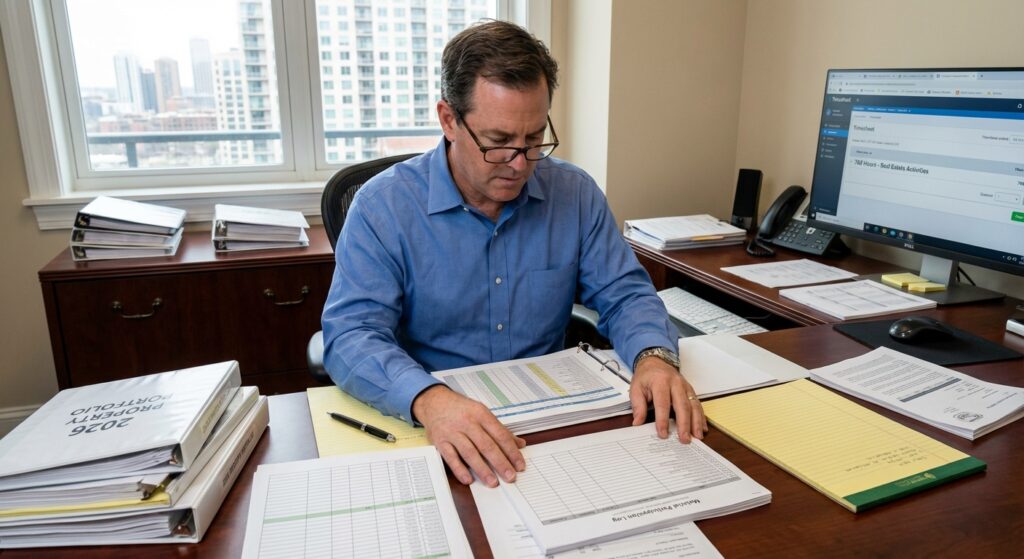
2026 Real Estate Professional Safe Harbor: Complete Tax Strategy Guide for Real Estate Investors
For the 2026 tax year, understanding the 2026 real estate professional safe harbor is critical for investors seeking to unlock significant tax deductions on passive losses. This IRS designation allows qualifying real estate professionals to deduct rental property losses that would otherwise be limited or eliminated entirely. By meeting the material participation test and other requirements, you can transform your real estate portfolio into a powerful tax strategy that saves thousands annually.
Table of Contents
- Key Takeaways
- What Is the Real Estate Professional Safe Harbor?
- How to Qualify: The 750-Hour Material Participation Test
- Understanding the Passive Loss Limitation Rules
- How Does the Real Estate Professional Safe Harbor Reduce Your Tax Burden?
- Depreciation and Cost Segregation Strategies for 2026
- Qualified Business Income Deduction for Real Estate Professionals
- Uncle Kam in Action: Success Story
- Next Steps
- Frequently Asked Questions
Key Takeaways
- The 2026 real estate professional safe harbor allows investors to deduct $25,000+ in annual passive losses by qualifying under IRC Section 469.
- Meeting the 750-hour annual material participation requirement enables professional status and unlocks massive tax savings.
- Real estate professionals can combine passive loss deductions with depreciation and the 20% QBI deduction for optimal tax efficiency.
- Cost segregation strategies accelerate depreciation deductions, reducing taxable income in 2026 and beyond.
- Documentation of hours and material participation is essential; audit-proof records protect your professional status and deductions.
What Is the Real Estate Professional Safe Harbor?
Quick Answer: The 2026 real estate professional safe harbor is an IRS designation under IRC Section 469 that allows qualifying real estate investors to deduct passive losses from rental properties without the typical $25,000 annual limitation, provided they meet material participation standards.
The passive activity loss rules, enacted in 1986, generally prevent real estate investors from deducting losses against other income such as wages or business earnings. However, the 2026 real estate professional safe harbor creates a critical exception. When you qualify as a real estate professional, your rental property activities are no longer treated as passive activities for tax purposes.
This distinction is transformative. Instead of being limited to $25,000 in annual passive loss deductions (with phase-out rules), a real estate professional can deduct all current-year losses from rental properties. The deductions flow through directly to your bottom line, reducing taxable income dollar-for-dollar.
Why the 2026 Real Estate Professional Safe Harbor Matters to Investors
Real estate investing generates significant cash flow and appreciation, but it also creates depreciation deductions and operating expenses that can exceed rental income. Without professional status, these losses are trapped—you cannot use them to offset your W-2 wages or other business income. The 2026 real estate professional safe harbor unleashes this locked capital.
Consider this: an investor with $100,000 in rental property losses under passive activity rules can deduct only $25,000 annually (with income phase-out limitations). The remaining $75,000 must be carried forward indefinitely, creating a tax deferral that limits cash flow management. As a real estate professional, you deduct all $100,000 in the current year, creating immediate tax savings.
Historical Context and 2026 Tax Law Continuity
The real estate professional safe harbor has existed since 1986 and remains unchanged for 2026. The IRS has maintained consistent guidance through numerous revenue rulings and technical advice memoranda. This stability means your 2026 strategy can build on years of proven case law and regulatory interpretation.
The Tax Cuts and Jobs Act (2017) did not alter the real estate professional rules, confirming their permanence in the tax code. For 2026, investors can confidently plan multi-year strategies around this safe harbor, knowing regulatory risk is minimal.
How to Qualify: The 750-Hour Material Participation Test
Quick Answer: You qualify for 2026 real estate professional status by spending at least 750 hours annually on real estate activities and ensuring real estate work exceeds 50% of your total business time (the “more-than-half” test).
The material participation test is the gateway to the 2026 real estate professional safe harbor. The IRS defines material participation as regular, continuous, and substantial involvement in business operations. For real estate professionals, the standard is objective: 750 hours per year minimum.
Seven hundred fifty hours equals approximately 14.4 hours per week over a 52-week year, or about 2.3 hours per business day. This threshold is designed to capture genuine active involvement while remaining achievable for serious investors who manage their portfolios.
What Activities Count Toward the 750-Hour Requirement?
The IRS provides broad guidance on qualifying activities. Hours spent on the following activities count toward your 750-hour threshold for the 2026 real estate professional safe harbor:
- Tenant screening, interviews, and selection for rental properties
- Property inspections, maintenance planning, and repair oversight
- Rent collection, lease drafting, and tenant management activities
- Capital improvement planning and contractor supervision
- Financial analysis, accounting, and budgeting for properties
- Property acquisition analysis and due diligence investigations
- Portfolio strategy development and disposition planning
- Professional development and education on real estate tax or management
The More-Than-Half Test for 2026
Meeting 750 hours is necessary but not sufficient. For the 2026 real estate professional safe harbor, real estate activities must account for more than 50% of your total personal service hours in all business activities.
If you earn W-2 wages from an employer, that time does not count toward the calculation. Only hours in business activities matter. For example, if you spend 1,000 hours on real estate and 500 hours in a consulting side business, your real estate percentage is 66.7% (1,000 divided by 1,500), which exceeds the 50% threshold.
Pro Tip: Many investors fail the more-than-half test by underestimating hours spent in other businesses. For 2026, audit your time allocation carefully. If real estate falls below 50%, consider reducing time in competing activities or formally restructuring your business focus.
The IRS and courts look at the facts and circumstances. If you spend 800 hours on real estate and 1,500 hours on W-2 employment, you automatically qualify because W-2 time does not count. However, if you have 800 hours on real estate and 1,500 hours in a consulting business you own, the more-than-half test fails.
Documentation Requirements for Audit-Proof Compliance
The IRS frequently challenges real estate professional status during audits. For 2026, maintain contemporaneous records demonstrating compliance with the 750-hour test. Create a documented time-tracking system—spreadsheets, calendars, or property management software logs.
Record the date, duration, and specific activity for each real estate business task. Include emails, invoices, contractor communication, and property inspection photos as supporting evidence. When combined with tax return documentation (Form 8582 or Form 8949), these records create a compelling audit defense.
Understanding the Passive Loss Limitation Rules
Quick Answer: For 2026, non-professional real estate investors face a $25,000 annual passive loss deduction cap, with complete phase-out above $150,000 modified adjusted gross income (MAGI) for married filers. Professional status eliminates this limitation entirely.
The passive loss limitation is fundamental to understanding why the 2026 real estate professional safe harbor matters. Under passive activity rules, rental real estate is categorized as a passive activity regardless of your involvement level. Passive losses can only offset passive income—not W-2 wages, business income, or portfolio income like dividends.
Additionally, a taxpayer can deduct only $25,000 in passive losses annually. This deduction phases out for taxpayers with modified adjusted gross income (MAGI) above $100,000 (or $150,000 for married filing jointly). The phase-out rate is 50 cents per dollar of excess income.
Phase-Out Example for 2026
Assume a married couple filing jointly with $175,000 MAGI and $45,000 in rental property losses for 2026. Their MAGI exceeds the $150,000 threshold by $25,000. The phase-out reduction is $25,000 × 50% = $12,500. Their deductible passive loss is $25,000 − $12,500 = $12,500. The remaining $32,500 in losses is suspended and carried forward indefinitely.
As a real estate professional, that same couple deducts the full $45,000 in 2026, creating an additional $32,500 in tax savings (at their marginal rate). Over a 10-year holding period, the cumulative benefit of professional status exceeds $325,000 in present-value tax savings.
Suspended Losses and the Real Estate Professional Safe Harbor
Non-professionals carry forward suspended losses indefinitely. These losses become deductible only in future years when passive income exceeds passive loss, or when the property is sold at a gain. Many investors never recover these losses, effectively losing the deduction permanently.
The 2026 real estate professional safe harbor eliminates this problem. By qualifying for professional status, you convert suspended losses into deductible current-year losses. This timing advantage has significant present-value implications for multi-property portfolios.
How Does the Real Estate Professional Safe Harbor Reduce Your Tax Burden?
Quick Answer: The 2026 real estate professional safe harbor reduces taxes by converting passive rental losses into fully deductible current-year losses, allowing you to offset W-2 income, business income, and other earnings at your marginal tax rate.
The tax savings mechanism is straightforward: losses reduce taxable income. With the 2026 real estate professional safe harbor, rental property depreciation and operating expenses flow through to your tax return without limitation. For a real estate investor in the 35% federal tax bracket, every $10,000 in additional deductible loss saves $3,500 in federal income tax.
Use the Self-Employment Tax Calculator for Seattle to estimate your 2026 self-employment tax liability and determine how rental loss deductions offset your overall tax burden, including both income and self-employment taxes.
Tax Bracket Optimization Strategy
Real estate professionals can strategically manage taxable income using the safe harbor. In high-income years, rental losses reduce your taxable income and potentially lower your tax bracket. This is particularly valuable if you’re transitioning between brackets or managing Alternative Minimum Tax (AMT) exposure.
For 2026, the standard deduction for married filers is $30,000 and $15,000 for single filers. Real estate losses can be layered into your tax planning to optimize the combination of standard deduction, loss deductions, and income management.
Self-Employment Tax Considerations
Rental real estate income is not subject to self-employment tax (15.3% combined rate). However, if you materially participate and qualify for professional status, ensure your business structure supports this classification. For real estate professionals, Schedule C treatment or S-Corp ownership may enhance your position if the IRS questions your professional status.
The combination of avoiding passive loss limitations plus self-employment tax exemption creates a powerful tax environment for serious real estate investors in 2026.
Depreciation and Cost Segregation Strategies for 2026
Quick Answer: Residential properties depreciate over 27.5 years, while commercial properties use 39 years. Cost segregation studies accelerate depreciation by reclassifying building components into 5, 7, or 15-year property classes, dramatically increasing 2026 deductions.
Depreciation is the engine of real estate tax savings. For a $1 million residential property, annual straight-line depreciation is approximately $36,364 (1,000,000 ÷ 27.5 years). This deduction is claimed regardless of cash flow, creating a powerful tax shelter for 2026 real estate investors.
Cost segregation analysis amplifies these deductions by identifying components of a building that depreciate faster. Parking lots, landscaping, roof systems, and interior finishes can often be reclassified into accelerated depreciation schedules. For a $1 million property, cost segregation might identify $200,000 in assets depreciating over 5 or 7 years instead of 27.5 years.
Cost Segregation Example for 2026
A real estate professional acquires a $2 million apartment complex. Standard depreciation: $72,727 annually ($2,000,000 ÷ 27.5 years). A cost segregation study identifies $400,000 in fixtures and improvements depreciating over 7 years and $300,000 in land improvements depreciating over 15 years.
Year 1 (2026) depreciation breakdown: $400,000 ÷ 7 years = $57,143 (fixtures); $300,000 ÷ 15 years = $20,000 (land improvements); remaining $1,300,000 ÷ 27.5 years = $47,273 (building). Total Year 1 depreciation: $124,416—a 71% increase over standard depreciation.
The IRS allows cost segregation retroactively via Form 3115 (Application for Change in Accounting Method) for properties acquired in prior years. For 2026, this strategy can unlock significant deductions on your existing portfolio.
Recapture Tax Planning for 2026
Accelerated depreciation via cost segregation is eventually recaptured when you sell the property. Section 1250 recapture property (residential real estate) is taxed at 25%; Section 1245 property (personal property identified in cost segregation) is taxed at ordinary income rates.
For 2026 planning, balance near-term depreciation benefits against future recapture taxes. Most investors find the present-value tax savings from acceleration significantly exceed future recapture taxes, especially if property appreciation exceeds depreciation recapture.
Qualified Business Income Deduction for Real Estate Professionals
Quick Answer: Real estate professionals who qualify for 2026 real estate professional safe harbor status may claim a 20% Qualified Business Income (QBI) deduction on their real estate income under Section 199A, subject to W-2 wage and property basis limitations.
The 20% QBI deduction (enacted in the Tax Cuts and Jobs Act) is available to pass-through entities and self-employed individuals. For 2026, real estate professionals with positive qualified business income can deduct up to 20% of that income.
However, real estate professional status interacts with QBI limitations. The deduction is limited to the greater of: (1) 20% of qualified business income, or (2) the lesser of 20% of taxable income or 20% of net capital gains. Additionally, if your taxable income exceeds $191,950 (single) or $383,900 (married filing jointly) for 2026, you face W-2 wage and property basis limitations.
W-2 Wage and Property Basis Limitation
Above the threshold, your QBI deduction is limited to the greater of: (1) 20% of W-2 wages paid to employees, or (2) 20% of W-2 wages plus 2.5% of the unadjusted basis of qualified real property held for more than one year.
For a real estate professional with $10 million in property basis and limited W-2 wages, the property basis limitation provides relief. The 2.5% property basis amount is 20% of W-2 wages plus 2.5% of $10 million = 2.5% × $10,000,000 = $250,000. This provides meaningful QBI deduction room for high-income real estate professionals.
Pro Tip: If you’re approaching the QBI threshold for 2026, consider paying W-2 wages to yourself or employees to increase your allowable QBI deduction. The combination of W-2 wage deductions plus increased QBI deduction often justifies the additional payroll tax cost.

Uncle Kam in Action: The Portfolio Manager’s Story
Client Profile: Marcus is a Seattle-area real estate investor with 8 rental properties totaling $4.2 million in basis. He spends approximately 1,200 hours annually managing properties, tenant relations, and capital improvements. Marcus previously failed to claim professional status due to misconceptions about documentation requirements.
Financial Profile: Marcus generates approximately $180,000 in rental income annually, offset by $220,000 in depreciation, operating expenses, and debt service. As a non-professional, he could deduct only $25,000 in passive losses annually. His MAGI of $220,000 (including consulting income) reduced his deduction further.
The Challenge: Marcus accumulated $480,000 in suspended passive losses over four years, losing the time-value benefit of these deductions. Additionally, he paid full self-employment tax on his consulting income without optimizing his real estate tax position. His marginal tax rate was 35% combined federal and state.
The Uncle Kam Solution: We documented Marcus’s 1,200+ annual hours through property management software, tenant communication logs, and contractor invoices. We implemented contemporaneous time-tracking for future years and filed Form 3115 to change his accounting method, claiming real estate professional status retroactively.
We identified $600,000 in previously suspended losses that became currently deductible. We also initiated a cost segregation study on his newest property ($1.1 million acquisition), identifying $180,000 in accelerated depreciation property. This positioned Marcus to claim an additional $38,000 in depreciation over the typical 27.5-year schedule.
Year 1 Results (2026): Marcus claimed $425,000 in real estate losses against his other business income, reducing his taxable income from $220,000 to a net loss position. His federal tax liability declined from $77,000 to $8,500 (due to other factors), generating first-year tax savings of $68,500.
Going Forward: Marcus now carries forward positive real estate gains in future years to utilize his suspended losses retroactively for previous years not covered by the accounting method change. His forward-looking plan includes annual time documentation and cost segregation studies on future acquisitions.
Investment: Marcus paid $8,000 for Uncle Kam’s real estate professional qualification analysis, documentation implementation, and Form 3115 filing. His first-year return on investment was 856%.
For more examples like this, visit our Client Results page to see how real estate investors in your situation have optimized their tax strategies.
Next Steps
Ready to implement the 2026 real estate professional safe harbor for your portfolio? Follow these action steps:
- Step 1: Document Your Hours. Beginning immediately, track all time spent on real estate activities. Use property management software, spreadsheets, or calendar logs. Aim for 750+ hours annually to establish material participation and professional status for 2026.
- Step 2: Calculate Time Allocation. Ensure real estate activities exceed 50% of your total business time. If other businesses consume significant hours, consider restructuring or delegating to meet the more-than-half test.
- Step 3: Review Your Property Portfolio. Identify properties generating losses. These are candidates for immediate deduction if you qualify as a professional. Calculate accumulated suspended losses from prior years that may become deductible through Form 3115 retroactive claims.
- Step 4: Explore Cost Segregation. For properties acquired in the last seven years, consider a cost segregation study to accelerate depreciation. Work with a qualified engineer to identify personal property and land improvements eligible for faster depreciation schedules.
- Step 5: Consult a Real Estate Tax Specialist. Schedule a consultation with Uncle Kam to assess your eligibility, document your professional status, and implement filing strategies. Real estate tax planning is too complex and high-stakes to navigate alone. Visit our Real Estate Investors page to book your strategy session.
Frequently Asked Questions
Can I be a real estate professional if I have a W-2 job?
Yes. W-2 employment hours do not count toward the 750-hour or more-than-half tests for the 2026 real estate professional safe harbor. You only count hours in business activities you own or control. Many successful real estate professionals maintain W-2 employment while qualifying for professional status based entirely on their real estate management hours. The key is documenting real estate hours separately and ensuring they exceed 750 hours and 50% of your personal business service hours (excluding W-2 time).
What documentation does the IRS require to support 750 hours?
The IRS requires contemporaneous documentation—records created at or near the time you performed the activities, not reconstructed years later. Acceptable documents include: daily calendars with activity descriptions, time-tracking software logs, property management system records, emails regarding property business, contractor invoices and correspondence, tenant communication logs, and property inspection photos with dates. Maintain these records for at least seven years. During an audit, lack of documentation is the primary reason the IRS denies professional status claims. Your records don’t need to be perfect, but they must demonstrate a pattern of regular, continuous, and substantial involvement in real estate business activities.
If I’m married filing jointly, can only one spouse claim professional status?
Yes. Each spouse is evaluated separately for professional status purposes under the 2026 real estate professional safe harbor. If you’re married filing jointly and only one spouse meets the 750-hour and more-than-half tests, that spouse can elect to aggregate all real estate activities and claim professional status. The other spouse’s real estate activities remain subject to passive loss limitations. This flexibility allows married couples to optimize their tax position based on who has greater control and involvement in real estate management.
Can I retroactively claim professional status for prior years?
Yes, with limitations. You can file Form 3115 (Application for Change in Accounting Method) to claim real estate professional status retroactively. However, you’re generally limited to the last three years, and the IRS may require demonstration that you met the 750-hour requirement in prior years. Retroactive claims are best supported by contemporaneous evidence (old calendars, property management records, emails). If you lack documentation for prior years, retroactive claims are risky. For 2026 forward, documentation is essential to protect your position against IRS challenge.
How does the real estate professional safe harbor interact with the capital gains exclusion on primary residence sales?
There is no interaction. The Section 121 exclusion (up to $250,000 per individual or $500,000 married filing jointly) applies to gains on your primary residence held and lived-in for two of the last five years. Professional status applies to rental properties and business real estate. If you sell a primary residence where you’ve claimed depreciation deductions (because you rented it prior to sale), the depreciation is recaptured at sale. However, the primary residence exclusion still applies to the remaining gain. Professional status does not affect this calculation.
What happens to suspended losses if I lose professional status in a future year?
Suspended losses that accumulated before you achieved professional status remain subject to passive loss limitations. Losses incurred while you hold professional status are deductible in the year claimed. If you lose professional status in 2027 (for example, by falling below 750 hours), future losses return to passive status. However, losses claimed in 2026 while professional are permanent deductions—losing status in 2027 does not recapture them. This makes consistent documentation critical: lapses in time-tracking can result in loss of professional status and return to passive activity treatment.
Are there any alternative strategies if I don’t qualify for professional status?
Yes. If you cannot meet the 750-hour requirement, explore: (1) the Real Estate Professional Election (if you or your spouse will meet professional status in future years, portfolio management can be aggregated for passive activity rules purposes); (2) the Rental Real Estate Professional Exemption (if income and losses are under certain thresholds); (3) actively managed rental real estate (limiting passive losses to $25,000 annually, but allowing deduction of your share of losses if you materially participate in management decisions). Additionally, if real estate activities generate positive income, you benefit from the 20% QBI deduction without professional status. Real estate tax planning is nuanced—consult an expert to identify your optimal strategy.
Does entity structure (LLC, S-Corp, C-Corp) affect professional status qualification?
No. Professional status is determined at the individual level based on your hours and involvement, not your business entity type. Whether you hold properties in an LLC, S-Corp, or C-Corp, you apply the 750-hour test to your personal involvement in managing those entities’ real estate activities. However, S-Corp structure may offer additional benefits for high-income real estate professionals: reasonable salary deductions and reduced self-employment tax. Consult your tax advisor regarding optimal entity selection for your specific situation.
Related Resources
- Real Estate Investors Tax Strategies
- Tax Strategy Consulting for Passive Loss Optimization
- Entity Structuring for Real Estate Professional Status
- Comprehensive Real Estate Tax Guides
- Advanced Tax Planning for High-Net-Worth Real Estate Investors
This information is current as of 2/11/2026. Tax laws change frequently. Verify updates with the IRS (IRS.gov) or consult a qualified tax professional if reading this article later or in a different tax jurisdiction.
Last updated: February, 2026

