
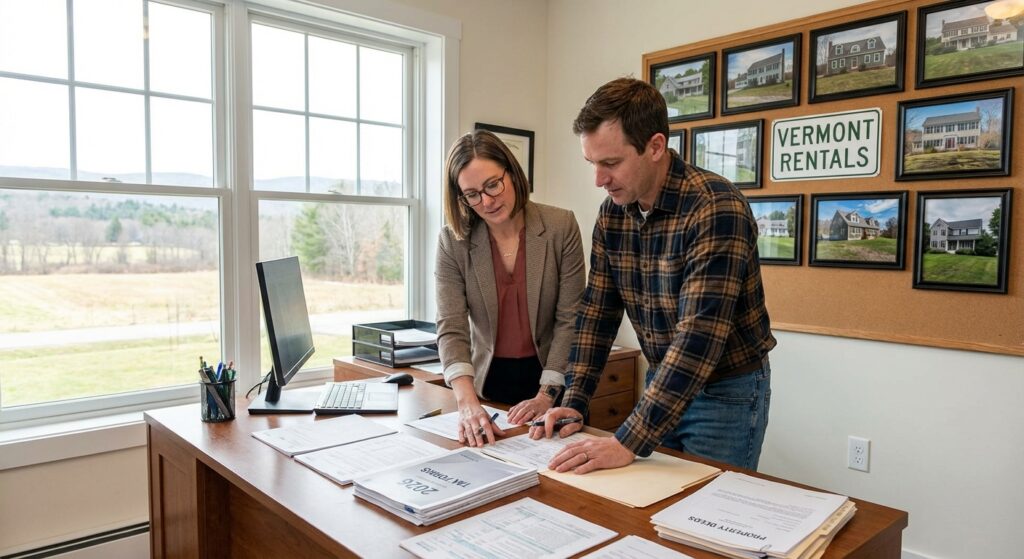
Vermont Real Estate Tax Advisor: 2026 Tax Strategies for Property Investors
For the 2026 tax year, Vermont real estate tax advisors are helping property investors capitalize on significant new tax benefits. The One Big Beautiful Bill Act (OBBBA), signed into law on July 4, 2025, introduced transformative provisions that directly impact real estate investors, including permanent 20% Qualified Business Income (QBI) deductions, 100% bonus depreciation on property acquisitions, and innovative farmland capital gains spreading rules. Working with a qualified Vermont real estate tax advisor ensures you leverage these opportunities while maintaining full compliance with IRS regulations.
Table of Contents
- Key Takeaways
- What Tax Changes Apply to Vermont Real Estate Investors in 2026?
- How Can Vermont Real Estate Investors Maximize Depreciation Benefits?
- What Is the Qualified Business Income Deduction for Real Estate?
- How Should You Plan for Capital Gains on Real Estate Sales?
- Can You Spread Farmland Capital Gains Over Four Years?
- Which Entity Structure Maximizes Tax Efficiency for Vermont Real Estate?
- Uncle Kam in Action
- Next Steps
- Frequently Asked Questions
Key Takeaways
- The 2026 tax year brings 100% bonus depreciation on qualified real property acquisitions for Vermont investors.
- A permanent 20% Qualified Business Income deduction reduces taxable income for real estate businesses.
- Vermont real estate tax advisors can help farmers spread capital gains taxes over four equal installments on farmland sales.
- The state and local tax (SALT) deduction cap increases to $40,000 for 2026, benefiting high-value property owners.
- Strategic planning with a Vermont real estate tax advisor can save investors thousands annually.
What Tax Changes Apply to Vermont Real Estate Investors in 2026?
Quick Answer: The One Big Beautiful Bill Act makes several permanent tax provisions that directly benefit real estate investors, including 100% bonus depreciation, expanded QBI deductions, and increased SALT deduction limits for the 2026 tax year.
For the 2026 tax year, Vermont real estate tax advisors must understand the landmark provisions introduced by the One Big Beautiful Bill Act. This legislation, signed July 4, 2025, fundamentally reshapes how real estate investors calculate their tax obligations. The most significant change is the permanence of tax benefits that were previously set to expire. Rather than facing uncertainty about whether provisions would continue, investors now have clarity heading into 2026 and beyond.
The OBBBA increases the standard deduction to $15,750 for single filers and $31,500 for married couples filing jointly in 2026, compared to $15,000 and $30,000 in 2025. More importantly for real estate investors, the state and local tax (SALT) deduction cap expands to $40,000 for 2026, up from the previous $10,000 limit. This change dramatically impacts Vermont property owners who incur significant property tax liabilities.
Understanding the Expanded SALT Deduction Cap
Vermont real estate tax advisors recognize the SALT deduction expansion as transformational for high-value property owners. Under 2026 rules, you can now deduct up to $40,000 in combined state and local taxes. For Vermont investors owning multiple properties or high-value residential real estate, this means substantially greater tax relief. Calculate your total property taxes across all holdings, state income taxes, and local assessments to determine your itemization strategy with your Vermont real estate tax advisor.
The interaction between the expanded SALT cap and depreciation benefits creates powerful tax optimization opportunities. When combined with bonus depreciation (discussed below), Vermont investors can reduce their effective tax rate significantly. Many property investors who previously didn’t benefit from itemizing now find itemization advantageous due to the increased SALT cap.
Permanence of Key Provisions Creates Planning Certainty
Previously, tax breaks for real estate investors were scheduled to expire. A qualified Vermont real estate tax advisor would have needed to constantly reassess strategies based on congressional actions. The 2026 tax year changes this dynamic entirely. The permanence of 100% bonus depreciation, the QBI deduction, and other provisions means you can plan long-term with confidence.
How Can Vermont Real Estate Investors Maximize Depreciation Benefits?
Quick Answer: For the 2026 tax year, qualified real property placed in service can claim 100% bonus depreciation under Section 168(n), allowing immediate deductions instead of depreciating over 39 years. Vermont real estate tax advisors help determine which properties and improvements qualify.
The 2026 tax year allows Vermont real estate investors to claim 100% bonus depreciation on qualified property acquisitions. This represents a dramatic acceleration of deductions compared to traditional depreciation schedules. Instead of deducting a qualified property’s cost over 39 years, you can deduct the entire amount in the year placed in service for 2026 tax purposes.
For residential investment properties, this means purchasing a $500,000 rental building allows you to claim substantial depreciation deductions on your 2026 return. Working with a Vermont real estate tax advisor becomes essential because the calculation requires identifying which components of your purchase qualify for bonus depreciation versus regular depreciation schedules.
Section 168(n) Manufacturing Property Deduction
A lesser-known but powerful provision for Vermont real estate investors involves Section 168(n), which allows 100% bonus depreciation for qualified production property. If your real property is used in manufacturing within the United States, you may deduct the entire cost in the year placed in service rather than over 39 years. Your Vermont real estate tax advisor will need to allocate the purchase price between manufacturing and non-manufacturing components to maximize this benefit.
Pro Tip: Documenting the allocation of property costs between manufacturing and non-manufacturing use is critical. Your Vermont real estate tax advisor should work with your accountant to prepare detailed cost segregation analyses for properties that qualify under Section 168(n).
Vermont investors should use our Small Business Tax Calculator to model how bonus depreciation deductions impact your 2026 tax liability across different property acquisition scenarios.
Timing Strategies for Property Acquisitions
A critical decision for Vermont real estate investors involves when to place property in service during 2026. Properties placed in service in January generate full-year depreciation deductions. Those placed in December generate the same amount, creating a powerful planning opportunity. Your Vermont real estate tax advisor might recommend accelerating purchases into December 2026 to claim significant deductions on your 2026 tax return rather than waiting until January 2027.
What Is the Qualified Business Income Deduction for Real Estate?
Quick Answer: For the 2026 tax year, the permanent 20% Qualified Business Income (QBI) deduction allows Vermont real estate investors to deduct up to 20% of qualified business income from rental properties, reducing taxable income directly.
The Qualified Business Income (QBI) deduction represents one of the most valuable tools for Vermont real estate tax advisors assisting investors. For the 2026 tax year, real estate businesses can deduct up to 20% of their qualified business income. This means if your rental property generates $100,000 in net income, you can deduct up to $20,000 from your taxable income.
The permanence of this deduction starting with the 2026 tax year provides certainty absent in previous years. Vermont real estate investors can plan multi-year strategies knowing this benefit won’t expire. Combined with depreciation deductions, the QBI deduction creates a powerful tax reduction framework.
QBI Eligibility and Income Limitations
For the 2026 tax year, most Vermont real estate investors qualify for the full 20% QBI deduction without income phase-out restrictions. However, qualified real property business income (QRBI) has specific limitations. Your Vermont real estate tax advisor must verify whether your business structure qualifies as a real property business eligible for full QBI benefits.
Real property businesses—including rental real estate operations—generally qualify for QBI deductions. The calculation requires determining your qualified business income (QBI), which represents your net income from the real estate operation after accounting for all business deductions, depreciation, and other adjustments.
Entity Structure Impact on QBI Deductions
Your choice of entity structure—whether S Corp, LLC, or partnership—significantly impacts your QBI deduction calculation. An experienced Vermont real estate tax advisor analyzes how entity structure interacts with the 20% deduction to optimize your 2026 tax position. Different entity choices produce different QBI calculations and deduction amounts.
How Should You Plan for Capital Gains on Real Estate Sales?
Quick Answer: For the 2026 tax year, Vermont real estate investors should work with tax advisors to plan property sales strategically, considering long-term capital gains rates and timing to optimize overall tax liability across multiple investment years.
Capital gains taxation on real estate sales represents a major tax consideration for Vermont investors. Federal capital gains rates apply to investment property sales, with long-term rates at 15% or 20% depending on income levels. A qualified Vermont real estate tax advisor helps timing sales to minimize your overall tax burden.
For the 2026 tax year, consider whether selling property generates capital gains that might push you into higher tax brackets. Your Vermont real estate tax advisor might recommend selling across multiple years to keep capital gains within lower tax brackets, thereby reducing your effective tax rate on the cumulative gains.
Cost Basis Calculation and Documentation
Accurately calculating your adjusted basis in rental property is essential for determining capital gains. Your purchase price plus acquisition costs minus depreciation deductions equal your adjusted basis. When you sell, the difference between your sale price and adjusted basis determines your capital gain.
Vermont real estate tax advisors emphasize maintaining detailed documentation of all property-related costs. Improvements, repairs, and capital additions all impact your adjusted basis. Poor documentation can result in overstating gains when you sell.
1031 Exchange Considerations
For Vermont investors holding appreciated property, 1031 exchanges provide a powerful tax deferral strategy. You can exchange your investment property for like-kind property without paying capital gains tax in 2026. This allows you to reinvest without depleting gains through taxes. Your Vermont real estate tax advisor can structure 1031 exchanges to ensure compliance with specific timing and identification requirements.
Can You Spread Farmland Capital Gains Over Four Years?
Quick Answer: Under the 2026 tax rules, Vermont farmers can elect to spread capital gains taxes on qualified farmland sales over four equal annual installments, dramatically reducing the tax liability in the year of sale.
The One Big Beautiful Bill Act introduces a transformative provision for Vermont farmers and farmland investors. For the 2026 tax year and beyond, farmers can elect to spread capital gains taxes on qualified farmland sales over four equal annual installments. This provision applies to sales or exchanges of farmland occurring in tax years beginning after July 4, 2025.
Consider this example: A Vermont farmer sells 150 acres of farmland with a $200,000 capital gain, generating $30,000 in capital gains tax at 15% rates. Rather than paying the entire $30,000 tax on the 2026 return, the farmer can elect to pay $7,500 annually for four years, beginning with the 2026 return. This spreading provision significantly improves cash flow for farmers making major land sales.
Farmland Eligibility Requirements for Tax Spreading
Not all farmland sales qualify for the four-year spreading provision. Your Vermont real estate tax advisor must verify that your property meets strict eligibility requirements. The farmland must have been used in farming operations substantially all of the prior ten years. This requirement ensures the provision benefits genuine agricultural operations rather than speculative land purchases.
Additionally, the buyer must covenant to use the property in farming operations for ten years following the sale. The buyer provides this covenant through a legally enforceable agreement or contract. Your Vermont real estate tax advisor coordinates with the buyer to ensure proper documentation of the farming covenant.
Mechanics of the Four-Year Installment Election
Under 2026 tax rules, the farmer calculates the total capital gains tax owed on the sale in the year of sale. This amount is then divided equally among four years. The first installment appears on the tax return for the year of sale, with remaining installments due on the following three years’ returns.
Your Vermont real estate tax advisor helps make the election on the appropriate IRS forms when filing your 2026 return. Proper election ensures the spreading applies. If you fail to make a timely election, you must pay all taxes on the year of sale.
Which Entity Structure Maximizes Tax Efficiency for Vermont Real Estate?
Quick Answer: For the 2026 tax year, Vermont real estate investors should work with a tax advisor to choose between LLC, S Corp, or partnership structures, each offering different depreciation and deduction advantages.
Your choice of business entity structure fundamentally shapes your real estate tax strategy. A qualified Vermont real estate tax advisor evaluates your specific situation to recommend the optimal structure. For 2026, three primary options exist: Limited Liability Companies (LLCs), S Corporations, and partnerships.
Each structure offers distinct advantages for depreciation deductions, QBI calculations, and liability protection. The correct choice depends on your income level, the number of properties held, and your long-term investment goals.
LLC Structure Advantages for 2026
Limited Liability Companies offer pass-through taxation with liability protection. Your Vermont real estate tax advisor values LLCs for their flexibility and simplicity. Depreciation deductions and business expenses flow through to your personal return, creating deductions that offset other income.
For the 2026 tax year, LLCs elected to be taxed as S Corporations provide additional self-employment tax savings. When your LLC generates significant real estate income, electing S Corp taxation can reduce your overall tax burden by avoiding self-employment taxes on distributions.
S Corporation Considerations
S Corporations can provide additional tax optimization opportunities for active real estate operators. Your Vermont real estate tax advisor might recommend S Corp status if you materially participate in property management. Self-employment tax savings can be substantial for high-income properties.

Uncle Kam in Action: Vermont Rental Property Owner Cuts Taxes by $18,500
Sarah, a Vermont real estate investor, owned a $450,000 rental property generating $35,000 in annual net income. Before consulting with a Vermont real estate tax advisor, Sarah paid federal and state income taxes on the entire $35,000. She wasn’t claiming depreciation deductions or utilizing the QBI deduction effectively.
After reviewing her situation, her Vermont real estate tax advisor restructured her property ownership into an LLC and implemented a comprehensive tax strategy for 2026. The advisor claimed $15,000 in depreciation deductions on the property, reducing Sarah’s taxable income from the property to $20,000. The advisor then calculated the 20% QBI deduction available under 2026 rules, providing an additional $7,000 deduction.
Additionally, Sarah’s state property taxes of $8,000 became deductible under the expanded 2026 SALT cap when combined with her other deductions. The Vermont real estate tax advisor structured Sarah’s return to claim $30,000 in total deductions against her real estate income, reducing her taxable income from $35,000 to just $5,000.
At Sarah’s effective tax rate, this restructuring saved her $18,500 in federal and state taxes for the 2026 tax year. Over a five-year period, the cumulative savings exceeded $92,000. Sarah’s Vermont real estate tax advisor also set up quarterly estimated tax payments and tax-saving strategies for future years, ensuring sustained benefits.
Next Steps
Taking action now ensures you capture all available 2026 tax benefits. First, compile all rental property documentation, including purchase prices, acquisition costs, depreciation schedules, and recent improvements. Second, schedule a consultation with a Vermont real estate tax advisor who understands the 2026 OBBBA provisions. Third, work with your advisor to model how different strategies impact your 2026 tax liability. Finally, implement your chosen strategy by year-end to ensure full benefits apply to your 2026 return. The Tax Advisory services from Uncle Kam can provide personalized guidance for your Vermont real estate portfolio.
Frequently Asked Questions
How much can I depreciate on rental property in 2026?
For the 2026 tax year, you can depreciate residential rental buildings over 27.5 years and commercial buildings over 39 years under standard depreciation rules. However, under the 100% bonus depreciation provisions of the OBBBA, qualified property acquisitions may claim full cost deductions in the year placed in service. Your Vermont real estate tax advisor calculates the specific amount based on your property’s cost allocation and acquisition timing. Generally, you cannot depreciate land, only the building structure and improvements.
Do I qualify for the QBI deduction if I own rental properties?
Most Vermont real estate investors qualify for the 20% QBI deduction for 2026 tax purposes. Real property business income from rental operations generally qualifies. Your Vermont real estate tax advisor confirms eligibility based on your specific business structure and income levels. The deduction applies to your qualified business income, calculated after all business expenses and depreciation.
What is the deadline for making farmland capital gains elections?
The election to spread farmland capital gains over four years must be made on your 2026 tax return for sales occurring in 2026. Your Vermont real estate tax advisor includes the election with your filed return. Missing the filing deadline means forfeiting the spreading benefit and owing all taxes in the year of sale. If you sold farmland in late 2025 that you thought should have qualified, consult your advisor about amended return options.
Should I convert my rental properties to an LLC?
Converting existing properties to an LLC for 2026 involves trade-offs. Your Vermont real estate tax advisor evaluates whether liability protection benefits and tax optimization justify conversion costs and potential due-on-sale clause complications. Many advisors recommend LLC ownership for new property acquisitions while leaving existing properties in their current structure to avoid triggering due-on-sale clauses.
How does bonus depreciation affect my property’s basis?
Claiming 100% bonus depreciation in 2026 reduces your adjusted basis in the property. When you eventually sell, this reduced basis increases your capital gains. Your Vermont real estate tax advisor models the long-term tax consequences of bonus depreciation. The immediate tax savings from depreciation must be weighed against higher capital gains when you sell.
Can I claim the QBI deduction if I have large depreciation deductions?
Yes, the 20% QBI deduction applies to your qualified business income after claiming depreciation. For 2026, if depreciation deductions reduce your net rental income to a loss, you generally cannot claim a QBI deduction that year. However, carrying forward losses creates opportunities in future profitable years. Your Vermont real estate tax advisor plans multi-year strategies to optimize both depreciation and QBI benefits.
Related Resources
- Entity Structuring Services for Real Estate Investors
- Real Estate Investor Tax Strategies
- 2026 Tax Strategy Planning
- Tax Preparation and Filing Services
This information is current as of 2/9/2026. Tax laws change frequently. Verify updates with the IRS (IRS.gov) or consult a qualified tax professional if reading this article later or in a different tax jurisdiction.
Last updated: February, 2026

