
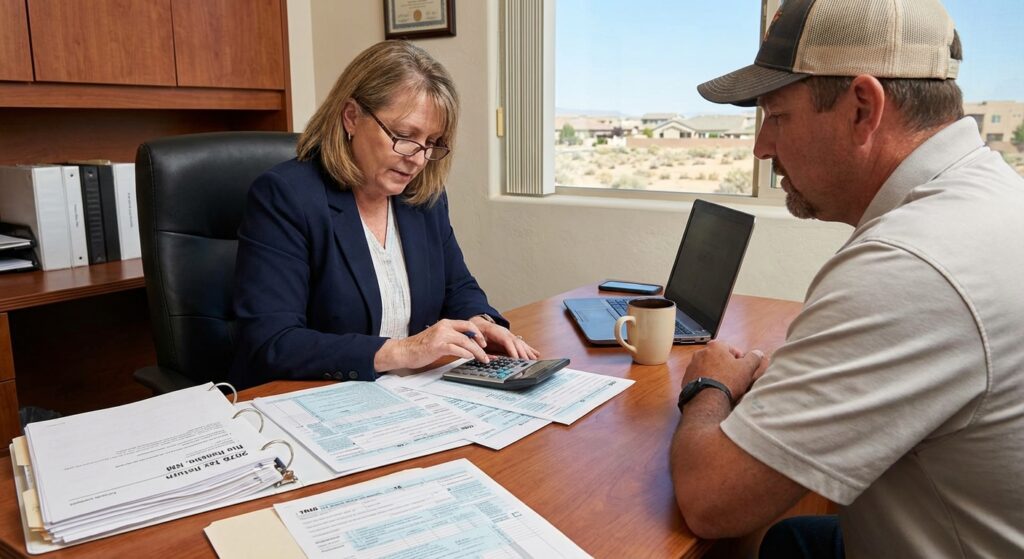
2026 Rio Rancho Tax Filing Guide: Deadlines, Deductions & Strategy for Business Owners
For the 2026 tax year, Rio Rancho business owners and self-employed professionals face a transformed tax landscape. The One Big Beautiful Bill Act (OBBBA), signed into law in July 2025, fundamentally changed standard deductions, introduced new temporary deductions, and expanded opportunities for tax planning. Understanding Rio Rancho tax filing for 2026 means navigating federal requirements, state compliance, and strategic deductions that could save thousands of dollars. This comprehensive guide covers everything you need to know about meeting your 2026 Rio Rancho tax filing obligations while maximizing available deductions and credits.
Table of Contents
- Key Takeaways
- 2026 Rio Rancho Tax Filing Deadlines
- What Is the Expanded Standard Deduction?
- What Entity Structure Maximizes Your 2026 Tax Savings?
- How Do You Claim New Temporary Deductions?
- What Are the SALT Deduction Changes?
- How Should You Prepare for IRS Processing Delays?
- Uncle Kam in Action
- Next Steps
- Frequently Asked Questions
Key Takeaways
- The 2026 standard deduction increased significantly: $46,700 for married couples and $23,750 for singles.
- April 15, 2026 is the federal deadline for Rio Rancho tax filing (March 16 for partnerships and S-Corps).
- New temporary deductions include qualified tips, overtime, car loan interest, and a $6,000 senior deduction.
- The SALT cap increased to $40,000, providing substantial relief for higher-income business owners.
- E-filing with direct deposit is critical to avoid IRS processing delays in 2026.
What Are the Critical 2026 Rio Rancho Tax Filing Deadlines?
Quick Answer: For most Rio Rancho filers, April 15, 2026 is the federal deadline. Partnerships and S-Corps must file by March 16. Agricultural producers have until March 2 if they didn’t make quarterly estimated payments.
The 2026 Rio Rancho tax filing season opened January 26, 2026, and creates important time-sensitive obligations for all business types. Missing deadlines triggers penalties and interest charges that erode your bottom line. Understanding which deadline applies to your business structure ensures compliant filing and avoids costly mistakes.
Individual and Self-Employed Rio Rancho Tax Filing: April 15, 2026
If you’re filing as a sole proprietor, freelancer, or independent contractor in Rio Rancho, your 2026 tax filing deadline is April 15, 2026. This applies whether you operate a Schedule C business or report 1099 income. The IRS expects all federal returns filed electronically by midnight on this date. Filing early—particularly in February or early March—reduces the risk of delays caused by the IRS’s current staffing challenges. Early filers also receive refunds faster, typically within 21 days for e-filed returns with direct deposit.
Self-employed Rio Rancho business owners should also make their final estimated tax payment for 2025 if they haven’t already. For most people, this is due January 15, but if you missed it, paying immediately when you file your return avoids additional penalties and interest.
Partnership and S-Corporation Deadlines: March 16, 2026
Partnerships and S-Corporations in Rio Rancho face an earlier deadline: March 16, 2026. These entities must file their informational returns (Form 1065 for partnerships, Form 1120-S for S-Corps) by this date, regardless of whether individual members or shareholders have filed. This earlier deadline allows time for partnerships and S-Corps to issue K-1 forms to partners and shareholders before they file their individual returns by April 15. Failure to meet this deadline can create cascading problems for all business owners waiting for their K-1s.
Rio Rancho business owners in partnerships or S-Corps should ensure their accountant or tax professional receives all necessary documents and information well before February 15 to meet the March 16 deadline comfortably.
Agricultural Producers: March 2, 2026 (Conditional)
Agricultural producers in Rio Rancho and surrounding areas have an accelerated deadline: March 2, 2026, but only if they have not made estimated tax payments. If an agricultural producer paid their estimated taxes by January 15, they have until April 15, 2026 to file. This provision recognizes the unique cash flow challenges farmers and ranchers face. Understanding whether you qualify as an agricultural producer under IRS rules is essential to meeting the correct deadline.
| Taxpayer Type | 2026 Filing Deadline |
|---|---|
| Individual/Self-Employed | April 15, 2026 |
| Partnership/S-Corp | March 16, 2026 |
| Agricultural Producer (no estimated payments) | March 2, 2026 |
| Agricultural Producer (with estimated payments) | April 15, 2026 |
Pro Tip: File electronically with direct deposit to minimize delays. The IRS processed most 2026 returns within 21 days when filers chose electronic filing and direct deposit options.
What Is the Expanded Standard Deduction for 2026 Tax Filing?
Quick Answer: For 2026, the standard deduction increased to $46,700 for married couples filing jointly and $23,750 for single filers—massive increases from 2025 levels.
The most significant change in the 2026 Rio Rancho tax filing landscape is the expanded standard deduction. The One Big Beautiful Bill Act dramatically increased these baseline deductions, meaning more business owners and self-employed professionals will benefit from using the standard deduction rather than itemizing. This fundamentally changes tax planning strategy for Rio Rancho families and entrepreneurs.
2026 Standard Deduction Amounts by Filing Status
- Married Filing Jointly: $46,700 (up from $31,500 in 2025)
- Single: $23,750 (up from $15,750 in 2025)
- Head of Household: Amount determined per IRS 2026 guidelines
- Married Filing Separately: Amount determined per IRS 2026 guidelines
Senior Deduction: An Additional $6,000 Benefit
Rio Rancho residents aged 65 and older benefit from a new temporary senior deduction worth up to $6,000 per individual ($12,000 for married couples filing jointly). This deduction applies on top of the standard deduction and phases out for taxpayers with modified adjusted gross income above $75,000 (single) or $150,000 (married filing jointly). For many Rio Rancho seniors, this provision dramatically reduces or eliminates federal income tax liability.
What Entity Structure Maximizes Your 2026 Tax Savings?
Quick Answer: Entity choice—sole proprietor, LLC, S-Corp, or C-Corp—fundamentally impacts your 2026 Rio Rancho tax liability. S-Corps offer the biggest potential savings through reasonable salary planning and strategic distributions.
Rio Rancho business owners making six figures or more should evaluate whether their current entity structure remains optimal for 2026. The expanded standard deductions and new OBBBA provisions create opportunities to restructure your business and save thousands in self-employment taxes while maintaining compliance with IRS regulations around reasonable compensation.
Comparing Entity Structures for 2026 Tax Efficiency
Rio Rancho entrepreneurs should compare four primary entity options when planning 2026 tax strategy: sole proprietorships, LLCs, S-Corporations, and C-Corporations. Each structure has different implications for self-employment tax, income taxes, and liability protection. An S-Corporation election, for example, allows you to pay yourself a reasonable salary (subject to FICA taxes) and take remaining profits as tax-free distributions. This strategy only works if your business generates consistent profits above $60,000 annually.
For Rio Rancho business owners earning significant income, running calculations with both entity structures should be part of your annual tax planning. Our LLC vs S-Corp Tax Calculator helps you estimate potential savings based on your specific income situation.
Pro Tip: An S-Corp election typically makes financial sense when net profit exceeds $60,000. Below that threshold, the additional accounting and filing costs usually outweigh the tax savings.
How Do You Claim New Temporary Deductions for 2026?
Quick Answer: New temporary deductions under OBBBA include qualified tips, overtime, car loan interest, and the senior deduction—all claimable on your 2026 return.
The One Big Beautiful Bill Act created several new temporary deductions that Rio Rancho taxpayers can claim on their 2026 returns, regardless of whether they itemize or take the standard deduction. These provisions, effective through 2028, provide meaningful tax relief for specific categories of income and expenses. Understanding eligibility requirements and documentation standards ensures you claim these benefits correctly.
Qualified Tips Deduction (2026-2028)
Rio Rancho service industry workers—bartenders, servers, hotel staff, and casino employees—can now deduct qualified tips received during the tax year. This applies regardless of whether tips are reported to employers. Documentation is critical: maintain records of all tips received, preferably using the IRS-provided Form 4137 to substantiate the amount claimed. The benefit applies only to tips actually received (not charged tips that went uncollected).
Overtime Income Deduction (2026-2028)
Employees who work overtime and claim the overtime portion of their wages as a deduction can reduce taxable income. This benefit applies to W-2 wage earners in Rio Rancho who work overtime hours. To claim this deduction, you need documentation showing your regular hourly rate and overtime hours worked. Your W-2 should itemize regular wages separately from overtime compensation.
Car Loan Interest Deduction (2026-2028)
Rio Rancho taxpayers can now deduct qualified car loan interest on their federal returns (previously limited to mortgage interest). This new deduction applies to loans taken out after a specific date under OBBBA. To claim this benefit, gather documentation showing the total interest paid on auto loans during 2026, which typically appears on your loan statement or in the year-end summary from your lender. This applies whether the vehicle is used for personal transportation or business purposes.
What Are the SALT Deduction Changes for 2026 Rio Rancho Tax Filing?
Quick Answer: The SALT (state and local tax) deduction cap increased from $10,000 to $40,000 for 2026, providing $30,000 in additional deduction space for high-income Rio Rancho filers.
The most consequential change for high-income Rio Rancho business owners is the expanded State and Local Tax (SALT) deduction. Previously capped at $10,000 across all states and localities, the new $40,000 cap dramatically increases deduction capacity for business owners in higher-tax states. For Rio Rancho entrepreneurs paying substantial state income taxes or property taxes, this change represents thousands of dollars in additional deduction opportunities.
Understanding the $40,000 SALT Cap for 2026
The $40,000 SALT deduction cap for 2026 includes state and local income taxes, real property taxes, personal property taxes, and sales taxes (if elected instead of income tax). For Rio Rancho business owners, this typically includes New Mexico state income tax on business profits plus any local property taxes on real estate holdings. Married couples filing separately face a $20,000 cap each.
Income limits apply to the SALT deduction. Taxpayers with modified adjusted gross income above certain thresholds experience a phase-out. Rio Rancho couples filing jointly with income above $400,000 should consult a tax professional to understand how the phase-out affects their specific situation.
How Should You Prepare for 2026 IRS Processing Delays?
Quick Answer: The IRS is understaffed for 2026. E-file with direct deposit, verify all income documents match, and avoid paper filings and amended returns to minimize delays.
Rio Rancho business owners need to understand that the 2026 tax filing season faces unique challenges. The IRS has experienced significant workforce reductions and is implementing complex new provisions from the One Big Beautiful Bill Act. These factors combine to create potential processing delays, particularly for complex returns or those flagged for review. Proactive steps minimize delays and refund wait times.
Best Practices to Avoid 2026 Filing Delays
- E-file your return: Electronic filing eliminates data entry errors and accelerates processing by the IRS.
- Elect direct deposit: Direct deposit refunds process within 21 days for most 2026 returns. Paper check refunds take considerably longer.
- Verify all income documents: Ensure W-2s, 1099s, and other income documents match what you report on your return. Mismatches trigger IRS inquiries and delays.
- File early: Filing in February or early March avoids late-season bottlenecks and IRS processing backlogs.
- Create an IRS online account: The IRS Individual Online Account allows real-time tracking of your return status and secure communication with the agency.
- Avoid complex amendments: If you filed incorrectly in prior years, amended returns take significantly longer to process in 2026.
Pro Tip: According to the IRS, taxpayers filing electronically with direct deposit and clean returns should see refunds within 21 days. This is the fastest path through IRS processing.

Uncle Kam in Action: Rio Rancho LLC Owner Saves $18,500 in 2026 Taxes
Marcus, a Rio Rancho construction LLC owner, had been running his business as a sole proprietor for five years. His construction company generates $350,000 in annual revenue with $280,000 in net profit. When he reviewed his 2025 tax return, he realized he’d paid approximately $39,500 in self-employment taxes on that profit.
During his 2026 tax planning consultation, Uncle Kam reviewed whether an S-Corporation election would serve Marcus better. The analysis showed that by electing S-Corp status for his LLC and paying himself a $180,000 reasonable salary (subject to payroll taxes), he could take the remaining $100,000 in profit as tax-free distributions. This structure would reduce his combined income and self-employment tax burden by approximately $18,500 for 2026.
Beyond entity structuring, Uncle Kam identified $12,000 in additional deductions Marcus had overlooked: qualifying business equipment purchases eligible for Section 179 depreciation and $3,000 in state property taxes now deductible under the expanded SALT cap. Combined with the S-Corp savings and new deductions, Marcus’s total 2026 tax benefit exceeded $30,000.
Results: Total 2026 tax savings: $30,500. Investment in planning and implementation: $3,000. First-year ROI: 1,017%. Most importantly, Marcus’s improved cash flow positioned him to invest in his business growth and family security.
Next Steps for Your Rio Rancho Tax Filing Strategy
Your 2026 Rio Rancho tax filing success starts now. Don’t wait until April to address your tax strategy. These concrete action steps position you to maximize deductions, minimize liability, and file confidently before the deadline. Book a tax strategy consultation with an experienced professional to evaluate your specific situation and identify opportunities unique to your business and income level.
- Gather all 2026 income documents (W-2s, 1099s, K-1s) by March 1
- Evaluate your entity structure and calculate potential S-Corp savings
- Document all deductible business expenses and calculate SALT deductions
- Consult a tax professional by February 15 to implement any strategy changes
- File your return electronically with direct deposit by March 15 to avoid deadline pressure
Frequently Asked Questions About Rio Rancho Tax Filing 2026
What happens if I miss the April 15, 2026 Rio Rancho tax filing deadline?
If you miss the April 15, 2026 deadline without filing an extension, the IRS assesses a failure-to-file penalty of 5% per month (maximum 25%) of unpaid taxes. Additionally, you’ll owe interest on any taxes owed, calculated daily. If you realize you’ll miss the deadline, file Form 4868 (Request for Automatic Extension of Time To File U.S. Individual Income Tax Return) to get a six-month extension. An extension gives you until October 15, 2026 to file, but any taxes owed are still due by April 15 to avoid penalties and interest.
Does Rio Rancho have local income tax requirements separate from federal filing?
Rio Rancho, as a municipality in New Mexico, follows New Mexico state income tax rules but does not impose a separate local income tax. However, New Mexico has state income tax with its own filing requirements. Many Rio Rancho taxpayers must file both federal returns (IRS) and state returns (New Mexico Taxation and Revenue Department) by similar deadlines. Some taxpayers with lower incomes may not be required to file state returns. Consulting a tax professional clarifies whether you have state filing obligations.
Can I claim the new temporary deductions if I have business income?
Yes. The new temporary deductions (qualified tips, overtime, car loan interest, senior deduction) apply whether you have business income or W-2 employment income. If you have business income and claim the standard deduction, you can still claim these temporary deductions because they apply above-the-line. However, business deductions normally claimed on Schedule C (such as vehicle depreciation for business use) are separate from the personal car loan interest deduction and shouldn’t be claimed twice.
What is considered “reasonable compensation” for S-Corp owners in Rio Rancho?
Reasonable compensation for S-Corp owners means the salary you pay yourself should be comparable to what others in similar positions earn for similar work. The IRS scrutinizes S-Corp owners who take minimal salaries and massive distributions. Generally, if your S-Corp generates $280,000 in profit, a reasonable salary might be 50-60% of that amount ($140,000-$168,000), with the remainder taken as distributions. Tax professionals use industry benchmarks and comparable business analysis to defend reasonable compensation determinations if audited.
Will my 2026 Rio Rancho return be delayed if it’s flagged for review?
Yes. Returns flagged for IRS review typically take 4-8 weeks longer than standard processing. Common triggers include claiming large business deductions, substantial charitable contributions, S-Corp salary/distribution ratios that seem aggressive, or discrepancies between reported income and expenses. The best mitigation is maintaining meticulous documentation and having a tax professional review your return before filing to identify potential red flags. If your return is flagged, responsive communication with the IRS accelerates resolution.
Should Rio Rancho self-employed professionals make estimated quarterly payments?
Yes, if your expected 2026 tax liability exceeds $1,000, you should make quarterly estimated payments. Rio Rancho self-employed professionals typically owe federal self-employment tax plus income tax. Making quarterly payments (due April 15, June 15, September 15, 2026, and January 15, 2027) avoids underpayment penalties and reduces the surprise of a large balance due when you file. Setting aside 25-30% of profit for taxes throughout the year prevents cash flow problems at filing time.
What records should Rio Rancho business owners keep for the 2026 tax year?
Rio Rancho business owners should maintain comprehensive documentation for the 2026 tax year: business income records (invoices, sales receipts, payment records), business expense documentation (receipts, invoices, credit card statements), mileage logs if claiming vehicle deductions, payroll records if you have employees, bank and investment statements, depreciation schedules for business assets, and loan documentation for business debt. The IRS generally has three years to audit your return, and seven years for certain situations. Maintaining organized records supports your deductions if audited and proves invaluable when planning future tax strategies.
This information is current as of 2/9/2026. Tax laws change frequently. Verify updates with the IRS or a tax professional if reading this later.
Last updated: February, 2026

