
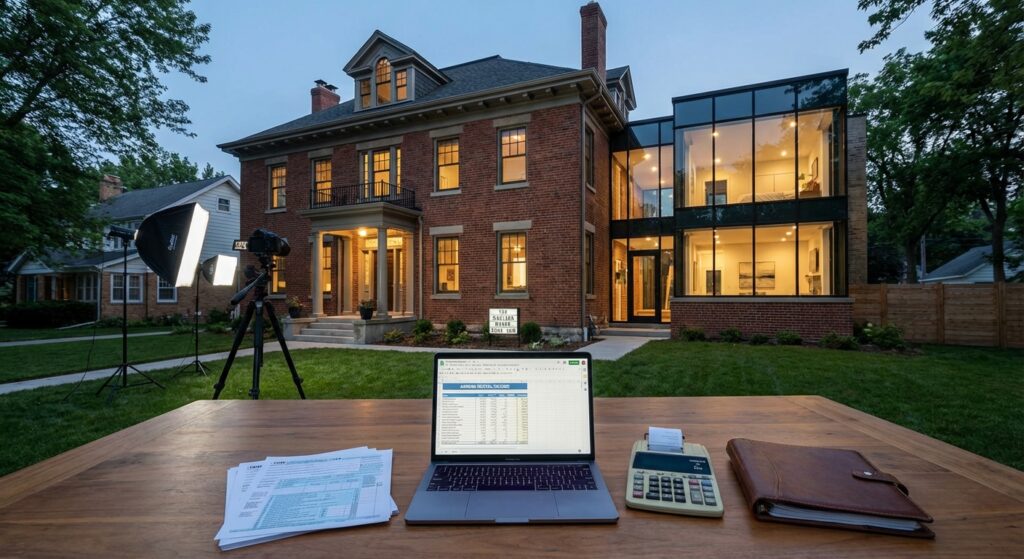
Airbnb Tax Planning Madison 2026: Complete Guide to Maximizing Deductions and Managing Short-Term Rental Taxes
For the 2026 tax year, Madison Airbnb hosts need a strategic approach to maximize profits while staying compliant with the IRS. Short-term rental tax planning in Madison requires understanding current deductions, passive activity loss rules, and depreciation strategies that can significantly impact your bottom line. This guide breaks down everything you need to know about Airbnb tax planning Madison style.
Table of Contents
- Key Takeaways
- What Is Airbnb Tax Planning and Why Does It Matter in Madison?
- What Tax Deductions Can You Claim for Your Madison Airbnb Property?
- How Does Depreciation Work for Short-Term Rental Properties?
- What Are Passive Activity Loss Limitations for Airbnb Income?
- How Do You Report Airbnb Income on Your Tax Return?
- What New 2026 Tax Laws Affect Madison Airbnb Owners?
- Uncle Kam in Action: Madison Airbnb Tax Success Story
- Next Steps
- Frequently Asked Questions
Key Takeaways
- Madison Airbnb hosts can deduct mortgage interest, property taxes, utilities, maintenance, insurance, and HOA fees under 2026 rules.
- Depreciation on residential property requires 27.5 years for cost recovery under 2026 IRS guidelines.
- Passive activity loss limitations cap deductions at 80% of taxable income starting in 2026 under OBBBA.
- Report all Airbnb income using Schedule E Form 1040 for accurate tax filing in 2026.
- The $40,000 SALT cap (state and local taxes) benefits high-earners in Wisconsin for 2026 tax planning.
What Is Airbnb Tax Planning and Why Does It Matter in Madison?
Quick Answer: Airbnb tax planning in Madison involves strategically managing deductions, depreciation, and rental income reporting to reduce your federal tax liability while ensuring full IRS compliance for the 2026 tax year.
If you own an Airbnb property in Madison or operate multiple short-term rental units, understanding Airbnb tax planning is critical to your bottom line. For the 2026 tax year, Madison-based hosts face both opportunities and obligations when it comes to tax planning for their rental properties. The IRS treats short-term rental income differently from traditional long-term rentals, which means your tax filing strategy must be carefully structured.
Madison’s competitive short-term rental market makes strategic tax planning essential. With declining mortgage rates making property investment more accessible in 2026, more hosts are entering the market. However, many fail to optimize their tax strategies, leaving thousands in unclaimed deductions on the table each year. This isn’t just about following the rules—it’s about maximizing profits through proper Airbnb tax planning.
Understanding Short-Term Rental Classification for Tax Purposes
The IRS classifies Airbnb properties as either rental real estate or business enterprises based on several factors. Your classification determines how you report income, which deductions apply, and whether passive activity loss limitations affect you in 2026. Properties rented for fewer than 15 days annually receive different tax treatment than those rented for the full season. This distinction matters significantly when optimizing your Airbnb tax planning strategy for Madison properties.
For most Madison Airbnb hosts, the property qualifies as rental real estate under 2026 tax law. This classification allows you to deduct expenses directly related to generating rental income. However, understanding these nuances prevents costly mistakes and ensures you’re claiming every legitimate deduction available for your 2026 tax filing.
Why Madison Hosts Need Proactive 2026 Tax Planning
Madison’s growth as a tourist destination and university town has made short-term rentals increasingly profitable. However, higher revenue means higher tax liability unless you actively manage your tax strategy. Proactive Airbnb tax planning in Madison allows you to structure your business legally and minimize taxes while maximizing cash flow available for property improvements or additional investments.
What Tax Deductions Can You Claim for Your Madison Airbnb Property?
Quick Answer: Madison Airbnb owners can deduct all ordinary and necessary business expenses, including mortgage interest, property taxes, utilities, maintenance, cleaning supplies, insurance, HOA fees, and property management fees under 2026 IRS guidelines.
Claiming all available deductions is the cornerstone of effective Airbnb tax planning. For the 2026 tax year, Madison hosts can deduct a comprehensive range of business-related expenses. These deductions reduce your taxable rental income, directly lowering your federal tax liability. Understanding which expenses qualify ensures you’re maximizing deductions while staying compliant with IRS rules for Airbnb tax filing.
Mortgage Interest and Property Tax Deductions
For Madison Airbnb properties with mortgages, the interest portion of your monthly payment is fully deductible as a rental business expense. Unlike primary residences with mortgage interest limitations, rental property mortgage interest provides unlimited deduction opportunities. Similarly, property taxes paid on your Madison rental are deductible, though subject to the 2026 SALT cap of $40,000 for state and local taxes combined. This cap applies to both income and property taxes, so strategic planning matters for high-tax Wisconsin properties.
Pro Tip: Track your mortgage statements separately from other property expenses. The IRS requires detailed documentation of interest versus principal portions. Use our Small Business Tax Calculator to estimate annual deductions from mortgage and property tax expenses.
Utilities, Maintenance, and Repair Deductions
All utilities used for your Madison Airbnb—electricity, water, gas, internet, and trash service—are fully deductible business expenses. Maintenance and repairs, including painting, carpet cleaning, appliance repairs, and landscaping, qualify as deductible expenses when they preserve the property’s condition. However, the IRS distinguishes between repairs (deductible) and capital improvements (depreciated over time). This distinction is crucial for proper Airbnb tax planning in Madison.
For 2026, keep detailed records of all maintenance expenses. Document whether work constitutes a repair (preserving existing condition) or improvement (adding new functionality or extending life significantly). This distinction directly impacts your current tax deductions versus future depreciation schedules.
Insurance, HOA Fees, and Management Expenses
Homeowners insurance, liability insurance, and loss of rents insurance for your Madison Airbnb are all fully deductible. HOA fees (if applicable) and property management company payments for Airbnb tax planning are deductible business expenses. These routine expenses significantly impact your annual tax liability, making thorough documentation essential for 2026 tax filing accuracy.
| Deductible Airbnb Expense Category | Examples for Madison Properties | 2026 Tax Treatment |
|---|---|---|
| Mortgage Interest | Monthly interest payments to lender | 100% deductible, unlimited |
| Property Taxes | Wisconsin county taxes on rental | Deductible, subject to $40,000 SALT cap |
| Utilities | Electric, water, gas, internet | 100% deductible |
| Repairs & Maintenance | Painting, cleaning, appliance repair | 100% deductible (repairs only) |
| Insurance | Homeowners and liability coverage | 100% deductible |
| Property Management | Professional cleaning and coordination | 100% deductible |
How Does Depreciation Work for Short-Term Rental Properties?
Quick Answer: Residential rental property depreciation for Airbnb uses a 27.5-year recovery period under 2026 IRS guidelines, allowing you to deduct a portion of your property’s value annually while maintaining substantial tax deductions.
Depreciation represents one of the most powerful tools in Airbnb tax planning for Madison hosts. This non-cash deduction allows you to reduce taxable rental income without actually spending cash, creating valuable tax losses that offset other income. Understanding depreciation strategy directly impacts your 2026 tax planning effectiveness.
Understanding Residential Depreciation Periods
The IRS requires residential rental properties to depreciate over 27.5 years for 2026. This means if your Madison Airbnb property cost $300,000, you would deduct approximately $10,909 annually ($300,000 ÷ 27.5 years). This substantial deduction continues year after year, significantly reducing your taxable rental income. However, this deduction has important implications when you eventually sell the property, making long-term planning essential.
For effective Airbnb tax planning in Madison, properly allocate the purchase price between land (non-depreciable) and improvements (depreciable). Land represents approximately 15-25% of purchase price in most Madison markets. A proper allocation ensures maximum depreciation deductions while maintaining IRS compliance throughout your ownership period.
Bonus Depreciation and Accelerated Deductions
For 2026, bonus depreciation at 100% is available for qualified property placed in service during the year. This allows immediate deduction of the full cost of certain equipment, appliances, and improvements, rather than spreading deductions over multiple years. Strategic use of bonus depreciation accelerates your Airbnb tax planning benefits in 2026.
When you purchase new furniture, appliances, or equipment for your Madison Airbnb property in 2026, potentially claim 100% bonus depreciation. This accelerated deduction creates immediate tax savings while preserving traditional depreciation benefits for the building structure itself.
What Are Passive Activity Loss Limitations for Airbnb Income?
Quick Answer: Starting in 2026, the OBBBA limits passive activity losses to 80% of taxable income under the business loss limitation rule, significantly impacting tax planning strategies for Madison Airbnb properties.
Understanding passive activity loss limitations is critical for optimizing Airbnb tax planning in Madison. These IRS rules restrict how much passive loss you can deduct against other income in any single year. Starting with 2026 tax filings, the One Big Beautiful Bill Act (OBBBA) imposes new limitations that fundamentally change how losses impact your overall tax liability.
The 2026 80% Business Loss Limitation Rule
Beginning with 2026 tax returns, business losses can offset only 80% of your total taxable income. This means if your Madison Airbnb generates a $50,000 loss through depreciation and expenses, you can only deduct $40,000 in 2026 (80% of $50,000). The remaining $10,000 carries forward to future tax years, fundamentally changing loss utilization timing.
This limitation requires strategic multi-year planning for your Airbnb tax planning in Madison. Rather than immediately deducting all losses in a single year, you may benefit from spreading deductions across multiple years to optimize tax benefits. Professional guidance ensures you navigate this complex rule effectively for 2026 and beyond.
Material Participation Exception for Active Operators
The passive activity loss rules contain important exceptions for hosts who materially participate in their rental operations. If you spend more than 100 hours annually managing your Madison Airbnb and control operational decisions, you may qualify for material participation status. This status can exempt your property from passive activity loss limitations, making 2026 Airbnb tax planning significantly more favorable.
Document your time spent managing the property, coordinating with guests, handling maintenance, and making business decisions. For 2026 tax filing purposes, demonstrating material participation requires detailed records supporting more than 100 hours of annual involvement. This exception can be worth tens of thousands in deductions for active Madison Airbnb hosts.
How Do You Report Airbnb Income on Your Tax Return?
Quick Answer: Report all Airbnb income and expenses using Schedule E (Form 1040) for rental real estate activities, with property-by-property reporting for multiple Madison properties under 2026 IRS filing requirements.
Proper tax reporting is essential for effective Airbnb tax planning in Madison. The IRS requires detailed documentation of rental income and expenses on Schedule E of Form 1040. Filing accurately for 2026 tax year ensures compliance while supporting all deductions claimed in your Airbnb tax planning strategy.
Schedule E Reporting Requirements for 2026
Schedule E allows separate reporting for each rental property owned. This enables precise tracking of income and expenses for individual Madison Airbnb properties. Accurate Schedule E reporting substantiates all deductions claimed in your Airbnb tax planning, demonstrating to the IRS that your property operates as a legitimate rental business.
For 2026 filing, organize your records by expense category: income, depreciation, mortgage interest, property taxes, utilities, repairs, insurance, and management fees. Schedule E requires this specific organization, making the reporting process streamlined when you’ve maintained proper documentation throughout the year.
Form 1099-K Reporting and Airbnb Income Documentation
Airbnb reports host income using Form 1099-K when annual payments exceed $20,000 and involve 200+ transactions. For the 2026 tax year, most Madison hosts receive 1099-K reporting. Your Schedule E filing must reconcile with 1099-K amounts reported to the IRS. Failing to report income matching your 1099-K triggers automatic discrepancy notices requiring response.
Maintain detailed records from Airbnb showing all income received, dates of stays, and guest information. For 2026 Airbnb tax planning in Madison, reconcile your reported income with Airbnb statements and any 1099-K forms received. Discrepancies must be resolved before filing to ensure smooth IRS processing and prevent audit risk.
What New 2026 Tax Laws Affect Madison Airbnb Owners?
Quick Answer: The One Big Beautiful Bill Act (OBBBA), effective 2026, introduces the 80% business loss limitation, higher SALT caps at $40,000, and modified depreciation rules that significantly impact Airbnb tax planning strategies for Madison hosts.
The 2026 tax year brings transformative changes affecting Airbnb tax planning in Madison. The One Big Beautiful Bill Act (OBBBA), signed July 4, 2025, implements sweeping tax law modifications that directly impact rental property owners. Understanding these changes ensures your 2026 Airbnb tax planning strategy remains compliant while maximizing available benefits.
OBBBA Impact on Airbnb Tax Planning
The OBBBA significantly affects how depreciation, loss deductions, and itemized deductions work for 2026. The new 80% business loss limitation directly impacts multi-property Madison Airbnb owners who previously could offset substantial losses against other income. This requires fundamental restructuring of multi-year tax planning strategies.
Additionally, the $40,000 SALT cap affects Wisconsin property owners more substantially than some other states. Madison’s relatively high property taxes mean many hosts now utilize full SALT deduction capacity. Strategic timing of property acquisitions and capital improvement timing can optimize 2026 tax planning effectiveness under OBBBA rules.
Declining Mortgage Rates and 2026 Investment Accessibility
For 2026, declining mortgage rates have made short-term rental property investment significantly more accessible. According to recent analysis, 2026 represents a favorable year for new Madison Airbnb acquisitions due to improved mortgage affordability. This accessibility means more hosts are entering the market, increasing competition but also expanding opportunities for strategic Airbnb tax planning.
Pro Tip: For new 2026 property acquisitions, plan your entity structure carefully. C-Corp, S-Corp, or Partnership structures may provide superior tax results compared to individual ownership depending on your circumstances. Consult a tax professional before purchasing additional Madison properties.
| 2026 Tax Law Change | Impact on Madison Airbnb Hosts | Planning Strategy |
|---|---|---|
| 80% Business Loss Limit (OBBBA) | Only 80% of losses offset income; remaining 20% carries forward | Spread deductions across multiple years; consider material participation |
| $40,000 SALT Cap (Expanded) | Increased from prior $10,000; Wisconsin high-tax properties benefit | Itemize property taxes and state income taxes together |
| Bonus Depreciation (100%) | Full depreciation available for equipment and appliances | Purchase qualifying property in 2026; accelerate equipment purchases |
| Mortgage Rate Accessibility | Declining rates enable new Madison acquisitions more readily | Evaluate new property acquisitions; optimize entity structure for new purchases |

Uncle Kam in Action: Madison Airbnb Tax Success Story
Client Profile: Jennifer, a Madison-based real estate investor, owns three Airbnb properties in downtown Madison’s university-adjacent neighborhood. Her properties generate approximately $180,000 in annual rental income across the three units. Before engaging with Uncle Kam’s tax strategy services, she was leaving significant tax savings on the table by not properly implementing depreciation strategies or optimizing her expense deductions.
The Challenge: Jennifer’s 2025 tax filing used a basic spreadsheet approach, recording only obvious expenses and missing numerous deductible categories. She reported approximately $120,000 in taxable rental income after basic expenses, resulting in roughly $25,000 in federal income tax liability. However, she hadn’t properly documented depreciation, hadn’t claimed utilities and maintenance expenses systematically, and hadn’t optimized her property tax deductions within the $40,000 SALT limit.
The Uncle Kam Solution: Working with Uncle Kam’s tax strategy advisors, Jennifer implemented comprehensive Airbnb tax planning for her 2026 properties. The strategy included: (1) properly allocating property purchase prices between land and improvements to maximize depreciation; (2) implementing monthly tracking systems for all utilities, maintenance, and repair expenses; (3) utilizing the expanded $40,000 SALT cap to deduct Wisconsin property taxes and state income taxes; (4) calculating and claiming accelerated bonus depreciation on recent equipment and appliance purchases; (5) structuring her operations to demonstrate material participation, reducing passive activity loss limitations.
The Results: Jennifer’s optimized 2026 Airbnb tax planning reduced her taxable rental income from approximately $120,000 to just $68,000 through legitimate deductions and depreciation strategies. This reduction resulted in approximately $11,000 in additional federal tax savings in 2026 alone. Her investment in professional tax planning yielded a 220% first-year return on fees paid. Over five years, the cumulative tax savings from proper depreciation and deduction strategies will exceed $65,000. Jennifer now understands how strategic Airbnb tax planning directly impacts her property investment returns and long-term wealth building.
Key Takeaway: Professional tax strategy implementation transformed Jennifer’s approach to Madison Airbnb tax planning. Rather than accepting default tax treatment, strategic planning ensured she claimed every legitimate deduction, optimized depreciation benefits, and structured operations to minimize passive activity loss limitations. This case demonstrates why dedicated Airbnb tax planning in Madison delivers measurable financial returns.
Next Steps
- Organize Your 2026 Records: Gather all mortgage statements, property tax receipts, utility bills, maintenance invoices, and insurance documents. Create a spreadsheet or folder system for easy access during tax planning.
- Calculate Property Depreciation: Determine the depreciable basis of your Madison Airbnb property by properly allocating between land and improvements. Use IRS Publication 946 or consult a tax professional for accurate calculations.
- Assess Material Participation Status: Document hours spent managing your property to determine if you qualify for material participation status, which can eliminate passive activity loss limitations.
- Review Entity Structure: Evaluate whether individual ownership, LLC, S-Corp, or Partnership structure optimizes your 2026 tax planning. Changing structure before year-end may yield substantial tax savings for multiple properties.
- Schedule Tax Planning Consultation: Work with a qualified tax professional specializing in real estate to implement comprehensive 2026 Airbnb tax planning aligned with your specific circumstances and goals. Professional tax advisory services ensure compliance while maximizing deductions and minimizing liability.
Frequently Asked Questions
Can I Deduct Losses on My Madison Airbnb Property for 2026?
Yes, but with the new 2026 limitation. Under OBBBA, your rental property losses can offset only 80% of your total taxable income. If your Madison Airbnb generates a $40,000 loss, you can deduct $32,000 in 2026, with the remaining $8,000 carrying forward to future years. This limitation fundamentally changes loss utilization planning and requires multi-year strategy consideration.
What Is the Difference Between Repairs and Capital Improvements for Airbnb Tax Planning?
Repairs maintain existing property condition and are fully deductible in the current year. Examples include fixing a leaky roof, repainting walls, or replacing broken appliances. Capital improvements add value or extend the property’s life significantly, such as installing new HVAC systems, upgrading electrical systems, or adding rooms. Capital improvements depreciate over time rather than receiving immediate deduction. For 2026 Airbnb tax planning in Madison, careful classification ensures appropriate deduction timing.
How Do I Document Expenses for Airbnb Tax Planning Verification?
The IRS requires documentation supporting all claimed deductions. Maintain copies of receipts, invoices, bank statements, and credit card statements for 2026. Photographs or before-and-after documentation prove maintenance work. For depreciation, keep purchase documentation and property allocation calculations. Organize records by expense category for easy Schedule E preparation. Digital storage using cloud services ensures records survive unexpected loss while remaining accessible for tax filing and potential audits.
Should I Form an LLC for My Madison Airbnb Properties?
LLC formation depends on your specific circumstances, including liability protection needs, tax optimization opportunities, and multi-property structure. An LLC provides limited liability protection, separating personal assets from rental property liability. From a tax perspective, single-member LLCs don’t change federal taxation unless you elect S-Corp treatment. Multiple properties may benefit from separate LLCs or partnership structures. Consult a tax professional before forming or restructuring entities for 2026 operations.
What Is Material Participation and How Does It Impact My Madison Airbnb?
Material participation means you spend more than 100 hours annually managing your property and exercise control over operational decisions. For 2026, hosts qualifying for material participation status can potentially deduct losses without passive activity loss limitations. This requires detailed documentation of time spent managing the property, coordinating with guests, handling maintenance decisions, and strategic planning. Demonstrating material participation requires careful record-keeping and professional guidance to ensure IRS compliance.
How Does Depreciation Recapture Work When I Sell My Madison Airbnb?
Depreciation recapture means recovering the depreciation you’ve deducted over the years when you sell. All depreciation deducted is recaptured and taxed at 25% maximum rate upon sale, separate from long-term capital gains rates. This reduces your net sale proceeds and increases your tax liability on the sale. Understanding depreciation recapture implications in your 2026 planning helps you evaluate long-term property holding strategy and assess whether continued holding or strategic sale makes financial sense.
This information is current as of February 9, 2026. Tax laws change frequently. Verify updates with the IRS or consult a tax professional if reading this later.
Related Resources
- Real Estate Investor Tax Strategies and Planning Services
- Comprehensive Tax Strategy Planning for Business Owners
- Entity Structuring Services for Rental Properties
- Professional Tax Preparation and Filing Services
- Business Solutions for Real Estate Operations
Last updated: February, 2026

