
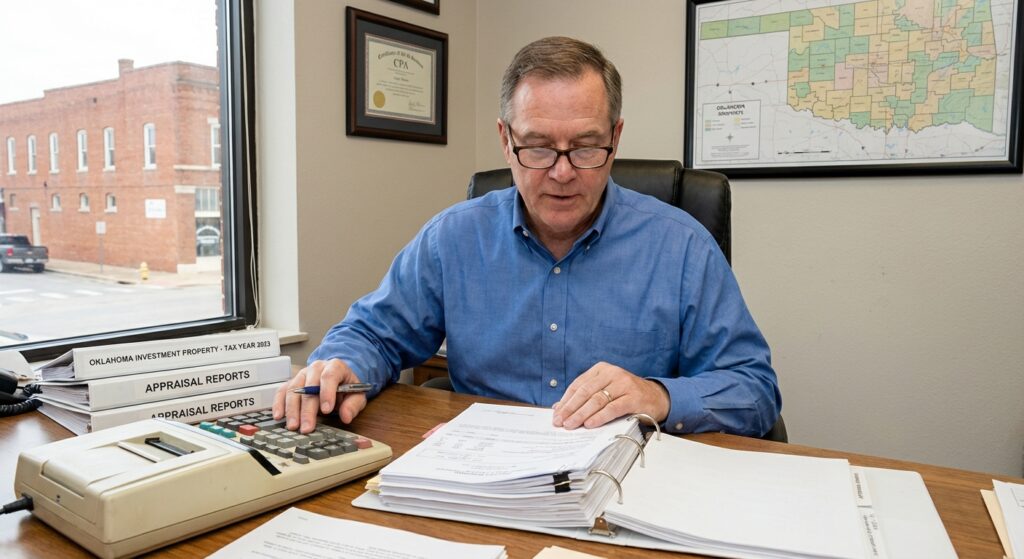
2026 Oklahoma Real Estate Tax Advisor Guide: Maximize Your Investment Returns
For the 2026 tax year, Oklahoma real estate investors face unprecedented opportunities to reduce tax liability through new provisions in the One Big Beautiful Bill Act (OBBBA). Working with an experienced Oklahoma real estate tax advisor is no longer optional—it’s essential. This guide explores the latest tax strategies, depreciation rules, and capital gains planning methods that can save you thousands of dollars annually.
Table of Contents
- Key Takeaways
- Why Do You Need an Oklahoma Real Estate Tax Advisor?
- How Can Farmland Capital Gains Be Spread Over Four Years?
- What Are the 2026 Bonus Depreciation Benefits?
- How Can Real Estate Professionals Reduce Their Tax Burden?
- What Itemized Deduction Limits Apply to High-Income Investors?
- Uncle Kam in Action
- Next Steps
- Frequently Asked Questions
Key Takeaways
- An Oklahoma real estate tax advisor helps you navigate 2026 OBBBA provisions and maximize deductions legally.
- Qualified farmland sales can spread capital gains taxes equally over four years starting in 2026.
- Bonus depreciation on manufacturing properties now allows 100% immediate expensing instead of 39-year depreciation.
- State and local tax deduction (SALT) cap increased to $40,000 for 2026, benefiting property owners.
- Passive activity loss limitations cap losses at 80% of taxable income beginning in 2026.
Why Do You Need an Oklahoma Real Estate Tax Advisor?
Quick Answer: Tax rules for real estate changed significantly in 2026. An Oklahoma real estate tax advisor ensures compliance while identifying deductions and strategies that save you money.
Real estate investment in Oklahoma has become increasingly complex. The One Big Beautiful Bill Act (OBBBA), signed into law on July 4, 2025, introduced sweeping changes that directly affect property owners, investors, and farm operators. For the 2026 tax year, these changes mean new opportunities—but only if you understand how to apply them.
An experienced Oklahoma real estate tax advisor specializes in maximizing deductions while ensuring IRS compliance. They understand depreciation schedules, passive activity loss rules, and recent legislative changes that affect your bottom line.
The Cost of DIY Tax Planning
Without professional guidance, real estate investors commonly miss deductions worth thousands. The standard deduction for 2026 remains substantial—$31,500 for married couples filing jointly. However, itemized deductions (including mortgage interest and property taxes) often exceed this amount when you own multiple properties.
Additionally, the SALT cap of $40,000 for 2026 creates complex planning scenarios. An Oklahoma real estate tax advisor models different strategies to ensure you claim every dollar of deductible expense.
State and Local Advantages in Oklahoma
Oklahoma offers specific tax advantages for real estate professionals. A qualified advisor understands state-specific rules that complement federal 2026 tax changes, creating additional savings opportunities for property owners in Oklahoma.
How Can Farmland Capital Gains Be Spread Over Four Years?
Quick Answer: Under OBBBA, farmers selling qualified farmland can elect to pay capital gains taxes in four equal installments rather than one lump sum in the year of sale.
One of the most significant benefits of OBBBA for Oklahoma real estate investors involves farmland sales. Beginning January 1, 2026, qualified farmers can spread capital gains taxes over four years. This isn’t a tax reduction—rather, it’s a cash flow management tool that aligns tax payments with farming income patterns.
Understanding the Four-Year Election
Here’s how the four-year farmland capital gains spread works: when you sell qualified farmland, you calculate the total capital gain. You then divide this amount by four and pay equal installments over four consecutive years, beginning with the tax return for the year of sale.
Consider this scenario: a farmer sold farmland with a $200,000 capital gain (taxed at approximately 15% federal rate). The total federal capital gains tax would be $30,000. With the four-year spread, the farmer pays $7,500 annually for four years starting with the 2026 tax return filing deadline of April 15, 2027.
Eligibility Requirements for Qualified Farmland
Not all farmland sales qualify for this benefit. To use the four-year spread, several requirements must be met. The property must be located in the United States and used for farming purposes. Additionally, you must have farmed the land substantially during the prior 10 years.
The buyer must also provide a covenant or other legally enforceable agreement certifying that the property will continue to be used in farming operations for at least 10 years after the sale. Both the seller and buyer must attach copies of this agreement to their tax returns for the year of sale.
Pro Tip: Work with your Oklahoma real estate tax advisor before entering into a farmland sale. Proper documentation and election timing ensures you receive the full benefit of the four-year spread.
What Are the 2026 Bonus Depreciation Benefits?
Quick Answer: For 2026, new manufacturing buildings can claim 100% bonus depreciation immediately instead of depreciating over 39 years under Section 168(n).
OBBBA introduced a game-changing provision for real estate investors in manufacturing sectors. Section 168(n) allows 100% bonus depreciation on new, nonresidential real property used in manufacturing in the United States. This represents a massive shift from traditional depreciation methods.
Traditional Depreciation vs. Bonus Depreciation
Historically, real estate investors depreciated nonresidential buildings over 39 years. This means a $5 million manufacturing facility building generated approximately $128,000 in annual depreciation deductions. With bonus depreciation, the entire $5 million could potentially be deducted in the year of acquisition, dramatically accelerating tax deductions.
The key advantage? Immediate tax deductions mean lower taxable income in 2026. This liquidity can be reinvested in property improvements, other investments, or business expansion.
Allocation Challenges and Planning
However, applying this rule requires careful analysis. The property must be new and used in manufacturing. Determining what qualifies as “manufacturing” versus non-manufacturing use requires detailed property allocation. Additionally, you must allocate the purchase price between the building (eligible for bonus depreciation) and land (not depreciable).
The IRS is still providing guidance on proper allocation methods. Your Oklahoma real estate tax advisor should model multiple scenarios to maximize your benefit while staying within IRS regulations.
How Can Real Estate Professionals Reduce Their Tax Burden?
Quick Answer: Real estate professionals with sufficient hours and income can avoid passive activity loss limitations and deduct all real estate losses against other income sources.
Passive activity loss (PAL) limitations historically restricted how much real estate investors could deduct against ordinary income. For the 2026 tax year, these rules remain but have evolved with new OBBBA provisions. An Oklahoma real estate tax advisor helps you optimize your status as a real estate professional.
Real Estate Professional Status Advantages
To qualify as a real estate professional for 2026, you must materially participate in real estate activities and demonstrate this with proper documentation. Material participation requires more than 500 hours annually in real estate business activities (during which you’re not employed elsewhere in a full-time capacity).
Real estate professionals bypass passive activity loss limitations entirely. Instead of being limited to $25,000 in annual real estate losses (or 0% of losses if income exceeds certain thresholds), professionals can deduct all real estate losses in the year incurred.
For example, if you’re a real estate professional with $150,000 in rental property losses during 2026, you could deduct the full $150,000 against other income sources like W-2 wages or business income. Use our Self-Employment Tax Calculator for real estate professionals to estimate how status changes impact your bottom line.
Documentation and Hour Tracking
The IRS requires contemporaneous documentation proving material participation. Your Oklahoma real estate tax advisor recommends maintaining detailed time logs showing activities like property inspection, tenant management, accounting, and strategic planning. Electronic calendars with hourly breakdowns provide strong audit defense.
What Itemized Deduction Limits Apply to High-Income Investors?
Quick Answer: Beginning in 2026, high-income investors face limitations reducing itemized deduction value even though the deductions themselves remain available.
For the 2026 tax year, itemized deductions for real estate investments continue to include mortgage interest and property taxes. However, new limitations reduce deduction value for high-income taxpayers. Understanding these rules is essential for comprehensive tax planning.
SALT Cap Expansion for 2026
The state and local tax (SALT) deduction cap increased significantly for 2026. Now capped at $40,000 annually (up from $10,000 in prior years and $20,000 for married filing separately), this benefits property owners in high-tax states like California.
For Oklahoma investors, while state property taxes may be lower, the expanded SALT cap creates planning opportunities if you also own out-of-state property. Your real estate tax advisor coordinates multiple property tax deductions across states to maximize your total SALT claim.
Pro Tip: For married couples, each spouse can claim $40,000 in SALT if filing jointly, up to combined $40,000 limit. Careful documentation of state and local taxes ensures maximum deduction without audit risk.
High-Income Deduction Limitations Beginning 2026
Starting in 2026, high-income taxpayers face limitations that reduce the value of most itemized deductions, including charitable contributions. While deductions themselves remain available, the reduction limits their value. Your Oklahoma real estate tax advisor models income scenarios to determine whether itemizing or taking the standard deduction (still $31,500 for married couples filing jointly for 2026) provides greater tax savings.

Uncle Kam in Action: Real Estate Professional Saves $47,000
Marcus Thompson, an Oklahoma-based real estate professional managing a seven-property portfolio, faced a challenging tax situation in 2025. He had engaged in active property management, renovations, and tenant relations—approximately 600 hours annually—but had never claimed “real estate professional” status on his tax returns.
His rental properties generated $185,000 in combined losses from depreciation deductions, repairs, and property management expenses. Under normal passive activity loss rules, Marcus could only deduct $25,000 of these losses, deferring $160,000 to future years.
Working with Uncle Kam’s Oklahoma real estate tax advisor team, Marcus documented his material participation through detailed time logs, email records, and property maintenance documentation. For 2026, he filed amended returns claiming real estate professional status with full documentation.
The result? Marcus deducted the full $185,000 in real estate losses against his W-2 income and business income. At his combined 35% federal and state tax rate, this translated to $64,750 in tax savings. After accounting for professional fees of approximately $17,750, Marcus achieved a net tax savings of $47,000.
Additionally, Marcus consulted Uncle Kam’s strategic planning team regarding his upcoming property sales. Using the OBBBA capital gains spreading provision for qualified farmland sales, he deferred significant capital gains taxes from 2026 into future years, improving his 2026 tax position further. This real-world example demonstrates how an Oklahoma real estate tax advisor identifies overlooked opportunities and translates tax law into actual savings. For additional case studies, visit Uncle Kam’s client results page.
Next Steps
- Schedule a consultation with an Oklahoma real estate tax advisor to review your 2026 tax situation immediately.
- Document real estate professional activities through time tracking and maintain organized property records.
- Review all planned property sales to determine if they qualify for OBBBA capital gains spreading benefits.
- Model depreciation scenarios for new property acquisitions to maximize 2026 deductions.
- Gather documentation supporting state and local tax deductions to maximize the $40,000 SALT cap.
Frequently Asked Questions
What specific qualifications should I look for in an Oklahoma real estate tax advisor?
Look for advisors with CPA, Enrolled Agent (EA), or tax attorney credentials who specialize in real estate. They should demonstrate knowledge of 2026 OBBBA provisions, depreciation strategies, and state-specific Oklahoma tax rules. Request references from current real estate investor clients and verify their experience with passive activity loss planning and professional status elections.
Can I claim real estate professional status if I have a full-time job?
No, generally you cannot. Material participation requirements specify that you must not be engaged in another full-time employment when claiming real estate professional status. However, if you own and actively manage sufficient real estate holdings (600+ hours annually) and the real estate business is your primary occupation, you may qualify even with W-2 income, depending on your specific situation.
Does the OBBBA farmland capital gains spread apply to non-farming real estate sales?
No. The four-year spread benefit applies exclusively to qualified farmland sales under OBBBA. Commercial or residential real estate sales do not qualify, regardless of size. Consult your Oklahoma real estate tax advisor about other strategies for managing capital gains on non-farm property sales.
How does bonus depreciation affect my cost basis for future sales?
When you claim bonus depreciation in 2026, your cost basis reduces by the depreciation amount deducted. For example, if you purchase a $5 million qualifying manufacturing building and claim $5 million bonus depreciation in 2026, your adjusted basis becomes zero. When you eventually sell the property, capital gains calculations reflect this reduced basis, potentially resulting in higher capital gains. Your Oklahoma real estate tax advisor models long-term implications before electing bonus depreciation.
What happens if I miss the four-year farmland capital gains election deadline?
The election must be made on the tax return for the year of sale. Missing this deadline could mean losing the benefit and owing all capital gains taxes in the year of sale instead of spreading over four years. Your Oklahoma real estate tax advisor ensures proper election timing and filing to protect your interests.
How are operating losses treated if they exceed 80% of taxable income in 2026?
Under OBBBA, business operating losses can offset maximum 80% of taxable income starting in 2026. Excess losses carry forward to future years. If you generate $100,000 in taxable income and $150,000 in real estate losses, you can deduct only $80,000 against 2026 income. The remaining $70,000 carries to 2027. Strategic deduction timing helps optimize multi-year tax positions.
Should I elect bonus depreciation or spread deductions over time?
This depends entirely on your income, tax rate expectations, and strategic goals. Some investors benefit from immediate depreciation to reduce 2026 income. Others prefer spreading deductions across multiple years to optimize AMT positions or coordinate with other deductions. Your Oklahoma real estate tax advisor models scenarios specific to your situation and projects multi-year tax impacts before you elect.
Can I use an Oklahoma real estate tax advisor remotely, or must they be located in Oklahoma?
Most reputable tax advisors work with clients remotely via secure video conferencing and digital document sharing. However, choosing an advisor familiar with Oklahoma-specific tax rules and real estate market conditions often provides advantages. Many national firms offer Oklahoma-based advisors alongside remote service capabilities.
Related Resources
- Expert tax advisory services for real estate investors
- Real estate investor tax strategies and planning
- Entity structuring for real estate portfolios
- Professional tax preparation and filing services
- Free tax calculators and planning tools
Last updated: February, 2026
Compliance Statement: This information is current as of 2/9/2026. Tax laws change frequently. Verify updates with the IRS or consult an Oklahoma real estate tax advisor if reading this after February 2026. All figures reflect 2026 tax year regulations only.

