
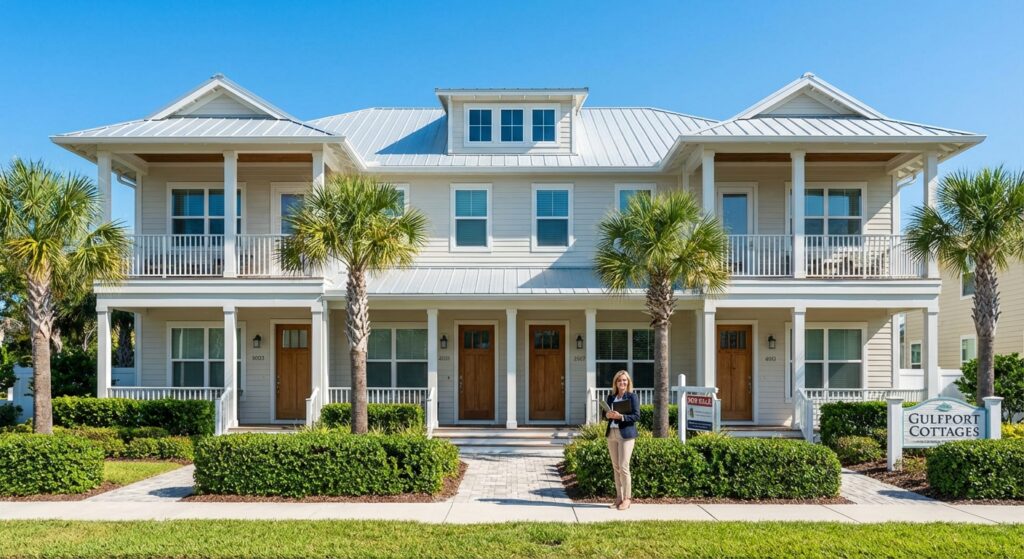
Gulfport Multi-Family Property Taxes: 2026 Strategies for Real Estate Investors
For real estate investors managing multi-family properties in Gulfport, Mississippi, understanding gulfport multi-family property taxes has never been more critical. The 2026 tax year brings substantial changes under the One Big Beautiful Bill Act (OBBBA), which fundamentally reshapes how you can depreciate buildings, claim deductions, and structure investments. Whether you own a small apartment complex or manage multiple multi-family buildings, this comprehensive guide reveals the 2026 strategies that could reduce your tax liability by thousands of dollars while keeping you compliant with IRS requirements.
Table of Contents
- Key Takeaways
- Understanding Gulfport Multi-Family Property Taxes in 2026
- What Rental Property Deductions Can You Claim in 2026?
- How Does Depreciation Benefit Your Multi-Family Investment?
- What Is Cost Segregation and Can It Accelerate Your Deductions?
- What New OBBBA Provisions Impact Your 2026 Tax Planning?
- Are There Mississippi-Specific Tax Incentives for Multi-Family Properties?
- Uncle Kam in Action
- Next Steps
- Frequently Asked Questions
Key Takeaways
- Multi-family properties depreciate over 27.5 years federally, creating substantial annual deductions.
- 100% bonus depreciation available on qualifying manufacturing property under 2026 OBBBA provisions.
- Cost segregation studies can accelerate deductions by 15-30% over the property’s holding period.
- Mortgage interest, property taxes, insurance, and maintenance are fully deductible in 2026.
- Operating loss limitations now cap deductions at 80% of taxable income for most real estate investors.
Understanding Gulfport Multi-Family Property Taxes in 2026
Quick Answer: Gulfport multi-family property taxes include federal income taxes on rental income, depreciation recapture, state taxes, and local property taxes. Mississippi maintains favorable treatment for rental property owners with strong investment fundamentals in 2026.
Gulfport multi-family property taxes operate at multiple levels. Federal income taxation applies to all rental income, while Mississippi state taxes and Harrison County local assessments add additional layers. Understanding each component helps you structure your investment strategy effectively.
Mississippi’s economic forecast through January 2026 shows general fund revenue collection exceeding expectations by $165 million, indicating a strong financial position that may support stable property tax rates. This positive outlook means Gulfport property owners benefit from consistent policy environments during the 2026 tax year.
Federal Income Tax on Rental Income
The 2026 federal tax rate on rental income depends on your filing status and total taxable income. Single filers with a standard deduction of $15,750 can shield that amount from federal taxation. Married couples filing jointly benefit from a $31,500 standard deduction for 2026. However, rental income exceeding these amounts is taxed at federal rates ranging from 10% to 37% depending on your tax bracket.
Mississippi State Taxation
Mississippi levies state income tax on rental property owners. Unlike some states, Mississippi doesn’t offer specific exemptions for real estate investors, meaning all net rental income is subject to state income tax. Gulfport multi-family property taxes at the state level require careful planning to minimize exposure through allowable deductions.
Local Property Assessment
Harrison County assesses property value annually. Multi-family properties are valued based on income approach, replacement cost, or comparable sales. Understanding your property’s assessed value and how it’s calculated allows you to challenge assessments if necessary and plan your acquisition strategy around valuation cycles.
What Rental Property Deductions Can You Claim in 2026?
Quick Answer: You can deduct mortgage interest, property taxes, insurance, utilities, maintenance, repairs, property management fees, advertising, and depreciation. These 2026 deductions reduce your taxable rental income dollar-for-dollar.
The IRS allows multiple deductions for gulfport multi-family property taxes and rental income purposes. These deductions reduce your taxable rental income, directly lowering your federal, state, and potentially local tax liability. Real estate investors who claim all allowable deductions typically reduce their effective tax rate significantly.
| Deduction Type | 2026 Status | Notes |
|---|---|---|
| Mortgage Interest | Fully Deductible | Entire interest portion of payments reduces taxable income |
| Property Taxes | Deductible (Capped) | SALT cap of $40,000 applies to high earners in 2026 |
| Insurance Premiums | Fully Deductible | All property and liability insurance payments |
| Maintenance/Repairs | Fully Deductible | Routine repairs deductible; capital improvements depreciated |
| Depreciation | Deductible (27.5 years) | Largest deduction available; recaptured at 25% on sale |
Pro Tip: Track every property-related expense in 2026. Investors who maintain detailed records claim an average of 35-45% more deductions than those with incomplete documentation. Use accounting software to categorize expenses automatically.
Operating Expenses You Can Write Off
Beyond the major categories, numerous operating expenses are deductible. Property management fees paid to professional companies reduce your gross rental income. Advertising costs for tenant recruitment are deductible. Utilities you pay directly (common areas, landscaping water) reduce taxable income. Homeowner association fees for communities with amenities also qualify for deduction.
Distinguishing Repairs from Improvements
A critical distinction affects your 2026 tax planning: repairs are deductible immediately, while capital improvements must be depreciated. Fixing a leaky roof is a repair (deductible). Replacing the entire roof is an improvement (depreciated over time). Repainting walls is a repair. New flooring throughout the building is an improvement. Consulting with your tax advisor before major work helps determine classification.
How Does Depreciation Benefit Your Multi-Family Investment?
Quick Answer: Multi-family properties depreciate over 27.5 years under 2026 IRS rules. A $2 million building generates approximately $73,000 in annual depreciation deductions, reducing your taxable rental income without reducing cash flow.
Depreciation is the single largest deduction available to multi-family property owners. The IRS allows you to deduct a portion of your building’s cost annually, even though you receive full rental income. This creates a powerful tax deferral mechanism. The catch: depreciation is recaptured at 25% when you sell the property, but this delay allows you decades of tax-free income growth on your investment.
Standard Depreciation Schedule
Residential multi-family property (four or more units) depreciates over 27.5 years. Calculate your annual deduction by dividing your adjusted basis in the building (not the land) by 27.5. If your building cost $2 million, your annual depreciation is approximately $72,727. This deduction applies each year regardless of your occupancy rate or actual income performance.
Land Cannot Be Depreciated
A critical calculation step: separate your total purchase price into building and land. Land cannot be depreciated because it doesn’t wear out. Typically, an appraisal or allocation analysis determines the building percentage. In Gulfport’s market, land usually represents 20-30% of total property value, leaving 70-80% eligible for depreciation.
What Is Cost Segregation and Can It Accelerate Your Deductions?
Quick Answer: Cost segregation studies break down multi-family buildings into components with different depreciation schedules. Parking lots (15 years), flooring (5-7 years), and mechanical systems (5-15 years) depreciate faster than the 27.5-year building, accelerating deductions by 15-30%.
Cost segregation is an advanced tax strategy that breaks down your property into components depreciating at different rates. Instead of treating your entire $2 million building as depreciating over 27.5 years, a study identifies that parking lot paving depreciates in 15 years, carpeting in 5-7 years, and HVAC systems in 15 years.
For a $2 million multi-family property, a typical cost segregation study might allocate:
- $1.4 million to 27.5-year building
- $300,000 to 5-7 year personal property
- $200,000 to 15-year land improvements
- $100,000 to land (non-depreciable)
This reclassification increases your 2026 deductions significantly. The 5-7 year components generate $43,000-$60,000 in year-one depreciation instead of $7,000 under standard 27.5-year depreciation. Cost segregation studies cost $3,000-$8,000 but typically return their investment within the first year through tax savings.
Pro Tip: Cost segregation works best for properties purchased in 2025 or early 2026. If you’re acquiring Gulfport multi-family property, obtain a cost segregation study before closing to maximize 2026 depreciation benefits. Use our Small Business Tax Calculator for Green Bay to estimate your 2026 tax savings from accelerated depreciation.
What New OBBBA Provisions Impact Your 2026 Tax Planning?
Quick Answer: The One Big Beautiful Bill Act (OBBBA), effective 2026, makes 100% bonus depreciation permanent for qualifying property, allows immediate expensing of R&D costs, and limits operating loss deductions to 80% of taxable income for most real estate investors.
Signed into law July 4, 2025, the OBBBA fundamentally reshapes real estate taxation for 2026. These provisions require strategic planning to optimize benefits while remaining compliant.
100% Bonus Depreciation for Manufacturing Property
If your Gulfport multi-family property includes manufacturing components (rare but possible), the OBBBA allows 100% bonus depreciation. Unlike standard 27.5-year depreciation, you deduct the entire investment in year one. This provision applies to new, nonresidential real property constructed in the U.S. for manufacturing use.
Operating Loss Limitations
The OBBBA caps business operating losses at 80% of taxable income starting in 2026. For multi-family investors, this matters when depreciation and deductions exceed rental income. Previously, unlimited loss carryforwards were available. Now, if depreciation creates a $100,000 loss, you can only offset 80% of current taxable income, deferring the remaining 20% to future years.
R&D Deduction Changes
The OBBBA allows immediate expensing of domestic research and development costs starting in 2025, continuing through 2026. While this primarily benefits manufacturing and tech companies, some property developers and managers with proprietary operational systems may qualify.
Are There Mississippi-Specific Tax Incentives for Multi-Family Properties?
Quick Answer: Mississippi offers opportunity zone incentives and strategic economic zone benefits. Gulfport, as a Gulf Coast development area, may qualify for enhanced depreciation and investment credits, but you must verify your specific property location.
Mississippi’s revenue collection through January 2026 exceeded forecasts by $165 million, indicating fiscal strength. This positive outlook supports stable tax policy for gulfport multi-family property taxes. State-specific incentives vary based on property location and designation.
Opportunity Zone Designations
If your Gulfport property is located in a qualified opportunity zone, you benefit from deferred capital gains taxation and 15% exclusion on long-term gains. These federal designations provide significant incentives for reinvestment in economically challenged areas, with Gulfport having multiple designated zones.
Local Gulfport Incentives
Gulfport, as part of Harrison County and the Gulf Coast region, benefits from state and local development initiatives. Verify with the City of Gulfport Economic Development office whether your property qualifies for any abatements or credits. Tourism-focused multi-family accommodations (extended-stay properties) may access additional incentives.

Uncle Kam in Action: Multi-Family Real Estate Investor Cuts Tax Liability by $47,000
Client Profile: Sarah owns a 24-unit multi-family apartment building in Gulfport purchased for $3.2 million in 2024. Annual rental income averages $288,000, generating strong cash flow. However, without proper tax planning, she faced a federal tax bill exceeding $72,000 on her rental income.
The Challenge: Sarah claimed basic depreciation and standard deductions but was missing significant tax-saving strategies available under the OBBBA. She paid income tax on essentially all her rental income despite building equity through principal paydown and property appreciation.
The Uncle Kam Solution: We implemented a comprehensive tax strategy:
- Obtained cost segregation study allocating $620,000 to 5-7 year components
- Documented all 2026 operating expenses (property management, insurance, utilities, maintenance)
- Maximized mortgage interest deduction ($116,000 annually on her loan)
- Applied cost segregation acceleration, claiming $94,000 in 2026 depreciation (vs. $65,000 standard)
- Properly categorized repairs vs. capital improvements, securing $28,000 in additional deductions
The Results: Sarah’s 2026 taxable rental income dropped from $288,000 to approximately $156,000. Combined with her rental deductions, her federal tax liability decreased from $72,000 to $25,000—a savings of $47,000 in 2026 alone. Over the 27.5-year depreciation schedule, she’ll save approximately $400,000+ in federal taxes.
Investment Analysis: Sarah paid Uncle Kam $6,500 for the cost segregation study and comprehensive tax planning. Her first-year return on investment exceeded 700%. Beyond the immediate tax savings, she now has a documented roadmap for future acquisitions and understands which improvements to expense immediately versus capitalize.
This example demonstrates why partnering with tax specialists familiar with real estate investment and gulfport multi-family property taxes delivers significant financial results. Sarah is now confident in her 2026 filing and can reinvest her tax savings into additional properties or property upgrades. View more client success stories at Uncle Kam.
Next Steps
Take action immediately to maximize your 2026 gulfport multi-family property tax benefits:
- Audit Your Property Records: Gather all 2026 expenses (mortgage statements, property tax bills, insurance invoices, maintenance receipts). Document repairs separately from capital improvements.
- Evaluate Cost Segregation: If you acquired property in 2025-2026, obtain a cost segregation study quote ($3,000-$8,000). Calculate whether acceleration benefits justify the cost for your situation.
- Review Your Entity Structure: Confirm your ownership structure (LLC, S-Corp, C-Corp, individual) optimizes your 2026 tax liability. Pass-through entities often provide advantages.
- Consult a Real Estate Tax Specialist: Schedule a tax strategy consultation with experts familiar with multi-family property taxation to identify missed deductions and OBBBA opportunities specific to your situation.
- Plan for 2027: Develop a multi-year tax plan addressing acquisition timing, depreciation strategy, and exit planning for your Gulfport multi-family properties.
Frequently Asked Questions
Can I deduct losses from my rental properties against my regular income?
Passive activity loss rules typically limit your ability to deduct rental property losses against W-2 wages or investment income. However, if you actively participate in management (self-managed or significant involvement), you may deduct up to $25,000 in losses annually if your modified adjusted gross income (MAGI) is under $100,000. Amounts over $100,000 phase out at $1 of deduction per $2 of income over the threshold. Additionally, the OBBBA limits all business losses to 80% of taxable income starting in 2026.
What happens to depreciation deductions when I sell my Gulfport property?
Depreciation claimed while you owned the property is recaptured at 25% when you sell. This means you’ll owe a 25% federal tax on all cumulative depreciation deductions taken. For example, if you deducted $400,000 in total depreciation over 10 years and sold for a $300,000 gain, you’d owe tax on both the $300,000 gain (15% long-term capital gains rate) and $400,000 depreciation recapture (25% rate). However, depreciation still provides tremendous value through years of tax deferral.
How do I allocate my purchase price between building and land for depreciation?
The allocation should be based on your property’s fair market value at purchase. The most defensible methods include: (1) using the appraisal from your lender, which typically allocates values; (2) obtaining an independent appraisal; or (3) using comparable sales analysis in your Gulfport area. Land typically represents 20-35% of total value in Gulfport multi-family properties. The IRS may challenge aggressive land undervaluation, so conservative allocation based on professional analysis is recommended.
Are there timing strategies for claiming repairs versus capital improvements in 2026?
Absolutely. Schedule major improvement projects strategically. Repairs are deducted immediately (decreasing 2026 taxable income), while improvements are depreciated over time. If you’re in a high-income year, accelerate repairs. If you’re in a lower-income year, consider deferring non-critical repairs to boost next year’s deductions. However, this strategy must align with actual property condition—you cannot artificially defer necessary maintenance for tax purposes.
Should I consider a 1031 exchange for my Gulfport multi-family property?
A 1031 exchange defers capital gains taxation when you trade your Gulfport property for another like-kind property (another rental property). This allows you to continue building your real estate portfolio without triggering depreciation recapture taxes. The process requires identifying replacement property within 45 days and closing within 180 days. This strategy works excellently when combined with cost segregation studies on your replacement property.
What documentation should I maintain for gulfport multi-family property tax deductions?
The IRS requires detailed documentation supporting all deductions claimed. Maintain: (1) property purchase agreement and closing statement; (2) appraisal allocating building vs. land; (3) mortgage statements showing interest paid; (4) property tax bills; (5) insurance policies and premium invoices; (6) contractor invoices for repairs and improvements; (7) receipts for supplies and materials; (8) property management agreements and invoices; (9) utility bills; (10) cost segregation study report; and (11) photographs or documentation distinguishing improvements claimed in 2026. Organize by category and maintain for 7 years after filing.
How frequently should I reassess my depreciation strategy for multi-family properties?
Review your strategy annually, particularly after significant property improvements or market changes. With the OBBBA’s new provisions and the 80% loss limitation, your approach may need adjustment year to year. Consult with your tax advisor each year to determine optimal timing for deductions and capital improvements. This ongoing review ensures you’re maximizing 2026 benefits while maintaining long-term tax efficiency.
This information is current as of 2/9/2026. Tax laws change frequently. Verify updates with the IRS (IRS.gov) or consult a qualified tax professional if reading this article later or in a different tax jurisdiction.
Last updated: February, 2026

