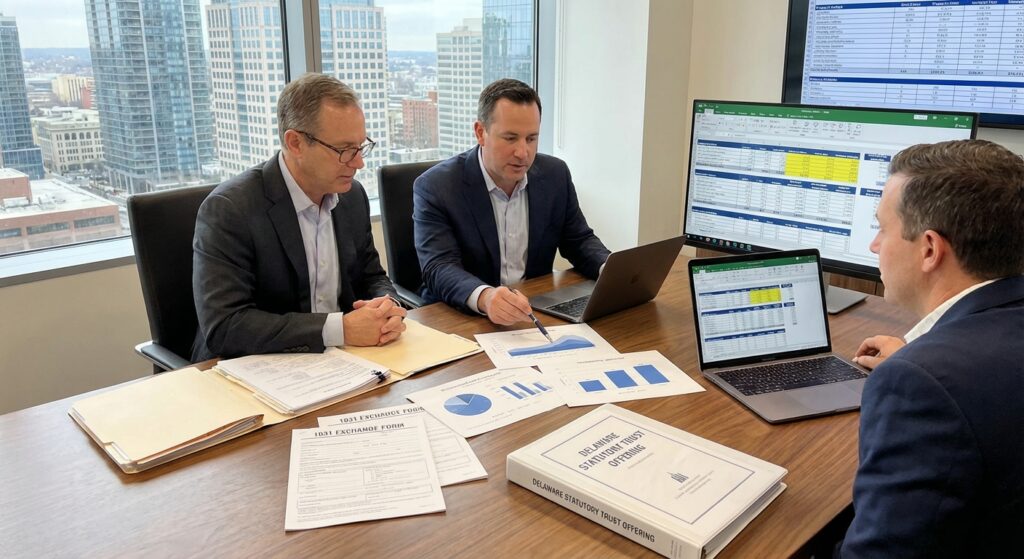
Delaware Statutory Trust 1031 Exchange Guide: 2026 Tax-Deferred Investment Strategy for Real Estate Investors
For the 2026 tax year, real estate investors seeking to defer capital gains taxes while transitioning to passive income-generating properties should explore Delaware statutory trusts (DSTs) within the 1031 exchange framework. A Delaware statutory trust 1031 exchange allows investors to swap appreciated real estate for professionally managed DST shares without triggering immediate tax liability. This strategy has become increasingly attractive as investors juggle market volatility, rising property management costs, and the desire for portfolio diversification across multiple properties.
Table of Contents
- Key Takeaways
- What Is a Delaware Statutory Trust?
- How Do 1031 Exchanges Work with DSTs?
- What Are the Tax Benefits of DST 1031 Exchanges?
- DST vs. Direct Property Ownership: Key Differences
- How Do You Evaluate DST Sponsors for Quality?
- What Are the Risks and Considerations?
- Uncle Kam in Action
- Next Steps
- Frequently Asked Questions
Key Takeaways
- Delaware statutory trusts are SEC-registered investment vehicles that allow investors to own fractional interests in professionally managed real estate.
- DSTs qualify for 1031 exchange treatment, enabling tax deferral on capital gains when exchanging appreciated real estate for DST shares.
- Investors eliminate day-to-day management responsibilities while maintaining depreciation deductions and passive income generation.
- Sponsor quality, property evaluation, and professional tax planning are critical to maximizing returns and minimizing tax exposure.
- State-level tax conformity on 1031 exchanges continues to evolve, requiring ongoing monitoring throughout 2026.
What Is a Delaware Statutory Trust?
Quick Answer: A Delaware statutory trust is an IRS-recognized entity that holds real estate on behalf of multiple investors, allowing fractional ownership with passive income and depreciation benefits.
A Delaware statutory trust (DST) is a special-purpose entity created under Delaware law to own and manage real property. The structure allows multiple individual investors to co-own properties—typically commercial real estate, multifamily apartments, industrial facilities, or net-lease retail properties—without forming a traditional partnership or corporation.
The DST holds title to the underlying real estate. Investors purchase beneficial interests (shares) in the trust, entitling them to a proportional share of rental income, depreciation deductions, and eventual sale proceeds. The trust is managed by a trustee (often the sponsoring company) who handles all operational decisions, tenant management, maintenance, and eventual disposition of the property.
Why Delaware Statutory Trusts Are Popular for 1031 Exchanges
The IRS recognizes DST interests as real property for purposes of IRC Section 1031 exchanges. This means an investor can exchange a directly held rental property (or farm, equipment, or other real property) for a beneficial interest in a DST. The transaction qualifies for tax deferral, allowing investors to reinvest capital that would otherwise go to federal and state taxes.
For busy real estate investors tired of managing tenants, repairs, and property-level decisions, a DST offers a pathway to passive real estate ownership. You maintain the tax benefits of property ownership while delegating day-to-day operations to professionals.
Key Characteristics of DSTs
- Professional Management: The trustee handles all property management, leasing, maintenance, and tenant communication.
- Fractional Ownership: Investors own a percentage interest in the trust, not the underlying property directly.
- Limited Control: Investors have minimal involvement in property decisions; governance is controlled by the trustee.
- Illiquidity: DST interests are not traded on secondary markets; exit requires waiting for a liquidation event or sale.
- SEC Registration: Larger DST offerings are typically registered with the Securities and Exchange Commission.
- Tax Pass-Through: Income, depreciation, and capital gains flow through to individual tax returns on Schedule K-1.
How Do 1031 Exchanges Work with DSTs?
Quick Answer: You sell your appreciated property through a qualified intermediary, identify replacement DST interests within 45 days, and complete the purchase within 180 days—allowing you to defer all capital gains taxes.
A 1031 exchange is a tax-deferred swap of real property. Under Internal Revenue Code Section 1031, if you exchange property held for business or investment use for other property of like-kind held for the same purpose, the gain is not recognized in the year of the exchange. This is one of the most powerful tax deferrals available to real estate investors.
The Tax Cuts and Jobs Act (TCJA) of 2017 eliminated the like-kind requirement for personal property but preserved it for real estate. The current standard is that any real estate (residential, commercial, industrial, land) is like-kind to any other real estate.
The 1031 Exchange Timeline
| Timeline Phase | Action Required | Deadline |
|---|---|---|
| Day 0 | Sale of relinquished property closes through qualified intermediary | Exchange begins |
| Day 1–45 | Identify replacement property (DST interests) to qualified intermediary | 45 days after close |
| Day 46–180 | Complete purchase of replacement property using exchange funds | 180 days after close |
| Day 181+ | File Form 8824 with 2026 tax return to claim exchange | By April 15, 2027 |
Critical Rules for Exchanging into DSTs
Several strict requirements must be met to ensure the exchange qualifies for tax deferral:
- Use a Qualified Intermediary: A third party holds the sale proceeds and facilitates the exchange. You cannot touch the funds.
- Like-Kind Property: DST interests in real property satisfy the like-kind requirement for all types of real estate.
- Equal or Greater Value: The replacement property (DST) should have value equal to or greater than the relinquished property to avoid boot recognition.
- Passive Investment: You cannot exchange into a DST that you manage or control actively. The trust must be independently managed.
- IRS Compliance: File Form 8824 with your 2026 tax return to report the exchange.
Pro Tip: Missing the 45-day identification period is a common mistake. Mark your calendar immediately after closing and work with your qualified intermediary and accountant to ensure timely identification.
What Are the Tax Benefits of DST 1031 Exchanges?
Quick Answer: You defer federal and state capital gains taxes, maintain depreciation deductions, and potentially create more passive cash flow while accessing more diversified properties.
The primary tax advantage of exchanging into a DST is the complete deferral of capital gains tax. Let’s explore the mechanics with a real example.
Capital Gains Tax Deferral Example
Suppose you own a rental property worth $1,000,000 with a basis of $400,000 (meaning your gain is $600,000). You’re considering selling and face:
- Federal long-term capital gains tax: 15–20% (depending on income)
- State tax: 0–13.3% (depending on state)
- Net Investment Income Tax (NIIT): 3.8% for high-income taxpayers
- Depreciation Recapture: 25% federal
Combined, taxes on a $600,000 gain could exceed $200,000 for a high-income investor in a high-tax state. By executing a 1031 exchange into a DST, you defer all of these taxes in the year of the exchange.
Did You Know? If you never sell the DST interest (or hold until death), the tax basis steps up, and your heirs inherit the property with a fresh basis—effectively wiping out the deferred gain tax.
Depreciation Benefits in DSTs
One critical tax advantage many investors overlook: you continue to claim depreciation deductions on your DST ownership interest. The trustee allocates the property’s depreciable basis (typically buildings, not land) proportionally to investors.
If you invest $500,000 in a DST, and the property has $3 million in depreciable improvements over a 27.5-year residential or 39-year commercial depreciation schedule, you’ll receive an annual depreciation deduction proportional to your investment. This flows through on your Schedule K-1 and reduces your taxable income each year.
Passive Activity Loss (PAL) Considerations
Because DST ownership is passive by definition (you have no active management), depreciation deductions and any losses are treated as passive. If you have passive income from other sources (other DSTs, partnerships, real estate), you can offset passive income with passive losses.
This can be highly advantageous for real estate investors with multiple holdings. However, if you have no passive income to offset, the passive loss limitation may suspend the deduction until you have passive gains or dispose of the asset.
 Free Tax Write-Off Finder
DST vs. Direct Property Ownership: Key Differences
Quick Answer: DSTs offer passive income and professional management but sacrifice control and liquidity; direct ownership offers full control but demands active management and operational responsibility.
| Feature | DST Ownership | Direct Property Ownership |
|---|---|---|
| Management | Professional trustee manages all operations | Owner or hired manager responsible |
| Control | Limited; trustee makes all decisions | Full control over property and tenant decisions |
| Liquidity | Illiquid; no secondary market | Can sell at any time in open market |
| Diversification | Can own fractional interests in multiple properties | Typically own one or few properties |
| Risk | Sponsor risk; property risk; market risk | Property risk; market risk; management risk |
| Depreciation | Claim share of building depreciation | Claim full depreciation deduction |
| Leverage | Limited; trustee controls financing | Owner can use leverage as desired |
| 1031 Eligible | Yes; like-kind real property | Yes; eligible as relinquished property |
How Do You Evaluate DST Sponsors for Quality?
Quick Answer: Review the sponsor’s track record, property quality, debt terms, property management expertise, investor protections, and fee structure.
Selecting the right DST sponsor is as critical as choosing the property itself. A poor-quality sponsor can erode returns, mismanage property, or face financial distress. Here’s how to evaluate:
Sponsor Track Record and Experience
- Years in Business: Favor sponsors with 15+ years managing DSTs and real estate.
- Assets Under Management: Look for sponsors managing $500 million+ in assets; size indicates stability.
- Historical Returns: Request documentation of actual (not projected) returns from prior offerings.
- Exit Track Record: Ask how many offerings have successfully exited and what the timeline was.
- Regulatory History: Check FINRA BrokerCheck and SEC databases for any enforcement actions.
Property Quality and Underwriting
- Property Type: Class A or B properties (newer, well-maintained) are preferable to Class C.
- Tenant Quality: National tenants (investment-grade tenants) with long lease terms reduce income risk.
- Market Conditions: Favor properties in strong markets with low vacancy rates and growing demand.
- Debt Terms: Inspect the loan structure—fixed rate, amortization period, prepayment penalties.
- Loan-to-Value Ratio: Lower LTV (50–65%) is better; it provides equity cushion for market downturns.
Pro Tip: Request the Offering Memorandum and Third-Party Property Report before investing. Read the risk factors section carefully. If the sponsor is unwilling to provide these, walk away.
Investor Protections and Fee Structure
- Acquisition Fees: Typically 2–4% of the offering; understand what services are included.
- Annual Management Fees: Usually 0.75–1.5% of assets; compare against industry standards.
- Disposition Fees: 1–2% upon sale of the property; this aligns incentives.
- Preferred Returns: Some offerings guarantee a preferred return (e.g., 5–7%); this protects investor priority.
- Sponsor Equity: Favor sponsors with meaningful skin in the game (typically 5%+ of the offering).
When evaluating real estate investment strategies, consider working with specialized real estate investment advisors to ensure DST selection aligns with your overall portfolio goals.
What Are the Risks and Considerations?
Quick Answer: Primary risks include illiquidity, sponsor dependence, limited control, market risk, leverage risk, and potential regulatory changes to 1031 exchange rules.
Illiquidity and Exit Challenges
Unlike direct property ownership, DST interests cannot be quickly sold on a secondary market. Your capital is locked in until the trust sponsors a liquidation or sale event—typically 7–10 years, though some offerings extend longer.
If you need to access capital before the exit, you face limited options: some sponsors allow redemptions (at a discount), but many do not. Ensure your cash flow and reserve accounts can sustain you without access to this capital.
Sponsor and Market Risk
Your returns depend entirely on the sponsor’s execution and market conditions. Poor property management, tenant loss, or market downturns can erode value. Unlike direct ownership, you have no recourse if the trustee underperforms.
Additionally, real estate markets are cyclical. A property that generates strong returns in a favorable market may underperform in a slowdown. Diversification across multiple DST properties can mitigate this risk.
Tax Law Changes and State Conformity
While 1031 exchanges remain viable for 2026, Congress has periodically proposed limiting or eliminating the exchange. Additionally, some states are decoupling from federal tax rules—for example, Washington D.C. and a few states have proposed limitations on 1031 exchange tax treatment.
Monitor state-level tax developments and maintain updated professional tax advisory relationships to stay informed of changes affecting your DST strategy.

Uncle Kam in Action: Real Estate Investor Defers $285,000 in Taxes with DST 1031 Exchange
Client Snapshot: Michael, a 58-year-old real estate investor from California, owned four rental properties across the state with a combined market value of $2.8 million. His original investment basis was $1.2 million, representing $1.6 million in unrealized gains.
Financial Profile: Michael had built substantial equity and was collecting roughly $180,000 annually in rental income. However, rising property taxes, ongoing maintenance costs, tenant turnover, and aging properties (some over 30 years old) were consuming increasing amounts of time and capital.
The Challenge: Michael wanted to consolidate his holdings into fewer, newer properties requiring less management and offering more predictable cash flow. A direct sale-and-reinvestment approach would trigger approximately $400,000 in federal and California state capital gains taxes, plus depreciation recapture, consuming roughly 17% of his equity. He’d be left with only $2.4 million to reinvest, significantly reducing his purchasing power.
The Uncle Kam Solution: We structured a 1031 exchange into two premium DST offerings: a $1.5 million allocation into an institutional-quality multifamily property in Austin, Texas, and $1.3 million into a net-lease industrial facility in Atlanta, Georgia. Both properties were sponsored by established firms with 20+ years of experience and strong historical returns.
Key benefits achieved:
- Deferred all capital gains taxes in year of exchange ($285,000 in combined federal and state taxes)
- Fully deployed $2.8 million in purchase power without tax reduction
- Reduced management burden to zero (professional trustees handle all operations)
- Maintained access to depreciation deductions (~$95,000 annually across both properties)
- Generated projected annual cash flow of $165,000 (8% yield on deployed capital)
- Achieved diversification across two property types and two markets
The Results: Michael eliminated the ongoing operational headaches of four direct properties. His schedule freed up significantly as property management responsibilities vanished. Additionally, his depreciation deductions of ~$95,000 annually provide passive activity losses that offset other passive income, delivering tax savings of $30,000+ annually.
Most importantly, the $285,000 in deferred taxes remained invested. Assuming 6% annual appreciation across the DST holdings, that deferred tax capital compounds at $17,100+ per year—creating an additional wealth-building opportunity.
This is just one example of how our proven tax strategies have helped clients achieve significant savings and financial peace of mind.
Next Steps
If you’re considering a DST 1031 exchange for 2026, take these immediate actions:
- Step 1: Calculate your unrealized gains on all appreciated properties using current fair market values and your original cost basis.
- Step 2: Consult with a qualified 1031 exchange intermediary to understand your specific timeline and requirements.
- Step 3: Work with a tax strategy professional to evaluate how DST ownership aligns with your overall tax picture and passive activity losses.
- Step 4: Review multiple DST sponsor offerings; request offering memorandums and property reports.
- Step 5: Schedule a review meeting to finalize your exchange timeline and ensure all parties (CPA, attorney, intermediary) are coordinated.
Frequently Asked Questions
Can I exchange a partial interest in a property into a DST?
Yes. If you own a property with other co-owners, you can exchange your individual interest into a DST. However, the property must be held in a form that allows you to transfer your specific share (e.g., tenancy in common, not joint tenancy). Coordinate with co-owners and a qualified intermediary to ensure compliance.
What happens if I can’t find a replacement DST within 45 days?
Missing the 45-day identification deadline disqualifies the exchange. The sale proceeds revert to you, and the full gain is recognized in the year of sale. You’ll owe capital gains taxes, depreciation recapture, and likely penalties. There is no extension for the 45-day deadline—it’s absolute. Work with your intermediary immediately upon closing.
Are DST investment distributions taxable?
Yes. Annual distributions are taxable to you based on the trust’s income. You’ll receive a Schedule K-1 showing your share of ordinary income, depreciation deductions, capital gains, and other items. However, depreciation deductions can offset the ordinary income, potentially resulting in a net loss (passive activity loss) for tax purposes.
Can I use a DST 1031 exchange if I have an adjustable-rate mortgage on my current property?
Yes, absolutely. The type of financing on your relinquished property doesn’t affect exchange eligibility. However, ensure your qualified intermediary accounts for any mortgage payoff proceeds as part of the exchange calculation. If the sale proceeds exceed the replacement property cost, the difference becomes boot and triggers tax.
What if the DST property declines in value? Can I get my investment back?
No. If the underlying property depreciates, your investment declines with it. You’re locked in until the trust’s liquidation event. This is one of the illiquidity and market risks of DST ownership. Diversifying across multiple DST properties in different markets and asset classes mitigates some of this risk.
Is a Delaware statutory trust DST different from a Delaware Limited Partnership DLP for 1031 exchanges?
Yes, structurally and operationally. Both DSTs and Delaware Limited Partnerships (DLPs) qualify for 1031 exchange treatment. However, DSTs typically offer more passive management and SEC regulation, while DLPs may offer different risk-sharing and control structures. Consult with your CPA or attorney on which structure best suits your situation.
Can I combine direct property purchases with DST investments in a single 1031 exchange?
Yes. You can exchange your relinquished property into a combination of direct property and DST interests. For example, invest 60% into a DST and 40% into a direct purchase. Both are like-kind real property. This hybrid approach gives you some control and liquidity (direct property) while maintaining passive income and management relief (DST portion).
Will state 1031 exchange rules change for 2026? Should I be concerned about California or New York tax conformity?
State-level 1031 treatment varies. While federal rules are stable for 2026, some states have discussed decoupling from 1031 exchange benefits or imposing additional taxes. California and New York have not eliminated 1031 treatment as of February 2026, but monitor legislative developments. Consult with a state-specific tax advisor if your property is in a jurisdiction with evolving rules.
How do I report a DST 1031 exchange on my 2026 tax return?
File IRS Form 8824 (Like-Kind Exchange) with your 2026 Form 1040. List the relinquished property, the replacement DST interests, the exchange date, and the qualified intermediary’s information. Your CPA and the qualified intermediary should coordinate to ensure accurate reporting.
Related Resources
- Comprehensive Tax Strategy Services for Real Estate Investors
- Real Estate Investor Tax Planning and Optimization
- See How We’ve Saved Real Estate Investors Thousands in Taxes
- IRS Official 1031 Exchange Guidelines
- SEC Database for DST Sponsor Filings and Enforcement History
This information is current as of 2/3/2026. Tax laws change frequently. Verify updates with the IRS or your state tax authority if reading this later.
Last updated: February, 2026

