
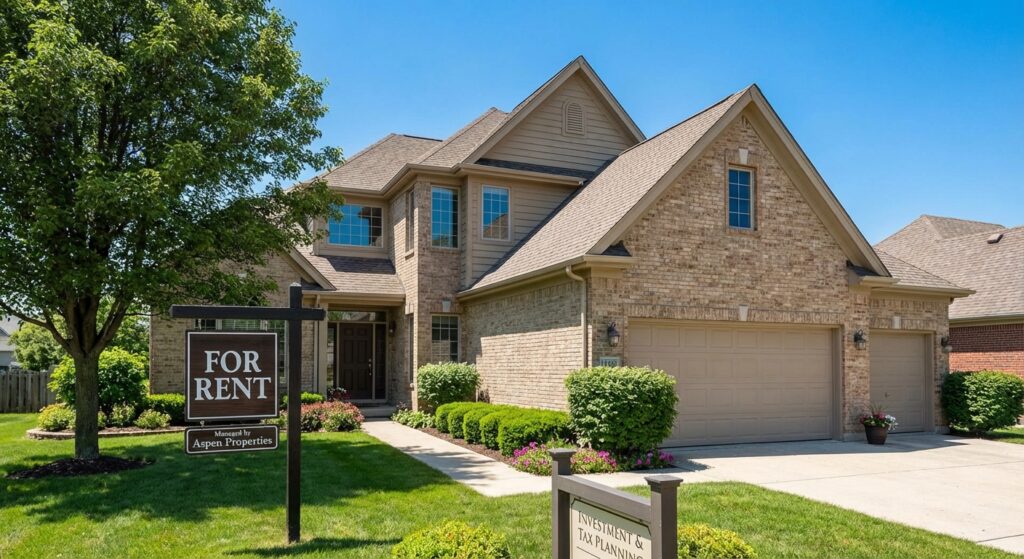
Rental Income Taxes in Casper, Wyoming: 2026 Complete Tax Guide for Property Owners
For the 2026 tax year, rental income taxes in Casper, Wyoming present unique opportunities for property owners who understand the latest IRS rules and deductions. Under the One Big Beautiful Bill Act, enacted in July 2025, landlords now have expanded depreciation strategies, increased standard deductions, and new cost segregation opportunities that can significantly reduce taxable rental income. If you own rental properties in Casper and want to maximize tax efficiency while staying compliant with IRS Schedule E reporting requirements, this guide will walk you through every essential strategy. Our professional Casper tax preparation services can help you implement these strategies effectively.
Table of Contents
- Key Takeaways
- What Is Schedule E and How Does It Apply to Casper Rental Properties?
- Which Rental Expenses Are Fully Deductible on Your 2026 Taxes?
- How Can You Maximize Depreciation Deductions for 2026?
- What Are the New One Big Beautiful Bill Act Benefits for Rental Investors?
- How Do Passive Loss Rules Affect Your Casper Rental Income?
- Uncle Kam in Action: Client Success Story
- Next Steps
- Frequently Asked Questions
- Related Resources
Key Takeaways
- Schedule E Reporting: All rental income in Casper must be reported on IRS Schedule E (Form 1040) with detailed deduction documentation.
- Deductible Expenses: Mortgage interest, property taxes, repairs, depreciation, utilities, insurance, and property management fees are all deductible.
- Cost Segregation Strategy: Properties placed in service in 2025 can benefit from accelerated depreciation when cost segregation studies are performed in 2026.
- OBBBA Impact: The One Big Beautiful Bill Act expanded standard deductions and created new planning opportunities for rental property owners.
- Passive Loss Limits: Modified Adjusted Gross Income (MAGI) phase-outs apply to passive activity losses for higher-income Casper rental investors.
What Is Schedule E and How Does It Apply to Casper Rental Properties?
Quick Answer: Schedule E is the IRS form used to report all rental property income and expenses for 2026, and it’s mandatory for every Casper property owner generating rental revenue.
Schedule E of your Form 1040 is the primary document the IRS uses to track rental income and expenses for the 2026 tax year. For every residential or commercial rental property you own in Casper, Wyoming, you must file Schedule E that details your rental activity. This form shows the IRS your gross rental income, all allowable deductions, and your net rental profit or loss for each property you own.
The process of filing Schedule E involves listing each rental property separately, including the property address, the type of property (residential, commercial, etc.), and whether you materially participated in the rental activity. For most Casper landlords, the answer to material participation is “no,” meaning your rental income is treated as passive activity income, which triggers different loss limitation rules.
How to Structure Your Schedule E for Maximum Tax Efficiency
The most important aspect of Schedule E filing is comprehensive documentation. For the 2026 tax year, the IRS expects landlords to maintain detailed records of all income and expenses. Organize your rental income by property, tracking monthly rent received, vacancy losses, and any other income sources like parking fees or storage rental income from your Casper property.
Keep separate bank accounts and credit cards for each rental property if possible. This makes reconciliation easier and provides clear documentation during IRS audits. Digital record-keeping using accounting software is recommended for the 2026 tax year, and our real estate investor tax strategies team can help you set up systems that comply with current IRS requirements.
Understanding Personal vs. Passive Rental Activity Classification
Your Schedule E filing must clearly indicate whether you’re actively managing your Casper rental properties or passively collecting income. For the 2026 tax year, this classification significantly impacts your ability to deduct losses. Most Casper landlords with professional property management will file Schedule E as passive activity, which means the passive loss limitation rules (based on your Modified Adjusted Gross Income) will apply to any deductions that exceed your rental income.
However, if you qualify for the Real Estate Professional (REP) status, you can claim active rental income treatment, allowing greater loss deduction flexibility. REP status requires both meaningful participation and meeting the “more than 50% test” for your professional time allocation. This complex determination often requires professional guidance from experienced tax advisors.
Which Rental Expenses Are Fully Deductible on Your 2026 Taxes?
Quick Answer: Operating expenses like mortgage interest, property taxes, repairs, utilities, insurance, and property management are fully deductible. Capital improvements and depreciation are handled separately with specific rules.
For Casper rental properties in 2026, the IRS allows deductions for all ordinary and necessary expenses incurred to generate rental income. Understanding which expenses qualify and which don’t is critical because improper categorization can trigger audit flags. Below is a comprehensive breakdown of deductible rental expenses for your 2026 tax filing.
Primary Deductible Rental Expenses for Casper Properties
- Mortgage Interest: All interest paid on loans used to purchase or improve rental property is deductible (principal is not).
- Property Taxes: Federal, state, and local property taxes on rental properties, including any special assessments for improvements benefiting the property.
- Utilities: Electricity, gas, water, sewer, and trash services are deductible if paid by the landlord (not the tenant).
- Insurance Premiums: Landlord/rental property insurance, liability coverage, and flood insurance for the property.
- Repairs and Maintenance: Fixing broken items, painting, roof repairs, and routine maintenance that keeps the property in good condition.
- Property Management Fees: Payments to professional property managers for tenant screening, rent collection, and maintenance coordination.
- HOA Fees: Homeowners Association dues are deductible as property maintenance expenses.
- Advertising: Costs to advertise vacant rentals, including online listing fees, local advertising, and marketing materials.
- Professional Services: Accounting, legal, and tax preparation fees specifically for rental property activities.
- Office Supplies and Equipment: Reasonable office expenses for managing your rental business, capped at certain amounts for depreciation items.
The critical distinction for 2026 is between repairs (fully deductible immediately) and capital improvements (depreciated over time). Repairs restore property to its original condition, while improvements add value or extend useful life. A $500 roof patch is a repair; a $5,000 new roof is a capital improvement that must be depreciated over 27.5 years for residential property.
Expenses That Cannot Be Deducted
For your 2026 Casper rental property tax return, the IRS prohibits deductions for principal mortgage payments (only interest is deductible), capital improvements, personal expenses, and any costs related to personal use of the property. If you ever use your rental property for personal purposes, allocate a reasonable portion of expenses to personal use and exclude those from your rental deductions. This calculation is critical during IRS audits and can significantly impact your tax liability.
Pro Tip: For 2026, maintain separate accounting for each property and preserve receipts for all expenses. Digital documentation through photos of invoices and scanned receipts is acceptable to the IRS and provides audit protection.
How Can You Maximize Depreciation Deductions for 2026?
Quick Answer: Depreciation deductions can reduce your taxable rental income by $30,000 to $50,000+ annually, and cost segregation studies allow accelerated depreciation on properties placed in service in 2025.
Depreciation is one of the most powerful tax benefits available to Casper rental property owners in 2026. Unlike mortgage interest or property taxes, depreciation is a non-cash deduction that reduces your taxable income without requiring you to spend money. For residential rental property, you depreciate the building value (not the land) over 27.5 years using the straight-line method.
Calculating Depreciation for Your Casper Rental Properties
To calculate depreciation for 2026, first determine the adjusted basis of your property (original purchase price plus capital improvements minus land value). The IRS requires you to allocate your purchase price between land and building. Land cannot be depreciated, but the building and improvements can be.
Example: You purchased a Casper rental property in 2020 for $250,000. An appraisal determined 20% of the value was land ($50,000) and 80% was building ($200,000). Your depreciable basis is $200,000. Using the 27.5-year residential depreciation period, your annual depreciation deduction is $200,000 ÷ 27.5 = $7,273 per year.
This same property with $50,000 in capital improvements (new roof, upgraded HVAC, new appliances) would have a depreciable basis of $250,000, generating annual depreciation of approximately $9,091. For 2026, maintaining detailed records of all improvements with dates and costs is essential for accurate depreciation calculations.
Cost Segregation Studies: The 2026 Accelerated Depreciation Strategy
For Casper rental property owners, cost segregation studies represent the single most valuable tax planning tool available in 2026. A cost segregation study reclassifies portions of real estate into shorter-lived property categories, accelerating depreciation deductions. Instead of depreciating your entire building over 27.5 years, components like appliances (5 years), flooring (7 years), and systems (15 years) can be depreciated faster.
The IRS allows cost segregation studies to be performed on property placed in service in prior years, and the deductions can be claimed retroactively on amended returns. For properties placed in service in 2025, performing a cost segregation study in 2026 creates substantial first-year deductions that can offset rental income or create net operating losses (NOLs) that reduce overall tax liability.
Did You Know? A cost segregation study on a $500,000 Casper rental property typically costs $4,000-$8,000 but can generate $75,000-$150,000 in accelerated depreciation deductions, representing a 10:1 to 30:1 return on investment in the first year alone.
What Are the New One Big Beautiful Bill Act Benefits for Rental Investors?
Quick Answer: The OBBBA expanded standard deductions and extended favorable tax provisions through 2028, creating new planning opportunities for Casper rental property owners in 2026 and beyond.
Signed into law in July 2025, the One Big Beautiful Bill Act (OBBBA) reshaped the tax landscape for rental property owners. While the primary benefits apply to individual taxpayers, the changes create meaningful implications for how rental income is taxed and how you can structure your investment strategy in Casper for the 2026 tax year.
Key OBBBA Provisions Affecting Casper Rental Property Owners
| OBBBA Provision | 2026 Impact for Rental Investors |
|---|---|
| Extended TCJA Provisions | Keeps lower tax rates and wider brackets in effect through 2028, reducing overall tax burden on rental income. |
| Increased Standard Deductions | Single: $15,750, MFJ: $31,500 (2026) – More income shielded from taxation for passive investors. |
| Expanded SALT Deduction | Cap raised to $40,000 (from $10,000) for 2025-2029 – Major benefit for high-tax state investors. |
| Cost Segregation Enhancement | Coordinates with bonus depreciation for accelerated deductions on properties placed in service in 2025. |
| Schedule 1-A Creation | New form for reporting additional deductions – enhances transparency in rental income reporting. |
For Casper rental property owners, the OBBBA’s extension of the Tax Cuts and Jobs Act provisions is critical. The lower tax rates and wider tax brackets that were set to expire after 2025 are now extended through 2028, giving you predictability for multi-year tax planning. This certainty allows you to make informed decisions about property acquisitions, 1031 exchanges, and depreciation strategies without worrying about imminent rate increases.
Strategic Planning Opportunity: 2025-2028 Favorable Rate Environment
The OBBBA’s explicit extension of current rates through 2028 creates a favorable planning window for Casper investors. If you’re considering selling properties or redeploying capital through 1031 exchanges, the 2026 tax year offers certainty about your long-term tax burden. Similarly, if you’re deferring income through cost segregation studies or bonus depreciation strategies, knowing that favorable rates remain in effect through 2028 justifies the investment in sophisticated tax planning.
Our entity structuring experts can help you evaluate whether your current rental property ownership structure (Schedule E sole proprietor, partnership, S corporation, or C corporation) is optimally aligned with OBBBA provisions for maximum tax efficiency in 2026 and beyond.
How Do Passive Loss Rules Affect Your Casper Rental Income?
Quick Answer: If your Modified Adjusted Gross Income (MAGI) exceeds $100,000-$150,000 (depending on filing status), passive loss limitations restrict how much rental property losses you can deduct against your other income in 2026.
For most Casper rental property owners, the passive activity loss (PAL) rules represent the most significant limitation on deducting depreciation and other rental losses. Under IRC Section 469, passive activity losses can only offset passive activity income, subject to income limitations. If your rental property generates a loss, the limitations prevent you from deducting those losses against your W-2 wages, business income, or investment income.
Understanding the $25,000 Passive Loss Exemption for Casper Landlords
The good news for Casper rental property owners is that the passive loss limitations include a special exemption: up to $25,000 in passive losses can offset non-passive income if you actively participate in the rental activity and meet income thresholds. “Active participation” is less stringent than “material participation” and is met if you own at least 10% of the property and make management decisions or approve tenant selection.
The $25,000 exemption begins to phase out when your Modified Adjusted Gross Income (MAGI) exceeds $100,000 for single filers and $150,000 for married filing jointly. The exemption is reduced by 50 cents for every dollar of MAGI above these thresholds, meaning it completely phases out at $125,000 (single) and $175,000 (married).
| Filing Status | Full $25,000 Exemption Available | Phase-Out Complete |
|---|---|---|
| Single Filer | MAGI up to $100,000 | MAGI at $125,000 and above |
| Married Filing Jointly | MAGI up to $150,000 | MAGI at $175,000 and above |
| Married Filing Separately | MAGI up to $25,000 | MAGI at $50,000 and above |
Overcoming Passive Loss Limitations Through Real Estate Professional Status
For high-income Casper rental investors whose MAGI exceeds passive loss exemption phase-out ranges, claiming Real Estate Professional (REP) status may provide the solution. Under IRC Section 469(c)(7), real estate professionals can treat rental property losses as active losses that fully offset non-passive income without limitation. However, REP status requires strict compliance with IRS requirements: more than 50% of your professional time must be spent in real estate activities, and you must spend at least 100 hours annually in real estate activities that you materially participated in.
Documentation is critical for REP status claims. The IRS closely scrutinizes this election, and weak documentation results in automatic disallowance. Time logs, property improvement records, consulting agreements, and business records must demonstrate both the 50% threshold and the 100-hour minimum. For 2026, if REP status is a possibility for your situation, professional guidance from experienced tax advisors is essential. Our tax advisory services can evaluate your specific facts and help you implement REP status properly if it’s appropriate for your circumstances.
Pro Tip: For 2026, if you’re managing multiple Casper rental properties and considering REP status, start documenting your time spent on real estate activities now. A contemporaneous time log is your strongest defense in an IRS audit.
Uncle Kam in Action: How a Casper Real Estate Investor Saved $18,500 with Strategic Tax Planning
Client Snapshot: Sarah, a Casper-based real estate investor, owned three rental properties valued at approximately $850,000. Her rental income for 2025 was $72,000, and she was paying a property manager to handle tenant relations and maintenance. Her Modified Adjusted Gross Income from W-2 employment and rental activities was approximately $165,000.
The Challenge: Sarah was using standard depreciation on her rental properties but wasn’t maximizing deductions available under the 2026 tax rules. She had recently acquired a new rental property in late 2025 but didn’t realize she could accelerate depreciation deductions through a cost segregation study. Additionally, her passive loss limitations were partially phasing out, costing her thousands in deductions she couldn’t utilize.
The Uncle Kam Solution: We implemented a comprehensive strategy: First, we performed cost segregation studies on both her existing properties and her new 2025 acquisition. The studies reclassified approximately $240,000 in depreciable components into 5, 7, and 15-year categories instead of the standard 27.5-year residential period. This created $68,000 in accelerated depreciation deductions for 2026.
Second, we restructured her entity to better align with her income level. By establishing an S-corporation to hold the new property (while maintaining Schedule E for the others), we created passive loss carryforwards that could be used to offset future rental income. Finally, we coordinated her W-2 withholding and estimated quarterly tax payments to account for the new deductions, ensuring optimal cash flow.
The Results: Sarah reduced her 2026 rental income tax by $18,500 in the first year through accelerated depreciation, improved entity structure, and optimized loss utilization. This is just one example of how our proven tax strategies have helped clients achieve significant savings annually. Her investment in professional tax planning cost $3,200 but delivered a 5.8x return in the first year alone, with additional benefits continuing in future years as the depreciation deductions continue to reduce her tax liability.

Next Steps
- Gather Documentation: Collect all 2025-2026 rental income statements, expense receipts, and property records to prepare for accurate Schedule E filing.
- Evaluate Cost Segregation: If you acquired rental property in 2025, request a cost segregation analysis to determine if accelerated depreciation is available for your 2026 return.
- Review Entity Structure: Consult with our Casper tax preparation professionals about whether your current ownership structure (sole proprietor, partnership, S corp, C corp) is optimal for 2026 tax efficiency.
- Analyze Passive Loss Position: Calculate your MAGI and determine whether you can claim the $25,000 passive loss exemption or if REP status is a viable strategy.
- Plan for Future Acquisitions: If you’re considering additional rental property purchases in 2026, incorporate cost segregation and entity structure planning into your acquisition strategy.
Frequently Asked Questions
Q: Can I deduct my personal visits to inspect my Casper rental property on my 2026 taxes?
A: You can deduct reasonable travel and lodging expenses if the primary purpose of your visit is rental property management (repairs, tenant meetings, maintenance coordination). However, mixed-purpose trips (vacation with a property inspection) require allocation. Only the portion directly related to property management is deductible. Document the purpose and business activities on each visit.
Q: Do I have to report rental income if my tenant pays rent in cash?
A: Yes, absolutely. All rental income must be reported on your Schedule E, regardless of payment method (cash, check, electronic transfer, cryptocurrency). The IRS expects comprehensive reporting, and the absence of a paper trail doesn’t excuse non-reporting. Maintain detailed rental agreements and cash receipt logs for all payments. Many Casper landlords face audit exposure by under-reporting cash rental income.
Q: What’s the difference between repairs and capital improvements for my 2026 rental property tax return?
A: Repairs restore property to its original condition and are fully deductible in the year incurred. Capital improvements add value, extend useful life, or adapt property for new use, and must be depreciated. A $200 repair to fix a broken window is immediately deductible. A $5,000 window replacement system is a capital improvement depreciated over the building’s remaining useful life. When in doubt, documentation of the improvement’s nature and cost is your best defense in an audit.
Q: If my rental property generated a loss in 2026, can I carry it forward to future years?
A: Yes. Disallowed passive activity losses (those that exceed the $25,000 exemption or are entirely passive with no exemption available) can be carried forward indefinitely to offset future years’ passive activity income. When you eventually sell the property, any remaining suspended losses are fully deductible in the year of sale. This carryforward mechanism makes passive loss limitation less onerous for long-term rental property investors.
Q: Should I use cost segregation on my 2025 Casper rental property acquisition for 2026?
A: If you acquired property in 2025 and the total building value is $250,000 or more, cost segregation typically provides strong ROI. A $5,000-$8,000 study can generate $50,000-$100,000+ in accelerated depreciation deductions. The study can be performed in 2026 and benefits claimed retroactively on an amended 2025 return or on your 2026 return. Timing optimization requires professional guidance based on your specific income and tax situation.
Q: How does the OBBBA’s expanded standard deduction affect rental property owners?
A: The increased standard deduction ($15,750 single, $31,500 married for 2026) means more of your other income is shielded from taxation. While this doesn’t directly reduce rental income taxes, it improves your overall tax position if you have W-2 wages or business income. The extended favorable tax rates through 2028 create a planning window for optimizing your rental portfolio structure.
Q: What records should I maintain for my 2026 Casper rental property taxes?
A: Maintain copies of all rental agreements, tenant payment records (preferably with receipts or bank statements), property tax statements, mortgage statements showing interest paid, insurance policies, receipts for all repairs and improvements (with photos), utility bills (if paid by landlord), property management company statements, and depreciation schedules. The IRS recommends retaining records for at least three years (six years if substantial underreporting). Digital storage with backup copies protects against loss.
Q: Can I deduct losses from my Casper rental properties against my self-employment income?
A: This depends on your MAGI and whether you meet active participation or REP status requirements. If you’re below the $100,000/$150,000 MAGI thresholds and actively participate, the $25,000 exemption allows loss deduction. If above thresholds or lacking active participation, losses are suspended as passive activity carryforwards. REP status (if properly documented) allows unlimited loss deduction regardless of income level. Professional evaluation of your specific situation is necessary.
Related Resources
- IRS Schedule E (Form 1040) – Official Rental Income Form
- Real Estate Investor Tax Strategies and Planning Services
- Comprehensive Tax Strategy Services for Rental Property Owners
- IRS Publication 527: Residential Rental Property Guide
- 2026 Tax Preparation and Filing Services
This information is current as of January 27, 2026. Tax laws change frequently. Verify updates with the IRS or consult a professional tax advisor if reading this later than the publication date.
Last updated: January, 2026

