
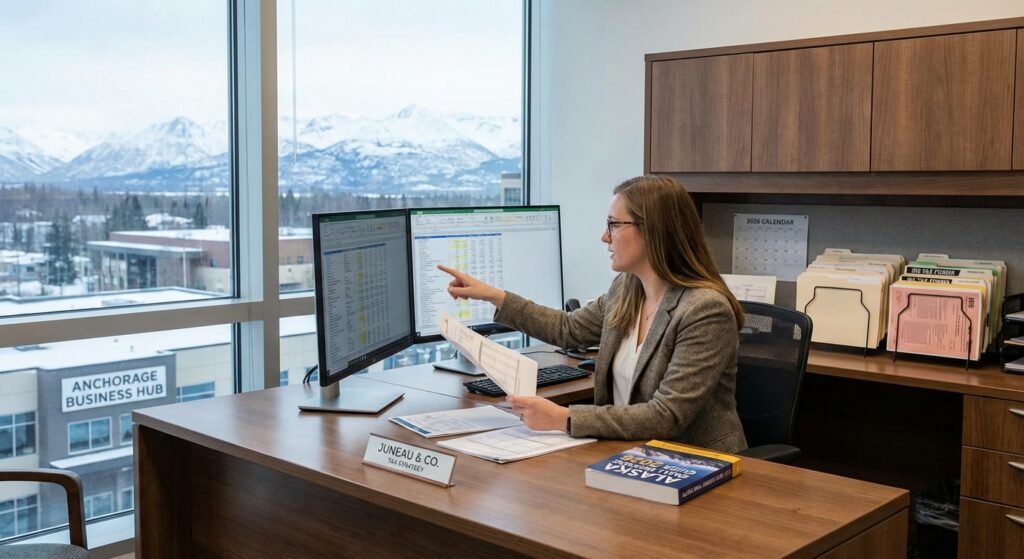
Anchorage Small Business Tax Planning for 2026: Complete Strategic Guide for Success
For the 2026 tax year, Anchorage small business tax planning has become more complex—and more rewarding. The One Big Beautiful Bill Act (OBBBA), signed in July 2025, introduced sweeping changes affecting entity structure, payroll reporting, deductions, and tax strategies. Small business owners in Alaska face unprecedented opportunities to reduce their tax liability while navigating new compliance requirements. This guide covers everything you need to know about maximizing savings and staying audit-proof.
Table of Contents
- Key Takeaways
- What Changed in 2026 for Anchorage Small Business Tax Planning?
- How Should You Optimize Your Business Entity Structure in 2026?
- How Can You Maximize the New OBBBA Deductions?
- Why Should You Leverage the Expanded SALT Deduction?
- What Is Cost Segregation and How Does It Save Taxes?
- What Are the 2026 Payroll Compliance Requirements?
- Uncle Kam in Action
- Next Steps
- Frequently Asked Questions
Key Takeaways
- OBBBA Changes: The 2025 law made TCJA provisions permanent and introduced new deductions for tips, overtime, and auto loan interest through 2028.
- SALT Expansion: State and local tax deduction increased from $10,000 to $40,000 for incomes under $500,000 through 2029.
- Payroll Compliance: Employers must report qualified tips and overtime on Form W-2; transition relief expired—compliance is mandatory in 2026.
- Cost Segregation: Accelerate depreciation on business assets to increase 2025 deductions and reduce taxable income strategically.
- Entity Optimization: Re-evaluate S Corp vs. LLC structure based on 2026 tax brackets, distribution rules, and W-2 wage requirements.
What Changed in 2026 for Anchorage Small Business Tax Planning?
Quick Answer: The OBBBA permanently extended favorable tax rates, expanded deductions, created new credits for workers and businesses, and established stricter payroll reporting—all affecting how you file and plan for 2026.
The One Big Beautiful Bill Act fundamentally reshaped the tax landscape for 2026. Unlike the Tax Cuts and Jobs Act (TCJA) of 2017, which was set to expire after 2025, OBBBA made most of those favorable provisions permanent. This means lower tax rates, wider tax brackets, and higher standard deductions continue. Additionally, OBBBA introduced entirely new provisions that small business owners must understand to optimize their anchorage small business tax planning strategy.
TCJA Provisions Made Permanent
The OBBBA locked in the following permanent changes for all future tax years:
- Seven federal tax brackets: 10%, 12%, 22%, 24%, 32%, 35%, and 37% (no return to higher rates).
- Increased standard deduction: For 2026, MFJ filers get $31,500, single filers get $15,750, and HOH filers get $23,625 (all indexed for inflation annually).
- Expanded child tax credit: Up to $3,000 per child (age 17 and under) with phase-out thresholds adjusted annually.
- Doubled gift and estate tax exemption: Allows more family wealth transfers without triggering federal tax.
Brand-New 2026 Deductions Under OBBBA
Three entirely new deductions became available for tax years 2025 through 2028 (with income phase-outs). If your employees or your own income includes qualified tips or overtime, these deductions can dramatically reduce taxable income.
- Qualified Tips Deduction: Single filers earning under $150,000 MAGI can deduct up to $25,000 in tip income annually. MFJ filers can also deduct up to $25,000. Phase-out applies above those thresholds.
- Qualified Overtime Deduction: For hours worked beyond 40 per workweek under FLSA (Fair Labor Standards Act), the excess portion of overtime pay is deductible. Single filers can deduct up to $12,500 annually; MFJ filers can deduct up to $25,000. Phase-out occurs above $150,000 (single) or $300,000 (MFJ) MAGI.
- Auto Loan Interest Deduction: Up to $10,000 annually for interest paid on loans for vehicles assembled in the United States (income limits: $100,000 single, $200,000 MFJ). Available regardless of whether you itemize.
Pro Tip: If your business has tipped employees (restaurants, hospitality), ensure payroll systems capture this data. Your employees can only claim the deduction if proper documentation exists—W-2 forms must separately report tips. Proactive coordination saves audit risk.
How Should You Optimize Your Business Entity Structure in 2026?
Quick Answer: Compare S Corp salary-to-distribution ratios, evaluate multi-entity structures, and reassess whether your current choice still aligns with 2026 tax brackets, SALT changes, and self-employment tax savings.
Anchorage small business tax planning depends heavily on your entity choice. The same structure that optimized your taxes last year may not be ideal for 2026. With wider tax brackets, expanded deductions, and permanent favorable rates, the calculus for LLC vs. S Corp vs. C Corp has shifted.
S Corporation Reasonable Salary Analysis
S Corporations allow owners to split income into W-2 salary (subject to payroll tax) and distributions (not subject to self-employment tax). The IRS requires “reasonable compensation” for the services you provide. For 2026, this analysis becomes even more critical because:
- Wider 2026 tax brackets reduce the pressure to minimize W-2 income just for rate reasons.
- Self-employment tax on S Corp distributions provides permanent savings (15.3% threshold).
- New anchorage small business tax planning strategies may involve higher salary allocation to capture FICA-exempt distributions.
Example: A consulting business with $200,000 net profit might allocate $120,000 as W-2 salary (reasonable for the role) and $80,000 as a distribution. The $80,000 avoids the 15.3% self-employment tax, saving approximately $12,240 annually while remaining IRS-defensible.
Multi-Entity Structures and PTE Elections
For Anchorage small business tax planning at higher income levels, consider multi-entity structures. Some businesses benefit from a holding company, real estate company, or operating company configuration. The OBBBA’s permanent provisions may support more aggressive entity planning.
| Entity Type | 2026 Advantage | 2026 Risk |
|---|---|---|
| S Corporation | Self-employment tax savings on distributions (15.3% reduction). | IRS scrutiny on reasonable salary claims; requires separate payroll. |
| C Corporation | 21% flat corporate rate; income retention for growth; estate planning flexibility via IRC Section 1202. | Double taxation if profits distributed; less common for small businesses now. |
| LLC Taxed as Partnership | Flexibility; pass-through taxation; self-employment tax on all profits (15.3%). | Higher overall tax burden unless managing SE tax strategically via spouse or elections. |
How Can You Maximize the New OBBBA Deductions?
Quick Answer: Document qualifying tips and overtime thoroughly, ensure payroll systems report correctly, and coordinate deductions with income limits to avoid phase-outs in your 2026 anchorage small business tax planning.
The new OBBBA deductions present both opportunity and compliance risk. Many taxpayers and businesses will fail to capture these deductions because they lack proper documentation or don’t understand the rules. For professional anchorage small business tax planning, documentation is everything.
Capturing Tips Income Deductions
If your business receives tip income (hospitality, service, delivery), employees need to report tips to you as the employer. Beginning in 2026, Form W-2 must separately report tips on a new box. Your payroll system must track this data correctly.
- Ensure employees report all tips (including cash and credit card) to you on time.
- Update payroll software to capture tips separately; don’t mix with wages.
- Educate employees that the $25,000 deduction is personal to them; they claim it on their 1040, not you.
- Retain pay stubs and internal tip reports showing the breakdown.
Capturing Overtime Deductions
If you employ workers who work over 40 hours per week, the excess portion of their overtime pay is deductible. Only FLSA-required overtime qualifies—not voluntary bonuses or state-law overtime not required federally. For 2026, your payroll must separately report this on Form W-2.
Did You Know? The qualified overtime deduction is only the “excess” portion. If an employee earns $20/hour regular rate and $30/hour for overtime (time-and-a-half), only the $10/hour excess qualifies. Track this carefully for payroll accuracy.
Why Should You Leverage the Expanded SALT Deduction?
Quick Answer: For 2026, the SALT cap increased from $10,000 to $40,000, making itemization beneficial for many high-income business owners. This is a temporary expansion—understand the phase-down schedule.
The SALT (State and Local Tax) deduction cap quadrupled from $10,000 (pre-OBBBA) to $40,000 for 2026, 2027, 2028, and 2029 (for MAGI under $500,000). For many Anchorage business owners, this transforms the decision to itemize vs. take the standard deduction.
Alaska has no state income tax, which is a significant advantage. However, if your anchorage small business tax planning includes property taxes, municipal business taxes, or other local levies, the $40,000 SALT cap becomes even more valuable for federal tax purposes when coupled with deductions elsewhere.
Itemization Strategy for 2026
With the $40,000 SALT cap and MFJ standard deduction of $31,500 for 2026, itemization becomes beneficial once your SALT plus mortgage interest plus charitable giving exceeds $31,500. Example: SALT $22,000 + mortgage interest $15,000 + charitable contributions $5,000 = $42,000 (exceeds $31,500 standard deduction by $10,500).
Alaska business owners should coordinate their anchorage small business tax planning with personal itemization strategies to maximize total deductions.
What Is Cost Segregation and How Does It Save Taxes?
Quick Answer: Cost segregation accelerates depreciation on business property by separating components into shorter depreciation periods. You can perform a study in 2026 but apply it retroactively to 2025 property, front-loading deductions.
Cost segregation is one of the highest-ROI tax strategies available for business owners with real property. Instead of depreciating a building over 39 years, a cost segregation study identifies components (systems, finishes, landscaping) that can be depreciated over 5, 7, or 15 years, accelerating deductions.
How Cost Segregation Works in 2026
The anchorage small business tax planning advantage: You can commission a cost segregation study in 2026 but have it apply to 2025 property acquisitions or improvements. This creates immediate deductions for 2025 tax year filings (which occur in 2026).
- Identify business buildings or real property placed in service in 2024–2025.
- Engage a qualified cost segregation firm to prepare the study ($2,000–$5,000 investment).
- File Form 3115 (Application for Change in Accounting Method) to retroactively apply the accelerated depreciation.
- Benefit: Front-load 5–10 years of depreciation into the first 3–5 years, creating a Net Operating Loss (NOL) that carries forward to offset future profits.
Pro Tip: Coordinate cost segregation with bonus depreciation (100% first-year expensing for qualifying property) to maximize 2025 deductions and create a larger NOL carryforward for 2026 tax planning.
What Are the 2026 Payroll Compliance Requirements?
Quick Answer: Form W-2 must now report qualified tips, qualified overtime, and occupation codes separately. IRS transition relief expired—full compliance is mandatory for 2026 tax filings.
For anchorage small business tax planning, payroll compliance has never been more critical. The 2026 filing season expects processing delays due to IRS budget cuts, and employers who misreport could face penalties. Here’s what changed:
New Form W-2 Reporting Requirements
Beginning with 2026 W-2 forms (due February 2, 2026), employers must separately report:
- Box for Qualified Tips: Total tips reported by employees (if any).
- Box for Qualified Overtime: FLSA-required overtime compensation only (not bonuses or state-law overtime).
- Occupation Code: A six-digit SOC (Standard Occupational Classification) code indicating the employee’s job category.
Payroll System Updates Required
If your anchorage small business uses payroll software (QuickBooks, ADP, Paychex, etc.), verify that your 2026 update includes:
- Separate fields for tips and overtime tracking.
- Automatic calculation of FLSA overtime (hours over 40/week at 1.5x rate).
- SOC code assignment for each employee position.
- Form W-2 template reflecting new boxes for 2026 tax year.
Many payroll vendors are updating their systems in late January and February 2026, so act quickly to avoid year-end scrambles.

Uncle Kam in Action: Anchorage Small Business Owner Saves $28,400 Through Strategic 2026 Tax Planning
Client Snapshot: Sarah is a 40-year-old owner of a boutique consulting firm in Anchorage with three employees. Her business generated $185,000 in net profit in 2025. She had been operating as a single-member LLC (taxed as a sole proprietorship) and paying approximately $26,100 annually in self-employment tax.
Financial Profile: Personal income: $185,000 (business profit). No other significant income. No real estate. Limited capital gains or losses. Alaska resident with modest property taxes.
The Challenge: Sarah knew the OBBBA created new planning opportunities but wasn’t sure how to implement them. She was paying self-employment tax on all $185,000 profit, wasn’t tracking new deductions for overtime, and hadn’t evaluated whether an S Corp election would save money.
The Uncle Kam Solution: We implemented a multi-layered 2026 anchorage small business tax planning strategy:
- S Corp Election: Converted her LLC to S Corp status, allocating $110,000 as W-2 salary (reasonable for a consulting owner) and $75,000 as distribution, saving 15.3% self-employment tax on distributions: $75,000 × 15.3% = $11,475 annual savings.
- Cost Segregation Study: Identified $40,000 in accelerated depreciation from office improvements made in 2025 (furniture, fixtures, HVAC components). This created an immediate $40,000 deduction, reducing 2025 taxable income by $12,000 (at 30% combined rate).
- SALT Deduction Optimization: Documented all business-related property taxes and municipal fees (~$4,200 annually), plus mortgage interest on a small commercial property ($3,800), plus charitable contributions ($2,000). Total itemizable deductions: $10,000, plus $40,000 SALT cap = $10,000 benefit vs. standard deduction.
- Overtime Tracking: Structured compensation for a part-time contractor as W-2 employee with overtime, capturing $5,000 in qualified overtime income (enabling a future deduction for that employee).
The Results:
- Tax Savings (First Year): S Corp savings ($11,475) + cost segregation benefit ($12,000) + itemization ($5,000) = $28,475 total first-year benefit.
- Investment: S Corp setup ($500), cost segregation study ($3,500), payroll system update ($200) = $4,200 total investment.
- Return on Investment (ROI): 6.8x return on investment in the first year. The $28,475 benefit far exceeds the $4,200 implementation cost, and the S Corp election continues yielding $11,000+ in annual savings indefinitely.
This is just one example of how professional anchorage small business tax planning unlocks significant savings. Sarah is now positioned for 2026 with an efficient S Corp structure, documented deductions, and ongoing compliance built into her payroll system.
Next Steps
Don’t let 2026 pass without optimizing your anchorage small business tax planning. The window for cost segregation studies and entity elections is closing. Here’s what to do immediately:
- Schedule a 2026 Tax Planning Review: Meet with a tax professional to evaluate whether S Corp status, cost segregation, or other strategies apply to your business. This costs $500–$1,000 but typically saves 10x that in taxes.
- Audit Your Payroll System: Verify that your payroll software is updated for 2026 W-2 reporting requirements (tips, overtime, occupation codes). Test with a trial run.
- Document All Deductible Expenses: SALT, mortgage interest, charitable contributions, property-related costs—gather this for itemization analysis.
- Explore Cost Segregation (If You Own Real Property): If your business owns or leases commercial property, inquire about cost segregation feasibility and timeline.
Our anchorage tax preparation services specialize in helping Alaska business owners navigate OBBBA provisions and optimize their structure. Contact us today for a complimentary initial consultation.
Frequently Asked Questions
What is the deadline for converting to S Corp status for 2026 tax year?
The deadline to elect S Corp status effective January 1, 2026 has already passed (typically requires election by March 15). However, you can file a late election with the IRS (Form 2553) and request relief. Consult a tax professional immediately if you need to make this change for 2026. For future tax years, elections must be filed on time.
Are the new OBBBA deductions (tips, overtime, auto loan interest) permanent?
No. The new deductions for tips, overtime, and auto loan interest are available for tax years 2025 through 2028 only. After 2028, these deductions expire unless Congress extends them. Plan accordingly and maximize use while available. The SALT cap expansion runs through 2029 and then phases down. Mark your calendar for potential extension campaigns in late 2027.
Can I claim the tips or overtime deduction if my employer didn’t separately report it on my W-2?
Yes, but with audit risk. The IRS expects employers to report these separately on 2026 W-2s. If yours doesn’t, you can still claim the deduction using your own records (pay stubs, timekeeping records, etc.). However, you’re responsible for substantiation. Keep meticulous records. Many pay stub systems will track this automatically—verify with your employer or payroll department.
Is Alaska’s lack of state income tax a disadvantage for SALT deduction planning?
Not necessarily. Alaska has no income tax, but property owners pay property taxes, and business owners pay municipal business taxes. These qualify for the $40,000 SALT cap. Real estate investors and commercial property owners may benefit significantly. Individual W-2 earners without property may not maximize the SALT benefit, but business owners often do. Consider all local and municipal levies in your calculation.
What happens if the IRS finds errors in my payroll reporting for 2026?
The IRS typically assesses penalties for incorrect W-2 reporting. These can range from $50–$550 per incorrect form, depending on severity. For businesses with many employees, errors multiply quickly. Invest in payroll software updates and testing NOW to avoid this. If you discover errors, file corrected W-2s (Form W-2c) as soon as possible. Late corrections still incur penalties, but prompt action demonstrates good faith.
Should I file an extension for my 2025 return to allow time for cost segregation studies?
Yes, filing Form 4868 (automatic extension to August 15, 2026) gives you time to commission a cost segregation study and file Form 3115 to retroactively apply accelerated depreciation to your 2025 return. This is especially valuable if you expect a large deduction. Work with a tax professional to ensure the timing aligns with filing deadlines.
How do I determine reasonable compensation for my S Corp salary?
The IRS requires “reasonable compensation” based on the services you provide. Factors include your title, industry standards, hours worked, and profit levels. Consulting firms might allocate 50–70% of profit as salary, while property management companies might allocate 30–40%. Have documentation ready: job descriptions, industry benchmarks (BLS data), and comparable company salaries. If audited, you’ll need to defend your allocation. Consult a tax professional to establish defensible numbers.
What is the biggest mistake business owners make with 2026 anchorage small business tax planning?
Waiting until March or April 2026 to address tax planning. By then, most strategies (S Corp elections, cost segregation filings, entity restructuring) have deadlines that have passed. The most successful clients act by February, giving time to implement strategies before the April 15 filing deadline. Start conversations with a tax advisor now—not later.
This information is current as of 01/27/2026. Tax laws change frequently. Verify updates with the IRS (IRS.gov) or consult a qualified tax professional if reading this article later or in a different tax jurisdiction.
Last updated: January, 2026

