
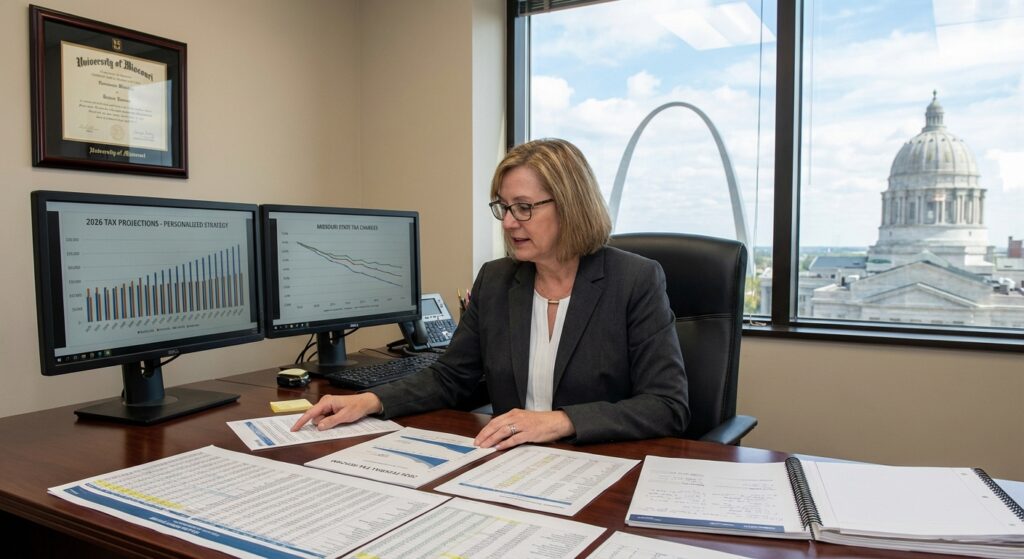
2026 Tax Changes: Your Complete Missouri Guide to New Deductions, Credits & IRS Deadlines
For the 2026 tax year, Missouri residents face one of the most significant tax law changes since 2017. The One Big Beautiful Bill Act of 2025 reshaped the federal tax landscape with new deductions, expanded SALT benefits, and substantial changes affecting refunds. Understanding these 2026 tax changes missouri brings will help you maximize savings and avoid costly errors. This guide covers everything you need to know—from filing your 2026 return to planning for years ahead.
Table of Contents
- Key Takeaways
- What Major Tax Changes Happened in 2026?
- What Are the New Deductions Available for 2026?
- How Does the Expanded SALT Deduction Impact You?
- What Is the New $6,000 Senior Deduction?
- Why Will Your 2026 Refund Be Bigger?
- What Challenges Will the IRS Face in 2026?
- Uncle Kam in Action
- Next Steps
- Frequently Asked Questions
Key Takeaways
- New deductions for tips, overtime, and auto loan interest save thousands for eligible filers.
- Seniors (65+) can claim an additional $6,000 deduction through 2028.
- SALT deduction cap increased to $40,000, benefiting Missouri property owners significantly.
- Expected refunds average $4,000+ due to withholding mismatches.
- File electronically and accurately to avoid IRS delays caused by budget cuts.
What Major Tax Changes Happened in 2026?
Quick Answer: The One Big Beautiful Bill Act permanently extended Tax Cuts and Jobs Act provisions. It added new deductions for tips ($25,000), overtime ($12,500), auto loan interest ($10,000), and seniors ($6,000). The SALT deduction cap jumped from $10,000 to $40,000.
The 2026 tax year marks a pivotal moment in federal tax policy. The One Big Beautiful Bill Act (OBBBA), signed into law in July 2025, fundamentally reshaped how Americans file taxes. This legislation made permanent the Tax Cuts and Jobs Act provisions that were set to expire. These include favorable tax brackets, an expanded standard deduction, and larger child tax credits.
Beyond extending existing benefits, the OBBBA introduced entirely new tax advantages. These provisions target specific taxpayer groups and situations. For example, workers earning tips or overtime now have above-the-line deductions. Vehicle owners financing purchases can deduct interest. These changes create significant planning opportunities for savvy filers.
The Tax Cuts and Jobs Act Extension
For years, taxpayers worried about tax increases when TCJA provisions sunset. The OBBBA eliminated this uncertainty. Lower tax brackets remain in place. The seven-bracket system (10%, 12%, 22%, 24%, 32%, 35%, 37%) continues protecting middle and upper-income earners. Standard deductions stay expanded, benefiting nearly all filers who don’t itemize.
This permanence creates planning certainty through 2030 and beyond. Families can confidently estimate tax liability. Business owners can structure transactions knowing bracket rates won’t spike unexpectedly. This stability alone represents significant value for long-term financial planning.
Did You Know? Without the OBBBA, millions of households would have faced automatic tax increases in 2026. The legislation saved middle-income families from potential bracket creep.
Temporary New Deductions (2025-2028)
The OBBBA introduced four major new deductions available through 2028. These above-the-line deductions reduce taxable income regardless of whether you take the standard deduction. This represents a historic change—previously, most taxpayers choosing standard deductions couldn’t claim certain specialized deductions.
Understanding which deductions apply to your situation is crucial. Claiming deductions you don’t qualify for triggers audit risk. Missing deductions you do qualify for costs real money. The details matter significantly in 2026.
What Are the New Deductions Available for 2026?
Quick Answer: New 2026 deductions include up to $25,000 for qualified tips, $12,500 for overtime pay, $10,000 for auto loan interest, and a $6,000 senior deduction for filers 65+. All include phase-out thresholds.
The OBBBA targets specific income sources and expenses that previously received limited tax relief. These new deductions recognize the realities of modern American work. Service workers, gig economy participants, and vehicle owners all benefit from these provisions.
Qualified Tips Deduction: Up to $25,000
The tips deduction represents a game-changer for servers, bartenders, hospitality workers, and other service professionals. For tax years 2025 through 2028, qualifying individuals can deduct up to $25,000 in annual tip income.
The deduction requires tips received from customers in professions historically identified as customarily receiving tips. The IRS provides specific guidance on qualifying professions. Tips must exceed income thresholds triggering phase-out rules for taxpayers with modified adjusted gross income above $150,000 (single) or $300,000 (joint filers).
Example: A server earning $35,000 in wages plus $18,000 in tips can deduct the full $18,000 in tips (below $25,000 limit), reducing taxable income to $53,000.
Qualified Overtime Deduction: Up to $12,500 (or $25,000 Joint)
Workers earning time-and-a-half overtime compensation can deduct the overtime portion of wages. The deduction applies to the excess over regular hourly rate. Maximum deduction is $12,500 per individual for 2025-2028, or $25,000 for joint filers.
Manufacturing workers, law enforcement officers, healthcare professionals, and others regularly working overtime can significantly benefit. The deduction requires qualifying overtime under Fair Labor Standards Act definitions. Employers report overtime wages on W-2 forms, simplifying documentation.
Example: A nurse earning 10 hours weekly overtime at 1.5x rate ($30/hour regular, $45/hour overtime) earns $7,800 annual overtime pay. She can deduct up to $7,800 (the $15/hour excess times hours worked).
New Vehicle Loan Interest Deduction: Up to $10,000
Car buyers who financed new vehicles after December 31, 2024 can now deduct loan interest. This is a historic change—personal vehicle interest hasn’t been deductible since the 1980s. The maximum annual deduction is $10,000 for interest payments on qualifying vehicles.
Qualifying vehicles must be new cars, minivans, SUVs, pickup trucks, or motorcycles with gross vehicle weight rating under 14,000 pounds. The vehicle must undergo final assembly in the United States. Financed through the 2028 tax year, the deduction phases out for taxpayers with income exceeding $100,000 (single) or $200,000 (married filing jointly).
Example: A buyer finances a $35,000 SUV at 6% interest over 60 months, paying $5,700 in year-one interest. She can deduct the full $5,700 (below the $10,000 limit).
Pro Tip: Track all vehicle financing documents carefully. Interest paid appears on your loan statements. Retain statements for tax return preparation and three years after filing.
How Does the Expanded SALT Deduction Impact You?
Quick Answer: The SALT deduction cap increased from $10,000 to $40,000 for 2025-2029. This benefits Missouri homeowners and business owners significantly. Phase-outs begin at $500,000 income.
The State and Local Tax (SALT) deduction cap increase represents one of the OBBBA’s most impactful provisions for property owners. Since 2018, the $10,000 SALT cap limited deductions for state income taxes and property taxes combined. For many high-tax-state residents, this meant losing deductions entirely.
Missouri taxpayers benefit considerably. The state income tax rate ranges from 1.4% to 5.3%. Combined with county and municipal property taxes, many homeowners now qualify for the increased deduction. The 2026 tax changes missouri brings expanded SALT benefits worth hundreds or thousands of dollars for homeowners.
Phase-Out and Income Limits
The $40,000 SALT deduction cap begins phasing out for taxpayers with modified adjusted gross income (MAGI) exceeding $500,000. Phase-out thresholds increase slightly each year through 2029. Above $500,000 MAGI, the deduction reduces gradually until it returns to $10,000 in 2030.
For most Missouri residents, the $500,000 threshold poses no issue. Households earning below this amount can claim the full $40,000 SALT deduction. This represents a three-fold increase from prior-year limitations.
| Income Level | SALT Deduction Availability |
|---|---|
| Below $500,000 MAGI | Full $40,000 deduction (2025-2029) |
| $500,001-$550,000 MAGI | Partial deduction (phase-out begins) |
| $550,000+ MAGI | Limited or $10,000 cap applies |
Planning Implications for Missouri Residents
Missouri residents with significant state and property tax burdens should plan accordingly. The expanded deduction remains temporary, reverting to $10,000 in 2030. Strategic timing of income recognition or timing of estimated state tax payments can optimize benefit capture.
Business owners paying Missouri state taxes through pass-through entities may benefit from specific entity tax elections. These strategies allow additional SALT deduction opportunity at the entity level. Our comprehensive 2026 tax law changes guide details entity-level planning strategies.
What Is the New $6,000 Senior Deduction?
Quick Answer: Taxpayers 65+ can claim an additional $6,000 deduction ($12,000 married filing jointly) for 2025-2028. The deduction phases out above $75,000 MAGI (single) or $150,000 (married).
The new senior deduction represents recognition of the financial needs of older Americans. Many seniors rely on fixed income including Social Security, pensions, and investment returns. The $6,000 deduction provides meaningful tax relief, allowing seniors to reduce taxable income regardless of whether they itemize deductions.
The deduction applies to taxpayers age 65 or older at the end of the tax year. It’s available whether filing single, married filing jointly, or head of household status. The $6,000 amount is available for individuals; married couples filing jointly can claim $12,000 combined.
Income Phase-Out Thresholds
The senior deduction begins phasing out for taxpayers with modified adjusted gross income exceeding $75,000 (single) or $150,000 (married filing jointly). The phase-out reduces the deduction gradually until eligibility disappears completely at $175,000 MAGI (single) or $250,000 (married).
Example: A single filer age 68 with $80,000 MAGI ($5,000 above threshold) loses partial deduction. At $175,000 MAGI, the deduction disappears entirely.
Pro Tip: Don’t view the senior deduction as Social Security tax relief only. It reduces any income type—interest, dividends, capital gains, or pension income. Strategic withdrawal timing can preserve this deduction.
Why Will Your 2026 Refund Be Bigger?
Quick Answer: The IRS didn’t update withholding tables to reflect 2025 OBBBA changes. This created a “withholding mismatch”—most employees paid more tax than required. Refunds averaged $3,052 in 2025; 2026 could exceed $4,000.
One of the most significant 2026 tax changes missouri brings involves refund sizes. The federal government intentionally delayed withholding table updates. This administrative decision created windfalls for millions of taxpayers. Without withholding adjustments, employees overpaid taxes throughout 2025 on expanded deductions and new tax breaks they qualified for.
When taxpayers file 2026 returns (for 2025 income), the refund calculations reflect actual tax liability under new law. Larger refunds result when actual liability falls below withholding. Estimated increases of $1,000 compared to recent years appear realistic for many filers.
Who Benefits Most from Larger Refunds?
Middle-income households (earning $50,000-$150,000 annually) see the most substantial refund increases. Families with children benefit from expanded child tax credits. Workers with tip or overtime income gain from new deductions. Homeowners with significant state and property taxes benefit from expanded SALT deductions.
Higher-income taxpayers may see smaller increases due to phase-out thresholds. Lower-income filers already paying little tax see minimal change. Strategic planning allows savvy taxpayers to maximize refunds while capturing current-year benefits.
Withholding Adjustment Going Forward
The IRS will eventually update withholding tables. When this occurs, employees receive more net pay throughout the year. However, future refunds likely decrease. The 2026 refund bump represents a one-time benefit from timing mismatch between law enactment and withholding updates.
What Challenges Will the IRS Face in 2026?
Quick Answer: The IRS expects 164 million returns in 2026 with a 9% budget cut ($11.2B vs. 2025’s $12.3B). Reduced staff combined with complex new deductions creates delays and processing backlogs.
The 2026 tax season promises challenges for both taxpayers and the IRS. The agency navigates historic headwinds: staffing reductions, budget cuts, and unprecedented complexity from new tax law provisions. Understanding these challenges helps taxpayers plan accordingly.
IRS Budget and Staffing Constraints
Congress allocated $11.2 billion to the IRS for remainder of fiscal 2026. This represents a 9% decline from 2025’s $12.3 billion budget. Reduced funding translates directly to fewer staff members processing returns and answering taxpayer questions.
The agency expects approximately 164 million individual returns during the 2026 filing season. That’s more returns per employee than prior years. Some tax professionals warn the 2026 season could be “turbulent” with potential delays in refunds and increased error-flagging for returns requiring manual review.
Complexity of New Deductions Drives Errors
The new deductions increase opportunities for mathematical errors and documentation issues. Taxpayers claiming tips, overtime, auto interest, or senior deductions must track qualifying income carefully. Missing documentation or inaccurate calculations trigger IRS review.
Returns flagged for processing delays average 30+ days beyond standard 21-day processing. Paper-filed returns take substantially longer. Refunds tied up in processing create hardship for some households.
| Filing Method | Expected Processing Time | Risk of Delay |
|---|---|---|
| Electronic (accurate) | 21 days | Low |
| Electronic (errors) | 30-60 days | High |
| Paper filed | 45-90+ days | Very High |
Pro Tip: File electronically with accuracy as your top priority. E-filed, error-free returns receive refunds within 21 days. This is the single most important factor controlling refund timing.

Uncle Kam in Action: Self-Employed Contractor Saves $18,500 Using 2026 Deductions
Client Snapshot: Michelle is a 68-year-old independent consultant in Kansas City, Missouri. She earns approximately $95,000 annually through consulting work and part-time bartending. She’s never worked with a tax strategist before, leaving money on the table.
Financial Profile: Consulting income of $70,000 and bartending tips of $25,000 annually. Social Security income of $24,000. Total MAGI approximately $95,000. She had been filing basic 1040 returns, claiming standard deduction only.
The Challenge: Michelle didn’t realize the 2026 tax changes missouri brought would benefit her significantly. She was familiar with “no tax on tips” messaging but didn’t understand how to claim the deduction. Her prior tax returns missed substantial opportunities because she lacked proper guidance on new OBBBA provisions.
The Uncle Kam Solution: Our team completed comprehensive planning analysis. We identified three major opportunities: (1) Senior deduction of $6,000, (2) Tips deduction of $25,000 (her actual tip income), and (3) Strategic income management to stay within phase-out thresholds. We documented her qualifying tip income and created a systematic tracking process for future years.
The Results:
- Tax Savings: $18,500 in combined federal and state tax savings through 2026 return (using 2026 tax rates of 24% federal plus 5.3% Missouri state rate on reduced taxable income)
- Investment: $3,200 one-time tax planning and preparation fee
- Return on Investment (ROI): 5.8x return on investment in the first year ($18,500 savings ÷ $3,200 investment)
This is just one example of how our proven tax strategies have helped clients achieve significant savings through strategic 2026 tax planning.
Next Steps
Understanding 2026 tax changes missouri brings is foundational. Maximizing benefits requires proactive planning:
- Assess Deduction Eligibility: Determine which new deductions apply to your situation. Document qualifying income systematically.
- Review Withholding: Check W-4 forms to ensure appropriate withholding. Adjust if needed to capture maximum refund benefit.
- File Electronically: E-filing ensures fastest refund processing. Accuracy prevents IRS delays and additional burden.
- Consult a Tax Professional: New deductions create complexity. Professional guidance prevents costly errors and identifies strategies you might miss.
- Plan for 2027 and Beyond: Most new deductions expire after 2028. Strategic planning today captures maximum benefit before sunset.
Frequently Asked Questions
Will my 2026 refund definitely be bigger than previous years?
Not necessarily. Refund size depends on your individual situation. If you benefited from 2025 OBBBA deductions and withholding wasn’t adjusted, likely yes. However, some taxpayers see minimal changes or potential smaller refunds if their income changed or they no longer qualify for certain deductions. The $1,000 average increase applies broadly, but individual experiences vary substantially.
How do I qualify for the tips deduction?
You must work in a profession customarily receiving tips. The IRS provides specific guidelines identifying qualifying occupations (servers, bartenders, bellhops, etc.). Tips must be reported on your tax return. The deduction is limited to $25,000 annually through 2028, with phase-outs beginning at $150,000 MAGI (single) or $300,000 (married filing jointly).
What happens to these new deductions after 2028?
The tips, overtime, auto loan interest, and senior deductions expire after December 31, 2028. Congress may extend or make these provisions permanent, but that’s uncertain. Plan accordingly by capturing maximum benefit during available years. Consider accelerating income or deferring expenses strategically during the 2025-2028 window.
How does the SALT deduction cap phaseout affect high earners?
For taxpayers with MAGI above $500,000, the SALT deduction begins phasing out. The reduction continues until the deduction returns to $10,000. High-income earners should model the impact carefully. Strategic charitable giving, pass-through entity elections, or income deferral strategies may preserve deduction value.
Should I file electronically if I’m worried about accuracy?
Yes. Electronic filing with a qualified tax professional is preferable. E-filing validates data format and catches certain errors before submission. Professional review ensures accuracy. The combination delivers faster processing and minimizes audit risk. Paper filing lengthens processing times significantly during peak season.
Can I claim multiple new deductions on the same return?
Yes, if you qualify for each deduction individually. A server earning $22,000 in tips who also paid $8,000 auto loan interest can claim both deductions (below their individual limits). A senior with $15,000 overtime income and $6,000 qualifying senior status can combine deductions. Documentation for each deduction is crucial.
This information is current as of January 24, 2026. Tax laws change frequently. Verify updates with the IRS or a tax professional if reading this later in 2026 or beyond.
Related Resources
- Complete 2026 Tax Strategy Planning Guide
- Tax Planning for Business Owners
- Self-Employed Tax Deductions and Strategies
- Advanced Tax Planning for High-Income Earners
- Professional Tax Advisory Services
Last updated: January, 2026

