
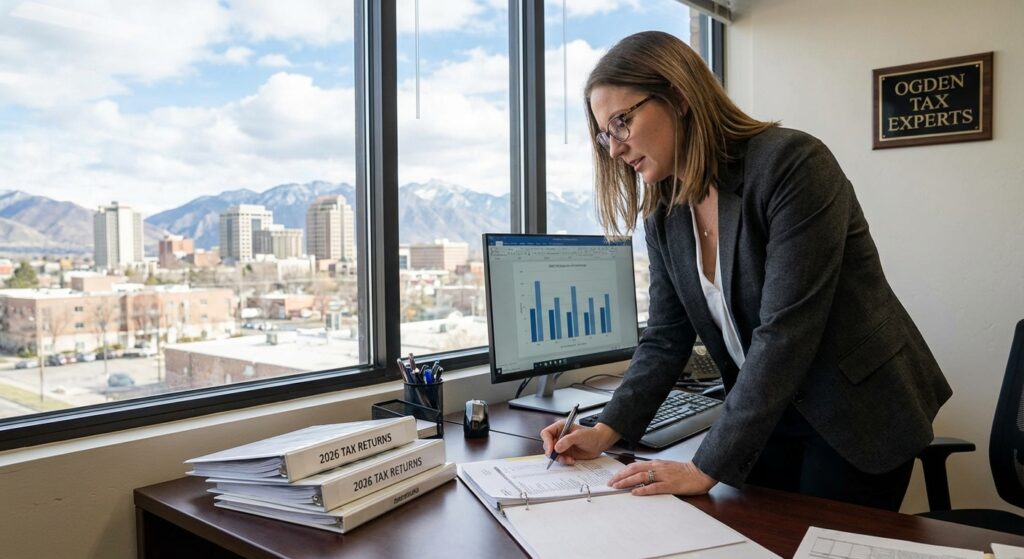
2026 Ogden Tax Return Preparation Cost: What to Expect This Filing Season
The 2026 Ogden tax return preparation cost has become increasingly relevant as the IRS faces a 9% budget reduction and simultaneously implements major new tax law changes under the One Big Beautiful Bill Act (OBBBA). For Ogden residents and business owners, understanding the true value of professional tax preparation and filing services is essential in navigating a challenging filing season. This comprehensive guide explains 2026 tax preparation costs, what drives pricing, and why expert guidance has never been more valuable.
Table of Contents
- Key Takeaways
- What Drives 2026 Ogden Tax Return Preparation Costs?
- How IRS Budget Cuts Impact Your 2026 Filing Season
- New 2026 Deductions Are Increasing Tax Complexity
- Cost Comparison: DIY Tax Filing vs Professional Preparation
- Maximizing Deductions While Minimizing Tax Preparation Costs
- Uncle Kam in Action: Ogden Business Owner Saves $18,900
- Next Steps
- Frequently Asked Questions
- Related Resources
Key Takeaways
- 2026 Ogden tax return preparation costs range from $250-$1,500+ depending on complexity, reflecting new OBBBA deductions and IRS challenges.
- The IRS budget of $11.2 billion (down 9%) creates processing delays; professional preparation minimizes audit risk and refund delays.
- New deductions for seniors ($6,000), tips ($25,000), and overtime ($12,500) create complexity; professional guidance ensures you claim what you’re entitled to.
- Professional tax preparation often pays for itself through deduction optimization and error prevention in the 2026 filing season.
What Drives 2026 Ogden Tax Return Preparation Costs?
Quick Answer: 2026 tax return preparation costs in Ogden vary from $250 for simple returns to $1,500+ for complex business returns, driven by new deductions, filing complexity, and the need for error prevention during a challenging IRS season.
The cost of professional tax return preparation in Ogden depends on several key factors. A standard individual return with W-2 income and basic deductions typically costs between $250-$400. However, returns involving self-employment income, multiple rental properties, or new OBBBA deductions often range from $600-$1,200 or more.
For 2026 specifically, tax preparation professionals are charging premium rates due to the unprecedented complexity introduced by President Trump’s One Big Beautiful Bill Act. This legislation created entirely new deduction categories that didn’t exist in previous years, requiring specialized knowledge and careful documentation.
Complexity Factors That Increase 2026 Ogden Tax Return Preparation Cost
- Business Entity Type: Sole proprietors, S Corp owners, and LLC members face different filing requirements and tax optimization opportunities, increasing preparation complexity.
- OBBBA Deduction Claims: New deductions for seniors, tips, overtime, and auto loan interest require meticulous documentation and income verification, adding preparation time.
- Income Level and Sources: Multiple income streams (W-2, 1099, rental, investment) increase filing complexity significantly compared to simple single-income returns.
- State Tax Considerations: Utah’s tax environment requires integrated federal-state planning, adding another layer of complexity to Ogden filers’ returns.
- Estimated Tax Adjustments: Withholding mismatches from 2025 payroll may require recalculation and planning for 2026, extending preparation time.
Average 2026 Tax Preparation Cost Breakdown by Return Type
| Return Type | 2026 Ogden Estimated Cost Range | Key Complexity Factors |
|---|---|---|
| Simple W-2 Individual Return | $250-$400 | Single income source, standard deduction |
| Return with OBBBA Deductions | $400-$650 | Senior, tips, overtime, or auto interest deductions |
| Self-Employed / 1099 Return | $600-$900 | Schedule C, self-employment tax, estimated tax adjustments |
| Small Business (LLC/S Corp) | $800-$1,500 | Entity return plus personal return, K-1 allocation, salary optimization |
| Real Estate Investor | $900-$1,800 | Multiple properties, depreciation, cost segregation planning |
These cost ranges reflect 2026 market conditions in Ogden and surrounding Utah communities. Prices may vary based on individual practitioner experience, firm reputation, and the specific level of planning and optimization you require.
How IRS Budget Cuts Impact Your 2026 Filing Season
Quick Answer: The 2026 IRS budget of $11.2 billion (down 9% from 2025’s $12.3 billion) means slower processing, increased audit complexity, and higher value from professional tax preparation to ensure accuracy and timely refunds.
Congress approved an IRS budget of $11.2 billion for fiscal year 2026, representing a 9% reduction from the previous year. This budget cut comes as the agency faces implementing unprecedented tax law changes while simultaneously processing approximately 164 million individual tax returns during the 2026 filing season.
The consequences of this reduced budget are significant for Ogden taxpayers. The IRS workforce has already declined by more than 25% due to previous hiring freezes and buyouts. With fewer staff and limited resources, the agency must prioritize its operations, which typically means slower processing of paper returns, longer phone wait times, and increased scrutiny of returns flagged for mathematical errors or inconsistencies.
Processing Delays and Refund Timeline Risks
The IRS typically processes electronically filed returns within 21 days. However, returns flagged for any reason—including mathematical errors, missing information, or new deductions the IRS views as unusual—can take significantly longer. Tax experts warn that the 2026 filing season could see widespread delays, particularly for returns claiming new OBBBA deductions that the IRS may not yet have fully integrated into its processing systems.
Professional tax preparation minimizes this risk by ensuring your return is mathematically accurate, properly documented, and filed electronically (which is faster and more reliable than paper filing). When preparation errors or omissions occur, they can delay your refund by weeks or even months during a season when cash flow matters most.
Pro Tip: File your 2026 return electronically as early as possible. Ogden residents who file in early February typically receive refunds by mid-March, while those filing in April often wait until late May or June due to IRS processing backlogs.
Why the 2026 Filing Season Will Be “Bumpy”
Tax experts, including Janet Holtzblatt from the Urban-Brookings Tax Policy Center, have warned that taxpayers should “buckle your seatbelts” for the 2026 filing season. The combination of budget constraints, workforce reductions, and the complexity of new tax deductions creates a perfect storm of challenges for both taxpayers and the IRS.
The IRS must simultaneously handle the normal volume of returns while implementing new forms (including Form 4547 for Trump Accounts) and providing guidance on deductions that many taxpayers have never claimed before. This operational strain makes professional tax preparation even more valuable, as experienced preparers can navigate these complexities more efficiently than individual taxpayers attempting DIY filing.
New 2026 Deductions Are Increasing Tax Complexity
Quick Answer: OBBBA introduced five major new deductions for 2026: senior deduction ($6,000), qualified tips ($25,000), qualified overtime ($12,500), auto loan interest, and expanded charitable deductions—each with specific eligibility rules and documentation requirements.
The One Big Beautiful Bill Act fundamentally changed the 2026 tax landscape by introducing several new deductions that are creating significant complexity. Understanding these deductions is essential for Ogden residents because claiming them incorrectly or missing them entirely can cost thousands of dollars in unnecessary taxes.
The New $6,000 Senior Deduction for 2026
Taxpayers age 65 and older can claim an additional deduction of $6,000 ($12,000 if married filing jointly) for the 2026 tax year. This deduction is available in addition to the standard deduction and applies regardless of whether you itemize or claim the standard deduction. For married couples with combined income of $150,000 or less, this represents an immediate reduction in taxable income and potentially $1,000-$2,000 in federal tax savings per year.
However, the deduction phases out for higher-income seniors. Single filers with modified adjusted gross income (MAGI) over $75,000 begin losing the deduction, with complete phase-out above $175,000. Married filing jointly filers experience phase-out above $150,000 MAGI, with complete loss above $250,000. Many Ogden seniors don’t realize they’re subject to these thresholds and can benefit from professional guidance on income management strategies.
Qualified Tips and Overtime Deductions
Service industry workers and salaried employees earning overtime can now deduct these amounts directly from their income. The maximum qualified tips deduction is $25,000 per individual, while qualified overtime (the “half” portion of time-and-a-half compensation) maxes out at $12,500 per individual ($25,000 if married filing jointly).
The complexity here is substantial. Employees must properly document and report tip income on their W-2 forms, and employers must ensure their payroll systems track this information correctly. Many Ogden workers are discovering these deductions for the first time and don’t understand the documentation requirements, making professional tax preparation invaluable.
Did You Know? The IRS has specifically warned that many taxpayers will claim these new deductions incorrectly in 2026, potentially resulting in flagged returns and refund delays. Professional preparation reduces this risk dramatically.
Auto Loan Interest and Expanded Charitable Deductions
For the first time, taxpayers can now deduct personal auto loan interest, subject to specific limits and income thresholds. Additionally, non-itemizers can claim an additional $1,000 charitable deduction ($2,000 if married filing jointly), allowing more Ogden residents to benefit from charitable giving even if they don’t itemize deductions.
These deductions all require careful documentation and understanding of eligibility rules. A mistake or omission can cost taxpayers hundreds of dollars. Professional tax preparation ensures you claim every deduction you’re entitled to while avoiding overclaiming that could trigger IRS scrutiny.
Cost Comparison: DIY Tax Filing vs Professional Preparation
Quick Answer: DIY tax software costs $60-$200 but offers minimal guidance on new deductions; professional preparation costs $250-$1,500 but typically saves $1,000-$5,000+ through deduction optimization, error prevention, and audit protection.
The surface-level math suggests DIY tax filing is cheaper. However, when you factor in the actual value—including deduction optimization, error prevention, and the cost of fixing mistakes—professional tax preparation frequently pays for itself many times over.
| Factor | DIY Tax Software | Professional Preparation |
|---|---|---|
| Direct Cost | $60-$200 | $250-$1,500+ |
| Time Investment | 8-20 hours | 1-2 hours (client coordination) |
| OBBBA Deduction Guidance | Limited; trial-and-error | Expert guidance; optimized claims |
| Audit Risk | Higher (errors or missed deductions) | Lower (professional standards) |
| Refund Delay Risk | Higher (math errors flag returns) | Lower (accuracy minimizes flags) |
| Potential Tax Savings | $0-$500 (if you find deductions) | $1,000-$5,000+ (through optimization) |
For Ogden residents with simple returns, DIY software may be adequate. However, for anyone claiming new OBBBA deductions, running a business, or earning over $100,000, professional preparation typically delivers a strong return on investment through deduction optimization and error prevention alone.
Maximizing Deductions While Minimizing Tax Preparation Costs
Quick Answer: Organize your documentation before filing, know which new deductions apply to you, work with experienced tax strategy professionals, and consider year-round planning to reduce complexity and preparation time (which reduces costs).
Professional tax preparation doesn’t have to be expensive. Several strategies can help you minimize the time and cost involved while maximizing the value you receive.
Strategy 1: Organize Documentation in Advance
The single biggest driver of tax preparation costs is disorganized records. When you walk into your tax professional’s office with shoeboxes of receipts or scattered bank statements, they must spend significant time sorting and categorizing information. This dramatically increases preparation time and cost.
Instead, organize your records before your appointment. Create folders for W-2s, 1099s, charitable donations, medical expenses, business expenses, and investment transactions. Use a simple spreadsheet to categorize expenses by type. This simple preparation step can reduce your preparation cost by 20-30% while improving accuracy.
Strategy 2: Ask Your Preparer About OBBBA Deductions
When you schedule your tax preparation appointment, specifically ask your professional about the new OBBBA deductions. Mention if you earned tips, worked overtime, claimed qualified charitable contributions, or own a vehicle with loan interest. This allows the preparer to focus their work on areas where you’re most likely to benefit from optimization, making the engagement more efficient.
Strategy 3: Consider Year-Round Tax Planning
Many Ogden residents work with tax professionals only once per year, at filing time. However, year-round tax advisory services can actually reduce your annual filing costs by optimizing your tax position throughout the year. Making strategic decisions about retirement contributions, estimated tax payments, and deduction timing can simplify your return and reduce preparation time.

Uncle Kam in Action: Ogden Business Owner Saves $18,900 Through Strategic Tax Preparation
Client Snapshot: Marcus is a 52-year-old small business owner in Ogden running a successful consulting firm with $280,000 in annual revenue. He employs three full-time staff and has been operating as an LLC taxed as an S Corporation for the past six years. He had never worked with a professional tax strategist and was simply filing his taxes with commercial tax software each year.
Financial Profile: Marcus generated $180,000 in net business income, took a $90,000 W-2 salary, and received $90,000 in distributions. He also owned a rental property generating $45,000 in annual rental income. His total household income approached $280,000 before deductions.
The Challenge: Marcus was paying far more in self-employment taxes than necessary due to his salary-to-distribution ratio. Additionally, with the introduction of new OBBBA deductions for 2026, he wasn’t even aware he might be leaving thousands of dollars in deductions on the table. His DIY approach to tax filing left him vulnerable to missed strategies and potential audit issues.
The Uncle Kam Solution: Our tax strategist conducted a comprehensive review of Marcus’s business structure and 2026 income situation. Key recommendations included: (1) Adjusting his W-2 salary and distribution split to optimize self-employment tax (demonstrating reasonable compensation for his S Corp while minimizing FICA taxes); (2) Implementing cost segregation study opportunities on his rental property to accelerate depreciation deductions for 2026; (3) Maximizing 401(k) contributions for 2026 ($24,500 employee deferral plus employer contribution); and (4) Strategic charitable giving planning to utilize his elevated income level.
The Results:
- Tax Savings: Marcus saved $18,900 in federal and self-employment taxes for the 2026 tax year through salary optimization and strategic deduction planning.
- Investment: A strategic tax planning and preparation engagement cost Marcus $2,500 (professional comprehensive service versus his previous $150 DIY software cost).
- Return on Investment (ROI): Marcus achieved a 7.56x return on investment in the first year alone ($18,900 saved ÷ $2,500 invested), with ongoing benefits for future years.
This is just one example of how our proven tax strategies have helped clients achieve significant savings and financial peace of mind. Marcus’s story illustrates why the 2026 Ogden tax return preparation cost, when properly invested with a strategic partner, often delivers returns far exceeding the professional fee.
Next Steps
Take action now to minimize your 2026 Ogden tax return preparation cost while maximizing tax savings:
- Review Your 2026 Income Situation: Gather all W-2s, 1099s, and income documents to understand which new OBBBA deductions apply to you (senior deduction, tips, overtime, charitable giving, auto interest).
- Organize Your Records: Sort receipts, donations, and business expenses into clear categories. This reduces your preparation time and cost significantly.
- Schedule a Tax Preparation Consultation: Discuss your specific situation with a tax professional before filing to understand the true cost and value of professional preparation for your 2026 return.
- Consider Year-Round Tax Planning: Ask about ongoing tax strategy and advisory services that can reduce your annual filing costs while improving your overall financial outcome.
- File Electronically and Early: Electronic filing is processed in 21 days versus months for paper returns. Filing by mid-February typically means receiving your refund by mid-March.
Frequently Asked Questions
What is the average cost of tax return preparation in Ogden for 2026?
For Ogden, 2026 tax return preparation costs range from $250 for simple individual returns to $1,500+ for complex business returns. The average self-employed or small business owner pays $600-$900. These costs reflect the increased complexity of new OBBBA deductions and the need for accuracy during a challenging IRS filing season.
Are tax preparation fees deductible on my 2026 return?
Unfortunately, tax preparation fees are not deductible for individual tax returns for the 2026 tax year. However, if you own a business and prepare a business tax return or business-related tax documents, a portion of tax preparation fees may be deductible as a business expense. Consult your tax professional for your specific situation.
How much can I save with the new $6,000 senior deduction in 2026?
The senior deduction of $6,000 ($12,000 if married) directly reduces your taxable income. At a 22% federal tax rate, a $6,000 deduction saves roughly $1,320 in federal taxes. At higher tax brackets (24-32%), the savings could reach $1,440-$1,920 per person. However, this assumes you’re within the income phase-out ranges (single: $75,000-$175,000 MAGI; married: $150,000-$250,000 MAGI).
Will the IRS take longer to process my 2026 return due to budget cuts?
Potentially, yes. The IRS budget reduction of 9% combined with a 26% workforce reduction means the agency will face significant processing challenges. Electronically filed returns are typically processed within 21 days, but returns flagged for errors or further review can take several months. Filing accurately and early (by mid-February) significantly improves your chances of timely refund processing.
Should I use tax software or hire a professional for 2026?
Tax software (cost: $60-$200) is adequate for simple W-2 returns with minimal deductions. However, if you claim new OBBBA deductions (senior, tips, overtime, auto interest), earn over $100,000, own a business, or have multiple income sources, professional preparation ($250-$1,500) typically delivers substantial value through deduction optimization and error prevention. The break-even point is usually around $800-$1,000 in potential tax savings, which most non-simple returns exceed.
What new deductions should Ogden residents watch for in 2026?
The five major new OBBBA deductions for 2026 include: (1) Senior deduction: $6,000/$12,000 for ages 65+; (2) Qualified tips deduction: up to $25,000; (3) Qualified overtime deduction: up to $12,500/$25,000 MFJ; (4) Auto loan interest deduction: now deductible (new); and (5) Enhanced charitable deduction: $1,000/$2,000 for non-itemizers. Each has specific eligibility rules, income phase-outs, and documentation requirements.
How early should I file my 2026 tax return to get my refund quickly?
The IRS begins accepting returns on January 27, 2026. Taxpayers who file by early February (within the first week) typically receive refunds by mid-March, assuming their returns are accurate and don’t require additional review. Filing in April or later often means waiting until late May or June for refund processing due to seasonal backlogs.
What happens if my 2026 return is flagged by the IRS?
Returns are flagged for mathematical errors, missing information, or inconsistencies between income sources and reported amounts. Flagged returns typically experience 30-90 day delays before the IRS contacts you for clarification. The IRS may also request documentation supporting new deduction claims. Professional tax preparation minimizes flagging risks by ensuring accuracy and proper documentation before filing.
This information is current as of 01/26/2026. Tax laws change frequently. Verify updates with the IRS (IRS.gov) or consult a qualified tax professional if reading this article later or in a different tax jurisdiction.
Related Resources
- Comprehensive 2026 Tax Strategy Services for Ogden Residents
- Professional Tax Preparation and Filing for 2026
- IRS 2026 Tax Filing Season Official Information
- See How We’ve Helped Clients Save Thousands on Taxes
- IRS Forms and Publications for 2026 Tax Year
Last updated: January, 2026

