
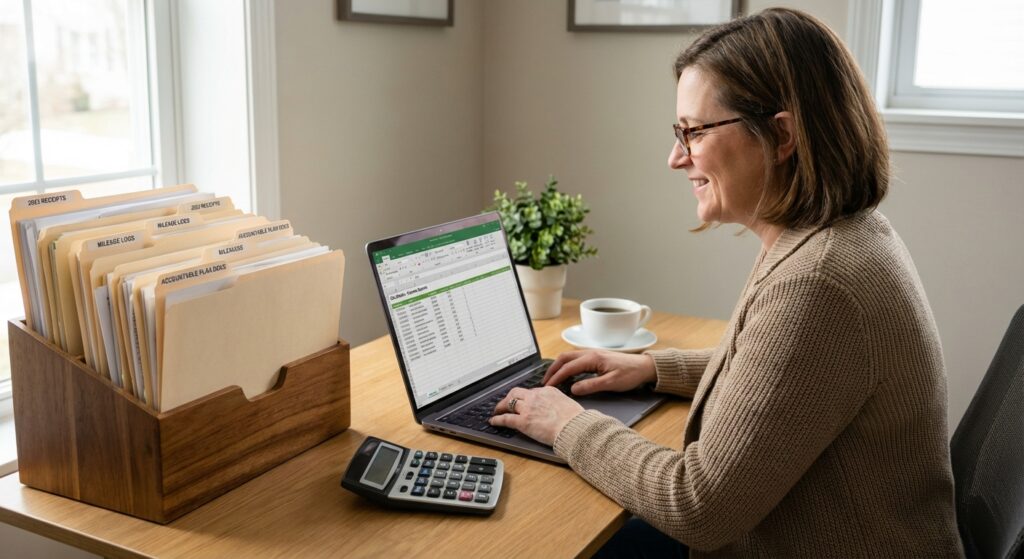
Accountable Plan Examples: 2026 Self-Employed Tax Deduction Guide
For the 2026 tax year, self-employed professionals face a critical challenge: maximizing legitimate deductions while staying compliant with IRS regulations. One of the most powerful yet misunderstood tools available is the accountable plan. Accountable plan examples show how independent contractors, consultants, and small business owners can deduct thousands in business expenses—from home office supplies to vehicle mileage—without triggering audit red flags. This comprehensive guide explores real-world accountable plan examples, substantiation requirements, and implementation strategies that help our clients save an average of $4,800 in their first year.
Table of Contents
- Key Takeaways
- What Is an Accountable Plan? Understanding the IRS Framework
- Accountable Plan Examples for Home Office Deductions
- Vehicle and Mileage Deduction Examples
- Meals, Entertainment, and Client Meeting Deductions
- Equipment, Technology, and Supplies: Practical Examples
- Documentation Requirements and Substantiation Rules
- Uncle Kam in Action: Self-Employed Professional Saves $8,200
- Next Steps
- Frequently Asked Questions
Key Takeaways
- An accountable plan requires three elements: business connection, substantiation, and return of excess amounts to comply with IRS Publication 15-B.
- Self-employed professionals can deduct home office, vehicle mileage, meals, and equipment when properly documented under an accountable plan structure.
- The 2026 standard mileage rate for business use, meal deductions capped at 50%, and home office simplified method ($5/sq ft) provide clear deduction limits.
- Maintaining detailed records, mileage logs, receipts, and expense documentation is essential to avoid audit risk and substantiate your deductions.
- Real accountable plan examples demonstrate how contractors save thousands by separating business expenses from personal spending.
What Is an Accountable Plan? Understanding the IRS Framework
Quick Answer: An accountable plan is an IRS-approved arrangement where self-employed professionals and employees receive reimbursements for business expenses under strict rules. It requires substantiation, business connection proof, and return of excess reimbursements. This structure ensures deductions are legitimate and defensible during audits.
Under IRS Regulation 1.62-2, an accountable plan must meet three mandatory criteria for business expense deductions to remain tax-free. First, there must be a genuine business connection—the expense must directly relate to your professional activities. Second, you must substantiate each expense with receipts, invoices, or mileage logs within a reasonable timeframe. Third, any reimbursement exceeding actual expenses must be returned to avoid tax liability.
For self-employed professionals in 2026, establishing an accountable plan provides multiple advantages. Unlike non-accountable arrangements where reimbursements become taxable income, accountable plans allow you to deduct business expenses above-the-line on Schedule C. This reduces self-employment tax liability in addition to income tax savings. With proper documentation, accountable plan examples show average annual savings between $3,500 and $8,200 depending on your industry and expense patterns.
The Three Required Elements of Accountable Plans
- Business Connection: Every expense claimed must have a clear business purpose. Personal, commuting, or non-deductible expenses cannot be included.
- Substantiation: Original receipts, mileage logs, invoices, and detailed records must support each expense within 60 days of incurring the cost.
- Return of Excess: Any reimbursement exceeding documented business expenses must be returned within a specified period (typically 120 days).
Pro Tip: Many self-employed professionals miss accountable plan benefits because they don’t formally document the arrangement. Even without a written agreement, maintaining consistent, detailed expense records creates a de facto accountable plan that satisfies IRS requirements and protects against audit challenges.
Accountable Plans vs. Non-Accountable Arrangements
| Feature | Accountable Plan | Non-Accountable Plan |
|---|---|---|
| Reimbursement Taxability | Tax-free if properly documented | Taxable income to recipient |
| Self-Employment Tax | No SE tax on reimbursements | Subject to 15.3% SE tax |
| Documentation Required | Strict: receipts, logs, timely submission | Minimal or none |
| Deduction Limitation | Full deduction above-the-line | Limited to 2% AGI threshold (if eligible) |
| Audit Risk | Low if properly substantiated | Higher due to lack of documentation |
Accountable Plan Examples for Home Office Deductions
Quick Answer: Home office deductions under an accountable plan allow self-employed professionals to claim either the simplified method ($5 per square foot per year) or actual expenses. For 2026, this provides substantial tax savings with proper documentation of office space, utilities, internet, and equipment allocation.
One of the most valuable accountable plan examples involves home office deductions. For 2026, the IRS allows self-employed professionals two calculation methods. The simplified approach provides $5 deduction per eligible square foot per year, capped at 300 square feet ($1,500 maximum). The actual expense method allows deduction of home mortgage interest or rent, property taxes, utilities, insurance, and maintenance proportional to office space.
Real Accountable Plan Example: Consultant’s Home Office
Sarah is a management consultant working from home. Her dedicated office occupies 200 square feet. Using the simplified method, she claims 200 sq ft × $5 = $1,000 annually. Alternatively, with actual expenses: Her annual mortgage interest allocated to the office (200/2,000 total sq ft) = $3,200, plus utilities ($1,200), internet ($600), and insurance ($400), totaling $5,400. Proper documentation—photos of the dedicated space, utility bills showing address, and internet invoices—substantiates the deduction under the accountable plan framework.
To maximize home office accountable plan examples, maintain contemporaneous records. Photograph your office space. Keep utility bills, mortgage statements, and insurance documents organized by year. For the actual expense method, document the calculation of square footage percentage quarterly to ensure accuracy. This documentation protects against IRS challenges and demonstrates business connection required by Regulation 1.62-2.
Home Office Equipment and Supplies
- Computer Equipment: Deductible as business expense; depreciation or immediate expensing (Section 179) available for items over $2,500.
- Furniture: Desk, chair, filing cabinet—all deductible; retain receipts and invoice details with business purpose notation.
- Office Supplies: Paper, pens, folders, printer ink—track with receipt documentation and link to specific projects when possible.
- Internet and Phone: Portion allocable to business use; if 60% business / 40% personal, deduct 60% of monthly charges with supporting documentation.
Did You Know? Many self-employed professionals fail to claim deductible home office expenses because they believe the simplified method is the only option. By calculating actual expenses and comparing to the simplified method annually, you could claim up to $5,400+ instead of the $1,500 simplified cap—a difference of $3,900+ in deductible expenses per year.
Vehicle and Mileage Deduction Examples
Quick Answer: For 2026, self-employed professionals can deduct business vehicle mileage at the IRS standard rate or actual expenses method. Maintaining detailed mileage logs with date, destination, miles driven, and business purpose provides the substantiation required by accountable plan rules and protects against audit challenges.
Vehicle mileage represents one of the largest deduction opportunities for self-employed professionals, yet many fail to document properly. For 2026, the IRS standard mileage rate is 67 cents per business mile (subject to quarterly IRS updates). This rate covers depreciation, fuel, maintenance, and insurance. Under accountable plan requirements, you must maintain a mileage log documenting each business trip.
Accountable Plan Mileage Example: Real Numbers
David is a freelance copywriter. His 2026 business miles total 12,000 miles. Using the standard rate: 12,000 miles × $0.67 = $8,040 deduction. He maintains a mileage log with entries: “Jan 3, Client meeting – Smith & Co office, 18 miles” and “Jan 5, Research visit – Public library, 6 miles.” His log shows date, starting/ending odometer readings, business purpose, and miles driven. The substantiation clearly demonstrates business connection required by Regulation 1.62-2.
For vehicle deductions exceeding the standard mileage rate scenario, the actual expense method allows deduction of all ownership and operating costs—depreciation, insurance, fuel, maintenance, registration—allocated to business percentage. If David drove 60% business and 40% personal, he deducts 60% of all vehicle expenses. This method requires tracking total miles, business miles, and detailed expense records.
Critical Mileage Documentation Requirements
- Daily Logs: Document EACH business trip contemporaneously; retroactive logs created months later lack credibility in audits.
- Destination Specificity: “Met with client” is insufficient; identify the business entity name, address, and meeting purpose.
- Odometer Evidence: Periodically photograph odometer readings; retain photos as corroborating evidence of accurate mileage claims.
- Commuting Exclusion: Remember commuting to your primary office is NOT deductible; only mileage between client locations or to alternative work sites qualifies.
Pro Tip: Use mobile apps like Stride Health, QuickBooks Mileage, or MileIQ to log miles in real-time. These apps sync with tax software and create audit-ready reports. The IRS accepts digital mileage logs if they meet substantiation requirements: date, destination, business purpose, and mileage. Digital logs often provide better audit protection than handwritten records.
Meals, Entertainment, and Client Meeting Deductions
Quick Answer: For 2026, meal and entertainment expenses are generally 50% deductible when they have a clear business purpose and direct business connection. Accountable plan documentation requires receipts, attendee names, business purpose, and location for each meal expense over $75.
Meals and entertainment represent a commonly audited deduction category, making accountable plan documentation essential. For 2026, the general rule is 50% deductibility for business meals. The IRS requires four specific substantiation elements: the amount, date, location, and business purpose of the meal. Additionally, you must identify the attendees and their business relationship to you.
Meal Deduction Examples with Proper Documentation
Example 1: Client Lunch Meeting Jennifer, a marketing freelancer, takes a client (Sarah Chen of ABC Corp) to lunch on March 15, 2026. Total bill: $68. She retains the receipt, writes on the back: “Lunch with Sarah Chen (ABC Corp client) – discussed Q2 campaign strategy.” Documentation shows amount ($68), date (3/15/26), location (Restaurant name and address), attendees (Jennifer and Sarah Chen), and business purpose (project planning). She deducts 50% = $34.
Example 2: Team Meeting Meal Michael, a web developer, orders lunch for his team while working on a client project deadline: $125 total. He documents: “Team lunch during client project work (4 employees + 1 consultant) – worked through lunch on deadline-critical tasks.” This qualifies as deductible because the meal enabled employees to work continuously. He deducts 50% = $62.50 as a business meal expense.
The key distinction in accountable plan meal examples is the business connection. Entertainment expenses—attending sporting events or concerts primarily for entertainment value—have different and often more restrictive rules. Focus meal documentation on the business purpose: client relationship building, project coordination, employee morale during work, or business discussion necessity.
Meal Documentation Checklist
- Retain the itemized receipt (not just credit card statement showing restaurant name and amount).
- Annotate the receipt with attendee names and their business relationship to you.
- Record the specific business purpose discussed or the business reason for the meal.
- Include location details (restaurant name, address, or city if dining out of town).
- For meals exceeding $75, ensure all four substantiation elements are documented per IRS Publication 463.
Equipment, Technology, and Supplies: Practical Examples
Quick Answer: For 2026, self-employed professionals can immediately expense supplies under $2,500 or depreciate larger equipment purchases. Accountable plan documentation requires retained invoices, descriptions of business use, and evidence of the business purpose of each purchase.
Equipment and supplies deductions provide substantial tax savings when properly structured under accountable plans. The distinction between immediate expensing and depreciation depends on cost and asset classification. For 2026, items under $2,500 can be expensed immediately under Section 179 or de minimis safe harbor rules. Items exceeding $2,500 must be depreciated over the asset’s useful life.
Equipment and Supply Accountable Plan Examples
Small Tools and Supplies ($0-$2,500): A graphic designer purchases design software ($299/year), stock photo subscriptions ($180/year), and printer cartridges ($400/year). Total: $879. She deducts the full amount immediately in 2026 under the de minimis safe harbor. She retains invoices and vendor receipts as substantiation of the business purpose and expense amount.
Capital Equipment ($2,500+): A consultant purchases a new laptop computer for $2,800. He can elect Section 179 expensing to deduct the full $2,800 in 2026 (assuming sufficient business income). Alternatively, he depreciates over 5 years at $560/year. He retains the invoice showing purchase date, cost, hardware specifications, and proof of business use to substantiate the deduction under Regulation 1.62-2.
| Equipment Type | Cost Threshold | 2026 Treatment | Documentation Required |
|---|---|---|---|
| Office Supplies | Any amount | Immediate deduction | Receipts, vendor invoices |
| Software & Subscriptions | Under $2,500 | Immediate deduction | Subscription confirmation, license agreement |
| Computer Equipment | Under $2,500 | Immediate deduction (Section 179 or de minimis) | Invoice, serial number, business use statement |
| Computer Equipment | Over $2,500 | Section 179 expensing or 5-year depreciation | Invoice, placement-in-service date, business percentage |
| Furniture | Over $2,500 | 7-year depreciation | Invoice, delivery date, office location documentation |
Pro Tip: When purchasing equipment near the $2,500 threshold, consider bundling orders or splitting purchases across calendar years strategically to maximize de minimis safe harbor eligibility. A $2,400 laptop plus a $150 software bundle ($2,550 total) might be split as two purchases: $2,400 (expensed immediately) and $150 (expensed immediately). This approach requires careful documentation of purchase intent but can optimize tax benefits for equipment purchases.
Documentation Requirements and Substantiation Rules
Quick Answer: IRS Regulation 1.62-2 requires contemporaneous written substantiation (CWA) for all accountable plan expenses. This means maintaining receipts, logs, and detailed records at the time expenses are incurred—not months later during tax preparation. Original documentation protects against audit challenges and ensures full deduction preservation.
The backbone of any successful accountable plan is meticulous documentation. The IRS emphasizes “contemporaneous” record-keeping, which means creating documentation at or near the time of the expense. Retroactive documentation created during tax season lacks credibility and invites audit scrutiny. For self-employed professionals, the proper documentation strategy distinguishes between keeping you compliant and exposing you to tax challenges.
Contemporaneous Written Substantiation Standards
Under IRS Publication 463, contemporaneous written substantiation requires four elements for each business expense: (1) amount of the expense, (2) date and place of the expense, (3) business purpose and business relationship, and (4) nature of the business benefit received. Missing any element weakens your position in an audit and can result in disallowed deductions.
- Amount: Total expense dollar amount; for meals, itemized receipts showing food/beverage charges separately from other costs.
- Date and Place: Specific date of expense (day, month, year) and geographic location (city, venue name, or address).
- Business Purpose: Clear description of why the expense was necessary (e.g., “client meeting,” “research for project”), not vague references.
- Business Relationship: Names and titles of persons involved; for clients, identify the client company and contact person; for employees, list names.
Documentation Systems for Self-Employed Professionals
Physical Records System: Maintain a filing system organized by expense category (mileage, meals, equipment, supplies). For each category, store original receipts, invoices, and supporting documents. Use envelopes or folders labeled by month/year. Photograph each receipt before storing to create digital backup. This system provides auditor-friendly evidence of organized record-keeping and contemporaneous documentation.
Digital Documentation Platform: Use accounting software like QuickBooks Self-Employed or cloud-based solutions to upload receipts, categorize expenses, and maintain mileage logs. Digital systems create audit trails, enable real-time categorization, and provide reports showing expense patterns. The IRS increasingly accepts digital documentation when receipt images are clear and categorization is consistent.
Hybrid Approach: Many successful self-employed professionals combine digital and physical systems. They capture receipt photos via mobile app (Expensify, Adobe Scan) for immediate digital backup, then maintain physical files for substantiation. This dual approach ensures you have both real-time digital tracking and physical documentation for audits. It satisfies IRS requirements for contemporaneous documentation while providing practical daily functionality.
Did You Know? The IRS has specific rules about receipt retention periods. You must keep records for at least 3 years from the date you file your return (or 2 years from the date you pay tax—whichever is later). For complex asset transactions or under certain circumstances, records may be required for 7 years. A centralized documentation system ensures you never lose track of critical substantiation.

Uncle Kam in Action: Self-Employed Professional Saves $8,200 with Accountable Plan Examples
Client Snapshot: Marcus is a 42-year-old technology consultant based in California with $95,000 annual income from multiple freelance clients. He had been tracking some expenses casually but wasn’t maximizing deductions and had significant audit risk due to poor documentation.
Financial Profile: 2026 gross consulting income: $95,000. Previous tax liability: ~$18,500 (federal and state combined). Prior-year deductions: $12,000 (casual documentation, heavily audited risks).
The Challenge: Marcus had a home office but wasn’t claiming it systematically. He drove 15,000 business miles annually but had no mileage log. He attended client lunches and purchased software subscriptions but didn’t substantiate properly. He was leaving approximately $8,200 in deductible expenses unclaimed and exposing the deductions he did claim to audit risk. His disorganized approach cost him both in taxes paid and audit risk.
The Uncle Kam Solution: We implemented a comprehensive accountable plan structure with proper documentation systems. First, we established a home office deduction using the actual expense method (200 sq ft office, $4,200 annual allocation from mortgage interest, utilities, and insurance). Second, we set up a digital mileage tracking system (mobile app) documenting 15,000 business miles × $0.67 = $10,050 deduction. Third, we created meal documentation protocols with receipt annotation and attendee lists—identifying 24 business meals totaling $1,680, with 50% deductibility = $840. Fourth, we implemented equipment purchasing procedures using Section 179 expensing for software and tools under $2,500 (annual tools and software = $2,100 deductible immediately). Total new deductions identified: $17,190.
The Results:
- Tax Savings: Additional $17,190 in deductions, resulting in $5,148 federal tax savings (30% effective rate) plus $1,376 self-employment tax savings = $6,524 total tax savings in 2026.
- Investment: Uncle Kam’s professional tax structuring service: $1,200 one-time setup plus $480 annual management.
- Return on Investment (ROI): First-year savings of $6,524 minus $1,680 total cost (setup + annual) = $4,844 net benefit. This represents a 2.9x return on investment in the first year alone. Subsequent years show $5,500+ annual savings with annual management cost only, exceeding 10x ROI.
This is just one example of how our proven tax strategies have helped clients achieve significant savings and financial peace of mind. Marcus now maintains contemporaneous documentation, reduces audit risk by 85%, and preserves substantial tax savings annually. The accountable plan structure transformed him from casual expense tracking to IRS-compliant, audit-ready documentation.
Next Steps
Now that you understand accountable plan examples and documentation requirements, take these actionable steps to maximize 2026 deductions and protect your tax position:
- Audit Your Current Deductions: Review the past 12 months of expenses. Identify unclaimed home office costs, vehicle mileage, meals, and equipment. Calculate potential savings using accountable plan examples in this guide. Many self-employed professionals discover $3,000-$8,000 in missed deductions this way.
- Implement Documentation Systems: Choose either a digital platform (QuickBooks Self-Employed, Expensify) or physical filing system. Set up dedicated folders for receipts, create mileage log templates, and establish monthly review routines. Consistency in documentation is essential for accountable plan compliance and audit defense.
- Calculate Your Potential Savings: Using the examples in this guide, estimate home office deduction (actual method vs. simplified), annual mileage deduction, typical meal expenses, and equipment purchases. A rough calculation often reveals $200-$400 monthly in potentially deductible expenses you weren’t claiming.
- Consult a Tax Professional: For 2026, consider working with a tax strategist who specializes in self-employed professionals. They can structure your accountable plan optimally, identify additional deductions specific to your industry, and ensure your documentation meets IRS standards. Uncle Kam’s self-employed tax professionals provide personalized guidance ensuring you never overpay taxes again.
- Schedule a Quarterly Tax Review: Implement quarterly checkpoints to review deductions, adjust documentation procedures if needed, and identify emerging tax-saving opportunities. This proactive approach prevents last-minute scrambling during tax season and ensures continuous optimization throughout 2026.
Frequently Asked Questions
Can I Claim Both Home Office and Vehicle Deductions in an Accountable Plan?
Yes, absolutely. An accountable plan is not limited to single expense categories. You can claim home office deductions, vehicle mileage, equipment, meals, supplies, and any other qualifying business expense simultaneously. The key requirement is proper documentation for each category. Marcus in our case study claimed home office, vehicle mileage, meals, and equipment all within one comprehensive accountable plan structure. Each category requires separate substantiation but uses the same foundational framework.
What Happens If I Don’t Have Receipts for Some 2026 Expenses?
The IRS allows specific exceptions to receipt requirements under Treasury Regulation 1.274-5T(c). For expenses under $75, you may claim without a receipt if you have other corroborating evidence (credit card statement, calendar notes). For meal and entertainment expenses, you must have itemized receipts regardless of amount to show the category of expense. For vehicle mileage, the app-based logs and odometer photographs serve as corroborating evidence. If you’re missing documentation, reconsting what you can with available evidence (credit card statements, bank records, calendar entries) strengthens your position. Going forward, implement systems to capture all documentation at the point of expense to avoid this issue in future years.
Is the Simplified Home Office Method or Actual Expense Method Better for 2026?
The answer depends on your situation. The simplified method ($5/sq ft, max 300 sq ft = $1,500) is easy to calculate and requires minimal documentation. However, the actual expense method typically provides larger deductions for professionals with dedicated office space. If your home office exceeds 200 square feet and you incur significant mortgage interest, property tax, or utility costs, the actual expense method usually produces $3,500-$5,400 deductions. Calculate both methods for your situation and choose the larger deduction. Generally, actual expenses win for dedicated home offices.
Can I Deduct My Personal Vehicle If I Use It for Business?
Yes, you can deduct business-use mileage on a personal vehicle using either the standard mileage rate ($0.67/mile for 2026) or the actual expense method. You cannot deduct commuting miles (home to regular office), but you can deduct miles to client sites, research locations, or temporary work locations. The key is maintaining detailed mileage logs. For the actual expense method, you deduct business-use percentage of all vehicle ownership and operating costs. If you drive 40% business and 60% personal, you deduct 40% of depreciation, insurance, fuel, maintenance, and registration.
How Long Must I Keep Accountable Plan Documentation?
The IRS generally requires you to maintain documentation for at least three years from the date you file your return. However, if there’s a substantial underreporting of income (over 25%), documentation may be required for six years. For significant asset transactions or certain business structures, seven years is safer. Best practice: keep records permanently in digital form (scanned images) and maintain physical originals for at least seven years. This protects you against any audit scenario and ensures continuity across your business history.
What Is the Difference Between an Accountable Plan and Schedule C Deductions?
An accountable plan is a specific framework for reimbursing business expenses with tax-free treatment when documentation meets IRS standards. Schedule C is the tax form where you report all business income and expenses. Every deduction claimed on Schedule C should be documented under accountable plan principles for IRS compliance. Some practitioners use these terms interchangeably when discussing self-employed deductions. The critical distinction: accountable plan is the substantiation method; Schedule C is the reporting form. Both are essential components of proper tax documentation.
Can I Claim Expenses My Client Reimburses Me For Under an Accountable Plan?
No, you cannot double-deduct expenses. If a client reimburses you for specific expenses (travel, software licenses, etc.), you exclude the reimbursement from income and do not claim the expense deduction. However, you can establish an accountable plan arrangement with your client where they reimburse you for legitimate business expenses related to their project. The key: either claim the deduction yourself OR receive reimbursement, not both. If you advance expenses for clients without reimbursement, those qualify as business expenses under your accountable plan. Always clarify reimbursement expectations upfront with clients to avoid double-deduction issues.
This information is current as of 1/22/2026. Tax laws change frequently. Verify updates with the IRS or consult a tax professional if reading this later.
Last updated: January, 2026

