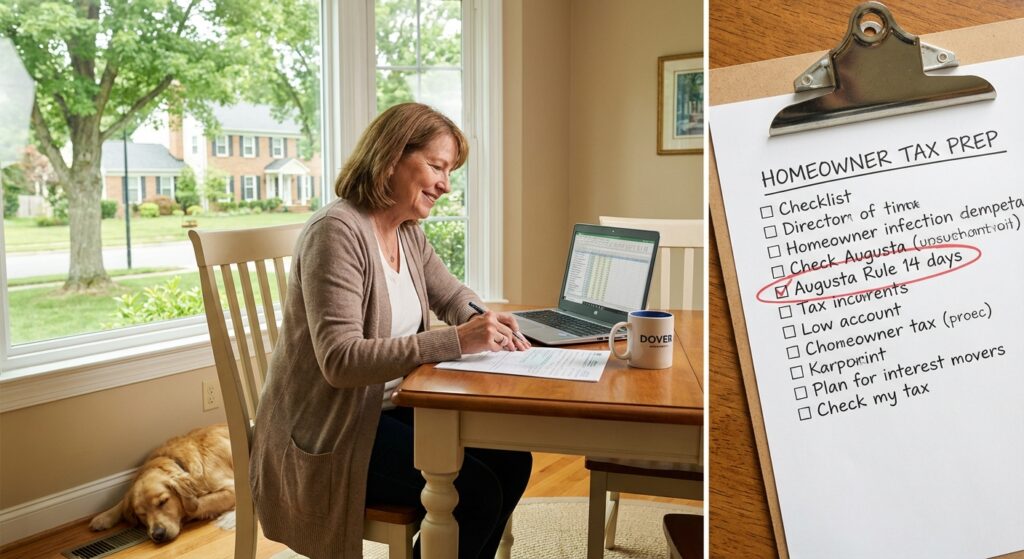
How the Augusta Rule Benefits Dover, Delaware Homeowners: Tax Savings Explained
When it comes to creative tax-saving strategies for homeowners in Dover, Delaware, few are as overlooked as the Augusta Rule. Originally designed for residents of Augusta, Georgia who rented out their homes during golf tournaments, this IRS provision is available nationwide — including right here in Delaware. If you own a home in Dover, you could pocket thousands of dollars in tax-free rental income each year without reporting a dime to the IRS. Here is everything you need to know about how the Augusta Rule works, what Delaware-specific considerations apply, and how to put this strategy into action.
What Is the Augusta Rule?
The Augusta Rule, formally known as IRS Section 280A(g), allows you to rent out your personal residence for up to 14 days per year without paying federal income tax on that rental income. The income simply does not get reported to the IRS, making it one of the most powerful and underused tax tools available to homeowners. There is no income cap on how much you can earn during those 14 days — the only limit is the number of days.
For Dover homeowners, this means you can rent your home for corporate retreats, community events, or business meetings and keep every dollar of that rental income completely tax-free. To learn more about how the 14-day limit works in detail, see our complete guide: Understanding the Augusta Rule 14-Day Limit for Tax-Free Rental Income.
Quick Answer: The Augusta Rule (Section 280A(g)) lets Dover, Delaware homeowners rent their personal residence for up to 14 days per year and keep all the rental income tax-free. There is no limit on how much you can charge per day — the only requirement is that you stay at or under 14 total rental days per tax year.
Who Can Use the Augusta Rule in Dover?
If you live in Dover, Delaware and own your home, you are likely eligible to take advantage of the Augusta Rule. The requirements are straightforward:
- The home must be your primary residence or a vacation property you personally own
- You must rent the property for 14 days or fewer in the tax year
- You must charge a fair market rental rate — not an inflated price designed to shift income
- The rental must be a legitimate, arm’s-length transaction with proper documentation
Dover homeowners are well positioned to benefit. As the state capital, Dover sees a steady flow of government officials, lobbyists, military personnel from Dover Air Force Base, and business professionals who need short-term rental space. Your home could be a perfect fit for corporate retreats, off-site meetings, or event hosting.
Delaware-Specific Tax Considerations for the Augusta Rule
Delaware follows federal tax law on the Augusta Rule, meaning your 14-day rental income is not reportable on your Delaware state return either. However, there are several Delaware-specific tax factors worth understanding before you put this strategy to work:
Delaware State Income Tax
Delaware imposes a graduated state income tax ranging from 2.2% to 6.6% on income above $60,000. However, because Augusta Rule income is excluded at the federal level under Section 280A(g), it is also excluded from your Delaware adjusted gross income. You will not owe state income tax on this rental income.
Delaware Gross Receipts Tax for Businesses
If your business rents your home for meetings or events, the business side of the transaction deserves attention. Delaware imposes a gross receipts tax on businesses rather than a traditional sales tax. The gross receipts tax rate varies by industry (typically 0.0945% to 0.7468%). While this tax applies to the business paying the rent (not to you as the homeowner), your business should properly account for the rental payment in its gross receipts calculations.
Property Tax Implications in Dover
Renting your Dover home for 14 days or fewer per year under the Augusta Rule does not change your property’s residential classification for Kent County property tax purposes. Your property will remain classified as owner-occupied residential, and you will continue to qualify for any homestead exemptions or senior property tax credits you currently receive. Short-term rental under the Augusta Rule is not considered converting your home to commercial use.
Pro Tip: Delaware has no sales tax, which is one fewer complication for Augusta Rule rentals. Unlike states that charge sales or occupancy taxes on short-term rentals, your 14-day Augusta Rule rental in Dover will not trigger any state or local lodging taxes. This makes Delaware one of the most favorable states for this strategy.
Common Augusta Rule Scenarios for Dover Homeowners
Dover’s unique position as Delaware’s state capital and home to Dover Air Force Base creates several natural opportunities to use the Augusta Rule:
- Government and legislative events: Dover regularly hosts legislative sessions, committee meetings, and government conferences that bring visitors to town
- Dover Air Force Base activities: Military events, family days, and ceremonies at the base create demand for nearby short-term housing
- Firefly Music Festival: This major annual event draws tens of thousands of visitors to the Dover area each year
- NASCAR at Dover Motor Speedway: Race weekends bring national attention and a surge of visitors who need accommodations
- Delaware State University events: Homecoming, graduation, and campus events bring families and alumni to Dover
- Business meetings and corporate retreats: If you own a business, renting your home to your company for board meetings, planning sessions, or training days is one of the most popular uses
As long as you follow the rules and stay within the 14-day limit, this rental income is completely tax-free at both the federal and Delaware state level.
How Much Can Dover Homeowners Save?
The potential tax benefit is tied to the fair market rental value of your Dover property for the days you rent it out. Dover rental rates vary based on your home’s size, location, and amenities. Based on comparable short-term rental rates in the Dover area, here is what your tax-free income could look like:
| Home Type | Est. Daily Rate | Rental Days | Tax-Free Income | Federal Tax Saved (24% bracket) |
|---|---|---|---|---|
| 2-BR Home near Downtown Dover | $250 | 14 | $3,500 | $840 |
| 3-BR Home (general Dover area) | $400 | 14 | $5,600 | $1,344 |
| 4-BR Home with event space | $600 | 14 | $8,400 | $2,016 |
| Large home near Dover AFB | $500 | 10 | $5,000 | $1,200 |
| Upscale home (business meetings) | $750 | 14 | $10,500 | $2,520 |
Keep in mind that the federal tax savings above do not include the additional Delaware state income tax savings. If you are in the 6.6% Delaware bracket, a $10,500 Augusta Rule rental would save you an additional $693 in state taxes — bringing your combined tax savings to over $3,200 for 14 days of renting your home.
Did You Know? If your business rents your Dover home for meetings, the business can deduct the rental payment as an ordinary business expense (reducing business taxable income), while you personally receive that rental income tax-free under the Augusta Rule. This creates a double tax benefit — a deduction for the business and tax-free income for you.
Step-by-Step Guide: Business Owners Renting to Their Own Entity
One of the most popular uses of the Augusta Rule in Dover is renting your personal home to your own business for meetings, planning sessions, or small events. Here is how to do it properly:
- Determine fair market rental value: Research comparable short-term rental rates in Dover for properties similar to yours. Check Airbnb, VRBO, and local venue rental prices. Document your research and keep records of the comparable listings you reviewed.
- Create a written rental agreement: Draft a formal lease between you (as the homeowner) and your business entity. Include the rental dates, the daily or event rate, the purpose of the rental, and payment terms. Treat this exactly as you would a rental agreement with a third party.
- Issue payment from the business account: Your business must pay the rental fee from its business bank account. Never pay yourself in cash without documentation. A check or bank transfer creates a clear paper trail.
- Document the business purpose: Keep meeting agendas, sign-in sheets, photos of the setup, and any other evidence that the rental served a legitimate business purpose. Board meeting minutes are especially valuable documentation.
- Record the deduction on the business return: Your business deducts the rental payment as a rent expense on its tax return (Schedule C, Form 1065, or Form 1120S depending on your entity type).
- Do NOT report the income personally: Under Section 280A(g), the rental income you receive is excluded from your personal income as long as total rental days do not exceed 14 for the year.
- Track your rental days carefully: Maintain a log of every day your home is rented. If you exceed 14 days, the entire rental arrangement becomes taxable and you must report all income on Schedule E.
Pro Tip: If you are an S Corp owner in Dover, you can have your S Corp rent your home for quarterly board meetings (4 days), an annual planning retreat (2 days), and several team strategy sessions throughout the year. At $500 per day, that is $7,000 in tax-free income for you and a $7,000 deduction for your business.
 Free Tax Write-Off Finder
Documentation Requirements for the Augusta Rule
Proper documentation is the foundation of a defensible Augusta Rule strategy. The IRS may ask you to prove that the rental was legitimate, that the rate was fair, and that you stayed within the 14-day limit. Here is what you should keep on file:
- Written rental agreement: A signed contract between the property owner and the renter specifying dates, rate, and purpose
- Fair market value documentation: Comparable rental listings from Airbnb, VRBO, or local venues in the Dover area that support your daily rate
- Proof of payment: Bank statements, canceled checks, or wire transfer confirmations showing the rental payment was made
- Business purpose records: Meeting agendas, attendee lists, presentation materials, or event programs that demonstrate the rental had a legitimate purpose
- Day-by-day rental log: A calendar or spreadsheet tracking each day the property was rented, to whom, and for what purpose
- Photographs: Photos of the home setup for the event or meeting can demonstrate that the space was genuinely used for the stated purpose
Keep all Augusta Rule documentation for at least seven years after the tax year in question. The IRS statute of limitations is generally three years, but can extend to six years if there is a substantial understatement of income.
Common Mistakes Dover Homeowners Should Avoid
The Augusta Rule is straightforward, but small errors can turn a legitimate tax strategy into a red flag. Here are the most common mistakes to avoid:
- Exceeding 14 days: Even one extra day means all rental income for the year becomes taxable and must be reported on Schedule E. Track your days meticulously.
- Charging above fair market value: Inflating your rental rate to shift more income tax-free is a red flag. Your rate must be supportable by comparable rentals in the Dover market.
- Renting to your employer: You cannot rent your home to an employer where you are a W-2 employee. The rule works for self-employed business owners renting to their own entity, not employees renting to their employer.
- Skipping documentation: Without a written lease, proof of payment, and evidence of fair market value, you have no defense if the IRS questions the arrangement.
- Renting to a majority-owned entity without proper structure: If you own more than 50% of the business renting your home, extra scrutiny applies. The transaction must be at arm’s length with documented business purpose.
When to Talk to a Tax Professional
The Augusta Rule offers unique advantages for Dover homeowners, but documentation and valuation are critical to staying IRS-compliant. You should consult with a tax professional if:
- You plan to rent your home to a business you own or control
- You are unsure what constitutes fair market rental value in Dover
- You also rent your home on Airbnb or VRBO and need to count those days toward the 14-day limit
- You want to combine the Augusta Rule with other tax strategies for maximum savings
- You have questions about how Delaware’s gross receipts tax or state income tax interacts with your rental arrangement
Need help putting the Augusta Rule to work in Dover, Delaware? Contact Uncle Kam Tax Preparation Service for a personalized strategy session. We help Dover homeowners and business owners implement tax-saving strategies that are fully documented and IRS-compliant.
Further Resources
- Understanding the Augusta Rule 14-Day Limit for Tax-Free Rental Income
- IRS Publication 527: Residential Rental Property
- Delaware Division of Revenue: Personal Income Tax
- Delaware Gross Receipts Tax Information
- Schedule a Free Consultation with Uncle Kam
Disclaimer: This article is for informational purposes only and does not constitute tax, legal, or financial advice. Tax laws change frequently. Consult with a qualified tax professional for guidance specific to your situation.
Last updated: February, 2026

Frequently Asked Questions
How do I document my Augusta Rule rental in Dover?
Use a formal written rental agreement that specifies the dates, daily rate, property address, and purpose of the rental. Collect payment via check or bank transfer for a clear paper trail. Keep comparable rental listings from Dover-area properties on Airbnb or VRBO to support your rate. Store meeting agendas, attendee lists, and photos of the event setup. Maintain all records for at least seven years.
Can I rent my Dover home to my own business under the Augusta Rule?
Yes. This is one of the most common and effective uses of the Augusta Rule. Your business pays you fair market rent for using your home for board meetings, planning sessions, or team events. The business deducts the rental payment as an expense, and you receive the income tax-free. The key requirements are a written lease, fair market rate, documented business purpose, and payment from the business bank account.
Does Delaware have its own rules about the Augusta Rule?
Delaware follows federal tax law regarding the Augusta Rule. Because the rental income is excluded from federal adjusted gross income under Section 280A(g), it is also excluded from your Delaware state income tax return. Delaware does not impose a separate lodging tax or sales tax on short-term rentals, making it one of the most straightforward states for implementing this strategy. The Delaware Division of Revenue offers additional resources on state filing requirements.
Is the Augusta Rule legal?
Absolutely. The Augusta Rule is codified in the Internal Revenue Code at Section 280A(g). It has been part of federal tax law since 1976. The IRS has published official guidance confirming that rental income from a personal residence rented for 14 days or fewer is not reportable income. The rule is legal, well-established, and used by homeowners across the country — including right here in Dover, Delaware.
What happens if I rent my Dover home for more than 14 days?
If you exceed the 14-day limit, the Augusta Rule no longer applies and all rental income for the year must be reported on Schedule E of your federal tax return. You would then be able to deduct rental-related expenses (such as a proportionate share of mortgage interest, property taxes, insurance, and maintenance), but the income itself becomes taxable. This is why tracking your rental days is so important — going even one day over changes the entire tax treatment.
How do I determine fair market rental value for my Dover home?
Research comparable short-term rental listings in Dover on platforms like Airbnb, VRBO, and local event venue sites. Look for properties of similar size, location, and amenities. You can also check hotel rates in the Dover area for additional context. Document at least three to five comparable listings with screenshots showing the daily rate, property features, and dates. If your home has unique features like a large yard, event-ready spaces, or proximity to Dover Air Force Base or the State Capitol, you may be able to justify a higher rate.
Is the Augusta Rule worth the effort for Dover homeowners?
For most Dover homeowners — especially those who own a business — the answer is yes. Even at a modest daily rate of $300 per day for 14 days, you are looking at $4,200 in tax-free income. If you are in the 24% federal bracket and the 6.6% Delaware bracket, that saves you over $1,280 in combined taxes with minimal paperwork. For business owners who rent their home to their own entity, the double benefit (tax-free income for you plus a business deduction) makes this one of the most efficient tax strategies available.

