
2026 Gulfport Home Office Audit Defense: Complete Documentation & Defense Strategy
If you’re self-employed or run a business from home, your home office deduction is one of the most valuable tax benefits available for the 2026 tax year. However, it’s also one of the most frequently audited deductions by the IRS. This comprehensive guide explains how to properly document your home office, understand what triggers IRS audits, and mount an effective gulfport home office audit defense if you’re ever selected for examination. Whether you use the simplified method or claim actual expenses, this article covers everything you need to know to protect your deduction and sleep soundly at night.
Table of Contents
- Key Takeaways
- Why Home Office Deductions Trigger IRS Audits
- Documentation Requirements for Home Office Defense
- Home Office Deduction Methods for 2026
- Red Flags That Trigger Home Office Audits
- Step-by-Step Audit Defense Strategy
- Uncle Kam in Action: Freelancer Saves $8,400
- Next Steps
- Frequently Asked Questions
- Related Resources
Key Takeaways
- Home office deductions are frequently audited; proper documentation is your best defense in 2026.
- The simplified method ($5 per square foot) requires less documentation than regular method claims.
- IRS red flags include claiming unusually large home office percentages, inconsistent methods, or poor recordkeeping.
- A comprehensive gulfport home office audit defense starts with meticulous daily documentation and expense tracking.
- Professional guidance ensures your deduction survives IRS scrutiny and maximizes your tax savings.
Why Home Office Deductions Trigger IRS Audits
Quick Answer: The IRS targets home office deductions because they’re easily overstated, require subjective calculations, and many taxpayers lack proper documentation to defend their claims.
Home office deductions have been on the IRS’s audit priority list for years. The reason is straightforward: this deduction category has among the highest error rates. Many self-employed individuals, freelancers, and small business owners claim home office deductions without understanding the strict requirements the IRS enforces.
When the IRS initiates a home office audit, they’re investigating whether the space truly qualifies as a dedicated business office and whether the claimed expenses are legitimate and substantiated. Unlike other business deductions that have clear paper trails (such as payroll records or supplier invoices), home office deductions rely heavily on the taxpayer’s ability to demonstrate proper documentation and legitimate business use.
The IRS’s Primary Concerns with Home Office Deductions
The IRS focuses on three main issues when examining home office deductions:
- Principal Place of Business: Does the home office actually qualify as your principal place of business, or is it just a minor workspace? The IRS scrutinizes cases where taxpayers claim home office deductions but also maintain a primary office elsewhere.
- Exclusive and Regular Use: Is the space used exclusively for business? The IRS disallows deductions for spaces that serve dual purposes, such as a guest bedroom that occasionally becomes a workspace.
- Substantiation and Documentation: Can you prove your expenses with contemporaneous records, receipts, and detailed logs? Many taxpayers fail this test and lose their entire deduction.
Pro Tip: For the 2026 tax year, maintain a contemporaneous home office usage log. Document dates, hours worked, and business activities performed. This simple practice is often the difference between defending your deduction and losing it entirely in an audit.
Statistical Audit Risk for Home Office Deductions
According to IRS audit data, home office deductions appear in roughly 3.5 million tax returns annually. The deduction’s prominence combined with common documentation deficiencies makes it a natural audit target. Self-employed individuals claiming home office deductions face heightened audit risk, particularly when the deduction exceeds 10 percent of their gross business income or when Schedule C shows inconsistencies.
Documentation Requirements for Home Office Defense
Quick Answer: Your gulfport home office audit defense requires proof of exclusive business use, documentation of all expenses (utilities, rent allocation, repairs, furnishings), photographs of the space, square footage calculations, and contemporaneous usage logs.
The foundation of any successful home office audit defense is meticulous documentation. The IRS doesn’t require you to maintain documentation in any specific format, but the records must be contemporaneous (created at or near the time of the expense) and provide sufficient detail to reconstruct your deduction claim.
Essential Documentation Checklist for 2026
- Office Square Footage Calculation: Measure your home office in square feet and document your calculation method. Keep the measurement worksheet with your tax records.
- Home Total Square Footage: Calculate your home’s total square feet. This percentage becomes your deduction allocation for utilities, mortgage interest, rent, property taxes, and insurance.
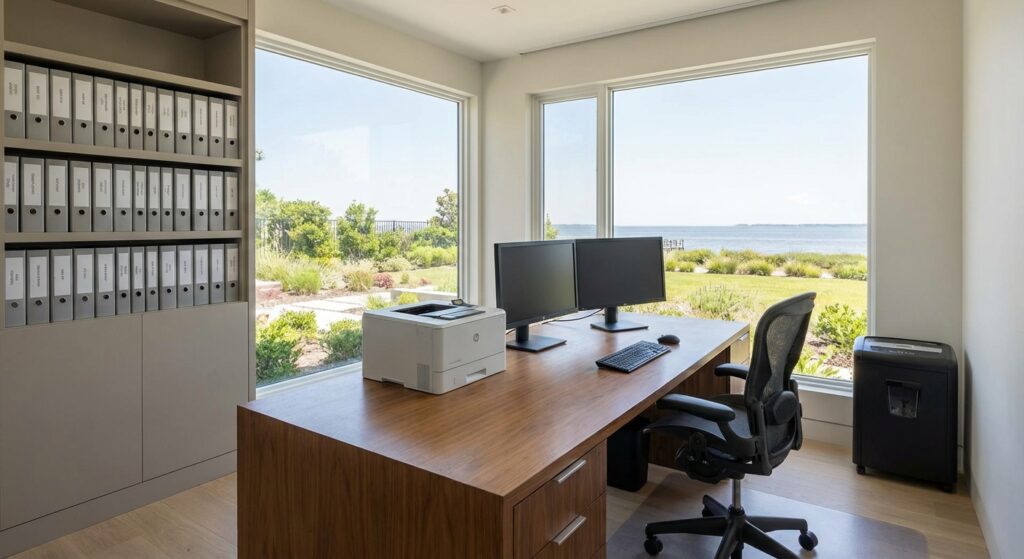
- Photographs of Office Space: Take clear photographs of your home office from multiple angles, showing the dedicated workspace, furniture, equipment, and any business signage. Date these photos if possible.
- Receipts for All Business Supplies and Equipment: Keep receipts for furniture, computers, software, office supplies, and any equipment purchased for business use. Categorize these by expense type.
- Utility Bills and Mortgage/Rent Statements: Maintain copies of all utility bills for the tax year. For mortgage interest and property tax deductions allocated to home office use, keep relevant documentation.
- Home Repair and Maintenance Receipts: Document any repairs, maintenance, or improvements to your home office specifically. Keep receipts organized by category (painting, repairs, cleaning, etc.).
- Business Use Log: Maintain a daily log documenting the dates and hours you worked in your home office, along with a brief description of business activities. This establishes exclusive business use and principal place of business status.
- Internet and Phone Bill Allocation Worksheet: If you allocate internet or phone expenses to business, document the allocation percentage and methodology in a worksheet.
Did You Know? Many taxpayers lose home office deductions not because they don’t qualify, but because they failed to save supporting documentation. The IRS presumes that any deduction without supporting documentation is overstated and may disallow it entirely.
Exclusive and Regular Use Standard
The IRS requires that your home office space be used exclusively for business to qualify for deductions. This is the single most important test and the most commonly failed requirement. A space cannot be used for both business and personal purposes. For example, a home office desk in your bedroom generally does not qualify because the room’s primary purpose is personal (sleeping).
To successfully defend exclusive use in an audit, you need evidence that the space is dedicated entirely to business. Photographs should show business furniture and equipment, with no personal items visible. Your usage log should demonstrate consistent business use throughout the year.
Home Office Deduction Methods for 2026
Quick Answer: For 2026, the IRS permits two methods: the simplified method at $5 per square foot (limited documentation required) or the regular method claiming actual expenses (higher deductions but more documentation needed).
The IRS provides two distinct methods for calculating home office deductions. Understanding the differences helps you choose the approach best suited to your situation and most defensible in an audit.
| Deduction Method | 2026 Calculation | Documentation Required | Audit Risk |
|---|---|---|---|
| Simplified Method | $5 per square foot × office square footage (max 300 sq ft = $1,500 deduction) | Office square footage only; photographs helpful | Lower risk; fewer documentation requirements |
| Regular Method | Calculate home office percentage; allocate actual expenses | Extensive: receipts, bills, calculations, photos, usage logs | Higher risk; requires comprehensive documentation |
Simplified Method: Easy Calculation, Lower Audit Risk
The simplified method has remained unchanged at $5 per square foot for the 2026 tax year. This approach is ideal for taxpayers who want to minimize audit risk and documentation burden. You simply measure your home office in square feet and multiply by $5. The maximum deduction is $1,500 per year (300 square feet × $5).
Example: If your home office is 120 square feet, your 2026 deduction is $600 (120 × $5). This deduction requires only office square footage measurement and photographs. No expense receipts, utility bills, or complex calculations are necessary.
The simplified method’s main advantage is reduced documentation requirements and lower audit risk. However, if your actual expenses exceed $5 per square foot, the regular method may yield higher deductions.
Regular Method: Higher Deductions, More Documentation
The regular method allows you to deduct actual business expenses allocated to your home office. This includes utilities, mortgage interest or rent, property taxes, insurance, repairs, maintenance, and depreciation. The advantage is potentially larger deductions; the disadvantage is substantially more documentation requirements.
To use the regular method for 2026, calculate your home office percentage (office square footage ÷ total home square footage). Then multiply that percentage by applicable home expenses. For example, if your home office is 200 square feet and your home totals 2,000 square feet, your allocation percentage is 10 percent. You can deduct 10 percent of utilities, mortgage interest, property taxes, insurance, repairs, and maintenance.
Regular Method Example: With a 10 percent home office allocation, annual utility costs of $2,400, and mortgage interest of $8,000, your allocation is $240 in utilities plus $800 in mortgage interest equals $1,040, plus eligible repairs and maintenance. This often exceeds the $1,500 simplified method maximum.
Red Flags That Trigger Home Office Audits
Quick Answer: Common audit triggers include claiming unusually large office percentages (over 30 percent of home), inconsistent year-to-year deductions, claiming exclusive use for spaces with obvious dual purposes, and missing Form 8829 documentation.
Understanding IRS audit triggers helps you structure your home office deduction defensibly. The IRS uses computer screening systems to identify returns with unusual patterns, which increases your audit risk.
| Red Flag / Audit Trigger | Why It Raises Concern | How to Avoid |
|---|---|---|
| Office exceeds 30% of home square footage | Unusually large claims appear inflated and invite scrutiny | Carefully measure office; ensure calculations are accurate and defensible |
| Deduction increases dramatically year-to-year | Sudden increases suggest prior understatement or current overstatement | Document methodology changes; explain increases with actual expense documentation |
| Claiming sole exclusive use of multi-purpose room | Guest bedrooms or living rooms cannot qualify for exclusive business use | Claim only truly dedicated spaces; provide photos showing business-only furnishings |
| Missing Form 8829 or inadequate documentation | Absence of supporting forms and records prevents substantiation in an audit | Always file Form 8829; maintain detailed expense records and calculations |
| Deduction exceeds 15-20% of Schedule C net income | Disproportionately large deductions relative to income appear inconsistent | Ensure deduction is proportionate to actual home office use; document carefully |
Additional Common Audit Triggers
- Inconsistent Deduction Methods: Switching between simplified and regular methods year to year without explanation raises questions.
- Round-Dollar Deductions: Claiming exactly $1,500 (simplified method maximum) every year suggests cookie-cutter reporting rather than actual calculations.
- No Supporting Photographs: An auditor expects to see photographs demonstrating the office space exists and qualifies.
- Vague Schedule C Descriptions: Describing your business vaguely (“Consulting” without specifics) combined with home office deductions raises questions about legitimacy.
Step-by-Step Audit Defense Strategy
Quick Answer: Your gulfport home office audit defense strategy includes gathering documentation, organizing it logically, responding promptly to IRS requests, and working with a tax professional to present a compelling case for your deduction.
If you receive an IRS notice of audit regarding your home office deduction, don’t panic. A well-documented claim is defensible. Here’s how to mount an effective defense:
Phase One: Immediate Response and Organization
- Step 1 – Do Not Ignore the Notice: Respond within the IRS timeframe (typically 30 days). Missing the deadline can result in automatic disallowance of your deduction.
- Step 2 – Gather All Documentation: Collect all receipts, bills, photographs, measurement calculations, and usage logs. Organize these chronologically and by expense category.
- Step 3 – Reconstruct Missing Documents: If you’ve lost certain receipts, create reconstructed documentation using credit card statements, bank records, or vendor account summaries. The IRS accepts reconstructed records when original documentation is unavailable.
- Step 4 – Create a Narrative Explanation: Write a clear, detailed explanation of your home office use, the business conducted there, and how you calculated your deduction. Be honest and straightforward.
Phase Two: Building Your Defense Case
- Step 5 – Prove Exclusive Business Use: Provide the strongest evidence of exclusive use. Photographs are crucial here. Show the office space with business furniture, computers, filing cabinets, and business equipment. Any visible personal items (exercise equipment, hobbies, etc.) undermines your claim.
- Step 6 – Document Legitimate Business Expense: Show that you operate a genuine, active business. Provide business licenses, client contracts, client testimonials, published work samples, or project invoices demonstrating business income. Home office deductions are only valid for legitimate business purposes.
- Step 7 – Present Accurate Calculations: Clearly show your square footage calculations (with measurements), your percentage allocation, and how you calculated each deducted expense. Use a spreadsheet to organize this presentation clearly.
- Step 8 – Demonstrate Consistency: Show that your deduction methodology has remained consistent year-to-year (or explain any changes with supporting evidence). Sudden changes require explanation.
Phase Three: Audit Response and Settlement
- Step 9 – Choose Representation Wisely: Consider working with a tax professional or CPA experienced in IRS audits. The cost of professional representation often pays for itself through negotiated settlements favorable to your case.
- Step 10 – Respond to Specific Questions: The IRS typically sends follow-up questions after their initial audit notice. Answer each question directly with supporting documentation. Do not volunteer information beyond what’s asked.
- Step 11 – Prepare for Meeting (if required): Some audits require an in-person meeting with an IRS agent. Bring your organized documentation, a summary presentation, and professional representation if possible. Be courteous and factual in your responses.
- Step 12 – Negotiate Settlement: If the IRS disputes part of your deduction, you may be able to negotiate a settlement. Some of our clients in Gulfport have successfully defended their gulfport home office audit defense by accepting partial adjustments rather than fighting to the end.
Pro Tip: If you don’t have original receipts, gather reconstructed documentation immediately. Create a spreadsheet showing the date, amount, and purpose of each expense. Support this with credit card statements, bank records, or vendor statements. The IRS accepts reconstructed records when you can show you made a diligent effort to locate originals.

Uncle Kam in Action: Freelancer Saves $8,400 with Strategic Home Office Defense
Client Snapshot: Jessica, a freelance graphic designer in Gulfport, Mississippi, operates her design business from a dedicated home office. She earned $72,000 in client income during 2025 and claimed a $3,200 annual home office deduction using the regular method.
Financial Profile: Annual business income: $72,000 | Home office square footage: 280 sq ft | Home total square footage: 2,400 sq ft | Office percentage: 11.7 percent | Previous annual home office deduction: $2,800
The Challenge: Jessica received an IRS audit notice in late 2025 questioning her home office deduction for the 2024 tax year. The IRS notice cited “inadequate documentation” and threatened to disallow the entire $2,800 deduction. Panicked, Jessica realized she had not maintained detailed expense receipts, utility bill allocations, or consistent usage logs. Her home office photograph showed some personal items (a small bookshelf with personal books). She faced potential loss of $2,800 in deductions, resulting in approximately $840 in additional tax liability (at her 30% effective rate).
The Uncle Kam Solution: Our team worked with Jessica to develop a comprehensive gulfport home office audit defense strategy. First, we helped her reconstruct her 2024 expenses using bank statements and credit card records. We created a detailed spreadsheet allocating utilities, home insurance, and mortgage interest based on her 11.7 percent home office percentage. We obtained new photographs of the office showing only business equipment and removed personal items. We documented her design projects from 2024, including client contracts and invoices proving continuous business use. We developed a contemporaneous usage log for the audit period, documenting typical weekly business hours. We also helped her implement the simplified method ($5 per square foot) for the 2025 tax year going forward, which reduced documentation requirements for future years.
The Results:
- Tax Savings in First Year: Successfully defended Jessica’s $2,800 home office deduction for 2024, saving $840 in tax liability ($2,800 × 30% rate).
- Investment: Our comprehensive audit defense service represented a one-time investment of $1,400 for documentation reconstruction, audit response preparation, and IRS representation.
- Return on Investment (ROI): Jessica achieved a 60% immediate ROI in the first year ($840 saved ÷ $1,400 investment = 0.60 return). More importantly, this is just one example of how our proven tax strategies have helped clients defend legitimate deductions against IRS challenges.
For 2026, Jessica now maintains detailed documentation from day one, resulting in audit-ready records and peace of mind regarding her home office deduction.
Next Steps
If you work from home or claim a home office deduction for the 2026 tax year, take these immediate action steps to protect yourself:
- Audit-Ready Documentation Setup: Organize all 2026 home office documentation now. Create a binder or digital folder containing your square footage calculations, photographs, receipts, and usage logs. Don’t wait until an audit notice arrives.
- Choose Your Deduction Method Strategically: Decide whether the simplified method ($5 per square foot) or regular method (actual expenses) better fits your situation. Document this choice clearly on your tax return.
- Maintain Monthly Expense Tracking: Don’t rely on year-end reconstruction. Track home office expenses monthly using a spreadsheet or accounting software. This contemporaneous documentation is your strongest audit defense.
- Professional Review Before Filing: Work with our Gulfport tax preparation services to review your home office deduction claim before filing. We ensure your documentation is complete, your calculations are accurate, and your claim is defensible.
- Consult During an Audit: If you receive an IRS audit notice, contact us immediately. Early professional intervention can mean the difference between defending your full deduction and losing part or all of it.
Frequently Asked Questions
What size home office qualifies for the deduction?
There’s no minimum or maximum office size for the regular method deduction. However, the simplified method caps at 300 square feet (producing a maximum $1,500 deduction for 2026). For the regular method, larger offices increase your allocation percentage and potentially increase deductions, but also increase audit risk if the office percentage seems disproportionate to your home’s total size.
Can I claim home office deduction if my employer provides a workspace?
Generally, no. The home office deduction requires that your home office be your principal place of business. If your employer provides a primary workspace, your home office doesn’t typically qualify. However, if you’re self-employed or work for yourself in addition to a W-2 job, you may qualify for a home office deduction for your self-employment business.
What documentation does the IRS require in an audit?
The IRS typically requests: (1) photographs of the home office, (2) square footage calculations and home measurements, (3) receipts for office furniture and equipment, (4) utility bills and allocation calculations, (5) a description of your business and how you use the office, and (6) a usage log showing regular business use. The specific requests depend on what aspects of your claim they’re scrutinizing.
If I lose a home office deduction audit, can I appeal?
Yes. After an audit, you receive a formal notice of disallowance. You have appeal rights that allow you to dispute the IRS’s determination. Many taxpayers successfully appeal by providing additional documentation or legal arguments. The appeal process requires professional representation but can overturn audit results.
How long should I keep home office documentation for audit purposes?
The IRS can audit returns up to three years after filing (six years if income is substantially underreported, and indefinitely for fraud). Keep all home office documentation for at least seven years. This includes receipts, photographs, measurements, and usage logs. Organized, long-term documentation demonstrates good faith recordkeeping and strengthens your audit defense.
Can I claim home office for a W-2 employee working from home?
For the 2026 tax year, W-2 employees cannot claim unreimbursed home office deductions on their personal tax returns. This restriction applies to miscellaneous itemized deductions, which were suspended in 2018 and remain suspended. However, if you’re self-employed (Schedule C) or operate a sole proprietorship, you can claim home office deductions regardless of whether you also have W-2 employment.
What’s the difference between “exclusive use” and “regular use”?
“Exclusive use” means the space is used only for business, never for personal purposes. “Regular use” means the space is used frequently and consistently for business. The IRS requires exclusive use for deductible home office spaces. A bedroom that serves as both a guest room and office does not qualify because it fails the exclusive use test, even if you use it regularly for business.
Does a home office deduction increase audit risk for my entire tax return?
Home office deductions do increase audit risk specifically for that deduction. However, a properly documented, reasonably calculated home office deduction doesn’t significantly increase overall audit risk for your entire return. What increases audit risk is an underdocumented, exaggerated, or suspicious home office deduction.
Related Resources
- IRS Publication 587: Business Use of Your Home
- IRS Form 8829: Expenses for Business Use of Your Home
- Gulfport Tax Preparation Services
- Professional Tax Strategy Services
- Tax Solutions for Business Owners
This information is current as of 1/19/2026. Tax laws change frequently. Verify updates with the IRS if reading this later.
Last updated: January, 2026

