
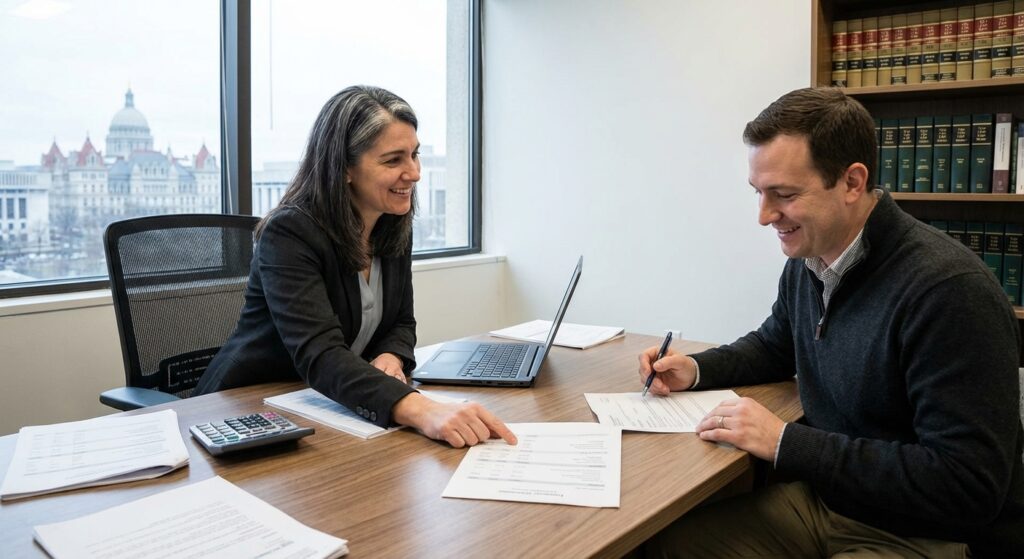
Best Tax Preparer in Albany: Complete Guide to Finding the Right Tax Professional for 2026
Finding the best tax preparer in Albany requires more than a quick internet search. For the 2026 tax year, Albany residents and business owners need professionals with proven credentials, deep knowledge of New York tax law, and a commitment to maximizing legitimate deductions and credits. This comprehensive guide walks you through the essential qualifications, red flags, and strategies for selecting a tax preparer who truly understands your financial situation and can deliver real tax savings.
Table of Contents
- Key Takeaways
- What Makes the Best Tax Preparer in Albany?
- Essential Credentials and Qualifications for Tax Preparers
- Red Flags to Avoid When Choosing a Tax Preparer
- Questions to Ask Before Hiring Your Tax Preparer
- Albany-Specific Tax Preparer Considerations for 2026
- How to Evaluate a Tax Preparer’s Specialty Expertise
- Uncle Kam in Action: Tax Preparer Success Story
- Next Steps
- Frequently Asked Questions
- Related Resources
Key Takeaways
- The best tax preparer in Albany holds current PTIN credentials and belongs to professional organizations like NYSSCPA or NATP.
- For 2026, look for preparers experienced with both federal and New York state-specific deductions to maximize your tax savings.
- Avoid preparers offering refund advances, contingency fees, or guarantees of specific refund amounts.
- Verify your tax preparer’s credentials with the IRS Preparer Tax Identification Number lookup and state licensing databases.
- The right tax preparer provides personalized recommendations tailored to your unique financial situation.
What Makes the Best Tax Preparer in Albany?
Quick Answer: The best tax preparer in Albany combines current credentials, deep tax knowledge, and proactive tax planning strategies that align with your specific financial goals.
A truly excellent tax preparer does far more than simply file your tax return. The best tax preparer in Albany takes time to understand your complete financial picture, identifies opportunities for legitimate tax savings, and provides guidance that extends far beyond April 15. For the 2026 tax year, this means having access to a professional who understands how the current standard deduction of $15,000 for single filers and $30,000 for married couples filing jointly affects your planning strategy.
The Core Qualities of an Excellent Tax Preparer
The best tax preparer in Albany should demonstrate several key qualities. First, they maintain current knowledge of constantly changing tax laws and regulations. For 2026, this includes understanding recent updates to retirement plan rules, the latest filing requirements, and emerging compliance issues. Second, they communicate clearly about fees, timelines, and what to expect from the tax preparation process. Third, they use appropriate technology to organize information, maintain confidentiality, and enhance efficiency.
Beyond these basics, the best tax preparers take a strategic approach. They don’t simply prepare returns in isolation. Instead, they look at your 2026 tax situation in context, asking questions about your income sources, deductions, and upcoming life changes. This forward-thinking approach allows them to suggest tax planning opportunities that could save you thousands of dollars, whether through proper entity structure selection, timing of business expenses, or strategic charitable giving.
Why Local Expertise Matters in Albany
Albany residents benefit from working with a local tax preparer who understands both the New York state tax environment and the unique characteristics of the Capital Region economy. A tax preparer serving Albany understands specific issues facing residents, such as state property tax credits, New York Earned Income Tax Credit eligibility, and how specific Albany-based business structures affect your tax liability. Local knowledge also means understanding which deductions and credits are particularly valuable for your community and income level.
The best tax preparer in Albany combines this local expertise with access to comprehensive tax strategy resources. This might include professional networks, continuing education in specialized areas, and relationships with other financial professionals. When your preparer can connect you with estate planning attorneys, business accountants, or investment advisors, you gain access to truly comprehensive financial guidance.
Essential Credentials and Qualifications for Tax Preparers
Quick Answer: Look for preparers with PTIN registration, CPA or EA credentials, and membership in professional organizations like NYSSCPA or NATP.
Understanding tax preparer credentials is essential when searching for the best tax preparer in Albany. The IRS requires all tax return preparers to obtain and maintain a Preparer Tax Identification Number (PTIN). This registration ensures basic accountability and allows you to verify your preparer’s standing through the IRS database.
Understanding Tax Professional Designations
Several professional credentials indicate higher levels of expertise and accountability. Certified Public Accountants (CPAs) complete rigorous education requirements, pass comprehensive exams, and maintain continuing education obligations. For the 2026 tax year, a CPA brings deep knowledge of complex tax situations, business taxation, and financial planning. Enrolled Agents (EAs) specialize specifically in tax matters and gain their credentials through examination by the IRS. Both CPAs and EAs must adhere to strict professional standards outlined in IRS Circular 230.
For the best tax preparer in Albany, you want someone with at least one of these designations. A CPA or EA has demonstrated commitment to professional standards, continuing education, and ethical conduct. These professionals maintain liability insurance and are subject to disciplinary action if they violate professional standards.
Professional Organization Membership
The best tax preparer in Albany often belongs to professional organizations. The New York State Society of CPAs (NYSSCPA), the National Association of Tax Professionals (NATP), and the American Institute of CPAs (AICPA) all maintain member directories and uphold professional standards. Membership signals that your tax preparer stays current with tax law changes, participates in ongoing education, and commits to ethical practice.
| Credential | Requirements | Best For |
|---|---|---|
| PTIN | IRS registration (required for all preparers) | Basic credential verification |
| CPA | College degree, exam passage, experience requirements | Complex returns and business taxation |
| Enrolled Agent (EA) | IRS exam (no formal education required) | Tax specialists with specialized expertise |
Pro Tip: Always verify credentials directly through the IRS PTIN lookup tool or state licensing boards rather than simply accepting a preparer’s claims about their qualifications.
Red Flags to Avoid When Choosing a Tax Preparer
Quick Answer: Avoid preparers who guarantee specific refund amounts, offer refund advances, base fees on refund size, or refuse to sign returns.
The IRS actively warns taxpayers about unethical tax preparers. For 2026, knowing what to avoid is just as important as knowing what to look for. The worst tax preparers engage in practices that expose you to audit risk and potential penalties.
Common Red Flags in Tax Preparation
- Refund guarantees: No legitimate tax preparer can promise a specific refund size. Tax law is complex and refunds depend on your actual tax situation.
- Refund advances: Some preparers offer to advance your expected refund (a loan). This is predatory and indicates the preparer is more focused on revenue than your best interests.
- Fee structure based on refund size: Legitimate preparers charge flat fees or hourly rates, never a percentage of your refund.
- Pressure to claim questionable deductions: The best tax preparer in Albany asks for documentation and explains why specific deductions qualify.
- Refusal to sign the return: Your tax preparer must sign the return using their PTIN and should provide you a copy for your records.
- Poor communication: If your preparer doesn’t return calls or explain how decisions were made, that’s a warning sign.
Protecting Yourself from Unethical Preparers
The IRS maintains a list of tax scams that includes problematic preparer practices. Never hire a preparer who discourages you from reviewing your return before signing. Never provide access to your bank account for the preparer to withdraw their fees. Never allow your preparer to collect prior years’ tax returns without providing copies for your records.
Remember that as the taxpayer, you remain responsible for what appears on your return. If your preparer encourages aggressive positions without proper documentation, you bear the audit risk and potential penalties. The best tax preparer in Albany takes the conservative approach, claiming only deductions and credits you clearly qualify for, and maintaining detailed documentation to support every position.
Questions to Ask Before Hiring Your Tax Preparer
Quick Answer: Ask about credentials, experience with your situation, fee structure, communication approach, and approach to tax planning and strategy.
Before committing to working with any tax preparer, schedule a consultation and ask thoughtful questions. This initial conversation reveals whether the best tax preparer in Albany for your needs has the right expertise and communication style.
Critical Questions About Credentials and Experience
- What are your specific credentials? Ask for CPA, EA, or other certifications.
- How many years have you been preparing taxes? Look for at least five years of experience.
- Are you a member of professional organizations? Check NYSSCPA or NATP membership.
- How often do you complete continuing education in tax law? For 2026, this should be ongoing.
- What is your experience with situations like mine? Whether self-employed, real estate investor, or W-2 employee.
Essential Questions About Fees and Process
- How do you charge? Ask for flat fees, hourly rates, or per-form fees (never percentage of refund).
- What is included in your fee? Does it cover consultations, amendments, or only basic preparation?
- When do you need information from me? Best preparers provide detailed checklists in advance.
- How do you communicate? Phone, email, in-person meetings, or secure portal?
- Can you provide references? Previous clients can validate experience and service quality.
Pro Tip: The best tax preparer in Albany will ask you detailed questions about your finances, goals, and concerns. If they don’t ask questions during your consultation, that’s a red flag.
Albany-Specific Tax Preparer Considerations for 2026
Quick Answer: Albany residents benefit from tax preparers who understand New York state tax rules, Empire State property tax credit programs, and Capital Region business structures.
Albany presents specific tax preparation needs that the best tax preparer in the region will understand. As New York’s capital, Albany has a unique economic mix of government employees, nonprofits, and private businesses. A local Albany tax preparer understands these dynamics and how they affect your tax planning.
New York State-Specific Deductions and Credits
For 2026, New York state offers several tax benefits that Albany residents should claim. The Property Tax Relief Credit (PTRC) provides relief for homeowners and renters. The Earned Income Tax Credit (EITC) provides substantial benefits for lower-income working families. Empire State property tax credits come in various forms depending on your income, age, and property status. The best tax preparer in Albany knows exactly which credits apply to your situation and how to properly claim them on your New York tax return.
New York also has specific rules about business income taxation that differ from federal treatment. For self-employed individuals and small business owners in Albany, understanding these differences is crucial. Your tax preparer should explain how S Corporation elections, LLC pass-through treatment, and partnership structures work differently under New York law compared to federal law.
Capital Region Business and Employment Issues
Albany is home to significant state government employment, higher education institutions, and nonprofit organizations. Each sector presents unique tax planning opportunities. Government employees may have specific retirement benefits and compensation structures that affect their tax filing. University employees and nonprofit staff often have access to retirement plans with special tax treatment. The best tax preparer in Albany understands these employment-specific issues and how they influence your tax planning for 2026.
How to Evaluate a Tax Preparer’s Specialty Expertise
Quick Answer: Verify specialty expertise by asking for case examples, requesting references from clients in similar situations, and testing their knowledge during consultation.
General tax preparation expertise differs significantly from specialized knowledge in specific areas. The best tax preparer in Albany may be excellent at handling W-2 employee returns but lack sophisticated business taxation knowledge. For 2026, you need to match the preparer’s specialty expertise with your specific tax situation.
Evaluating Self-Employment and Business Tax Expertise
If you’re self-employed or own a business, your tax preparer needs deep expertise in Schedule C reporting, home office deductions, vehicle deductions, and business structure optimization. Ask your potential preparer questions like: How would you optimize income splitting through an S Corporation election? How do you handle mixed-use property deductions? What’s your approach to meal and entertainment expense documentation? Their answers reveal their sophistication level.
Real Estate Investment Expertise Assessment
For real estate investors, the best tax preparer in Albany understands cost segregation strategies, depreciation optimization, passive loss limitations, and 1031 exchange implications. Discuss how they would handle a rental property situation with negative cash flow. Ask about their experience with short-term rental taxation. Inquire how they approach capital improvement versus repair classification. These detailed questions reveal whether your potential preparer has true real estate taxation expertise.
| Specialty Area | Key Questions to Ask | Experience Indicators |
|---|---|---|
| Self-Employment | S Corp strategy? Home office approach? | Explains entity selection pros/cons clearly |
| Real Estate | Cost segregation? 1031 exchanges? | Provides rental property case studies |
| Investment Income | Capital gains strategy? Dividend treatment? | Discusses tax-loss harvesting and positioning |
Pro Tip: The best tax preparer in Albany for business owners is someone who proactively offers tax strategy advice, not just preparation after the year ends.

Uncle Kam in Action: How Strategic Tax Preparation Saved an Albany Business Owner $18,750 in 2026
Client Snapshot: Sarah, a 42-year-old management consultant operating as an S Corporation in Albany, generates approximately $180,000 in annual revenue. She had been working with a basic tax preparer who simply filed her returns without offering strategic guidance.
Financial Profile: Annual consulting revenue of $180,000, significant home office expenses, vehicle use, and professional development costs. Modest retirement savings and limited additional income sources.
The Challenge: Sarah was overpaying self-employment taxes by retaining excess income in her S Corporation. She had no formal retirement plan, so she couldn’t deduct substantial retirement contributions. Her vehicle expenses were being handled inefficiently, and she wasn’t taking advantage of available business tax credits that qualified based on her industry and location.
The Uncle Kam Solution: The best tax preparer in Albany for Sarah’s situation implemented a comprehensive strategy. First, she optimized her S Corporation salary to the “reasonable compensation” requirement, reducing self-employment tax exposure by approximately $8,400 annually. Second, they established a Solo 401(k) allowing her to contribute an additional $15,000 in pre-tax retirement funds for 2026. Third, they implemented proper vehicle tracking and cost segregation for her home office, identifying $4,200 in previously unclaimed depreciation deductions. Finally, they positioned her to claim the small business research and development tax credit, which qualified based on her consulting work scope.
The Results:
- Tax Savings: $18,750 in combined federal and state tax reduction for 2026, primarily through optimized S Corp salary structure ($8,400), increased retirement contributions ($4,200 tax savings), enhanced deductions ($3,750), and research credit positioning ($2,400).
- Investment: A strategic tax planning engagement with quarterly consultation meetings, totaling $3,500 for the year.
- Return on Investment (ROI): A 5.4x return on investment in the first year, with ongoing tax savings projected for future years as these strategies continue to generate benefits.
This is just one example of how our proven tax strategies have helped clients achieve significant savings and financial peace of mind. The difference between basic tax preparation and strategic tax planning can literally mean thousands of dollars in your pocket each year.
Next Steps
Finding the best tax preparer in Albany requires intentional effort, but the investment pays substantial dividends. Here’s your action plan for 2026:
- Verify Credentials: Use the IRS PTIN lookup tool to confirm any preparer’s current registration and good standing status. Check New York state CPA licensing database for CPAs in your area.
- Schedule Consultations: Contact 2-3 potential preparers in Albany and conduct initial consultations. Ask the questions outlined in this guide and evaluate their communication style and expertise level.
- Request References: Ask for references from clients in situations similar to yours. Speak directly with these references about their experience and satisfaction levels.
- Review Engagement Terms: Once you’ve selected a preparer, get fee structure and engagement terms in writing. Understand what’s included, what timeline to expect, and how you’ll communicate.
- Plan for Tax Strategy Sessions: Schedule a tax planning consultation before year-end 2026. The best tax preparer in Albany will work proactively to identify planning opportunities for your situation.
Frequently Asked Questions
What’s the difference between a CPA and an Enrolled Agent for tax preparation?
CPAs complete broader accounting education and may have expertise in financial statements and auditing beyond tax preparation. Enrolled Agents specialize specifically in taxation and gain credentials through IRS examination. For basic tax preparation, both are equally qualified. For complex business situations, a CPA may have additional benefits. Both must follow IRS Circular 230 standards and maintain continuing education.
How much should I expect to pay for tax preparation in Albany for 2026?
Tax preparation fees vary based on return complexity. Simple returns (W-2 income, basic deductions) typically cost $300-$600. Returns with self-employment income, rental properties, or business deductions may cost $800-$2,000. For comprehensive tax strategy consulting with ongoing guidance, expect $3,000-$5,000 annually. Never pay percentage-based fees on refund size, as this incentivizes aggressive positions rather than conservative accuracy.
Should I use local Albany tax preparers or national tax services?
Local Albany tax preparers offer personalized service, understanding of regional tax issues, and ongoing availability for questions. National services offer convenience and competitive pricing but may lack the strategic planning approach. For business owners and complex situations, local tax preparers typically provide superior value. For simple W-2 returns, either approach works adequately for 2026.
Can I switch tax preparers in the middle of tax season?
Yes, you can switch preparers at any time. Request copies of all your prior-year returns and supporting documentation from your previous preparer. The new preparer will need this information to complete your 2026 return accurately. This is an excellent opportunity to implement improved tax strategies starting fresh with better documentation and planning.
What should I bring to my tax preparation appointment in Albany?
The best tax preparer in Albany will provide you a comprehensive information checklist before your appointment. Generally, bring W-2 statements, 1099 forms, business income and expense documentation, charitable contribution records, mortgage interest statements, property tax statements, and medical expense records. For 2026, also bring any retirement plan statements and cryptocurrency transaction records if applicable.
How can I verify my tax preparer hasn’t made errors on my return?
Request a complete copy of your return before signing. Review every line, verify that all your income sources are reported, and confirm that deductions match your documentation. Ask your preparer to explain any numbers you don’t recognize. The best tax preparers encourage this review process and expect questions about their work. For 2026 returns, don’t sign anything until you fully understand and agree with every position taken.
Related Resources
- Comprehensive Tax Strategy Services for 2026
- Professional Tax Preparation and Filing Services
- Tax Solutions for Albany Business Owners
- Client Success Stories and Case Studies
- IRS Find a Preparer Tool and PTIN Lookup
Last updated: January, 2026

