
2026 Montana 1031 Exchange Guidance: Complete Strategic Tax Planning Guide for Real Estate Investors
For the 2026 tax year, Montana real estate investors have access to powerful Montana 1031 exchange guidance that enables strategic property replacement while deferring capital gains taxes indefinitely. Understanding current IRS regulations, strict timelines, and the role of qualified intermediaries is essential for successful tax-deferred exchanges. This guide provides a detailed roadmap for navigating 1031 exchanges in Montana, including recent legislative changes that impact your strategy and the critical deadlines you cannot miss.
Table of Contents
- Key Takeaways
- What Is a Montana 1031 Exchange and How Does It Work?
- What Are the Critical Deadlines for Your 2026 Exchange?
- How Do Qualified Intermediaries Ensure Exchange Compliance?
- What Properties Qualify as Like-Kind Under Current Rules?
- How Much Can You Save with Strategic 1031 Planning?
- How Does 2026 Bonus Depreciation Change Your Strategy?
- What Are the Most Costly 1031 Exchange Mistakes to Avoid?
- Uncle Kam in Action
- Next Steps
- Frequently Asked Questions
Key Takeaways
- 1031 exchanges under Montana 1031 exchange guidance allow complete deferral of federal capital gains taxes when you reinvest proceeds into qualified like-kind property.
- The 45-day identification deadline and 180-day completion deadline are firm—missing either deadline disqualifies your exchange permanently.
- A qualified intermediary is mandatory; self-dealing violates IRC Section 1031 and triggers immediate taxation.
- 2026 bonus depreciation reinstatement (100% for property acquired after January 19, 2025) compounds your tax savings exponentially.
- Montana real estate qualifies for federal 1031 exchanges; strategic planning can position you for multi-property portfolios without tax consequences.
What Is a Montana 1031 Exchange and How Does It Work?
Quick Answer: A 1031 exchange is an IRS-sanctioned transaction allowing you to sell investment property and defer all federal capital gains taxes by reinvesting proceeds into like-kind property. Montana 1031 exchange guidance adheres to IRC Section 1031, enabling indefinite tax deferral when structured correctly.
A 1031 exchange is a powerful tax strategy under Internal Revenue Code Section 1031 that permits property investors to completely defer federal capital gains taxes when exchanging real estate. Unlike standard property sales—where you owe capital gains taxes on the difference between your purchase price and sale price—a qualifying 1031 exchange allows you to reinvest sale proceeds into replacement property without triggering immediate taxation.
Montana 1031 exchange guidance specifically recognizes that Montana real property qualifies under federal rules. When structured correctly, your tax basis transfers to the replacement property. This means if you eventually sell the replacement property decades later, you still owe only on the original gain, compounding the benefit through multiple exchanges over your investment lifetime.
How the Basic 1031 Exchange Structure Works
The mechanics of a 1031 exchange follow strict IRS regulations. First, you identify that you want to sell your property. You then engage a qualified intermediary (explained in detail below) to handle the transaction. Your sale proceeds are held by the intermediary in a segregated account—you never touch the funds directly, as direct receipt would disqualify the exchange.
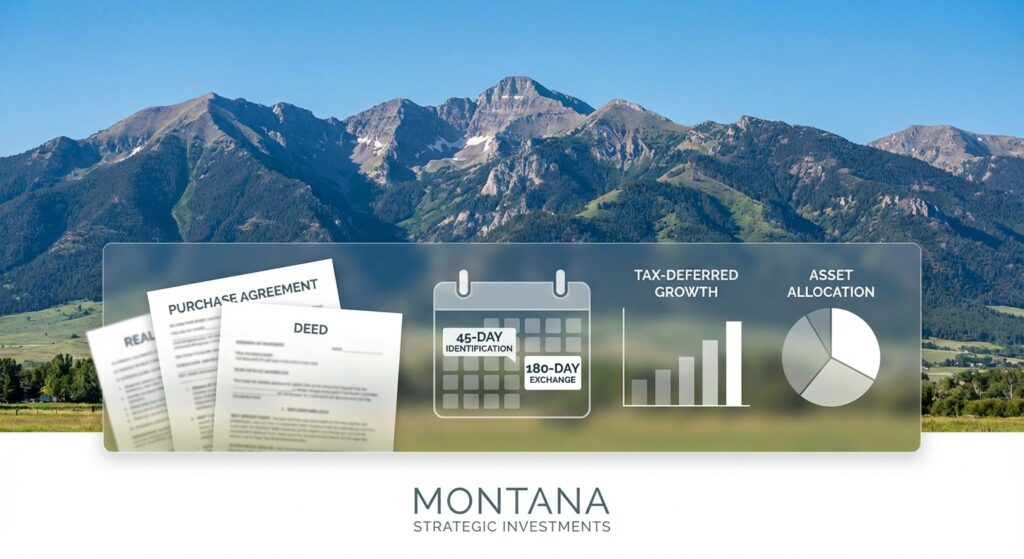
Within 45 days of closing your sale, you must identify replacement properties. You have 180 days total from the sale date to complete the purchase of replacement property. The qualified intermediary ensures funds transfer directly from your sale to the replacement purchase, maintaining the IRS-compliant structure that preserves your tax deferral.
Why Montana Real Estate Investors Choose 1031 Exchanges
Without a 1031 exchange, selling a Montana rental property triggers federal capital gains tax. For 2026, long-term capital gains rates are 0%, 15%, or 20%, with high-income investors paying the 20% rate plus 3.8% net investment income tax (23.8% combined). On a $500,000 gain, this means a $119,000 tax bill—money that doesn’t reinvest in your portfolio.
A 1031 exchange preserves that entire $500,000 for reinvestment. You can trade one Montana property for two properties, or upgrade to higher-appreciation properties, all without capital gains taxes. Over a 20-year investment career with multiple exchanges, the compounding effect of tax deferral can add hundreds of thousands to your net wealth. This is why our real estate investors use 1031 exchanges as the cornerstone of strategic portfolio growth.
What Are the Critical Deadlines for Your 2026 Exchange?
Quick Answer: The 45-day identification deadline and 180-day completion deadline are non-negotiable. Missing either deadline—even by one day—permanently disqualifies your exchange and triggers immediate capital gains taxation on your entire gain.
The IRS enforces two critical timelines in 1031 exchanges, and these deadlines are absolute. There are no extensions, no exceptions, and no second chances. Real estate investors must understand exactly when each clock starts and when it stops.
The 45-Day Identification Period: Your First Critical Deadline
The clock on your 45-day identification period starts on the day your original property closes. Within exactly 45 days, you must formally identify replacement property in writing through your qualified intermediary. This doesn’t mean you must close on the replacement property—you only need to identify it.
The IRS allows three identification strategies: identify one property of equal or greater value, identify up to three properties regardless of value, or identify more properties if their combined value exceeds 200% of the relinquished property’s value. Most investors use the “three-property” rule for flexibility, identifying three Montana properties they’re genuinely interested in purchasing.
Critical timing consideration: If your sale closes on January 15, 2026, your 45-day deadline expires on March 1, 2026. If you send identification paperwork on March 2, your exchange is invalidated. Documentation must reach your qualified intermediary on or before the deadline date. Smart investors submit identification paperwork at least two days early to account for mail delays or processing time.
The 180-Day Completion Deadline: Your Second Critical Deadline
From the same closing date, you have 180 days to actually close on your replacement property. This is your outer limit—you must have taken title to replacement property within this window. If your sale closes January 15, 2026, your 180-day deadline is July 14, 2026.
You can close on replacement property before the 45-day identification deadline, but you still must formally identify it by day 45. You can also close on multiple properties if you identified more than one, as long as you complete all closings by day 180. Most investors close on one primary replacement property well before the deadline, building in safety margin.
Important reminder: Both deadlines are calculated from your relinquished property closing date, not from when you sign the contract. If you contract to sell in December 2025 but close in January 2026, the deadlines reset to January’s close date. This is why investors coordinate with their qualified intermediary before taking any action.
| Deadline Milestone | Timeframe from Close | Action Required | Missing Deadline Results In |
|---|---|---|---|
| 45-Day Identification | 45 days from close date | Identify replacement property in writing | Immediate taxation of entire gain; exchange fails |
| 180-Day Completion | 180 days from close date | Close on replacement property | Immediate taxation of entire gain; exchange fails |
How Do Qualified Intermediaries Ensure Exchange Compliance?
Quick Answer: A qualified intermediary is a specialized third party who holds sale proceeds and coordinates the exchange transaction. Using a qualified intermediary is mandatory—if you touch the money yourself, the IRS disqualifies your exchange immediately, triggering full taxation.
One of the most critical components of a successful 1031 exchange is the role of the qualified intermediary. This is not optional—the IRS requires that sale proceeds never pass through your hands. Any direct receipt of funds, even for a single day, disqualifies the entire exchange.
What Qualifies as a Qualified Intermediary?
A qualified intermediary must meet strict IRS requirements under Treasury Regulation 1.1031(k)-1. Generally, it is a person or entity (usually a company) that facilitates 1031 exchanges professionally. The intermediary must not be related to you—you cannot use your CPA, your real estate agent, your attorney, or a family member as your intermediary.
Qualified intermediaries typically include specialized 1031 exchange companies, title companies experienced in exchanges, and some law firms specializing in real estate transactions. The intermediary opens a segregated account in your name (not their name), receives sale proceeds, holds the funds for the required 180-day period, and coordinates payment to the replacement property seller.
Most qualified intermediaries charge fees ranging from $500 to $1,500 for handling a single exchange. This is a worthwhile investment because the intermediary ensures strict IRC compliance, protects your tax deferral status, and manages the complex coordination between your sale and your purchase.
How the Intermediary Protects Your Exchange Status
The intermediary maintains documentation proving you never had constructive receipt of the funds. They hold the segregated account, provide regular statements, obtain written identification from you within the 45-day window, and coordinate the replacement purchase. By keeping funds separate and operating within the strict timeline, the intermediary creates the IRS-compliant paper trail that proves your exchange qualifies for tax deferral.
Pro Tip: Select your qualified intermediary before you list your property for sale. This allows you to coordinate timing and ensure the intermediary is ready to move quickly when your sale closes. A qualified intermediary experienced with Montana properties understands state-specific closing procedures and can handle complex timelines seamlessly.
What Properties Qualify as Like-Kind Under Current Rules?
Quick Answer: For 2026, like-kind property means real estate exchanging for real estate. Improved property can exchange for unimproved property. Commercial property can exchange for residential rental property. The IRS has simplified the rules—if both assets are U.S. real property interests, they qualify.
The Tax Cuts and Jobs Act of 2017 significantly simplified like-kind exchange rules. Before 2018, businesses could exchange various types of property (equipment, vehicles, intellectual property). Now, only real estate qualifies for 1031 treatment. This simplification actually benefits Montana real estate investors because it clarifies that virtually all Montana real estate exchanging situations qualify.
What Montana Properties Qualify for Like-Kind Exchanges?
- Rental apartments or multi-unit residential buildings can exchange for any real estate: commercial office, industrial warehouse, or raw land.
- Commercial real estate (retail, office buildings) can exchange for residential rental property or any other real estate.
- Raw land or agricultural property qualifies as long-term investment property qualifies for exchange into developed property.
- Vacation rental properties that generate consistent rental income qualify for 1031 exchange into other investment real estate.
- Net-leased properties and commercial real estate held for investment qualify for exchange into any other real property.
What Does NOT Qualify for 1031 Exchange Treatment?
- Your primary residence does not qualify for 1031 exchange (use the $250,000/$500,000 home sale exclusion instead).
- Personal property like vehicles, equipment, or artwork cannot be exchanged under Section 1031.
- Foreign real estate does not qualify; both relinquished and replacement property must be U.S. real estate.
- Property held primarily for sale (inventory, dealer property) does not qualify for 1031 treatment.
The key distinction: your property must be held for productive business use or investment purposes, not for personal use or quick resale. If you own a rental home or commercial building in Montana held for income generation, it qualifies for 1031 exchange into any other Montana real estate—or real estate in any other state.
How Much Can You Save with Strategic 1031 Planning?
Quick Answer: For 2026, selling a Montana property with a $300,000 capital gain without a 1031 exchange costs $69,000 in federal capital gains taxes (23% combined rate). A 1031 exchange defers 100% of this tax, keeping the full $300,000 for reinvestment.
The financial benefit of a 1031 exchange becomes clear when you calculate the taxes saved. In 2026, long-term capital gains for high-income investors are taxed at 20%, plus 3.8% net investment income tax, totaling 23.8%. For many investors, the rate is 15% plus 3.8% (18.8%), or 0% plus 3.8% for lower-income taxpayers.
Did You Know? Over a 30-year investment career, completing three 1031 exchanges can defer over $500,000 in capital gains taxes for a typical real estate portfolio. The compounding effect of reinvesting tax money instead of paying it to the IRS creates exponential wealth multiplication.
Real-World Tax Savings Example: Montana Rental Property Exchange
Let’s calculate actual 2026 tax savings using realistic numbers. Assume you purchased a Bozeman rental property in 2015 for $400,000. Your adjusted basis is $380,000 after depreciation deductions. Today in 2026, you sell for $850,000.
Your capital gain: $850,000 (sale price) − $380,000 (adjusted basis) = $470,000 gain. At 2026 long-term capital gains rates of 23.8% (20% capital gains plus 3.8% net investment income tax), your tax liability would be: $470,000 × 23.8% = $111,860 in federal taxes.
After paying $111,860 in taxes, you have $738,140 remaining to reinvest. But with a 1031 exchange, you keep the full $850,000 to reinvest. You can purchase a $850,000 property in Missoula or a multi-property portfolio. The $111,860 difference—now working in your portfolio—generates additional rental income and appreciation that compounds over decades.
If that $111,860 generates 8% annual returns over 20 years, it grows to $494,000 in additional wealth. This is the real power of 1031 exchanges—you’re not avoiding taxes forever, just deferring them while your money compounds. Most investors eventually pass property to heirs, who receive stepped-up basis at death, meaning the capital gains tax is never paid.
How Does 2026 Bonus Depreciation Change Your Strategy?
Quick Answer: The One Big Beautiful Bill Act permanently reinstated 100% bonus depreciation for property acquired after January 19, 2025. Replacement property in your 2026 1031 exchange qualifies, meaning you can deduct the full depreciable basis the first year, creating significant cash-flow tax deductions.
A major 2026 development significantly increases the power of 1031 exchanges: 100% bonus depreciation is now permanent. Previously scheduled to phase out, the One Big Beautiful Bill Act reinstated full bonus depreciation for qualified property acquired after January 19, 2025. This compounds the benefits of 1031 exchanges dramatically.
Leveraging Bonus Depreciation with Your 1031 Exchange
When you complete a 1031 exchange into a replacement property acquired after January 19, 2025, that replacement property qualifies for 100% bonus depreciation on the depreciable basis. For a commercial building worth $600,000, approximately 80% is depreciable (building structure), with 20% being land value. Your depreciable basis would be $480,000.
With 100% bonus depreciation, you can deduct the full $480,000 in depreciation in the year you acquire the replacement property. If you’re in the 24% federal tax bracket (for 2026), this $480,000 deduction saves $115,200 in federal taxes in a single year. At state income tax rates, additional state-level savings apply.
This accelerated deduction reduces your taxable income without reducing your cash flow—you still collect rent from the property. This strategy is particularly powerful for high-income investors who can use rental property deductions to offset other business or investment income, effectively saving significant taxes in the exchange year.
Pro Tip: For maximum tax savings, coordinate your 1031 exchange to close in the same year as high-income events (business sales, large capital gains). The bonus depreciation deduction can offset that other income, creating a tax shield that saves thousands or tens of thousands in taxes in that specific year.
What Are the Most Costly 1031 Exchange Mistakes to Avoid?
Quick Answer: Common mistakes include missing deadlines, touching sale proceeds directly, using unqualified intermediaries, and exchanging into ineligible property. Each mistake triggers full taxation of your entire capital gain immediately.
Real estate investors consistently make preventable mistakes that invalidate 1031 exchanges, triggering unexpected tax bills. Understanding these costly errors protects your tax deferral status.
Mistake #1: Missing the 45-Day or 180-Day Deadline
The single most common error is missing the identification or completion deadline. If your property closes March 1 and you don’t identify replacement property by April 15 (45 days), your exchange fails. If you don’t close by August 29 (180 days), your exchange fails. These deadlines are absolute—the IRS provides no extensions, no exceptions.
Prevention: Work backward from your target sale date. Identify potential replacement properties before you list your property. Have a qualified intermediary ready to move immediately upon closing. Build in 5-10 day buffers before each deadline.
Mistake #2: Directly Receiving Sale Proceeds
If you receive sale proceeds in your bank account—even for one day—the IRS considers you to have received constructive receipt. This disqualifies your exchange immediately. Some investors try to save intermediary fees by handling proceeds themselves, but this creates immediate taxation of the entire gain.
Prevention: Never let sale proceeds touch your personal account. Instruct your real estate attorney or title company to wire funds directly to the qualified intermediary’s segregated account. Verify wire instructions with the intermediary directly—never rely on email instructions alone.
Mistake #3: Using an Unqualified Intermediary
Some investors use family members, their CPA, or local business contacts as intermediaries to save fees. The IRS requires specific qualifications: the intermediary cannot have had a prior relationship with you in the preceding two years. Family relationships automatically disqualify someone.
Prevention: Use established 1031 exchange companies with years of experience, errors & omissions insurance, and IRS compliance certifications. The $500-1,500 fee is insurance against a $100,000+ tax bill. Your professional tax advisor can recommend qualified intermediaries in your area.
Mistake #4: Identifying Property You Don’t Actually Purchase
You can identify up to three replacement properties, but many investors identify property they’re not serious about acquiring. If you identify property A, B, and C but your financing falls through and you don’t close on any of them by day 180, your exchange fails. Identification isn’t binding, but failing to close on any identified property invalidates the exchange.
Prevention: Only identify properties you can realistically close on within 180 days. Have financing pre-approved and property inspections completed before identifying. Work with experienced real estate professionals who understand exchange timelines.
Uncle Kam in Action: Real Estate Investor Defers $87,000 in Taxes Through Strategic 1031 Exchange
Client Snapshot: Marcus is a Montana real estate investor with a portfolio of three rental properties in Missoula and Bozeman. Over 12 years, he’s accumulated significant appreciation and depreciation deductions. Annual rental income totals $125,000 before expenses.
Financial Profile: Marcus’s adjusted gross income is $185,000 (from rental operations and W-2 employment). His oldest property, purchased for $380,000 in 2014, is now worth $520,000. Adjusted basis after depreciation: $310,000. His capital gain: $210,000.
The Challenge: Marcus wanted to consolidate his portfolio by selling the older Missoula property and acquiring a higher-appreciation property in Bozeman. Without strategic planning, selling would trigger federal capital gains tax of $210,000 × 20% (his tax bracket) + 3.8% net investment income tax = $50,120. State taxes would add $12,600. Total tax hit: $62,720. Marcus would have only $457,280 to reinvest instead of the full $520,000.
The Uncle Kam Solution: We structured Marcus’s transaction as a 1031 exchange. He engaged a qualified intermediary and identified a $550,000 Bozeman property. His March 15 closing on the Missoula property started the 45-day identification window (deadline May 29) and 180-day completion window (deadline September 11). He identified the Bozeman property by May 15 and closed on it by August 20. His basis from the Missoula property ($310,000) transferred to the Bozeman property. Additionally, the Bozeman property qualified for 100% bonus depreciation on the depreciable basis (approximately $440,000 at 80% depreciable), creating a $105,600 tax deduction in year one (at 24% tax bracket).
The Results:
- Tax Savings on Capital Gains: $62,720 deferred (compared to standard sale)
- Investment from Bonus Depreciation: $1,500 (intermediary fee) plus $500 (tax planning)
- Return on Investment (ROI): $62,720 in savings ÷ $2,000 total investment = 31.4x return on investment in year one. Over 20 years, the $62,720 compounding at 8% annual returns grows to $291,000 in additional wealth.
This is just one example of how our team at Uncle Kam helps real estate investors leverage 1031 exchanges and bonus depreciation to achieve significant tax savings. Marcus kept his $62,720 working in his portfolio instead of paying it to the IRS, accelerating his path to financial independence. For professional guidance on your specific Montana 1031 exchange strategy, our Montana tax preparation services provide expert analysis and execution.
Next Steps
Now that you understand Montana 1031 exchange guidance and the 2026 opportunities available, take action to implement your strategy:
- Document your property basis: Gather original purchase price, capital improvement receipts, and prior depreciation schedules for each property in your portfolio.
- Identify qualified intermediary: Research 1031 exchange companies in Montana and interview at least two about their experience, fees, and compliance procedures.
- Calculate your tax exposure: Determine the capital gain on each property if sold today. This reveals your potential tax savings through 1031 exchange strategy.
- Create a portfolio roadmap: Outline your replacement property targets, timeline, and financing strategy before listing property.
- Consult with Uncle Kam: Our professional team provides Montana tax preparation services that include 1031 exchange planning, bonus depreciation analysis, and comprehensive tax strategy for real estate investors.
Frequently Asked Questions
Can I do a 1031 exchange if I’ve owned the property for less than a year?
Yes. The IRS doesn’t require a minimum holding period for 1031 exchange eligibility. The property must be held for productive business use or investment, but there’s no time requirement. However, short holding periods can trigger IRS scrutiny about whether the property was held for investment versus speculation, so document your investment intent clearly.
What happens if I don’t have enough proceeds to buy equivalent value replacement property?
If your replacement property costs less than your sale proceeds, the excess funds received are taxable as boot. For example, selling for $500,000 but buying for $400,000 means $100,000 is taxable. To avoid this, either reinvest all proceeds or use a build-to-suit strategy where you exchange into raw land and construct improvements.
Can I exchange my Montana property for property outside Montana?
Absolutely. Section 1031 exchanges work nationwide. You can exchange a Bozeman apartment building for a Nevada casino investment property, a Colorado vacation rental, or properties in multiple states. The only requirement is that both properties are U.S. real estate held for investment or productive business use.
What if my replacement property doesn’t close by the 180-day deadline due to financing?
The 180-day deadline is absolute—no extensions are possible, even for financing delays. If you can’t close by day 180, your entire exchange fails and all proceeds become taxable. Prevention: Pre-approve financing before identifying replacement property and use experienced lenders who understand exchange timelines.
Can I do a reverse 1031 exchange where I buy first, then sell?
Yes, but it’s more complex and expensive. In a reverse exchange, you use a qualified intermediary to acquire replacement property before selling your current property. The intermediary holds title to the replacement property for up to 180 days while you sell your current property. This strategy requires specialized expertise and higher intermediary fees but provides flexibility when replacement property deals move faster than your sale.
How does the depreciation recapture tax work with 1031 exchanges?
Depreciation recapture (taxed at 25% federal rate for 2026) applies to all real property exchanges—1031 exchanges don’t avoid this. The recapture tax applies to prior depreciation you deducted. If your property appreciated $200,000 but you deducted $100,000 in depreciation, your gain is $300,000: $100,000 taxed at 25% (depreciation recapture) plus $200,000 at capital gains rates. A 1031 exchange defers both but doesn’t eliminate depreciation recapture.
Can I exchange into a property with different financing structure?
Yes, completely. You could exchange from a cash property into a financed property, or vice versa. If you have $600,000 in proceeds and purchase a $600,000 property with $400,000 financing, that’s perfectly fine. Just remember that taking on debt doesn’t change the fact that your basis transfers—you still owe capital gains tax eventually if you don’t do another 1031 exchange.
What if I sell my property in 2026 but want to delay the exchange to 2027?
The 45-day and 180-day deadlines start on your sale closing date—they cannot be delayed. If you close in December 2026, your 45-day deadline expires in early 2027, and your 180-day deadline expires in mid-2027. The deadlines automatically move into the next calendar year. You cannot defer starting your exchange timeline.
Are there any new Montana-specific 1031 exchange rules for 2026?
Montana follows federal IRC Section 1031 rules; state law doesn’t add additional requirements or restrictions. However, Montana property transfer procedures (recording requirements, title company involvement) may differ from other states. Work with a qualified intermediary experienced in Montana real estate to ensure compliance with state recording procedures.
This information is current as of 1/18/2026. Tax laws change frequently. Verify updates with the IRS or a professional tax advisor if reading this later.
Related Resources
- Real Estate Investor Tax Strategy Resources
- 2026 Tax Strategy for Maximum Savings
- Bonus Depreciation and Cost Segregation Services
- IRS Notice 2026-11: Bonus Depreciation Guidance
- IRS Publication 946: How to Depreciate Property
Last updated: January, 2026

