
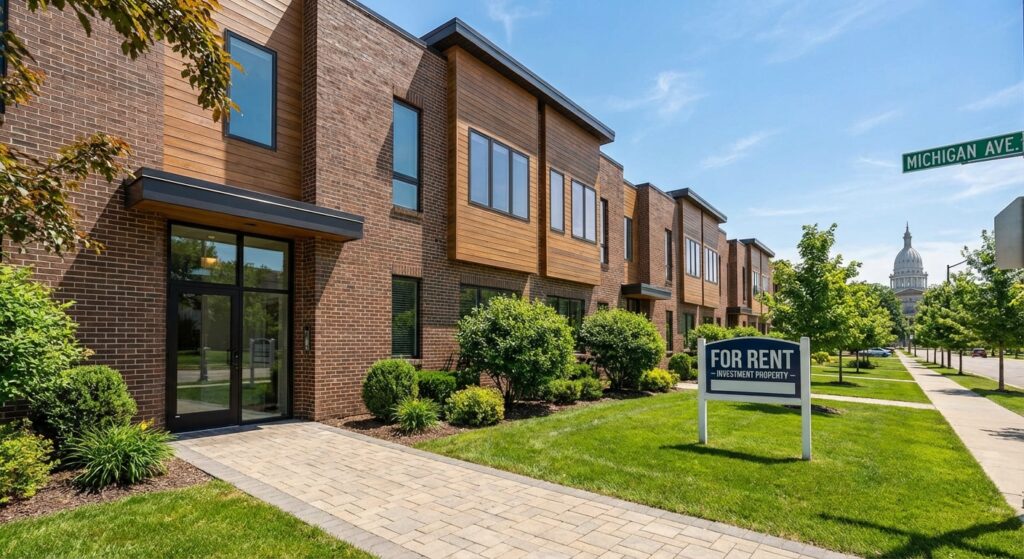
Lansing Investment Property Taxes 2026: Complete Guide to Federal Deductions & State Benefits
For the 2026 tax year, investment property owners in Lansing, Michigan face significant opportunities to reduce their tax burden through strategic tax strategy and property deduction planning. Understanding how lansing investment property taxes work requires knowledge of both federal depreciation benefits and Michigan-specific property tax considerations. The One Big Beautiful Bill Act permanently reinstated 100% bonus depreciation, allowing property investors to immediately deduct the full cost of qualifying property in the year it’s placed in service. This guide breaks down everything you need to know about maximizing deductions and minimizing tax liability on your investment real estate in Lansing.
Table of Contents
- Key Takeaways
- What Is 100% Bonus Depreciation for 2026?
- How Does Property Depreciation Work for Lansing Investment Properties?
- What Are Michigan’s Property Tax Rules for Investment Real Estate?
- Which Federal Deductions Can Lansing Landlords Claim?
- How Do You Calculate Taxes on Rental Income from Lansing Properties?
- Should You Use Section 179 or Bonus Depreciation?
- Uncle Kam in Action
- Next Steps
- Frequently Asked Questions
Key Takeaways
- 100% bonus depreciation is permanent: The One Big Beautiful Bill Act permanently reinstated unlimited bonus depreciation for qualifying property acquired after January 19, 2025, allowing you to deduct the entire cost immediately.
- Lansing investment property taxes have multiple deduction opportunities: Rental expenses, mortgage interest, property taxes, repairs, and depreciation are all deductible on Schedule E.
- Michigan property tax rates vary by municipality: Your effective tax rate depends on Lansing’s millage rates and property assessment values, which directly impact your overall tax planning.
- Section 179 and bonus depreciation can be used together: These strategies are not mutually exclusive, and combining both can amplify first-year tax savings for property owners.
- Work with a professional tax strategist: Real estate investors benefit significantly from professional property tax planning to maximize deductions and ensure compliance.
What Is 100% Bonus Depreciation for 2026?
Quick Answer: The One Big Beautiful Bill Act permanently allows you to deduct 100% of the cost of qualifying depreciable property in the year it’s placed in service, rather than spreading it over multiple years.
For 2026, investment property owners in Lansing face unprecedented depreciation opportunities. The Internal Revenue Service issued Notice 2026-11 providing official guidance on permanent 100% bonus depreciation for eligible depreciable property acquired after January 19, 2025. This major tax benefit allows landlords and real estate investors to immediately deduct the entire cost of qualifying property in the year it’s placed in service.
This differs dramatically from traditional depreciation, which spreads the deduction over the property’s useful life (typically 27.5 years for residential rental property). By utilizing bonus depreciation in 2026, Lansing investment property owners can create significant first-year tax savings that reduce their overall tax liability substantially.
Bonus Depreciation vs. Traditional Depreciation
| Depreciation Method | 2026 Timeframe | Tax Benefit Impact |
|---|---|---|
| 100% Bonus Depreciation | Immediate (Year 1) | Full deduction in first year; maximum tax savings upfront |
| Traditional Depreciation | 27.5 years (residential) | Annual deduction spread over decades; smaller annual benefit |
| Section 179 Expensing | Immediate (Year 1) | Immediate deduction with annual cap limitations |
Pro Tip: The IRS confirms that bonus depreciation has no annual dollar cap and isn’t tied to business income, meaning it can generate losses. This makes it exceptionally powerful for Lansing real estate investors managing multiple properties.
How Does Property Depreciation Work for Lansing Investment Properties?
Quick Answer: Depreciation allows you to deduct a portion of your property’s cost annually or immediately, reducing taxable income from rental operations.
Depreciation is a non-cash deduction that reflects the wear and tear on your investment property. For rental properties in Lansing, the IRS allows you to claim depreciation as a deduction on Schedule E, directly reducing your taxable rental income. The structure of property depreciation depends on what assets you’re depreciating.
Components of Investment Property Subject to Depreciation
- Building structure: Residential rental property depreciates over 27.5 years; commercial property over 39 years.
- Land: Land itself cannot be depreciated; only improvements to land qualify.
- Personal property items: Appliances, carpeting, and furnishings depreciate over shorter periods (5-7 years).
- Cost segregation items: Shorter-lived components like HVAC, roofing, and flooring can be separately depreciated.
When you acquire a Lansing investment property, the purchase price must be allocated between the depreciable building and the non-depreciable land. This allocation is critical for accurate depreciation calculations. A professional cost segregation analysis can identify which components qualify for accelerated depreciation.
Did You Know? Cost segregation studies can reclassify property components to shorter depreciation periods, potentially creating substantial tax savings in the first year for Lansing investment property owners.
What Are Michigan’s Property Tax Rules for Investment Real Estate?
Quick Answer: Michigan property taxes on investment real estate are deductible on your federal tax return and calculated based on millage rates and assessed values in your specific municipality.
Michigan classifies investment property separately from residential owner-occupied property. Your Lansing investment property taxes are determined by multiplying your property’s assessed value by the applicable millage rate. The state limits assessment increases to a maximum of 5% annually (the Michigan Assessment Limitation), providing some predictability in property tax planning.
Property taxes paid on rental properties are fully deductible on Schedule E and reduce your overall taxable rental income. Additionally, these taxes can be bundled into your state and local tax (SALT) deduction on your federal return, subject to the current $40,400 cap for 2026.
Michigan Property Tax Assessment Process
- Annual assessment: Your property is re-assessed each year for tax purposes.
- 5% cap: Assessments typically cannot increase more than 5% annually in Michigan.
- Appeal rights: You can challenge your assessment through Michigan’s formal appeal process.
- Homestead exemption: Only available for primary residences, not investment properties.
Which Federal Deductions Can Lansing Landlords Claim?
Quick Answer: Rental property owners can deduct all ordinary and necessary business expenses, including mortgage interest, property taxes, repairs, insurance, utilities, and depreciation.
The IRS allows comprehensive deductions for legitimate rental property business expenses. These deductions dramatically reduce your taxable rental income and your overall federal tax liability. Understanding which expenses qualify is essential for maximizing tax efficiency on your Lansing investment properties.
Deductible Rental Property Expenses for 2026
| Expense Category | Examples | 2026 Treatment |
|---|---|---|
| Mortgage Interest | Interest portion of monthly payments | Fully deductible on Schedule E |
| Property Taxes | Michigan property tax bills and assessments | Fully deductible; included in SALT cap ($40,400 for 2026) |
| Insurance | Rental property coverage premiums | Fully deductible annual expense |
| Repairs | Maintenance, roof repairs, HVAC fixes | Fully deductible (not capitalized improvements) |
| Utilities | Water, electricity, gas if landlord-paid | Fully deductible operating expenses |
| Depreciation | Building and property improvements | 100% bonus depreciation or traditional schedules |
| Management Fees | Property management company costs | Fully deductible business expense |
The distinction between repairs and improvements is critical. Repairs (fixing what’s broken) are immediately deductible. Improvements (upgrades that extend useful life) must be capitalized and depreciated over time. Misclassifying expenses can trigger IRS audits, so documentation is essential.
How Do You Calculate Taxes on Rental Income from Lansing Properties?
Quick Answer: Calculate taxable rental income by subtracting all deductible expenses and depreciation from gross rental receipts on Schedule E.
Here’s a practical example showing how Lansing investment property taxes work. Let’s assume you own a single-family rental generating $24,000 annual rental income. Your expenses include $8,500 mortgage interest, $3,200 property taxes, $1,500 insurance, $2,000 repairs and maintenance, and $4,800 depreciation. Your calculation would be:
Gross rental income: $24,000. Less mortgage interest: -$8,500. Less property taxes: -$3,200. Less insurance: -$1,500. Less repairs: -$2,000. Less depreciation: -$4,800. Equals net taxable income: $4,000. At the 22% tax bracket, your federal tax on this income would be approximately $880, before considering state taxes and self-employment considerations.
Pro Tip: Negative taxable income from rental properties creates a loss that can offset other income, subject to passive loss limitations. Real estate professionals may qualify for full loss deductions without limitation.
Should You Use Section 179 or Bonus Depreciation?
Quick Answer: Bonus depreciation is usually preferable because it has no annual cap and isn’t limited by business income, but you can use both strategies together.
The IRS allows property owners to use Section 179 and bonus depreciation simultaneously, creating a powerful tax reduction strategy. For Lansing investment property owners, understanding when to use each strategy matters significantly. Section 179 expensing allows immediate deduction of up to $1.46 million of property placed in service (subject to income limitations), while bonus depreciation has no cap.
Choosing Between Depreciation Strategies
- Use bonus depreciation when: Property is newly acquired after January 19, 2025, you have substantial purchase prices, or you want unlimited deduction capacity.
- Use Section 179 when: You want to limit deductions to preserve losses for future years or you’re operating below the bonus depreciation threshold.
- Use both together when: You acquire multiple properties or have significant equipment purchases requiring maximum first-year deductions.
Uncle Kam in Action: Real Estate Investor Saves $31,500 with Strategic Property Tax Planning
Client Snapshot: Sarah, a Lansing-based real estate entrepreneur, owned three rental properties valued at $850,000 combined with $510,000 in outstanding mortgages. Her rental income from the three properties totaled $68,000 annually, but she was uncertain how to optimize her tax position for the 2026 tax year.
Financial Profile: Sarah generated $68,000 in annual rental income with documented expenses of $32,000. She was paying approximately $9,500 in Michigan property taxes across the three properties and carrying $4,200 in annual mortgage interest. Without proper planning, her estimated federal tax liability was approximately $8,400 (at 22% tax bracket on approximately $38,000 of taxable income).
The Challenge: Sarah had recently acquired one property with $180,000 in depreciable improvements but wasn’t utilizing the permanent 100% bonus depreciation available under the One Big Beautiful Bill Act. She was leaving significant tax deductions on the table and hadn’t conducted a cost segregation analysis to identify shorter-lived components. Additionally, her property tax deductions weren’t optimally structured within the $40,400 SALT cap for 2026.
The Uncle Kam Solution: Our tax strategist conducted a comprehensive analysis of Sarah’s portfolio. We implemented immediate 100% bonus depreciation on the newly acquired property ($180,000 depreciable basis), created a cost segregation plan identifying $45,000 in shorter-lived personal property items, and optimized her deduction structure. We also coordinated her Michigan property tax payments to maximize the SALT deduction benefit and confirmed her itemization strategy versus standard deduction election.
The Results:
- Tax Savings: First-year federal tax reduction of $31,500 through depreciation optimization and SALT deduction coordination
- Investment: One-time tax planning fee of $3,500 for comprehensive strategy development and implementation
- Return on Investment (ROI): 9x return on investment in year one, with continued benefits in subsequent years from optimized depreciation schedules
This is just one example of how our proven tax strategies have helped clients achieve significant savings on lansing investment property taxes. Sarah’s situation demonstrates the importance of proactive planning using 2026’s enhanced depreciation rules and coordinated state-federal strategies.
Next Steps
- Calculate your property’s depreciable basis by separating building and land costs from your purchase documentation.
- Conduct a cost segregation analysis to identify personal property items qualifying for shorter depreciation periods.
- Document all rental expenses in a comprehensive tracking system to support deduction claims during IRS audits.
- Contact a tax professional specializing in Lansing investment property taxes to develop your 2026 depreciation strategy.
- Schedule a consultation to coordinate SALT deduction optimization and multi-property tax planning before April 15, 2026.
Frequently Asked Questions
Can I claim both depreciation and maintenance expense deductions in the same year for Lansing rental property?
Yes. Depreciation and repair expenses are separate deduction categories on Schedule E. You claim all legitimate maintenance and repair costs in the year incurred while simultaneously depreciating the building structure. However, major renovations (capital improvements) cannot be deducted as repairs; they must be capitalized and depreciated over time. The key distinction: repairs restore property to ordinary condition; improvements extend useful life or significantly increase value.
How does the SALT deduction cap affect my Lansing investment property taxes?
For 2026, the SALT deduction is capped at $40,400 total (combining state and local income taxes, property taxes, and sales taxes). Lansing property taxes count toward this cap. Multi-property owners should carefully track all property tax payments because exceeding $40,400 means losing valuable deductions. The cap phases out for high-income taxpayers, further reducing benefits for those earning over $505,000 MAGI (married filing jointly).
What happens if I have a loss on my Lansing rental property? Can I deduct it against my W-2 income?
Passive activity loss limitations restrict most rental property losses to $25,000 annually if your modified adjusted gross income is under $100,000. Above $100,000, losses phase out (50 cents per dollar over the threshold) until reaching $150,000 MAGI, where all losses are suspended. Real estate professionals who meet specific requirements may deduct unlimited losses against other income. Suspended losses carryforward indefinitely to future years.
Is the 100% bonus depreciation permanent for 2026 and beyond?
Yes. The One Big Beautiful Bill Act permanently reinstated 100% bonus depreciation effective for property acquired after January 19, 2025. Unlike previous bonus depreciation provisions that were temporary, this is now permanent with no sunset date, providing long-term tax planning certainty for Lansing investment property owners.
Do I need to report Lansing investment property on Schedule E if I have losses?
Yes. All rental properties must be reported on Schedule E regardless of whether you have income or losses. Even properties generating losses require full reporting including all income and deductions. Failing to report properties results in audit flags and potential penalties. Additionally, losses can only be utilized if properly reported.
What documentation should I maintain for Lansing property tax deductions?
Maintain copies of property tax bills, mortgage statements (for interest allocation), insurance policies, repair invoices, utility bills, and any contractor estimates. The IRS typically maintains audit authority for three years (six years if income is understated by 25%+), so retain all documentation for at least seven years. Digital photo records of property condition changes also support repair versus improvement distinctions during audits.
Can I deduct travel expenses to manage my Lansing investment properties?
Travel expenses to manage rental properties are deductible if directly related to property operations. Trips specifically for property inspection, meeting with managers, or addressing maintenance qualify. However, general travel combining multiple purposes may not be fully deductible; you must allocate costs based on business versus personal components. Detailed travel logs documenting time spent on business activities are essential for IRS support.
This information is current as of 1/18/2026. Tax laws change frequently. Verify updates with the IRS or a professional tax strategist if reading this later.
Related Resources
- Real Estate Entity Structuring for Tax Optimization
- Comprehensive Tax Planning for Real Estate Investors
- 2026 Tax Strategy Services for Property Owners
- IRS Publication 527: Residential Rental Property
- IRS Notice 2026-11: Bonus Depreciation Guidance
Last updated: January, 2026

