
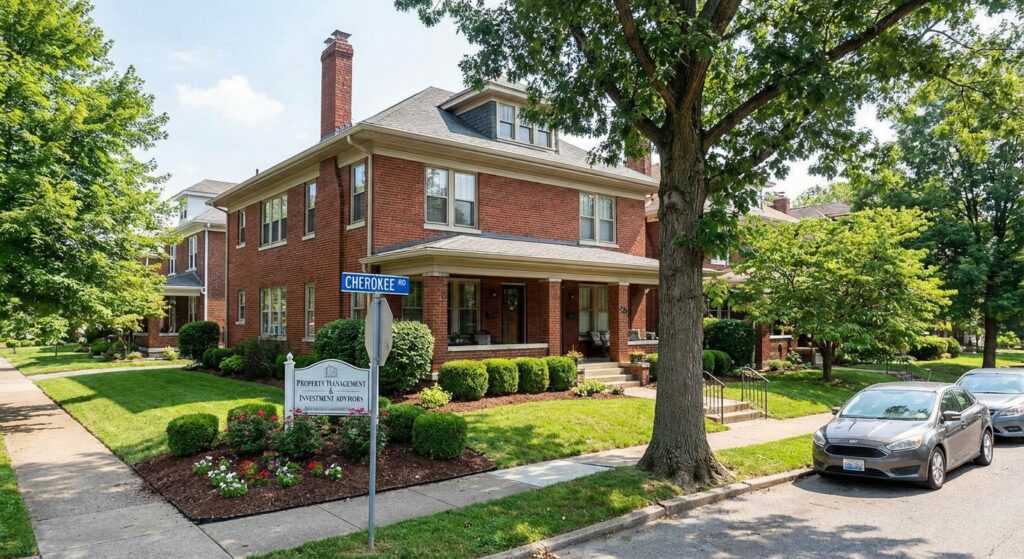
Louisville Rental Property Taxes 2026: Complete Tax Deduction & Strategy Guide for Real Estate Investors
For the 2026 tax year, Louisville rental property owners can unlock significant tax savings through strategic deductions and advanced planning techniques. With the One Big Beautiful Bill Act’s 100% bonus depreciation deduction now permanent, the SALT deduction cap at $40,400, and new Section 163(j) amendments allowing depreciation add-backs, rental property investors face both challenges and unprecedented opportunities to minimize their tax liability while building wealth through real estate.
Table of Contents
- Key Takeaways
- What Are the Primary Tax Deductions for Louisville Rental Properties?
- How Does Depreciation Reduce Your Louisville Rental Property Taxes?
- What Is the 100% Bonus Depreciation for 2026?
- How Does the SALT Deduction Cap Affect Your Louisville Rental Property Taxes?
- What Operating Expenses Can You Deduct from Rental Income?
- How Do Passive Activity Loss Limitations Apply to Your Rental Properties?
- Uncle Kam in Action: Real Investor Results
- Next Steps
- Frequently Asked Questions
Key Takeaways
- For 2026, the 100% bonus depreciation deduction is now permanent for rental property improvements acquired after January 19, 2025.
- The 2026 SALT deduction cap is $40,400, phasing out for high-income Louisville real estate investors earning above $505,000 in MAGI.
- Schedule E deductions include mortgage interest, property taxes, insurance, maintenance, repairs, and depreciation on your rental property.
- Passive activity loss limitations cap deductions at $25,000 for lower-income rental property owners, but professional real estate investors can deduct unlimited losses.
- The IRS Section 163(j) amendment allows you to add back depreciation deductions when calculating business interest expense limitations.
What Are the Primary Tax Deductions for Louisville Rental Properties?
Quick Answer: Louisville rental property owners can deduct mortgage interest, property taxes, insurance, repairs, maintenance, utilities, property management fees, HOA fees, advertising, legal and accounting fees, and depreciation when reporting rental income on Schedule E.
For the 2026 tax year, rental property deductions represent your biggest opportunity to reduce taxable income from your Louisville real estate. The IRS allows you to deduct ordinary and necessary business expenses associated with managing and maintaining your rental property. These deductions significantly reduce the amount of your rental income subject to federal income tax.
When you rent out property in Louisville, Kentucky, you’re operating a business. The IRS recognizes this by allowing you to offset rental income with legitimate business expenses. You report these deductions on Schedule E (Form 1040), and they flow to your individual tax return where they reduce your overall taxable income. This is why many successful real estate investors can generate substantial rental income while maintaining minimal tax liability through strategic deductions.
Above-the-Line Deductions for Rental Properties
Above-the-line deductions directly reduce your adjusted gross income (AGI) before you even decide whether to itemize deductions. For rental properties in Louisville, the primary above-the-line deduction is mortgage interest expense. This is a critical deduction because it allows you to deduct interest paid on loans used to acquire or improve your rental property. Unlike principal payments on your loan, interest is 100% deductible as a rental business expense in 2026.
- Mortgage Interest: All interest paid on loans for rental property acquisition or improvement is deductible (principal payments are not).
- Business Interest Deduction: Under Section 163(j) of the IRS code (amended for 2026), you can generally deduct business interest expense up to 30% of adjusted taxable income.
- Depreciation Deduction: This represents your largest deduction for most Louisville rental property owners (detailed below).
Itemized Deductions for Rental Properties
Kentucky property taxes, homeowners association (HOA) fees, and other state and local property taxes paid on your Louisville rental property count toward your itemized deductions. However, 2026 brings a critical limitation: the SALT (State and Local Taxes) deduction cap is $40,400 for the tax year. This cap is especially important for Louisville rental property owners with multiple properties or high-value real estate.
- Property Taxes: Kentucky property taxes on rental real estate are deductible up to the $40,400 limit for 2026.
- HOA Fees: If your Louisville rental property is in a community with mandatory HOA fees, these are deductible as property management expenses.
- Business Licenses & Permits: Any fees paid to Louisville or Kentucky for licenses or permits related to rental activity are deductible.
Pro Tip: Track your Louisville rental property taxes separately from other itemized deductions. If you’re near the $40,400 SALT cap for 2026, prioritize deducting the highest-value property taxes first, as they offer the most tax benefit before hitting the phase-out range.
How Does Depreciation Reduce Your Louisville Rental Property Taxes?
Quick Answer: Depreciation allows you to deduct a portion of your property’s cost annually, even though you’re not making a cash payment. For residential rental properties, you typically deduct the building cost (not land) over 27.5 years, creating substantial annual tax deductions that offset rental income.
Depreciation is arguably the most powerful deduction available to Louisville rental property owners in 2026. The IRS allows you to deduct a portion of your property’s building cost each year based on the asset’s useful life. This is a non-cash deduction, meaning you get the tax benefit without writing a check, which makes it exceptionally valuable for reducing taxable income.
When you purchase a rental property in Louisville for $400,000, you must first allocate that purchase price between land and building. The IRS allows depreciation only on the building, not the land. If your purchase price breaks down as $300,000 for the building and $100,000 for the land, you can depreciate the $300,000 building cost over 27.5 years, creating an annual deduction of approximately $10,909 without any additional cash outlay.
Standard Depreciation Calculation for Residential Properties
Residential rental properties use a 27.5-year depreciation schedule under current IRS rules. This means you deduct 1/27.5 (or approximately 3.636%) of the depreciable basis annually. For a $300,000 depreciable building, this creates a yearly depreciation deduction of $10,909 in 2026.
| Scenario | Building Cost | Annual Depreciation Rate | 2026 Deduction |
|---|---|---|---|
| Modest Louisville Single-Family | $250,000 | 3.636% | $9,090 |
| Mid-Range Louisville Duplex | $400,000 | 3.636% | $14,544 |
| High-Value Louisville Portfolio | $800,000 | 3.636% | $29,088 |
Depreciation Recapture and Your Tax Liability
An important consideration for 2026: when you sell your Louisville rental property, the IRS recaptures depreciation deductions you claimed during ownership. This means you’ll owe 25% federal tax on the depreciation you deducted, even if you deferred that tax during the holding period. However, this recapture only occurs when you sell, so it rarely influences the decision to claim depreciation deductions annually.
Did You Know? Depreciation deductions reduce your cost basis in the property for tax purposes, which means they increase your capital gain when you sell. Many Louisville rental property investors still claim depreciation because the current-year tax savings exceed the future recapture tax at higher rates.
What Is the 100% Bonus Depreciation for 2026?
Quick Answer: The One Big Beautiful Bill Act permanently authorizes 100% bonus depreciation for qualified depreciable property acquired after January 19, 2025. This means you can deduct the entire cost of eligible improvements in the year acquired, not spread over 27.5 years.
The most significant change to Louisville rental property tax planning for 2026 is the permanent 100% bonus depreciation deduction. Effective for property placed in service after January 19, 2025, the one Big Beautiful Bill Act allows you to deduct 100% of the cost of qualified property immediately, rather than over the standard 27.5-year depreciation period.
This change from the prior law is transformational for rental property tax planning. Under prior rules, bonus depreciation was scheduled to decline, eventually phasing out completely. Now, in 2026, you have the opportunity to claim permanent full-year expensing for certain rental property improvements, creating substantial first-year tax deductions.
Qualified Property for 100% Bonus Depreciation in 2026
Not all property qualifies for 100% bonus depreciation. The property must be depreciable and have a recovery period of 15 years or less (with specific exceptions). For Louisville rental property owners, this includes improvements such as roofing systems, HVAC units, flooring, appliances, and other building components with short useful lives.
- Qualified Improvement Property (QIP): Interior improvements to the building placed after January 19, 2025 (e.g., flooring, built-in cabinets, interior walls).
- Tangible Property: Equipment with a recovery period of 20 years or less (e.g., HVAC, water heaters, appliances).
- Land Improvements: Certain landscaping, parking lots, and sidewalk improvements qualify for bonus depreciation in 2026.
- Not Included: The building structure itself and land do not qualify for bonus depreciation (but the structure qualifies for standard depreciation).
Election to Use 40% or 60% Instead of 100%
The IRS recognizes that some Louisville rental property investors may prefer to spread deductions over multiple years to manage tax brackets. IRS Notice 2026-11 allows you to elect 40% bonus depreciation (or 60% for certain longer-production-period property) instead of the full 100%. This election is made on your tax return and can be beneficial if you’re concerned about generating too much deduction in a single year.
Pro Tip: Work with a Louisville tax professional to analyze whether claiming 100% bonus depreciation or electing the 40%/60% alternative serves your overall tax strategy for 2026. The decision depends on your total income, other deductions, and multi-year planning goals.
How Does the SALT Deduction Cap Affect Your Louisville Rental Property Taxes?
Quick Answer: For 2026, the SALT deduction cap is $40,400 (up from $40,000 in 2025). This limit applies to all state and local taxes combined, including Louisville/Kentucky property taxes on all properties. High-income investors with MAGI above $505,000 face additional phase-outs.
The State and Local Tax (SALT) deduction cap is a critical constraint for Louisville rental property owners in 2026. The temporary increase from the standard $10,000 cap to $40,400 expires after 2029, so understanding how this limit affects your 2026 tax return is essential for multi-property investors. For 2026, the SALT cap is $40,400, increased 1% from 2025 as part of annual inflation adjustments.
SALT Phase-Out Rules for High-Income Louisville Investors
If your Modified Adjusted Gross Income (MAGI) exceeds $505,000 for 2026, you face an additional reduction in your SALT deduction. The deduction is reduced by 30% for each dollar of MAGI above the $505,000 threshold, creating a second limiting mechanism for high-income investors. Investors with MAGI above $606,000 lose the increased cap entirely and are limited to the standard $10,000 SALT deduction.
| 2026 MAGI for Louisville Investors | SALT Deduction Calculation | Maximum SALT Deduction |
|---|---|---|
| Below $505,000 | Full amount subject to cap | $40,400 (2026) |
| $505,000 to $606,000 | $40,400 minus 30% of excess over $505,000 | Reduced by phase-out |
| Above $606,000 | Limited to standard deduction only | $10,000 |
For Louisville rental property investors with multiple properties, this phase-out creates a significant planning challenge. If you own three rental properties with $18,000 in property taxes each ($54,000 total), and your MAGI is $550,000, your SALT deduction would be reduced by 30% of the $45,000 excess over $505,000, resulting in a $13,500 reduction. This leaves you with a $26,900 SALT deduction instead of the full $40,400.
SALT Deduction Planning for 2026-2030
The increased SALT cap expires after 2029, reverting to $10,000 beginning in 2030. This creates a planning opportunity for Louisville rental property owners who can accelerate deductions into 2026-2029 while the cap is higher, or structure their rental business to manage MAGI strategically. Working with a professional tax advisor helps you maximize the benefit of the temporary increased cap.
Pro Tip: For Louisville investors with multiple properties, consider the combined impact of SALT limitations. If you can legitimately defer certain income or accelerate deductions into 2026-2029, you could capture significant tax savings before the cap drops to $10,000 in 2030.
What Operating Expenses Can You Deduct from Rental Income?
Quick Answer: You can deduct ordinary and necessary business expenses including repairs, maintenance, insurance, utilities, property management fees, advertising, legal fees, accounting fees, travel expenses related to managing the property, and supplies—all reported on Schedule E for 2026.
Beyond depreciation and mortgage interest, Louisville rental property owners have access to dozens of specific expense deductions that directly reduce rental income. These operating expenses are the backbone of profitable rental property investing, and proper documentation in 2026 ensures you capture every allowable deduction.
Repairs vs. Improvements: Critical Tax Planning for 2026
The most important distinction in rental property expense deductions is understanding the difference between deductible repairs and capital improvements. Repairs restore a property to its previous condition and are 100% deductible in 2026. Improvements add new functionality or significantly extend the useful life of the property and must be capitalized and depreciated over time. This distinction is critical because misclassifying an improvement as a repair creates compliance risks with the IRS.
- Repairs (Deductible in 2026): Patching drywall, painting, fixing broken windows, patching roof leaks, replacing broken plumbing fixtures, fixing HVAC issues.
- Improvements (Capitalized and Depreciated): Installing a new roof system, replacing an entire HVAC system, adding new appliances for updated functionality, installing new flooring, building additions.
Comprehensive Operating Expense Deductions
Louisville rental property owners should systematically track these expenses throughout 2026 and retain all receipts and documentation. The IRS’s treatment of depreciation improvements has changed for 2026 under the One Big Beautiful Bill Act, so some expenditures may qualify for bonus depreciation that previously had to be capitalized and deducted over time.
- Insurance: Landlord insurance, liability insurance, and umbrella coverage protecting your Louisville property.
- Utilities: If you pay utilities (water, sewer, garbage, electric) that are not passed to tenants.
- Property Management: Property manager fees, administrative costs, tenant screening costs.
- Professional Services: CPA fees, tax preparation, legal advice related to rental business, bookkeeping services.
- Advertising & Promotion: Rental listing fees, MLS listings, online advertising for tenant recruitment.
- Office Supplies & Technology: Computer software for property management, internet service, office supplies, software subscriptions.
- Travel & Transportation: Mileage to inspect properties or meet with contractors (using the IRS mileage rate for 2026).
- HOA Fees: If applicable to the Louisville property.
Did You Know? Louisville rental property owners can deduct mileage at the IRS standard rate when driving to the property for repairs or maintenance, but commuting between your home and the property does not qualify as deductible mileage for 2026.
How Do Passive Activity Loss Limitations Apply to Your Rental Properties?
Quick Answer: For 2026, passive activity loss limitations cap most Louisville rental property owners’ deductions at $25,000 annually if their Modified Adjusted Gross Income is below $150,000. High-income investors lose this deduction entirely, but real estate professionals can deduct unlimited passive losses.
Passive activity loss limitations represent a significant constraint on deductions for many Louisville rental property investors in 2026. Under IRC Section 469, losses from passive activities (including rental real estate) cannot offset active income (wages, business income) in excess of $25,000 per year for investors in certain income ranges. Understanding these limitations is critical to accurate tax planning.
The $25,000 Passive Activity Deduction
Individuals with Modified Adjusted Gross Income (MAGI) between $0 and $150,000 in 2026 can deduct up to $25,000 in passive losses from all sources, including rental properties. This is in addition to passive income. For example, if your Louisville rental property generates a $28,000 loss due to large depreciation and repairs, you can deduct $25,000 against your W-2 wages or business income, with the remaining $3,000 carried forward to future years.
Phase-Out Range and Loss of Deduction
For investors with MAGI between $150,000 and $200,000, the $25,000 allowance phases out at $1 for every $2 of income above $150,000. At $200,000 MAGI, the deduction disappears entirely. High-income Louisville real estate investors with MAGI above $200,000 cannot deduct passive losses against active income in 2026; instead, losses are suspended and carried forward indefinitely.
Real Estate Professional Exception
The passive activity loss limitation does not apply if you qualify as a “real estate professional” under IRS rules. To qualify in 2026, you must spend more than 50% of your working time in real property businesses (including rental real estate) and more than 750 hours annually in such work. Real estate professionals can deduct unlimited passive losses from rental properties against active income, making this classification extremely valuable for full-time Louisville rental property investors.
Pro Tip: If you’re a full-time real estate investor in Louisville with multiple properties, evaluate whether you meet the real estate professional test. Qualifying eliminates passive activity loss limitations and can unlock deductions of $50,000+ annually if your properties generate significant depreciation losses.
Uncle Kam in Action: Real Investor Results
Client Snapshot: David owns three single-family rental properties in Louisville, Kentucky, generating combined gross rental income of $48,000 annually. He has significant equity in the properties but carries mortgages on two of them. His W-2 income from his technology job is $130,000.
Financial Profile: Total combined rental property value: $650,000. Combined mortgages: $320,000. Annual mortgage interest payments: $14,500. Annual property taxes (combined): $18,000. Combined insurance and maintenance: $9,000 annually.
The Challenge: Before working with Uncle Kam, David was reporting his rental income using a simplified approach, deducting only mortgage interest and property taxes. He wasn’t claiming depreciation deductions or understanding the tax implications of his bonus depreciation opportunity for recent property improvements. As a result, he was showing taxable rental income of approximately $8,500 annually (after basic deductions), creating a significant hidden tax liability. His overall federal tax bracket was 22%, meaning this “extra” rental income was costing him approximately $1,870 in federal taxes—plus additional state taxes.
The Uncle Kam Solution: Our team implemented a comprehensive tax strategy for David’s Louisville rental properties for the 2026 tax year. First, we properly calculated depreciation deductions on all three properties. The combined building values were approximately $420,000 (after allocating the land value). This generated annual depreciation deductions of $15,273 (at the standard 27.5-year residential rate). Second, we analyzed his recent property improvements: new HVAC systems ($16,000 combined) and kitchen appliances for rental units ($8,000). Under the new One Big Beautiful Bill Act’s 100% bonus depreciation rules, these improvements qualified for immediate deduction in 2026, totaling $24,000 in bonus depreciation.
We also captured deductions for his property management fees ($4,800), insurance ($3,600), repairs and maintenance ($3,200), accounting fees ($1,500), and property management software ($480). Additionally, we tracked his mileage for property inspections and contractor meetings, capturing an additional $850 in mileage deductions.
The Results:
- Tax Savings: David’s rental property deductions increased from approximately $32,500 (mortgage interest and property taxes only) to $66,903 (comprehensive deductions including bonus depreciation). This $34,403 increase in deductions resulted in approximately $7,569 in federal income tax savings for 2026 (at his 22% bracket), plus approximately $2,570 in Kentucky state income tax savings, for a total first-year tax savings of $10,139.
- Investment: David paid Uncle Kam a one-time fee of $2,500 for the comprehensive rental property tax strategy, business structure review, and 2026 tax return preparation for his rental properties.
- Return on Investment (ROI): David achieved a 4.1x return on his investment in the first year alone ($10,139 tax savings ÷ $2,500 fee = 4.1x). More importantly, the depreciation deductions he’s now claiming (approximately $15,273 annually) will continue to provide tax benefits on an ongoing basis, creating long-term wealth preservation.
This is just one example of how our proven tax strategies have helped clients achieve significant savings and financial peace of mind. David now has a documented tax strategy that optimizes his Louisville rental property tax liability while maintaining full compliance with IRS requirements.
Next Steps
If you own Louisville rental properties, taking action now in early 2026 positions you to optimize your tax situation before the year ends. Here are your immediate action items:
- Organize Your Rental Property Records: Gather all 2026 documentation for your Louisville rental properties: property tax statements, insurance bills, mortgage statements, repair receipts, and property management invoices. This creates the foundation for claiming all available deductions.
- Evaluate Your Depreciation Strategy: Calculate the depreciable basis of your rental properties and confirm you’re claiming the standard depreciation deduction. If you made qualifying improvements in 2025-2026, determine whether 100% bonus depreciation or the 40%/60% election serves your overall tax strategy.
- Review Your SALT Deduction Position: Estimate your 2026 MAGI and determine whether you’ll be subject to the SALT phase-out. If you’re in the phase-out range, strategic planning around other deductions may preserve your SALT deduction benefit.
- Document Operating Expenses Systematically: Implement a tracking system for all rental property business expenses. Take photos of repairs, retain receipts, and maintain a mileage log if you drive to properties regularly.
- Consult a Tax Professional: Work with our team at Uncle Kam’s Louisville tax preparation services to develop a comprehensive rental property tax strategy. We can analyze your specific situation, confirm all deductions, and ensure you’re not missing any 2026 tax-saving opportunities.
Frequently Asked Questions
Can I Deduct My Mortgage Principal Payments on My Louisville Rental Property?
No, mortgage principal payments are not deductible. Only the interest portion of your mortgage payment is deductible as a rental business expense in 2026. Many Louisville rental property owners are surprised to learn this distinction. Your lender provides a Form 1098 showing the interest portion, or you can calculate it using your mortgage amortization schedule. Typically, in early years of a mortgage, 70-80% of your payment is interest; this percentage declines over time as principal accumulates.
What Is the Difference Between a Repair and an Improvement for Tax Purposes in 2026?
A repair restores your rental property to its previous condition and is fully deductible in 2026. An improvement adds new value or significantly extends the useful life of the property and must be capitalized (added to the property’s basis) and depreciated over time. For example, patching drywall is a repair (deductible), but replacing all drywall is an improvement (capitalized). The line is not always clear, so when in doubt, consult with your tax professional. Under the 2026 rules with bonus depreciation, some improvements may qualify for immediate deduction under Section 168(k), making this distinction less impactful in some cases.
How Are Louisville Rental Property Taxes Different from My Personal Residence Taxes?
Rental properties are treated as business assets for federal tax purposes, while your primary residence receives preferential treatment. For rental properties in Louisville, you can deduct all operating expenses, depreciation, and property taxes. For your primary residence, you cannot deduct property taxes beyond the $40,400 SALT limit for 2026 (and the total SALT deduction applies to all state/local taxes combined, including income taxes). Additionally, depreciation is not available for rental residential properties held primarily for personal use, but it is available for investment rental properties.
When Should I Consider a 1031 Exchange for My Louisville Rental Properties?
A 1031 exchange allows you to defer federal income tax when you sell a rental property and reinvest the proceeds in another qualifying property. The depreciation recapture tax (approximately 25% of deductions claimed) and capital gains tax can be substantial when you sell. A 1031 exchange is beneficial if you want to consolidate multiple properties into fewer properties, upgrade to higher-quality properties, or relocate your investments. However, 1031 exchanges are complex and carry strict timing requirements, so professional guidance is essential. Uncle Kam can help you evaluate whether a 1031 exchange aligns with your overall investment strategy.
What Documentation Should I Keep for My Louisville Rental Property for 2026 Tax Filing?
The IRS recommends keeping records for at least 3 years (7 years for depreciation-related items). For your Louisville rental properties, maintain: (1) original purchase documentation and settlement statements, (2) property tax bills and receipts, (3) insurance policies and premium statements, (4) mortgage statements showing interest paid, (5) receipts for all repairs and maintenance, (6) property management agreements and fees paid, (7) mileage logs for property-related travel, (8) photographs of the property condition, and (9) bank statements showing rental income received. Digital copies are acceptable, and many tax professionals recommend maintaining organized spreadsheets categorizing expenses by type.
Do I Need to File a Schedule E for Each Louisville Rental Property or Can I Combine Them?
You can report multiple rental properties on a single Schedule E form (you’ll use separate lines for each property). However, consolidating your reporting creates complexity if one property operates at a loss. For clarity and to ensure you’re capturing all deductions properly, many tax professionals recommend organizing your Schedule E clearly with each property separated. The IRS system processes Schedule E information electronically, so proper organization helps with audit defense if questions arise. Our team at Uncle Kam can advise on the best structure for your specific situation.
Will Claiming Depreciation Increase My Tax Liability When I Sell My Louisville Rental Property?
Yes, depreciation recapture creates a tax liability when you sell. The IRS taxes depreciation deductions claimed at a 25% rate (the depreciation recapture rate) regardless of your ordinary income tax bracket. However, this recapture tax only applies when you sell, so for long-term investors, the current-year tax savings from depreciation usually exceed the future recapture tax. For example, if you claim $10,000 in depreciation in 2026 and save $2,200 in federal taxes (at your marginal rate), but pay $2,500 in depreciation recapture tax when you sell in 15 years, you still achieved tax deferral. Additionally, if you use a 1031 exchange, you can defer the recapture tax indefinitely.
Related Resources
- Real Estate Investor Tax Strategies at Uncle Kam
- Comprehensive 2026 Tax Strategy Services
- Louisville, Kentucky Tax Preparation & Planning Services
- IRS Publication 527: Residential Rental Property
- IRS Notice 2026-11: Bonus Depreciation Guidance
Last updated: January, 2026
This information is current as of 1/15/2026. Tax laws change frequently. Verify updates with the IRS if reading this later.

