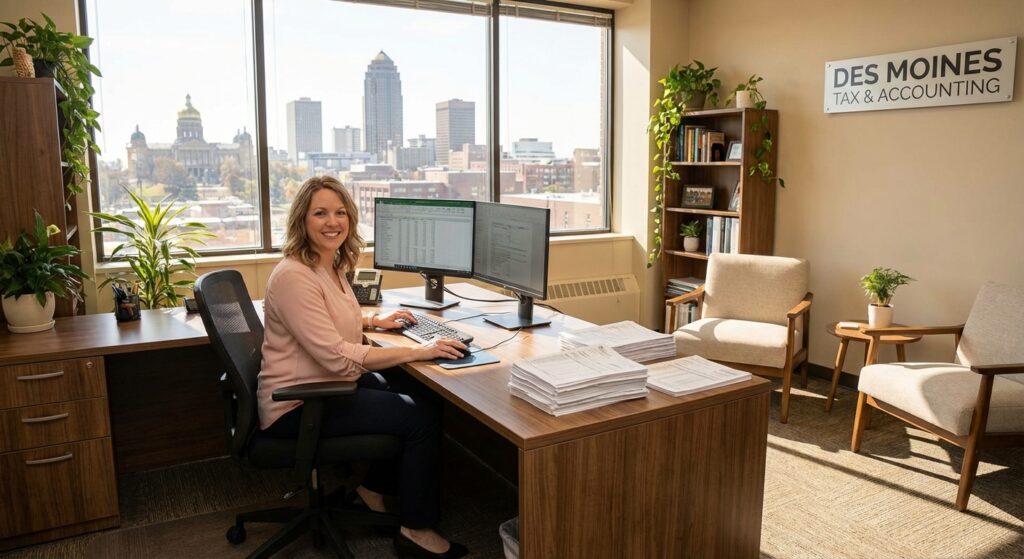
Des Moines CPA: Your Trusted Guide to Tax Preparation and Financial Services
Are you searching for a trusted Des Moines CPA for your personal or business financial needs? Whether you’re an individual looking to optimize your tax return or a business owner who needs expert financial guidance, working with a certified public accountant can make all the difference. Des Moines, Iowa is home to thousands of small businesses and working families who rely on professional CPAs to navigate Iowa’s unique tax landscape, maximize deductions, and stay compliant with both state and federal regulations.
Quick Answer: A Des Moines CPA provides tax preparation, tax planning, bookkeeping, payroll, IRS representation, and business consulting services. Iowa residents and business owners benefit from a CPA who understands Iowa-specific tax rules, including the state’s graduated income tax system, property tax credits, and recent legislative changes affecting 2026 filings. Contact Uncle Kam today for a free consultation.
Table of Contents
- What is a CPA?
- CPA Services in Des Moines
- Iowa-Specific Tax Rules You Need to Know
- 2026 Tax Changes Affecting Iowa Businesses
- Cost of CPA Services in Des Moines
- How to Choose the Right Des Moines CPA
- When to Hire a CPA vs. Doing It Yourself
- Common Mistakes Des Moines Business Owners Make
- Key Benefits of Hiring a CPA
- Frequently Asked Questions
- Conclusion
What is a CPA?
A Certified Public Accountant (CPA) is a licensed financial professional who specializes in tax preparation, accounting, auditing, and consulting services. CPAs uphold rigorous standards and continuing education requirements, which differentiate them from non-credentialed tax preparers.
In Iowa, CPAs are licensed by the Iowa Accountancy Examining Board and must meet strict educational, examination, and experience requirements before they can practice. Des Moines CPAs are held to high ethical standards and must complete ongoing professional development each year to maintain their license, ensuring they stay current with the latest tax law changes and financial regulations.
Des Moines CPA Credentials Table
| Requirement | Description |
|---|---|
| Education | Bachelor’s degree in accounting or related field (150 credit hours in Iowa) |
| Examination | Pass the Uniform CPA Exam (all four sections) |
| Experience | Minimum of one year of work experience under supervision |
| Continuing Education | Required yearly to maintain license (40 hours per year in Iowa) |
| Ethics | Must adhere to AICPA Code of Professional Conduct and Iowa state rules |
CPA Services in Des Moines
CPAs in Des Moines offer a wide range of services, including:
- Tax preparation and filing: Individual, business, and non-profit tax returns
- Tax planning: Personalized guidance to minimize tax liabilities
- Accounting and bookkeeping: Ongoing management of financial records
- Financial statement preparation: Compiling and reviewing essential reports
- Audit and assurance: Ensuring accurate, compliant financials
- Business consulting: Growth strategies, budgeting, cash flow analysis
- Payroll services: Timely and accurate payroll processing
- IRS representation: Help with audits and tax issues
Des Moines business owners especially benefit from working with a CPA who understands the local economy. From restaurants and retail shops in the East Village to professional service firms in the Western Gateway, each industry has unique tax requirements and deduction opportunities. A Des Moines CPA familiar with Iowa business regulations can help you take advantage of state-specific credits and incentives that out-of-state preparers might miss.
Des Moines CPA Service Type Table
| Service | Description | Who Benefits |
|---|---|---|
| Tax Preparation | Federal, state, and local tax return preparation | Individuals, businesses, nonprofits |
| Tax Planning | Strategies to reduce future tax liability | High earners, business owners |
| Accounting | Monthly and annual financial record keeping | Small businesses, startups |
| Audit | Financial review and compliance checks | Corporations, nonprofits |
| Consulting | Business growth and profitability guidance | Growing businesses, entrepreneurs |
| Payroll | Employee payroll processing and tax withholding | Employers with W-2 employees |
Iowa-Specific Tax Rules You Need to Know
Iowa has a distinct tax system that differs from many other states. If you live or operate a business in Des Moines, understanding these Iowa-specific rules is essential for staying compliant and minimizing your tax burden.
Did You Know: Iowa has been phasing in a flat income tax rate. As of 2026, Iowa individual income tax has moved to a flat rate of 3.9%, down from the previous graduated system that reached as high as 8.53%. This is one of the most significant tax changes in Iowa history, and a Des Moines CPA can help you understand how it affects your specific situation.
Key Iowa Tax Rules for Des Moines Residents
- Flat income tax rate: Iowa now uses a flat 3.9% individual income tax rate, simplifying calculations but changing planning strategies for many taxpayers
- Iowa does not tax Social Security: Social Security benefits are fully excluded from Iowa taxable income, which benefits retirees in the Des Moines area
- Retirement income exclusion: Iowa excludes retirement income for taxpayers 55 and older, including pensions and 401(k) distributions
- Property tax credits: Iowa offers homestead credits, military service credits, and elderly/disabled property tax credits that Des Moines homeowners should claim
- Iowa sales tax: The state sales tax rate is 6%, and Polk County (Des Moines) adds a 1% local option sales tax for a combined 7%
- Section 179 conformity: Iowa conforms to the federal Section 179 deduction, allowing Des Moines business owners to deduct qualifying equipment purchases
- Research Activities Credit: Iowa offers a state-level research activities credit modeled after the federal R&D credit, relevant for Des Moines tech and manufacturing firms
A knowledgeable Des Moines CPA will ensure you are taking advantage of all applicable Iowa credits and exclusions while staying fully compliant with Iowa Department of Revenue requirements. For a personalized review of your Iowa tax situation, schedule a consultation with Uncle Kam.
2026 Tax Changes Affecting Iowa Businesses
The 2026 tax year brings several important changes that Des Moines business owners and individuals should be aware of. Working with a CPA who stays current on these developments is critical for proper planning.
Pro Tip: Many provisions of the 2017 Tax Cuts and Jobs Act (TCJA) are set to expire or have already expired. The standard deduction, individual tax brackets, and the qualified business income (QBI) deduction under Section 199A may be affected. Your Des Moines CPA should be proactively planning for these changes with you now, not waiting until filing season.
Federal Changes Impacting Des Moines Taxpayers in 2026
- TCJA expiration provisions: Several individual tax provisions from the Tax Cuts and Jobs Act are scheduled to sunset, potentially raising effective tax rates for many Des Moines families
- Bonus depreciation phase-down: Bonus depreciation continues to phase down, meaning Des Moines businesses that invest in equipment and vehicles need to plan capital expenditures carefully
- Corporate Transparency Act (CTA): Beneficial ownership reporting requirements under FinCEN affect many Des Moines LLCs and corporations. Your CPA can help ensure compliance
- Increased IRS enforcement: The IRS continues to expand its enforcement capabilities, making accurate filings more important than ever for Des Moines taxpayers
Iowa State-Level Changes for 2026
- Flat tax fully implemented: The transition to Iowa’s 3.9% flat income tax rate is now complete, which may change how Des Moines taxpayers approach deductions and income timing
- Corporate tax rate reduction: Iowa’s corporate income tax rate has also been reduced as part of the state’s tax reform efforts
- Continued retirement income exclusion: Iowa continues to exclude retirement income from taxation for those 55 and older, making Des Moines attractive for retirees
Staying ahead of these changes requires proactive tax planning. A Des Moines CPA like Uncle Kam can model different scenarios and help you make strategic decisions before year-end.
Cost of CPA Services in Des Moines
One of the most common questions people ask is how much a CPA costs in Des Moines. Fees vary depending on the complexity of your tax situation, the type of services you need, and the CPA firm you choose.
| Service | Typical Des Moines Cost Range |
|---|---|
| Individual tax return (simple) | $150 – $350 |
| Individual tax return (itemized/complex) | $300 – $700 |
| Small business tax return (sole proprietor) | $400 – $800 |
| S-Corp or LLC tax return | $800 – $2,000 |
| Monthly bookkeeping | $200 – $600/month |
| Payroll services | $50 – $200/month |
| Tax planning consultation | $200 – $500 per session |
| IRS audit representation | $1,000 – $5,000+ |
Pro Tip: The cost of hiring a Des Moines CPA often pays for itself through tax savings, error prevention, and time saved. Many Des Moines business owners find that the deductions and credits their CPA identifies far exceed the professional fees. Contact Uncle Kam for a free estimate based on your specific needs.
 Free Tax Write-Off Finder
How to Choose the Right Des Moines CPA
Selecting the right CPA in Des Moines is an important decision that can affect your financial well-being for years to come. Here are the key factors to consider:
- Verify credentials and licensure through the National Association of State Boards of Accountancy or the Iowa Accountancy Examining Board
- Seek referrals from friends, business associates, or professional directories
- Evaluate their experience with your specific financial needs (e.g., small business, estate planning, non-profit)
- Read online client reviews on Google, Yelp, and the Better Business Bureau
- Interview potential CPAs to discuss service approach and fees
- Ask about their familiarity with Iowa-specific tax laws and Des Moines local regulations
- Confirm they offer year-round availability, not just during tax season
- Ensure they use secure technology for document sharing and communication
The best Des Moines CPAs build long-term relationships with their clients. They get to know your financial goals, your business operations, and your family situation so they can provide personalized advice year after year. Learn about Uncle Kam’s approach to client-first tax preparation and financial services.
When to Hire a Des Moines CPA vs. Doing It Yourself
Not everyone needs a CPA for every tax situation. However, there are clear scenarios where hiring a professional Des Moines CPA is the smarter choice.
You Should Hire a Des Moines CPA If:
- You own a business (LLC, S-Corp, C-Corp, or sole proprietorship) in Des Moines
- You have rental properties in the Des Moines metro area
- You earn income from multiple sources (W-2, 1099, investments, side businesses)
- You experienced a major life event (marriage, divorce, inheritance, home purchase)
- You received an IRS notice or are being audited
- You need to file back taxes or amend previous returns
- You want proactive tax planning to reduce future liability
- You are unsure how Iowa-specific rules affect your return
DIY Tax Filing May Be Sufficient If:
- You have a single W-2 job with no additional income
- You plan to take the standard deduction
- You have no dependents or special tax situations
- You are comfortable using tax software and reviewing your own return
Did You Know: According to the IRS, taxpayers who use a paid preparer are less likely to receive notices for errors on their returns. For Des Moines residents with complex tax situations, the peace of mind alone can be worth the investment. See Uncle Kam’s tax preparation services.
Common Mistakes Des Moines Business Owners Make
Even savvy Des Moines entrepreneurs can make costly tax mistakes. Here are the most common errors a CPA can help you avoid:
1. Mixing Personal and Business Finances
Many Des Moines small business owners use a single bank account for both personal and business transactions. This makes bookkeeping difficult, increases audit risk, and can jeopardize your LLC or corporate liability protection. A Des Moines CPA will advise you to maintain separate accounts and set up proper accounting systems from day one.
2. Missing Estimated Tax Payments
If you are self-employed or earn income that does not have taxes withheld, Iowa requires quarterly estimated tax payments. Missing these deadlines results in penalties and interest. Your CPA can calculate the correct amounts and set up reminders so you never miss a payment.
3. Overlooking Iowa-Specific Deductions and Credits
Iowa offers credits and deductions that many Des Moines business owners are unaware of, including the Iowa Tuition and Textbook Credit, the Solar Energy System Tax Credit, and the Volunteer Fire Fighter and Emergency Medical Services Personnel Tax Credit. A CPA who knows Iowa tax law will ensure you claim every credit you are entitled to.
4. Poor Record Keeping
Failing to maintain organized records of income, expenses, and receipts is one of the biggest mistakes Des Moines business owners make. Without proper documentation, you cannot substantiate deductions if the IRS or Iowa Department of Revenue asks for proof. A CPA can set up bookkeeping systems and provide guidance on what records to keep and for how long.
5. Choosing the Wrong Business Entity
Operating as a sole proprietor when an S-Corp election would save thousands in self-employment taxes is a common oversight. Conversely, some Des Moines businesses are structured as corporations when a simpler entity would be more tax-efficient. A CPA can analyze your revenue, expenses, and growth plans to recommend the optimal entity structure for your Des Moines business.
Key Benefits of Hiring a Des Moines CPA
- Compliance confidence: Ensure accurate and timely tax filings with both the IRS and the Iowa Department of Revenue
- Tax savings: Expert knowledge of deductions, credits, and planning opportunities specific to Iowa and Des Moines
- Peace of mind: Focus on life or business while your finances are in skilled hands
- IRS resolution: CPAs can represent you and help solve tax disputes (IRS resource)
- Long-term planning: Build your financial future strategically with a trusted Des Moines advisor
- Time savings: Reclaim hours spent struggling with tax forms, receipts, and software so you can focus on growing your Des Moines business
- Audit protection: A CPA-prepared return is less likely to contain errors, and if you are audited, your CPA can represent you before the IRS or Iowa Department of Revenue
Quick Answer: The biggest benefit of hiring a Des Moines CPA is the combination of tax savings and risk reduction. A qualified CPA typically saves clients far more in taxes than the cost of their services, while also protecting you from costly errors, penalties, and audits.

Frequently Asked Questions
How do I know if my Des Moines CPA is licensed?
You can verify Iowa CPA licensure by searching the Iowa Accountancy Examining Board online database. All licensed CPAs in Iowa must be registered with this board, and their status, license number, and any disciplinary history are publicly available. You can also verify credentials through the National Association of State Boards of Accountancy (NASBA).
What documents should I bring to a CPA for tax preparation?
Common documents include your previous year’s tax return, income statements (W-2s, 1099s), receipts for deductible expenses, investment income details (1099-B, 1099-DIV, 1099-INT), mortgage interest statements (1098), property tax records, health insurance forms (1095-A/B/C), and any Iowa-specific documents such as Iowa property tax credit claims. For a complete checklist, visit our guide on what to bring to your tax appointment.
How early should I contact a CPA before tax deadlines?
It’s best to schedule your consultation as soon as you have your tax paperwork — ideally no later than February for timely filing. Des Moines CPAs are busiest from mid-February through April 15, so booking early ensures you get the time and attention your return deserves. For tax planning consultations, consider meeting with your CPA in the fall to make year-end adjustments before December 31.
Do Des Moines CPAs handle only taxes?
No. While tax preparation is the most common service, Des Moines CPAs also assist with financial planning, business consulting, bookkeeping, payroll processing, auditing services, estate planning, and IRS representation. Many CPAs serve as year-round financial advisors for both individuals and businesses in the Des Moines area.
Is hiring a CPA worth it for individuals?
If you have multiple income streams, own a business, have rental properties, or face complex tax situations, hiring a CPA is highly recommended for accuracy and potential savings. Even for individuals with simpler returns, a CPA can identify deductions and credits you might miss on your own. The cost of a CPA is often offset by the additional refund or reduced tax liability they achieve.
What is the difference between a CPA and a tax preparer in Des Moines?
A CPA has passed the rigorous Uniform CPA Exam, met education and experience requirements, and is licensed by the Iowa Accountancy Examining Board. Tax preparers who are not CPAs may have varying levels of training and are not subject to the same licensing requirements. CPAs can represent you before the IRS, provide auditing services, and offer a broader range of financial services. When choosing between the two for your Des Moines tax needs, consider the complexity of your situation.
How does Iowa’s flat tax rate affect my 2026 return?
Iowa’s transition to a flat 3.9% individual income tax rate means all Iowa taxpayers now pay the same rate regardless of income level. For higher-income Des Moines residents, this represents a significant reduction from the previous top rate of 8.53%. For lower-income filers, the change may be less impactful. Your Des Moines CPA can analyze how the flat tax rate affects your specific situation compared to prior years and adjust your tax planning strategy accordingly.
Can a Des Moines CPA help with IRS back taxes or unfiled returns?
Yes. A Des Moines CPA can help you file back taxes, negotiate with the IRS on payment plans or offers in compromise, and resolve outstanding tax issues. If you have unfiled returns from previous years, it is critical to work with a CPA who can assess any penalties, interest, and potential refunds you may still be able to claim. The sooner you address unfiled returns, the better your options will be. Contact Uncle Kam to discuss your situation confidentially.
Does Uncle Kam offer virtual CPA services for Des Moines clients?
Yes. Uncle Kam offers both in-person and virtual tax preparation and consulting services for Des Moines clients and throughout Iowa. Virtual consultations allow you to work with a trusted CPA from the comfort of your home or office. Documents can be shared securely through our online portal. Schedule your virtual consultation today.
Conclusion
Choosing a Des Moines CPA is a valuable investment in your financial confidence and peace of mind. From tax returns to strategic planning and business growth, a qualified CPA is your partner for financial success. Whether you are a Des Moines individual navigating Iowa’s new flat tax rate, a small business owner looking to maximize deductions, or a family planning for the future, the right CPA can make a measurable difference in your financial outcomes.
At Uncle Kam, we specialize in helping Des Moines residents and Iowa business owners with personalized tax preparation, proactive tax planning, and year-round financial guidance. Our team stays current on all Iowa and federal tax law changes so you do not have to.
Related Resources
- What to Bring to Your Tax Appointment with a CPA
- Complete Tax Preparation Services
- Contact Your Des Moines CPA Today
- About Uncle Kam Tax Services
- Uncle Kam Tax Blog
For more information about local and national accounting resources, visit AICPA, National Association of Tax Professionals, or IRS.gov.
Disclaimer: The information provided on this page is for general informational purposes only and does not constitute legal, tax, or financial advice. Tax laws and regulations change frequently, and the applicability of the information discussed here may vary based on your individual circumstances. Always consult with a qualified CPA or tax professional before making financial decisions. Uncle Kam makes no representations or warranties regarding the accuracy, completeness, or timeliness of the information on this page. For personalized advice specific to your Des Moines, Iowa tax situation, please contact our office directly.

