
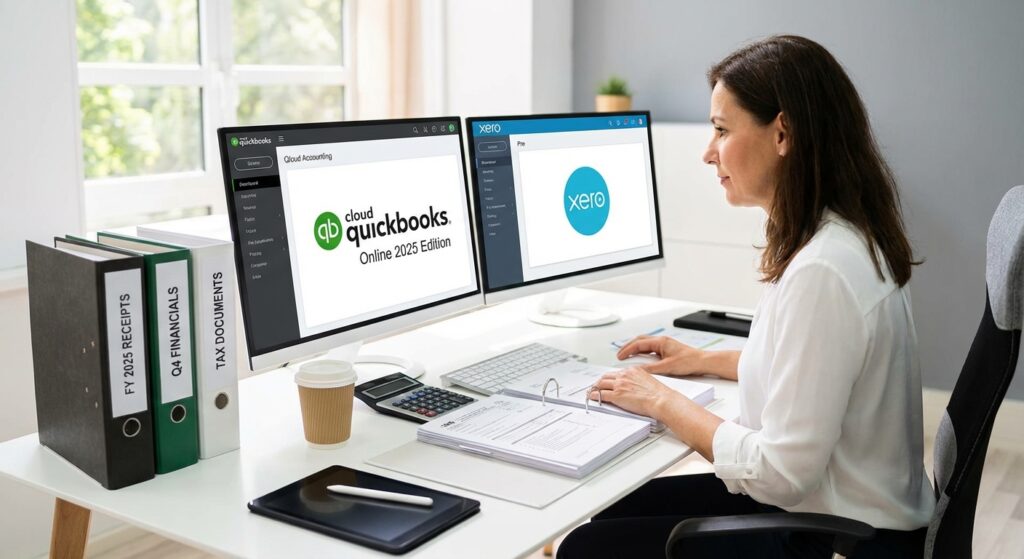
The Complete Guide to Bookkeeping for Small Business in 2025: Essential Records, Tax Compliance, and Audit Prevention
For the 2025 tax year, proper bookkeeping for small business is more critical than ever. Accurate financial records determine whether you maximize deductions, minimize audit risk, and have clarity on your business’s true profitability. Small business owners who maintain strong bookkeeping systems save thousands in taxes while avoiding IRS scrutiny.
Table of Contents
- Key Takeaways
- Why Does Bookkeeping for Small Business Matter?
- What Are IRS Record-Keeping Requirements for Small Businesses?
- How Do You Separate Business and Personal Finances?
- What Deductions Should You Track for 2025?
- How Should You Document Expenses and Receipts?
- What Common Bookkeeping Mistakes Trigger IRS Audits?
- Uncle Kam in Action: LLC Owner Saves $8,400 with Better Bookkeeping
- Next Steps
- Frequently Asked Questions
Key Takeaways
- Proper bookkeeping for small business is legally required and directly impacts your tax liability and audit risk.
- Mixing business and personal transactions is one of the biggest audit triggers; maintain separate bank accounts and credit cards.
- For 2025, track business mileage at 70 cents per mile and document home office expenses with specific square footage calculations.
- Reconcile all accounts by December 31st each year to ensure your financial statements are accurate and trustworthy for tax filing.
- The Section 179 deduction limit for 2025 is $2.5 million, allowing immediate write-offs for equipment and business assets.
Why Does Bookkeeping for Small Business Matter?
Quick Answer: Accurate bookkeeping is the foundation of tax compliance, audit defense, and profitable business decisions. Without it, you’ll lose deductions, overpay taxes, and face audit risk.
Bookkeeping for small business serves three critical purposes. First, it ensures you meet IRS legal requirements for maintaining business records. Second, it gives you visibility into your actual profitability and cash flow, enabling smarter pricing and expense decisions. Third, it creates an audit-proof trail if the IRS ever questions your return.
Many small business owners avoid bookkeeping because they think it’s tedious or expensive. The reality is the opposite. Time spent organizing records early prevents costly accounting bills later and protects you from IRS penalties that can exceed your annual tax liability.
According to tax experts, mixing business and personal transactions is one of the top audit triggers. Business owners who maintain clear separation between business and personal finances demonstrate professionalism and reduce the likelihood of an IRS examination by up to 40 percent.
The Real Cost of Poor Bookkeeping
Poor bookkeeping creates a cascade of problems. You miss deductions because you can’t find receipts. Your profit-and-loss statement becomes unreliable. You overpay quarterly taxes because you don’t have accurate income projections. Most dangerously, the IRS sees inconsistencies in your records and initiates an audit.
A single IRS audit costs the average small business owner between $5,000 and $15,000 in accountant fees and lost time. Worse, if the IRS finds underreported income or disallowed deductions, you’ll owe back taxes, interest, and penalties that compound over multiple years.
Pro Tip: Implement bookkeeping systems now while your business is still manageable. Retrofitting records for a prior year costs 5-10x more than maintaining them properly in real-time.
What Are IRS Record-Keeping Requirements for Small Businesses?
Quick Answer: The IRS requires you to keep all records that support income, deductions, and credits for at least three years, including receipts, invoices, bank statements, and documentation of business expenses.
The IRS doesn’t dictate how you maintain records—only that you keep them accurate and accessible. Under IRS Publication 552, small business owners must retain documents supporting every figure on their tax return. This includes:
- All bank statements and credit card statements for business accounts
- Receipts and invoices documenting all income received
- Expense receipts organized by category (supplies, travel, utilities, etc.)
- Payroll records, including W-2s and 1099s issued to employees and contractors
- Mileage logs if you deduct business vehicle expenses
- Documentation supporting home office deductions, including square footage calculations
Record Retention Timeline
The IRS generally has three years to audit a tax return. However, if you underreport income by more than 25 percent, the period extends to six years. If you fail to file a return or file fraudulently, there is no time limit.
To be safe, retain all business records for at least seven years. Many tax professionals recommend keeping permanent records of income and major asset purchases indefinitely, since depreciation schedules can span decades.
Digital vs. Physical Records
The IRS accepts both digital and physical records. However, digital records are preferable because they’re easier to organize, search, and backup. If you use accounting software like QuickBooks, FreshBooks, or Xero, you automatically generate organized records that satisfy IRS requirements.
For receipts, photograph them with your phone and store them in cloud storage organized by month and category. This hybrid approach—digital expense tracking plus photographed receipts—provides redundancy and audit protection.
How Do You Separate Business and Personal Finances?
Quick Answer: Open a separate business bank account and credit card immediately. Never mix business and personal transactions. This single step reduces audit risk dramatically and simplifies your bookkeeping by 50 percent.
Mixing business and personal finances is the fastest way to trigger an IRS audit. When your tax return shows business income but your bank statements show personal spending, the IRS flags it as a compliance risk. They’ll question which expenses are actually business-related and which are personal.
The solution is simple: establish complete financial separation. Here’s how:
Step 1: Open a Business Bank Account
Open a separate business checking account in your company name. Deposit all business income into this account. Pay all business expenses from this account. Never use it for personal purchases. This creates a clear audit trail that proves business legitimacy.
If you’re a sole proprietor, the account can be in your personal name with “DBA” (doing business as) designation. If you’re an LLC, S Corp, or C Corp, the account must be in the business entity name with an EIN (Employer Identification Number).
Step 2: Get a Business Credit Card
Use a dedicated business credit card for recurring business expenses like software subscriptions, office supplies, and marketing costs. This automatically organizes your expenses and provides monthly statements that double as backup documentation.
Many business credit cards offer expense categorization features that feed directly into accounting software, reducing manual data entry and the likelihood of categorization errors.
Step 3: Document Owner Distributions
If you need to withdraw money from the business for personal use, transfer it as an owner distribution or salary, not as a business expense. Document these transfers in your accounting records. This maintains clear separation between business income and personal income.
Did You Know? If you’re an S Corp, the IRS requires you to pay yourself a “reasonable salary” as a W-2 employee. Failing to do so can trigger automatic audits. For 2025, ensure your W-2 compensation reflects reasonable market rates for your industry.
What Deductions Should You Track for 2025?
Quick Answer: Track business mileage (70 cents/mile in 2025), home office expenses, supplies, equipment up to $2.5 million (Section 179), contractor payments, and all professional services. These are the deductions most small businesses miss.
For 2025, the IRS allows you to deduct any “ordinary and necessary” business expenses. The key word is necessary—the expense must be common in your industry and essential to your business operations. Here are the top deductions small business owners should track:
| Deduction Category | 2025 Details | Documentation Required |
|---|---|---|
| Vehicle Mileage | 70 cents per mile for business use | Detailed mileage log with dates and purposes |
| Home Office | Calculate percentage of home used exclusively for business | Square footage of office divided by total home square footage |
| Equipment (Section 179) | Up to $2.5 million immediate deduction limit | Purchase invoices and proof of payment |
| Contractor Payments | Issue 1099-NEC for payments over $600 | W-9 from contractor and payment records |
| Professional Services | Accountant, attorney, consultant fees | Invoices and payment proof |
Mileage Deductions (70 Cents Per Mile in 2025)
For 2025, the IRS standard mileage rate for business driving is 70 cents per mile. If you drive 10,000 business miles annually, that’s a $7,000 deduction—a significant tax savings for many small business owners.
To claim mileage deductions, maintain a detailed log showing the date, starting location, ending location, miles driven, and business purpose. Apps like MileIQ automate this process, but a simple spreadsheet works too. The key is consistency and contemporaneous documentation—don’t estimate mileage months later.
Home Office Deductions
Home office deductions are commonly missed because they require specific documentation. You can only deduct the percentage of your home used exclusively and regularly for business. If your home is 2,000 square feet and your office is 200 square feet, you can deduct 10 percent of rent, utilities, insurance, and mortgage interest.
The IRS scrutinizes home office deductions closely, so be precise. Use a measuring tape to determine exact square footage. Keep photos of your workspace. Document that you use it exclusively for business—not as a guest bedroom or general storage area.
Section 179 Equipment Deduction
The Section 179 deduction allows you to immediately write off equipment and machinery purchases instead of depreciating them over multiple years. For 2025, the limit is $2.5 million with a phase-out at $4 million in total business asset purchases.
This is a powerful deduction for businesses buying computers, office furniture, machinery, or vehicles. Instead of capitalizing the asset and deducting it over 5-7 years, you deduct the full amount in the year of purchase, reducing your taxable income immediately.
How Should You Document Expenses and Receipts?
Quick Answer: Use accounting software to track expenses automatically, photograph all receipts, store them in organized folders by month and category, and reconcile accounts monthly.
Documentation systems don’t need to be complex. Here’s a practical approach used by successful small business owners:
- Weekly: Photograph all physical receipts and upload them to cloud storage (Dropbox, Google Drive, or accounting software)
- Monthly: Reconcile bank and credit card statements in your accounting software. Categorize all transactions by expense type
- Quarterly: Review income and expense trends. Ensure you’re on track for tax liability estimates
- Annually: Archive records, prepare final reconciliation, and meet with your CPA before year-end
For invoicing to clients, use invoicing software that automatically tracks payments and follow-ups. This ensures you capture all income and can provide the IRS with evidence of revenue reported on your tax return.
What Common Bookkeeping Mistakes Trigger IRS Audits?
Quick Answer: Mixing business and personal finances, failing to reconcile accounts, claiming unreasonably high home office or vehicle deductions, and underreporting income are the top audit triggers.
The IRS uses sophisticated matching algorithms to flag returns with inconsistencies. Here are the most common red flags:
1. Business and Personal Transactions Mixed
This is the #1 audit trigger. If bank deposits show personal living expenses mixed with business income, the IRS questions what’s legitimate. Solution: Use separate accounts exclusively.
2. Unreconciled Accounts
If your accounting records don’t match bank statements, the IRS assumes you’re hiding transactions. Reconcile monthly and resolve discrepancies immediately.
3. Disproportionately High Deductions
If you claim 50 percent of your home as office space or 50,000 miles of business driving annually, the IRS will scrutinize. Be realistic and document everything.
4. Missing 1099-NEC Forms
If you paid a contractor $600 or more but didn’t issue a 1099-NEC, you’ll get caught. The IRS matches 1099s across returns. Collect W-9s from all contractors and issue forms by January 31st.
Pro Tip: Before December 31st each year, collect W-9s from all contractors who will receive 1099s. This ensures you have their tax information and can file forms on time without penalties.
Uncle Kam in Action: LLC Owner Saves $8,400 with Better Bookkeeping
Client Snapshot: Sarah is a marketing consultant operating as an LLC. She has $120,000 in annual business income but had been managing finances haphazardly—mixing personal and business expenses, losing receipts, and guessing at deductions.
Financial Profile: Annual business revenue $120,000. Home office in 300 sq ft home office (1,500 sq ft total home). Drives approximately 8,000 miles annually for client meetings. Pays $18,000 to independent contractors annually.
The Challenge: Sarah’s tax returns were missing significant deductions. Her accountant was spending 20+ hours reconstructing her records each year, costing $3,000 in prep fees. She was overestimating her taxes because she wasn’t tracking deductions. Worse, her mixing of personal and business finances created audit risk.
The Uncle Kam Solution: We implemented a complete bookkeeping system. First, we opened a dedicated business checking account and credit card for all business expenses. Second, we set up accounting software (QuickBooks Online) with automatic bank and credit card syncing. Third, we created a system for photographing receipts and storing them in organized folders. Fourth, we educated Sarah on 2025 deduction opportunities, including accurate mileage tracking and home office calculations.
The Results:
- Tax Savings (2025): $8,400 in additional deductions (mileage: $5,600 at 70 cents/mile; home office: $2,800 from proper calculation)
- Investment: $2,500 one-time cost for bookkeeping setup and CPA consultation; $120/month for software
- Return on Investment (ROI): 3.36x return in first year alone (savings of $8,400 / investment of $2,500)
Beyond the immediate tax savings, Sarah now has audit-proof records. Her accountant preparation time dropped from 20 hours to 4 hours, saving her $1,600 annually in ongoing accounting fees. This is just one example of how proper bookkeeping for small business creates lasting financial benefits for entrepreneurs.
Next Steps
Start implementing bookkeeping improvements today:
- This Week: Open a separate business bank account if you haven’t already. Stop using personal accounts for business expenses.
- This Month: Select accounting software (QuickBooks, FreshBooks, or Wave). Link your bank and credit card accounts for automatic transaction importing.
- This Quarter: Implement receipt management system. Start mileage tracking. Calculate your home office square footage.
- Before Year-End: Meet with a CPA to review your 2025 bookkeeping, ensure you’re maximizing deductions, and plan for quarterly estimated tax payments. Learn more about proven tax strategy services that can optimize your business structure.
Frequently Asked Questions
Can I use personal accounts for small business expenses?
Technically, sole proprietors can use personal accounts for business expenses. However, doing so is one of the top audit triggers. The IRS assumes mixed accounts indicate hidden transactions or personal spending disguised as business deductions. Even for sole proprietors, a separate business account demonstrates professionalism and audit defensibility. The account costs $5-15 monthly but saves thousands in potential audit exposure.
What’s the difference between bookkeeping and accounting?
Bookkeeping is the day-to-day recording of transactions—deposits, expenses, invoices. Accounting is the larger function of analyzing those records, preparing financial statements, and providing tax guidance. You should handle bookkeeping yourself (or hire a bookkeeper for $500-1,500 monthly). Hire a CPA or tax professional for accounting and tax strategy. The separation allows you to save money on routine data entry while benefiting from expert tax planning.
How long should I keep receipts and records?
The IRS can audit returns for three years after filing. If you underreport income by more than 25 percent, they can go back six years. To be safe, retain all records for seven years. For major assets, keep depreciation schedules indefinitely since depreciation claims can span 15-27 years. Digital storage is ideal—photograph receipts and store them in cloud-based systems that provide searchable archives.
What happens if the IRS audits my business?
The IRS typically starts with a correspondence audit asking for documentation of specific deductions. If your records are organized and you can provide receipts and justifications, the audit often concludes in your favor. If records are missing or don’t support your deductions, the IRS will disallow them and assess back taxes plus interest and penalties. Strong bookkeeping turns audits into routine document reviews rather than costly investigations.
Is it cheaper to hire a bookkeeper or use software?
For most small businesses under $500,000 in annual revenue, accounting software ($50-300/month) is more cost-effective than hiring a bookkeeper ($500-1,500/month). Software handles transaction importing automatically and costs a fraction of a bookkeeper’s salary. However, if your business has complex inventory or multiple revenue streams, a part-time bookkeeper ($15-25/hour, 10-20 hours monthly) might be worthwhile. Ideally, use software for daily bookkeeping and hire a part-time bookkeeper to review monthly reconciliations and catch errors.
What business entity structure affects bookkeeping?
Sole proprietors, LLCs, S Corps, and C Corps all have different bookkeeping requirements. S Corps require payroll processing (even if you’re the only employee). C Corps must track corporate and shareholder distributions separately. Partnerships require allocation of income and losses among partners. Before choosing an entity structure, consult a CPA about the bookkeeping implications. Often, the right entity structure can reduce bookkeeping complexity and taxes significantly.
Can I deduct contractor payments without a 1099?
No. If you paid a contractor $600 or more during the year, you must issue a 1099-NEC form. The IRS receives copies of all 1099s filed and matches them against contractor tax returns. If you claim a business deduction but the contractor doesn’t report income from a matching 1099, the IRS will audit both of you. Always collect W-9s from contractors and issue 1099s by January 31st of the following year.
How does the Section 179 deduction work for equipment purchases?
For 2025, you can immediately deduct up to $2.5 million in equipment, machinery, and vehicle purchases instead of depreciating them over multiple years. This is powerful for businesses making capital investments. For example, if you buy a company vehicle for $40,000, you can deduct the full $40,000 in 2025 rather than deducting $8,000 annually over five years. This reduces your 2025 taxable income by $40,000, saving you roughly $9,600 in federal taxes (assuming 24 percent bracket). Consult your CPA to ensure your purchase qualifies for Section 179 treatment.
Last updated: December, 2025
Related Resources
- Business Solutions and Accounting Services
- Entity Structuring for Tax Optimization
- Tax Preparation and Compliance Services
- General Tax FAQs
- IRS Publication 552: Record Keeping for Individuals

