
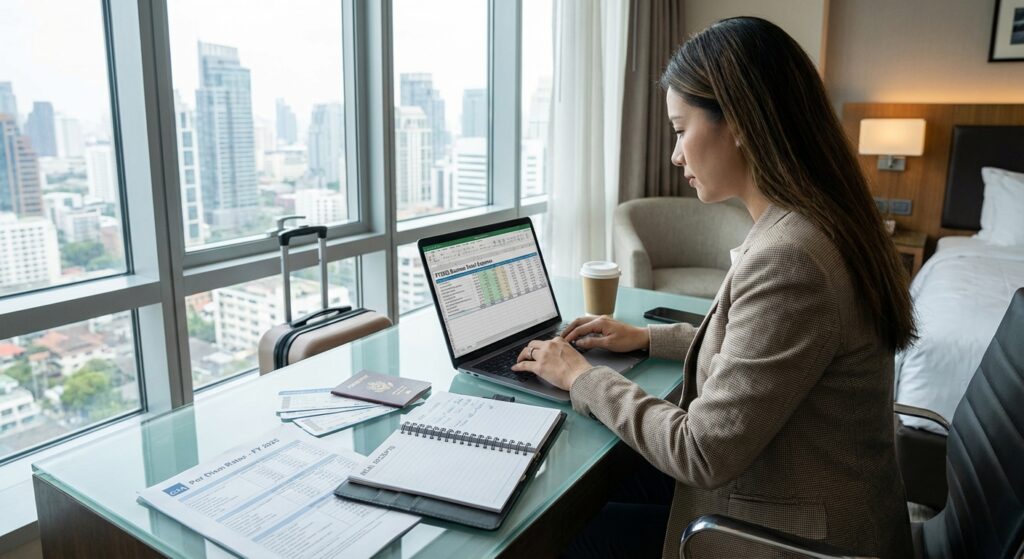
2025 M&IE Per Diem Rules for Self-Employed: Complete Guide to Meals, Lodging & Travel Deductions
For the 2025 tax year, understanding M&IE per diem rules is essential for self-employed contractors and 1099 workers who travel for business. M&IE (Meals and Incidental Expenses) per diem allowances allow you to claim standard deductions for meal costs without keeping detailed receipts. This comprehensive guide explains the 2025 M&IE per diem rules, how they work for self-employed professionals, and strategies to maximize your travel-related deductions while staying compliant with IRS requirements.
Table of Contents
- Key Takeaways
- What Are M&IE Per Diem Rules for 2025?
- How Do 2025 GSA Per Diem Rates Work?
- What Are the Meal & Entertainment Deduction Limits for Self-Employed?
- How Should You Track M&IE Expenses for Tax Compliance?
- Actual Expense Method vs. Per Diem: Which Strategy Saves More?
- What Are Common M&IE Per Diem Mistakes That Trigger Audits?
- How Can You Maximize Travel Deductions Beyond M&IE?
- Uncle Kam in Action
- Next Steps
- Frequently Asked Questions
Key Takeaways
- M&IE per diem rules let self-employed professionals deduct standardized meal costs without itemized receipts.
- For 2025, GSA per diem rates vary by location, with meal portions ranging from $60 to $85 daily.
- The 50% meals and entertainment deduction rule limits your claim to half of actual qualifying expenses.
- Proper documentation and classification prevent IRS audits and maximize deductions legitimately.
- Self-employed 1099 contractors may benefit more from per diem than actual expense method depending on travel patterns.
What Are M&IE Per Diem Rules for 2025?
Quick Answer: M&IE per diem rules for 2025 allow self-employed professionals to deduct standardized meal allowances based on GSA rates rather than tracking individual receipts. These rules simplify travel expense documentation while maintaining IRS compliance.
M&IE per diem rules represent a critical tax deduction strategy for self-employed contractors and 1099 workers. The IRS recognizes that business travel involves meal and incidental expense costs that are difficult to itemize individually. For the 2025 tax year, the M&IE per diem system allows you to claim standardized daily allowances rather than producing receipts for every coffee break or meal.
The term \”M&IE\” stands for \”Meals and Incidental Expenses.\” This includes not just restaurant meals and food, but also gratuities, tips, and incidental costs associated with business travel. When you use the per diem method for 2025 M&IE per diem rules, you declare a single daily amount for a location rather than itemizing individual purchases.
How M&IE Per Diem Rules Differ from Regular Deductions
Standard meal and entertainment deductions require you to maintain meticulous records of each expense. You must keep receipts, document the business purpose, and note attendees for qualifying meals. The M&IE per diem method simplifies this burden by allowing you to use standardized amounts set by the General Services Administration (GSA).
For self-employed professionals filing Schedule C, the distinction matters significantly. While both methods provide deductions, the per diem approach reduces your audit risk and administrative burden during travel assignments lasting multiple days or weeks.
Why Self-Employed Professionals Prefer M&IE Per Diem Rules
Self-employed contractors benefit from M&IE per diem rules because the method simplifies record-keeping. Instead of collecting hundreds of receipts, you maintain basic documentation proving your travel dates, locations, and business purpose. This straightforward approach reduces the likelihood of audit adjustments and allows more time for business development.
Pro Tip: Keep a simple travel log noting departure date, return date, destination city, and business purpose. For 2025 M&IE per diem rules, this minimal documentation often satisfies IRS requirements better than conflicting receipt amounts.
How Do 2025 GSA Per Diem Rates Work?
Quick Answer: The GSA publishes per diem rates by location for 2025, with separate amounts for lodging and M&IE. Most U.S. locations fall within the standard rate category, while high-cost cities have elevated allowances.
The General Services Administration establishes per diem rates annually for federal employees traveling on government business. For the 2025 tax year, the IRS allows self-employed professionals to use these same GSA rates when claiming M&IE per diem deductions. The rates vary significantly by location, reflecting actual cost-of-living differences across the United States.
GSA per diem consists of two components: lodging and meals with incidental expenses. For M&IE per diem rules, you focus on the meals portion. For 2025, standard meal allowances typically range from $60 to $85 per day depending on your location.
Finding Your Location’s 2025 M&IE Per Diem Rate
The GSA per diem website provides lookup tools to identify your specific destination rate for 2025. You enter the city and state, and the system displays both lodging and meal allowances. For self-employed professionals, identifying the correct rate prevents both underclaiming and audit exposure from overclaiming.
Most locations fall into the \”standard rate\” category with M&IE per diem amounts around $60-$65 daily. High-cost metropolitan areas like New York City, San Francisco, and Washington D.C. have elevated rates reaching $80-$85 for meals and incidentals. When you travel to multiple cities, you may apply different rates for different days based on where you’re actually located.
| Location Category | 2025 Daily M&IE Rate (Approximate) | Example Cities |
|---|---|---|
| Standard Rate | $60-$65 | Most U.S. cities, regional areas |
| High-Cost Areas | $75-$85 | New York, San Francisco, Los Angeles, Washington D.C. |
| First/Last Day Partial | 75% of daily rate | Applied to days of departure and return |
Calculating Your Total 2025 M&IE Deduction
To calculate your 2025 M&IE per diem deduction for a business trip, multiply the daily rate by the number of qualifying days. If you travel from Monday morning to Friday evening, that’s five days of deduction eligibility. For the first day (Monday) and last day (Friday), you claim 75% of the applicable daily rate due to partial day travel.
Example calculation: A self-employed consultant travels to Chicago (standard rate $62/day) for a three-day conference Monday through Wednesday. She calculates: Monday (75% × $62 = $46.50) + Tuesday ($62) + Wednesday (75% × $62 = $46.50) = Total $155 deduction for M&IE.
Did You Know? The 75% partial-day calculation applies only when you’re traveling before noon on departure day or after noon on return day. If you depart before noon, claim the full daily rate.
What Are the Meal & Entertainment Deduction Limits for Self-Employed?
Quick Answer: For 2025, self-employed professionals can deduct only 50% of qualifying meals and entertainment expenses, whether using per diem or actual expense method. This limitation applies to Schedule C deductions.
The most critical rule affecting 2025 M&IE per diem deductions is the 50% limitation on meal and entertainment expenses. This means even if your business travel to a standard-rate city qualifies for the full $62 daily M&IE allowance, you can only deduct 50% on your tax return. This is a mandatory limitation for self-employed professionals filing Schedule C.
Applying the 50% rule changes your calculation: That Chicago trip example now yields only $155 × 50% = $77.50 actual deduction. This limitation reflects the IRS policy that meals serve a personal necessity component alongside business purposes. Understanding this rule prevents mismatched deduction amounts on your tax return.
When the 50% Limitation Doesn’t Apply
Specific meal and entertainment expenses qualify for full deduction (100%) without the 50% limitation. These include employee meals during work events, client entertainment that generates substantial new business, and specific types of employer-sponsored meals. However, for self-employed solo professionals traveling on business, the 50% rule almost always applies to M&IE per diem deductions.
The IRS Publication 463 (Travel, Gift, and Car Expenses) provides detailed guidance on distinguishing between fully deductible and 50%-limited meals. Documentation becomes essential here—you must prove the business purpose of each meal or the per diem rules provide safer protection through their standardized nature.
Documenting Meal Deductions Properly
When claiming 2025 M&IE per diem deductions, you need minimal documentation compared to itemized receipts. The IRS requires proof of: (1) the location and dates of travel, (2) the business purpose, and (3) the amounts claimed. With per diem, you don’t track individual meal costs. Your documentation instead shows where you traveled and why, with the GSA rate doing the heavy lifting.
- Travel calendar with trip dates and cities
- Meeting confirmations or project agreements showing business purpose
- Hotel confirmations that prove your presence in the location
- Calculation worksheet showing per diem rates applied
How Should You Track M&IE Expenses for Tax Compliance?
Quick Answer: For 2025 M&IE per diem rules compliance, maintain a simple travel log with dates, cities, and business purpose. Keep hotel confirmations and GSA rate documentation supporting your per diem calculations.
Proper tracking of M&IE expenses separates successful deduction claims from audit risks. While the per diem method requires far less documentation than itemized receipts, you must still maintain records proving your eligibility for the rates claimed. The IRS approaches per diem claims with a measure of acceptance, but only when supporting documentation exists.
Building Your Travel Expense Documentation System
Create a spreadsheet or use accounting software to log 2025 business travel. Include columns for: trip start date, trip end date, destination city, business purpose, number of M&IE days, applicable GSA rate, and total M&IE deduction. This organized approach demonstrates to auditors that you’ve thoughtfully applied rules rather than randomly claiming amounts.
Digital travel log apps can streamline this process. Many mobile applications automatically categorize transactions and generate reports, while others allow real-time photo documentation of hotel confirmations. For self-employed professionals managing multiple simultaneous projects, this organization prevents duplicate claims and ensures proper allocation by project or client.
| Documentation Element | Purpose for 2025 M&IE Rules | Format/Example |
|---|---|---|
| Travel Dates | Proves duration and M&IE day count | 3/10/2025-3/12/2025 |
| Destination City | Determines correct GSA rate | Chicago, IL (Standard Rate) |
| Business Purpose | Justifies deduction as business expense | Client project meeting, network conference |
| Hotel/Lodging Confirmation | Corroborates presence in location | Confirmation number, screenshot |
| GSA Rate Reference | Shows amount calculations are accurate | GSA website printout or reference number |
Common Documentation Pitfalls to Avoid
Self-employed professionals often make three critical documentation mistakes with 2025 M&IE per diem rules. First, they fail to document the business purpose clearly—the IRS wants specifics like \”client ABC project meeting\” not vague \”business travel.\” Second, they claim per diem without proving presence in the location via hotel booking or calendar evidence. Third, they apply incorrect GSA rates by either using outdated amounts or misidentifying their destination’s rate category.
Pro Tip: Save GSA rate documentation (screenshot or printout) from the exact date you file your return. The GSA updates rates occasionally, and having the contemporaneous rate documentation prevents disputes with auditors.
Actual Expense Method vs. Per Diem: Which Strategy Saves More?
Quick Answer: For most self-employed professionals, 2025 M&IE per diem rules save more in tax time and audit risk than itemized actual expenses. However, high-spending travelers may benefit from actual expenses in specific scenarios.
Choosing between per diem and actual expense methods is one of the highest-impact decisions for self-employed professionals managing 2025 M&IE deductions. The per diem approach provides simplicity, while actual expenses offer potential for larger deductions when you spend significantly more than GSA rates allow. Understanding when each method works requires analysis of your specific travel patterns.
When Per Diem Advantages Outweigh Actual Expenses
The per diem method advantages become clear for self-employed professionals with moderate travel spending. When you spend close to or below GSA rates, per diem deductions equal or exceed what itemized expenses would provide. Beyond the financial calculation, per diem offers administrative superiority: you avoid organizing hundreds of receipts, eliminate audit risk from receipt discrepancies, and spend minimal time on documentation.
For 1099 contractors taking multiple short trips annually, per diem creates predictable deductions. You know in advance that a three-day Chicago trip generates exactly $155 in M&IE before the 50% limitation. This certainty allows accurate quarterly estimated tax calculations without mid-year surprises from missing receipts or forgotten expenses.
When Actual Expenses May Generate Larger Deductions
Actual expense deductions become preferable when your documented meal and entertainment spending significantly exceeds GSA rates. This scenario most commonly affects consultants in high-cost areas who regularly entertain clients or attend premium-price business meals. If you consistently spend $120 daily on meals in a city with a $65 GSA rate, itemized expenses double your deduction potential.
However, the actual expense advantage requires meticulous documentation. You need itemized receipts for every transaction, including business purpose notes and attendee information for entertainment expenses. One missing receipt or incomplete entry can trigger IRS disallowance of the entire day’s deduction. For many self-employed professionals, the administrative burden negates the financial benefit.
| Situation | Better Method | Why |
|---|---|---|
| Spending near or below GSA rates | Per Diem | Equal deduction with less hassle |
| Multiple short trips annually | Per Diem | Simplicity and predictability |
| Spending 50%+ above GSA rates consistently | Actual Expenses | Higher deduction potential justifies documentation effort |
| Poor receipt-keeping habits | Per Diem | Avoids denied deductions from missing receipts |
What Are Common M&IE Per Diem Mistakes That Trigger Audits?
Quick Answer: The most common audit triggers involve claiming M&IE for non-business trips, using incorrect 2025 GSA rates, or failing to prove business purpose and travel location. Simple mistakes create audit exposure.
Understanding 2025 M&IE per diem rules helps you avoid pitfalls that attract IRS examination. Even experienced self-employed professionals make errors that compromise their entire travel deduction strategy. The good news: most mistakes are preventable through awareness and systematic documentation practices.
Mistake #1: Claiming Per Diem for Non-Business Travel
The most serious error involves deducting 2025 M&IE per diem for personal vacation or family trips. The IRS strictly prohibits meal deductions when travel lacks a legitimate business purpose. If you travel to attend a conference plus spend three days vacationing afterward, you can only deduct M&IE for conference days, not the vacation portion.
Auditors scrutinize travel to destinations known as vacation hotspots. Claiming M&IE per diem for Miami, Hawaii, or Caribbean trips generates additional documentation requests unless your business purpose is exceptionally clear and well-documented. Stick to the rule: no business purpose, no M&IE deduction.
Mistake #2: Using Outdated or Incorrect GSA Rates
Self-employed professionals sometimes claim 2025 M&IE per diem using 2024 rates or general approximations rather than the actual official rates. This creates immediate audit red flags. If you claim $65 per day for Chicago meals but the 2025 GSA rate is actually $62, the discrepancy signals carelessness even if unintentional.
The GSA website maintains current 2025 per diem rates with city-by-city specificity. Take the extra five minutes to look up the exact rate for your destination. Document this rate in your records, creating a clear audit trail showing you applied official amounts rather than guesses.
Mistake #3: Failing to Prove Travel Dates and Location
Many self-employed professionals claim M&IE deductions without supporting evidence of when they actually traveled or where they actually stayed. The IRS accepts per diem claims most readily when you provide hotel confirmations, airline tickets, or calendar records proving your presence. Vague claims like \”I was in Chicago for three days\” without proof invite scrutiny.
Create a file for each business trip containing hotel confirmation, flight receipt, and meeting confirmation. These three documents together create an undeniable narrative: \”I was here on these dates for this business purpose.\” This documentation transforms your 2025 M&IE per diem claim from a casual assertion to a factual statement.
Mistake #4: Mixing Per Diem and Actual Expenses for the Same Trip
The IRS requires you to choose either per diem or actual expenses for a given trip—you cannot mix methods for the same travel dates. Some self-employed professionals claim per diem for meals but actual expenses for entertainment, creating an inconsistent approach that triggers audit questions. Select one method per trip and apply it consistently.
Pro Tip: Track your method choice in your travel log. Add a column that says \”Per Diem\” or \”Actual Expenses\” so come tax time you remember which approach you took. This consistency prevents accidental mixing.
How Can You Maximize Travel Deductions Beyond M&IE?
Quick Answer: Maximize travel deductions by combining 2025 M&IE per diem with lodging, transportation, and incidental expense claims. Comprehensive travel deduction strategies require understanding what qualifies beyond meals.
2025 M&IE per diem rules form only part of your comprehensive travel deduction strategy. Self-employed professionals who understand the full landscape of business travel expenses capture significantly larger total deductions. Beyond meals and incidentals, you can deduct lodging, transportation, and numerous supporting expenses that many contractors overlook.
Lodging Deductions: The Companion to M&IE Per Diem
While M&IE per diem covers meals, you separately deduct 100% of reasonable hotel costs. The GSA per diem includes a lodging component, but you deduct your actual hotel bill rather than a standardized amount. If your hotel costs $150 and the GSA lodging allowance is $120, you deduct your actual $150. This separation allows optimization: use per diem for meals while claiming full actual lodging expenses.
Lodging deductions include not just the room rate but also hotel taxes, parking fees, and utility costs related to your stay. Keep all hotel itemizations and receipts, as these often exceed the GSA calculation.
Transportation Deductions: Flights, Rental Cars, and Mileage
Self-employed contractors often overlook the full scope of transportation deductions available alongside 2025 M&IE per diem. All flights to business destinations qualify for 100% deduction. Rental car costs, parking, tolls, and taxi/rideshare services to and from airports also qualify completely. Additionally, any mileage driven for the business purpose of your trip (not personal driving) may be deducted using the 2025 business mileage rate of 70.5 cents per mile (for use on 2025 returns).
Many contractors underutilize business mileage deductions. If you rent a car to drive to client offices during your business trip, every mile qualifies for the standard mileage deduction. Keep a simple trip log recording starting mileage, ending mileage, and business purpose to substantiate these claims.
Incidental Expenses: The Hidden Deduction Opportunity
The \”IE\” portion of M&IE represents a broader category than many realize. Beyond tips on meals, incidental expenses include laundry charges for extended trips, business center usage, WiFi charges (if not included in lodging), baggage fees, and conference or event registration costs. Some contractors claim M&IE per diem and overlook the incidental expenses piece entirely.
- Conference or seminar registration fees
- Business center services (copying, printing, faxing)
- Laundry for trips exceeding 4 days
- Baggage fees for checked luggage
- Travel insurance for business trips
- Valet parking related to business meetings
Did You Know? Professional clothing purchases for a business trip can sometimes be deducted as trip-related expenses if you purchased them specifically for that trip and cannot wear them for personal use. Documentation of this unusual circumstance is critical.
Uncle Kam in Action: 1099 Consultant Captures $4,200 Additional Tax Savings Through M&IE Strategy Optimization
Client Snapshot: Sarah is a 1099 management consultant generating $185,000 in annual contract income. She travels 8-10 weeks per year to client sites, mixing conference attendance with on-site client work.
Financial Profile: Annual travel expenses exceeded $28,000 including flights, hotels, meals, and ground transportation. Sarah previously tracked every receipt individually but frequently struggled with missing documentation for meals.
The Challenge: Sarah’s old approach claimed meal deductions based on credit card statements without the business purpose documentation the IRS expects. This exposed her to audit risk and actually limited her deductions because missing receipts forced conservative estimates. She also overlooked that not all her travel-related expenses qualified uniformly under her claimed method.
The Uncle Kam Solution: Our strategy shifted Sarah to 2025 M&IE per diem rules for meals and incidentals while optimizing her other travel expenses. We identified that her actual meal spending averaged $58-$62 daily, perfectly aligned with standard GSA rates ($60-$65 depending on location). By switching to per diem, Sarah eliminated receipt tracking burden while gaining consistency auditors accept readily. Simultaneously, we ensured she claimed actual lodging costs (not per diem amounts), capturing the full $150-$180 daily hotel bills she’d been undervaluing. We also documented every business mileage opportunity—ground transportation between airports and client offices, rental car usage for client visits—applying the 2025 standard business mileage rate.
The Results:
- M&IE Deduction Increase: Switching to per diem with proper documentation added $2,100 in total travel meal and incidental deductions compared to her conservative prior estimates.
- Lodging Optimization: Claiming actual hotel costs instead of per diem amounts added $1,800 in additional lodging deductions over her annual travel.
- Business Mileage Capture: Systematic documentation of client-related ground transportation mileage generated $800 in previously overlooked mileage deductions.
- Tax Savings: $4,700 in additional travel deductions × 32% effective tax rate = $1,504 immediate tax savings, with potential 20% QBI deduction benefit adding $188, totaling approximately $1,700 first-year tax reduction.
Strategic Investment: Sarah invested $1,200 in our tax strategy consulting to implement these 2025 M&IE per diem optimizations and create systematic travel documentation processes. Her first-year return on investment: 141% ($1,700 tax savings ÷ $1,200 investment).
This is just one example of how our proven tax strategies have helped clients save thousands annually through intelligent application of tax rules like 2025 M&IE per diem regulations.
Next Steps
Take action to optimize your 2025 M&IE per diem deductions:
- Audit Your Travel Patterns: Review your actual meal spending during business trips to determine whether per diem or actual expenses provides maximum benefit for your specific situation.
- Download 2025 GSA Rates: Visit the GSA per diem database and document the official rates for all locations you visited or plan to visit during 2025.
- Implement Documentation System: Create a spreadsheet or use accounting software to systematically record travel dates, cities, business purpose, and M&IE calculations for every business trip.
- Collect Supporting Documents: Gather hotel confirmations, airline receipts, and meeting confirmation emails to support your travel deduction claims.
- Consult Tax Professional: Consider working with a tax advisor experienced in self-employed deductions to ensure your 2025 strategy maximizes legitimate tax savings while minimizing audit risk.
Frequently Asked Questions
Can I claim M&IE per diem for a one-day business trip?
Generally yes, but with limitations. The IRS allows M&IE per diem claims for same-day business trips if you meet specific criteria: you leave home before 9 a.m., return after 9 p.m., and incur meal expenses away from home. One-day trips typically qualify for 75% of the applicable daily GSA rate rather than the full amount. Documentation becomes even more critical for same-day trips since the business purpose must be particularly clear.
What if I attend a conference and some days include provided meals?
When a conference provides meals (breakfast, lunch, dinner), you reduce your M&IE per diem claim for that day or partial day. The GSA methodology accounts for this through the \”incidental expenses only\” rate, typically 5% of the full meal allowance. If a conference provides dinner but not breakfast and lunch, claim 75% of the daily M&IE rate. Detailed conference materials should clearly show which meals are included. When in doubt, deduct conservatively rather than risking audit adjustment.
Can I switch between per diem and actual expenses year to year?
Yes, you can change methods between tax years. However, you cannot change methods during the same tax year for different trips. If you used per diem for a January 2025 trip, you must use per diem for all other 2025 business travel unless you want to change to actual expenses for future years. This consistency prevents IRS auditors from questioning whether you’re trying to maximize deductions through selective method choice.
How do I handle travel to multiple cities during one trip?
When your business trip spans multiple cities, apply each location’s specific GSA rate for the days you’re there. If you spend Monday in Chicago ($62 rate) and Tuesday-Wednesday in New York ($85 rate), calculate Chicago’s amount separately from New York’s amount. Your travel log should clearly show when you moved between locations. This day-by-day approach captures the accurate rate for each destination and prevents underclaiming in high-cost areas.
What documentation do auditors actually require for M&IE per diem claims?
IRS Publication 463 specifies that for per diem claims you must document: (1) the dates and location of travel, (2) the business purpose of the trip, (3) the GSA rates you applied, and (4) your calculation methodology. You do not need individual meal receipts. Hotel confirmation, flight receipt, and meeting confirmation typically satisfy the first two requirements. Your travel log and GSA rate printout handle the remaining documentation. This is significantly less burdensome than actual expense methods requiring detailed receipts.
If I’m reimbursed by a client for travel expenses, can I still deduct M&IE per diem?
No, you cannot deduct M&IE per diem (or any travel expenses) that are fully reimbursed by clients. If a client reimburses you $500 for travel costs including M&IE, you cannot also deduct those same expenses on your tax return. However, if a client reimburses only partial travel costs, you can deduct the unreimbursed portion. This prevents double-dipping and maintains the tax system’s integrity.
What happens if my business trip is in a location without a published GSA rate?
Most U.S. cities have published GSA rates, but occasionally contractors travel to small towns without specific rates. In these cases, apply the \”default\” or \”standard\” continental U.S. rate, typically $60-$65 per day depending on the current year. Document this fact in your travel log, explaining that you applied the default rate because no location-specific rate existed. Auditors generally accept this approach as reasonable when supported by documentation.
Are there any meals I can deduct at 100% rather than the 50% limitation?
For self-employed using the per diem method, the 50% limitation applies to your full M&IE deduction. However, meals provided to employees during mandatory work events sometimes qualify for 100% deduction. Since most self-employed contractors don’t have employees, this exception rarely applies. Additionally, certain meals related to events generating substantial new business might qualify for higher deduction percentages, but these require exceptional documentation and are beyond typical per diem claims.
How should I report M&IE per diem on my Schedule C tax form?
M&IE per diem deductions are reported on Schedule C, Part II, under \”Deductions.\” They typically fall under \”Travel\” or \”Meals and entertainment\” depending on your categorization. The amount you report should be your total per diem deduction after applying the 50% limitation. If you’re also claiming other travel expenses (lodging, transportation), they appear on separate lines. Keep your calculation worksheet showing per diem rates × days × 50% limitation visible for reference during tax preparation.
This information is current as of 12/30/2025. Tax laws change frequently. Verify updates with the IRS (IRS.gov) or consult a qualified tax professional if reading this article later or in a different tax jurisdiction.
Last updated: December, 2025

