
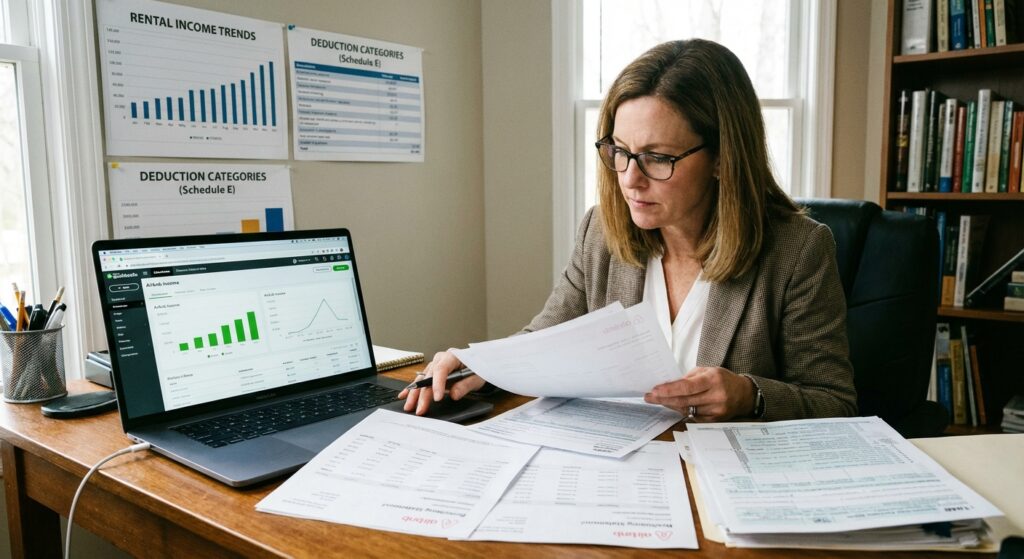
Bookkeeping for Airbnb Host: 2025 Tax Deductions, Forms & Compliance Guide
For the 2025 tax year, proper bookkeeping for Airbnb host operations is more critical than ever. With new 1099-K reporting thresholds and updated tax legislation, understanding how to organize your short-term rental income and expenses can save you thousands in taxes while keeping you compliant with IRS requirements. This comprehensive guide covers everything you need to know about bookkeeping for Airbnb hosts, including deductions, documentation, and 2025 tax law changes.
Table of Contents
- Key Takeaways
- Why Is Bookkeeping Critical for Airbnb Hosts?
- What Are the 2025 1099-K Reporting Rules for Airbnb Hosts?
- What Tax Deductions Can You Claim?
- How Should You Track Income and Expenses?
- How Do You Report Airbnb Income on Schedule C?
- What About Self-Employment Tax for Airbnb Hosts?
- Can You Depreciate Your Rental Property?
- Next Steps
- Frequently Asked Questions
Key Takeaways
- For 2025, you’ll receive a 1099-K only if you earn over $20,000 AND have 200+ transactions from payment processors.
- Deductible expenses include mortgage interest, property taxes, repairs, utilities, insurance, and depreciation.
- Airbnb rental income is reported on Schedule C as self-employment income.
- Self-employment tax for 2025 is 15.3% applied to 92.35% of your net income.
- Systematic expense tracking and accurate documentation are essential for maximizing deductions and surviving an audit.
Why Is Bookkeeping Critical for Airbnb Hosts?
Quick Answer: Proper bookkeeping for Airbnb hosts separates those who maximize profits from those who leave thousands in potential deductions on the table. It also protects you during IRS audits.
When you operate an Airbnb business, the IRS views you as self-employed. That means you’re responsible for reporting all income, claiming allowable deductions, and paying self-employment tax. Without systematic bookkeeping for Airbnb host operations, you risk missing deductions, misreporting income, and facing audit consequences.
The stakes are high. Rental hosts who fail to track expenses miss 20–40% of legitimate deductions. For a host earning $50,000 annually, that could mean leaving $10,000 to $20,000 in tax savings unclaimed. Additionally, poor documentation triggers IRS scrutiny, especially for high-income hosts or those with unusual deduction patterns.
The Business Nature of Airbnb Hosting
The IRS distinguishes between casual rental activity and a genuine business. If you rent a property regularly (typically 15+ days annually or more than 2 weeks of personal use), the IRS classifies you as running a trade or business. This means you file Schedule C on Form 1040, which is where all your Airbnb income and expenses are reported.
This classification matters because business income requires strict documentation. You can’t simply estimate deductions or claim expenses without receipts. The IRS requires itemized records showing what was spent, when, and why it’s business-related.
Pro Tip: Start bookkeeping for your Airbnb host operations on day one, not when tax season arrives. This establishes a clear pattern of business intent and makes tax filing straightforward.
What Are the 2025 1099-K Reporting Rules for Airbnb Hosts?
Quick Answer: For 2025, Airbnb hosts receive a 1099-K only if total payments exceed $20,000 AND involve 200+ transactions. This higher threshold, set by the One Big Beautiful Bill Act (OBBBA), means many small hosts won’t receive a 1099-K.
Understanding the 1099-K filing requirement is crucial for bookkeeping for Airbnb host tax compliance. The 1099-K Form is issued by payment processors to document payment transactions. For the 2025 tax year, the IRS significantly raised the reporting threshold after receiving criticism about overly aggressive reporting in prior years.
2025 1099-K Threshold Requirements
You will receive a 1099-K for Airbnb payments only if BOTH conditions are met:
- Total payments from a single payment processor exceed $20,000 in calendar year 2025
- AND you conducted more than 200 transactions on that platform
This is a substantial change from 2024, when the threshold was $5,000. Many part-time Airbnb hosts won’t receive a 1099-K under the new rules. However, you still must report all rental income on your tax return—whether or not you receive a 1099-K.
Did You Know? Even without a 1099-K, the IRS expects you to report all Airbnb income. Bookkeeping for Airbnb hosts protects you by creating independent income records that match your bank deposits.
Reporting Without a 1099-K
If you don’t receive a 1099-K because you’re below the threshold, you still report all income on Schedule C. Your bank records, Airbnb transaction history, and IRS Publication 587 (Business Use of Your Home) documentation become your proof of income. This is why systematic bookkeeping for Airbnb host operations is non-negotiable—you need records to substantiate your claimed income when filing.
What Tax Deductions Can You Claim?
Quick Answer: Deductible Airbnb host expenses include mortgage interest, property taxes, repairs, utilities, insurance, cleaning costs, advertising, supplies, and depreciation—all documented through systematic bookkeeping.
One of the biggest advantages of running an Airbnb business is the substantial deductions available to reduce your taxable income. The IRS allows you to deduct any ordinary and necessary expense directly related to your rental operation. Here’s a breakdown of commonly claimed deductions for Airbnb hosts.
Mortgage Interest and Property Taxes
If you have a mortgage on your rental property, the interest portion is fully deductible as a business expense (not the principal payment). Similarly, all property taxes attributable to your rental property are deductible. For 2025, state and local tax deductions are capped at $40,000 per household, up from $10,000 in prior years, though this is temporary and reverts to $10,000 in 2029.
Repairs, Maintenance, and Utilities
Repairs (like fixing a leaky roof or replacing broken fixtures) are immediately deductible. Maintenance costs (regular cleaning, landscaping, HVAC servicing) are deductible. Utilities (electric, water, gas, internet) are fully deductible if you pay them for the rental. Supplies (cleaning products, linens, kitchen items) are deductible if directly used in the rental business.
| Expense Category | Deductible Status (2025) | Documentation Required |
|---|---|---|
| Mortgage Interest | 100% Deductible | Loan statements showing interest |
| Property Taxes | 100% Deductible (SALT cap $40,000) | Tax assessment statements |
| Repairs and Maintenance | 100% Deductible | Invoices, receipts, contractor bills |
| Utilities | 100% Deductible | Utility bills, paid invoices |
| Insurance | 100% Deductible | Insurance policy statements |
| Advertising/Marketing | 100% Deductible | Credit card receipts, payment records |
| Cleaning and Laundry | 100% Deductible | Invoices, receipts from cleaners |
Pro Tip: Keep all receipts and invoices for minimum 3–7 years. The IRS can audit tax returns from prior years, and bookkeeping for Airbnb hosts requires documented proof of every deduction claimed.
Airbnb Service Fees and Payment Processing Costs
Any fees paid to Airbnb (typically 3% host service fee) are deductible. Payment processor fees charged by Stripe, PayPal, or Airbnb’s payment system are also deductible business expenses. These are often overlooked but represent meaningful deductions for high-volume hosts.
How Should You Track Income and Expenses?
Quick Answer: Use cloud-based accounting software (QuickBooks, FreshBooks, Wave) to automate bookkeeping for Airbnb hosts, categorize expenses, and generate reports for tax filing.
Effective bookkeeping for Airbnb host operations requires a system. Manual spreadsheets often miss transactions, duplicate entries, or miscategorize expenses. Cloud-based software solves this by automating bank feeds, categorizing expenses, and producing financial reports needed for Schedule C.
Recommended Expense Tracking System
- Cloud Accounting Software: Automatically sync bank and credit card transactions. QuickBooks Self-Employed and FreshBooks offer Airbnb-friendly templates.
- Separate Business Bank Account: Open a dedicated checking account for your rental business. This simplifies bookkeeping for Airbnb host transactions and makes tax reporting straightforward.
- Separation of personal and business finances protects you during audits and provides clear records of rental income and expenses.
- Digital Receipt Storage: Use apps like Receipt Bank or Expensify to photograph and store receipts automatically. This creates a searchable archive of all documented expenses.
- Monthly Reconciliation: Spend 15–30 minutes monthly reviewing transactions, categorizing new expenses, and catching errors before they compound.
Income Documentation
Your bookkeeping for Airbnb host income should document every booking. Airbnb provides monthly statements showing gross revenue before fees. Export and save these statements monthly. Cross-reference them with your bank deposits to ensure all income is accounted for and properly categorized.
How Do You Report Airbnb Income on Schedule C?
Quick Answer: All Airbnb rental income is reported on Schedule C (Form 1040) as gross rental income. Deductible business expenses are subtracted to calculate net profit, which is subject to self-employment tax.
When you operate an Airbnb business, you’re self-employed. This means your income and expenses are reported on Schedule C (Profit or Loss from Business), which is filed with your personal Form 1040 income tax return. The profitability of your Airbnb business directly affects your overall tax liability.
Schedule C Structure for Airbnb Hosts
Part I: Income requires you to report gross rental income from Airbnb bookings. This includes all payments received before Airbnb fees. Do not net out Airbnb’s service fees here—those are deducted separately as business expenses in Part II.
Part II: Expenses is where your bookkeeping for Airbnb host operations pays dividends. You itemize all deductible expenses: mortgage interest, property taxes, repairs, utilities, insurance, cleaning, advertising, supplies, depreciation, and professional services (accounting, legal). Each category has a specific line item on the form.
Net Profit Calculation: Gross income minus total deductions equals your net profit. This figure flows to Form 1040 and becomes part of your adjusted gross income (AGI), subject to self-employment tax.
Pro Tip: Hire a CPA or tax professional to file your Schedule C if your bookkeeping for Airbnb host operation generates more than $25,000 in annual income. Professional preparation reduces audit risk and identifies overlooked deductions.
What About Self-Employment Tax for Airbnb Hosts?
Quick Answer: For 2025, self-employment tax is 15.3%, calculated on 92.35% of your net rental profit. This covers Social Security and Medicare taxes that employees would normally split with employers.
Self-employed Airbnb hosts pay self-employment tax in addition to income tax. This is calculated on Schedule SE (Self-Employment Tax) using your net profit from Schedule C. Understanding this calculation is critical to budgeting for tax payments throughout the year.
2025 Self-Employment Tax Calculation
Formula: Net Profit × 92.35% × 15.3% = Self-Employment Tax (approximate)
Example: If your Airbnb business generates $40,000 net profit in 2025, your self-employment tax is approximately $5,657 ($40,000 × 0.9235 × 0.153). This is in addition to federal income tax on your total income.
You’re allowed to deduct half of your self-employment tax as an adjustment to gross income on Form 1040, which slightly reduces your overall tax burden. However, planning for these quarterly estimated tax payments is essential to avoid penalties and underpayment interest.
Quarterly Estimated Tax Payments
If you expect to owe more than $1,000 in self-employment and income taxes for 2025, you must file estimated tax payments quarterly (April 15, June 15, September 15, and January 15 following year). Failure to pay estimated taxes results in penalties and interest charges. Proper bookkeeping for Airbnb host operations helps you predict quarterly tax liability accurately.
Can You Depreciate Your Rental Property?
Quick Answer: Yes. You can depreciate the building structure over 27.5 years and personal property (furniture, appliances, equipment) over 5–7 years. Depreciation is a major tax deduction for rental property owners.
One of the most valuable—and overlooked—deductions for Airbnb hosts is depreciation. The IRS allows you to deduct the decline in value of your rental property and furnishings over time. This is a non-cash deduction, meaning you get a tax benefit without spending money in that year.
Depreciation Categories and Timeframes
- Building/Structure: Depreciated over 27.5 years (residential property). Note: Land is not depreciable.
- Furnishings and Appliances: Depreciated over 5–7 years depending on classification.
- Fixtures (Roof, HVAC, Flooring): Depreciated over varying periods, typically 5–27.5 years.
- Bonus Depreciation (2025): For 2025, you can claim 100% bonus depreciation on qualified business property placed in service. This allows you to deduct the full cost of eligible assets in the year of purchase.
Example Depreciation Benefit
Suppose you purchase a furnished Airbnb property for $400,000. You hire an appraiser to allocate the purchase price: $320,000 for the building and $80,000 for furnishings and appliances. You can deduct depreciation annually:
- Building: $320,000 ÷ 27.5 years = $11,636 annual depreciation
- Furnishings: $80,000 ÷ 5 years = $16,000 annual depreciation (accelerated)
- Total first-year deduction: ~$27,636 (non-cash deduction reducing taxable income)
Did You Know? Depreciation recapture applies when you sell your Airbnb property. You’ll owe tax on depreciation deductions taken, typically at a 25% rate. Plan for this when eventually selling.
Uncle Kam in Action: Airbnb Host Saves $12,340 with Strategic Bookkeeping
Client Snapshot: Sarah, 38, a full-time marketing manager who purchased a 2-bedroom townhouse in Austin, Texas as an Airbnb investment in late 2024.
Financial Profile: W-2 salary of $85,000 + Airbnb rental income of $48,000 in 2025 = $133,000 total household income (single filer).
The Challenge: Sarah tracked Airbnb income informally and had receipts scattered across email, bank statements, and credit cards. She wasn’t aware of deductions like depreciation, separate utility deductions, and Airbnb service fees. When tax season approached, she faced a potential self-employment tax bill exceeding $7,000—money she hadn’t budgeted for.
The Uncle Kam Solution: Our team implemented systematic bookkeeping for her Airbnb host operations. We:
- Set up QuickBooks Self-Employed with automatic bank feeds.
- Categorized all 2025 expenses and identified $18,500 in deductible costs (utilities, repairs, insurance, cleaning, property management services).
- Calculated depreciation on furnishings ($14,200 first year) and the building allocation ($9,100 first year).
- Prepared Schedule C showing: Gross Airbnb Income $48,000 – Total Deductions $41,800 (expenses + depreciation) = Net Profit $6,200.
The Results:
- Tax Savings: $12,340 reduction in 2025 federal tax liability through strategic deductions and depreciation planning.
- Self-Employment Tax: Instead of $7,000+ owed, Sarah owed only $877 ($6,200 net profit × 0.9235 × 0.153).
- Investment: $2,100 for professional bookkeeping setup and tax preparation.
- Return on Investment: 5.9x first-year ROI. Sarah recovered her service fees through tax savings and avoided penalties from underpayment.
This is just one example of how systematic bookkeeping and strategic tax planning transforms Airbnb host operations from a chaotic expense into a professionally managed business that maximizes profitability.
Next Steps
- ☐ Open a dedicated business bank account for your Airbnb income and expenses.
- ☐ Set up QuickBooks Self-Employed or FreshBooks and sync your bank account.
- ☐ Gather all 2025 receipts and invoices and categorize them by expense type.
- ☐ Consult with a tax professional about depreciation planning and estimated quarterly payments.
- ☐ Schedule estimated tax payments for Q1 2026 (due April 15, 2026) to avoid IRS penalties.
Frequently Asked Questions
Is Airbnb Host Income Considered Rental Income or Self-Employment Income?
Airbnb rental income is classified as self-employment income, not passive rental income. This means you file Schedule C and pay self-employment tax (15.3% in 2025). The distinction is important: self-employment income subjects you to both income tax and self-employment tax, whereas passive rental income (like a long-term lease) only incurs income tax. The IRS makes this distinction based on your involvement in managing the property and frequency of rentals.
Can I Deduct Home Office Supplies If I Manage My Airbnb from Home?
Yes. If you dedicate a home office space to managing your Airbnb business (responding to inquiries, coordinating cleaners, accounting), you can deduct a portion of home office expenses. You calculate this using either the simplified method ($5 per square foot, up to 300 sq ft) or actual expense method (utilities, rent, insurance, repairs). For systematic bookkeeping for Airbnb host operations, the simplified method is often easier to document and defend in an audit.
What If I Rent Out Multiple Properties? Does Bookkeeping Get More Complicated?
Managing multiple properties requires more sophisticated bookkeeping for Airbnb host operations, but the principles remain the same. You should create separate line items or accounts for each property in your accounting software to track income and expenses independently. This simplifies tax reporting and helps you identify which properties are most profitable. Cloud-based software easily handles multi-property tracking and generates separate financial reports for each unit.
When Should I Make Estimated Tax Payments for My Airbnb Business?
Estimated tax payments for 2025 Airbnb income are due quarterly: April 15, 2025 (Q1), June 16, 2025 (Q2), September 15, 2025 (Q3), and January 15, 2026 (Q4). Calculate your quarterly liability based on projected annual profit. If you expect to owe more than $1,000, the IRS requires estimated payments to avoid penalties. Many tax professionals recommend making equal quarterly payments (25% of total estimated liability) unless your income fluctuates significantly by season.
How Long Should I Keep Records for Bookkeeping for Airbnb Hosts?
The IRS recommends keeping tax records for a minimum of 3 years from the date you file your return. However, if you underreported income by 25% or more, the IRS can audit back 6 years. For bookkeeping for Airbnb host operations, storing digital copies of receipts, bank statements, and transaction records for 7 years provides extra protection. Cloud storage solutions like Google Drive or Dropbox are inexpensive and make records accessible if you’re audited.
Can I Deduct Losses If My Airbnb Business Doesn’t Profit?
Yes, if you operate as a legitimate business (meaning you have a profit motive and maintain proper records), you can deduct losses against other income. However, the IRS applies a “hobby loss” test. If you show losses for 3 of 5 consecutive years, the IRS may classify your Airbnb business as a hobby, preventing loss deductions. To avoid this, maintain systematic bookkeeping for Airbnb host operations showing legitimate business intent, marketing efforts, and a realistic path to profitability.
What Documentation Do I Need for an IRS Audit of My Airbnb Business?
If audited, the IRS will request: (1) Bank statements showing deposits and withdrawals; (2) Airbnb transaction statements; (3) Receipts, invoices, and canceled checks for all claimed deductions; (4) Mortgage statements, property tax bills, and insurance policies; (5) Depreciation schedules and asset purchase documentation; (6) Mileage logs if you claim vehicle expenses; (7) Contracts with contractors, cleaners, or property managers. Systematic bookkeeping for Airbnb host operations provides all these documents organized and accessible, significantly reducing audit stress and the likelihood of adjustments.
Related Resources
- Complete Self-Employed Tax Strategy Guide for 1099 Contractors
- Real Estate Investor Tax Planning and Deduction Strategies
- 2025 Tax Filing and Compliance Services
- Strategic Tax Planning for Business Income Reduction
- Bookkeeping and Financial Management for Small Businesses
Last updated: December, 2025
This information is current as of 12/25/2025. Tax laws change frequently. Verify updates with the IRS or a qualified tax professional if reading this later.

