
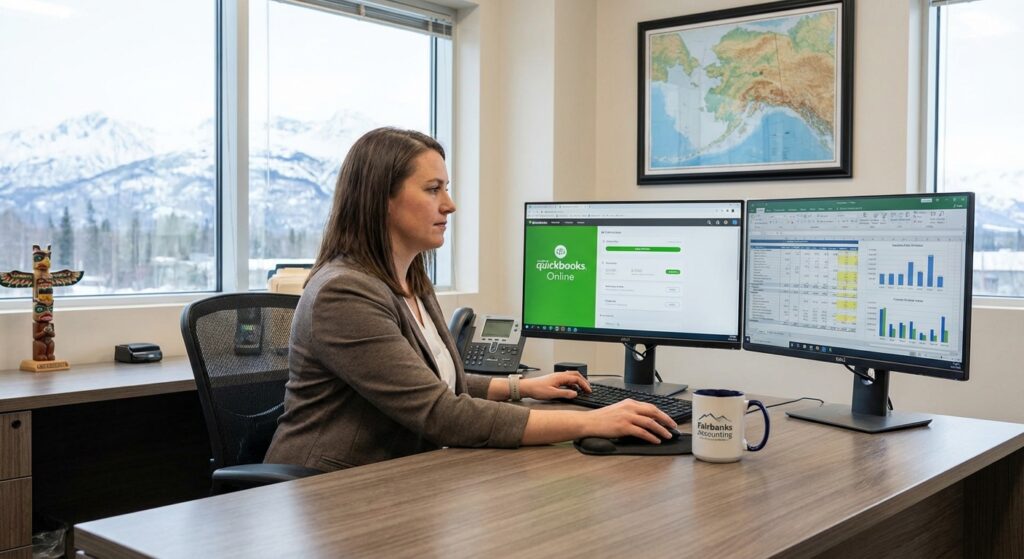
Alaska Bookkeeping Services: The Complete 2025 Guide for Business Owners
Alaska bookkeeping services have become essential for business owners navigating the 2025 tax year. Whether you’re a sole proprietor, LLC owner, or small business operator, proper bookkeeping directly impacts your tax liability, eligibility for deductions, and IRS compliance. This comprehensive guide explores everything you need to know about Alaska bookkeeping services, from choosing the right provider to maximizing tax advantages for your specific business situation.
Table of Contents
- Key Takeaways
- Why Alaska Bookkeeping Services Matter for Your Business
- What Are the Core Bookkeeping Requirements for 2025?
- How Can You Maximize Tax Deductions Through Proper Bookkeeping?
- What Is the Schedule C Filing Process for Alaska Business Owners?
- How Do 1099 and Form Reporting Requirements Work in 2025?
- How to Choose the Right Alaska Bookkeeping Services Provider
- What Are the Unique Tax Advantages for Alaska Business Owners?
- Uncle Kam in Action
- Next Steps
- Frequently Asked Questions
- Related Resources
Key Takeaways
- Professional Alaska bookkeeping services ensure IRS compliance and maximize deductions for 2025 tax filings.
- Alaska has no state income tax, creating unique advantages for business owners compared to other states.
- Accurate bookkeeping is required to correctly file Schedule C and calculate self-employment taxes at 15.3%.
- The 2025 1099-K reporting threshold requires more than $20,000 in online payments or 200+ transactions.
- Bookkeeping software and services are deductible business expenses that reduce your overall tax burden.
Why Alaska Bookkeeping Services Matter for Your Business
Quick Answer: Professional Alaska bookkeeping services provide the financial foundation needed for accurate tax filing, regulatory compliance, and strategic business decision-making throughout 2025.
Many Alaska business owners underestimate the importance of professional bookkeeping. Yet accurate financial records directly impact your ability to claim legitimate deductions, minimize tax liability, and avoid costly IRS penalties. For the 2025 tax year, the standard deduction for married filing jointly is $31,500, while self-employed individuals must calculate taxes on net business income using Schedule C.
When you invest in quality Alaska bookkeeping services, you’re essentially investing in tax savings. Professional bookkeepers understand the nuances of business expense categorization, quarterly estimated tax requirements, and year-end tax planning strategies. They help you identify every deductible expense, from office supplies to vehicle expenses, ensuring you’re not leaving money on the table when you file your return.
The Cost of Poor Bookkeeping
Without proper Alaska bookkeeping services, you risk missing valuable deductions that could reduce your federal tax liability. Consider that self-employment tax for 2025 is calculated at 15.3% on net earnings—proper expense tracking can significantly reduce that obligation. Additionally, disorganized records make tax filing stressful, error-prone, and potentially audit-risky. The IRS expects detailed documentation of business income and expenses, and inadequate records can result in penalties ranging from $250 to $10,000 depending on the severity of the violation.
Strategic Advantages of Professional Services
Professional Alaska bookkeeping services offer strategic advantages beyond basic record-keeping. They provide real-time financial reporting, helping you understand cash flow throughout the year. This visibility enables proactive tax planning rather than reactive tax filing. Bookkeepers also stay current with changing IRS regulations and ensure your business complies with all federal requirements, reducing audit risk.
Pro Tip: Alaska business owners should set aside 25-30% of net business income for taxes. Professional bookkeeping helps you track this obligation accurately.
What Are the Core Bookkeeping Requirements for 2025?
Quick Answer: The IRS requires detailed records of all business income and expenses, organized by category, with supporting documentation such as receipts and bank statements.
The IRS doesn’t mandate a specific bookkeeping system, but it does require that you maintain organized financial records. For Alaska bookkeeping services to be effective, they must track and categorize all business transactions. This includes income from all sources and legitimate business expenses that reduce your taxable income.
Essential Records to Maintain
- Bank Statements: Monthly bank statements for all business accounts (checking, savings, credit cards).
- Receipts and Invoices: Original receipts for all business expenses exceeding $75, plus invoices for income received.
- Expense Records: Categorized expenses including supplies, equipment, rent, utilities, and professional services.
- Income Documentation: Records of all revenue sources, including 1099s from clients and payment platform records.
- Mileage Logs: If deducting vehicle expenses, maintain contemporaneous records of business-related miles.
- Payroll Records: If you have employees, keep detailed payroll documentation and tax withholding records.
Alaska bookkeeping services organize these records in a way that facilitates Schedule C filing. The IRS expects to see clear documentation for any deduction claimed, and professional bookkeepers create audit trails that protect you if questions arise during an audit.
Retention and Documentation Standards
The IRS recommends retaining business records for at least 3 years, though some situations require longer retention. Alaska bookkeeping services should maintain organized files with original receipts, digitized documents, and a clear audit trail showing when and why entries were made. This level of documentation protects you in case of an IRS inquiry and provides valuable historical data for business analysis.
How Can You Maximize Tax Deductions Through Proper Bookkeeping?
Quick Answer: Comprehensive Alaska bookkeeping services track all deductible business expenses, ensuring you claim every legitimate deduction to minimize your 2025 tax liability.
One of the primary benefits of Alaska bookkeeping services is identifying and documenting every possible tax deduction. For the 2025 tax year, business owners can deduct ordinary and necessary expenses that reduce gross income. Professional bookkeepers understand IRS guidelines for what qualifies as a deductible expense and help you maximize savings while maintaining compliance.
Common Deductible Business Expenses
| Expense Category | Deductible 2025 Examples |
|---|---|
| Office Supplies & Equipment | Pens, paper, printer ink, filing cabinets, and computers (depreciated if over $2,500) |
| Professional Services | Accounting, bookkeeping services, legal fees, and consulting fees |
| Technology & Software | QuickBooks, project management tools, email services, and website hosting |
| Vehicle Expenses | Mileage (67 cents per mile for 2025), fuel, maintenance, and insurance |
| Home Office Deduction | Utilities, rent/mortgage interest, maintenance (if you have dedicated workspace) |
| Marketing & Advertising | Website development, social media advertising, and business cards |
Did You Know? Alaska bookkeeping services can help you identify home office deductions that many solo entrepreneurs overlook, potentially saving hundreds on your 2025 tax return.
Year-End Tax Planning Strategies
Professional Alaska bookkeeping services help you implement year-end strategies that minimize your 2025 tax liability. One approach is prepaying business expenses before December 31 if you use cash-basis accounting. For example, purchasing supplies in December for use in 2026 creates a deduction in the current year. Similarly, making estimated quarterly tax payments on time ensures you avoid underpayment penalties while reducing your final tax bill.
Another strategy involves maximizing retirement contributions. If you’re self-employed, you can contribute to a Solo 401(k) (limited to $23,500 in 2025) or SEP-IRA. These contributions reduce your self-employment income and provide valuable tax-deferred savings. Alaska bookkeeping services coordinate these contributions with your tax planning for maximum benefit.
What Is the Schedule C Filing Process for Alaska Business Owners?
Quick Answer: Schedule C reports your business income and expenses, calculates net profit, and is filed with your personal Form 1040 tax return for the 2025 tax year (filed by April 15, 2026).
Schedule C is the primary form used by sole proprietors and single-member LLCs to report business income to the IRS. This form requires detailed information about revenue, costs of goods sold (if applicable), and operating expenses. Accurate Alaska bookkeeping services ensure all information on Schedule C is properly documented and substantiated, reducing audit risk.
Schedule C Components for 2025
- Gross Income: Report all business income from all sources, including cash payments and online transaction income.
- Expenses: Detailed categorization of deductible business expenses (rent, utilities, supplies, professional services, etc.).
- Net Profit/Loss: Calculated by subtracting total expenses from gross income (this flows to Form 1040).
- Self-Employment Tax: Net profit is subject to 15.3% self-employment tax (12.4% Social Security + 2.9% Medicare).
Filing Deadlines for Alaska Businesses
For the 2025 tax year, sole proprietors must file Schedule C by April 15, 2026. If you operate an S Corporation, the deadline is March 16, 2026. Alaska bookkeeping services help you organize all necessary documentation well before these deadlines, ensuring timely and accurate filing. Filing early provides tax refunds more quickly and reduces audit risk by demonstrating organized financial management.
How Do 1099 and Form Reporting Requirements Work in 2025?
Quick Answer: 1099 forms document income from clients, and proper Alaska bookkeeping services reconcile this income with your business records and Schedule C filing.
If you receive income from clients or online payment platforms, you’ll likely receive 1099-NEC or 1099-K forms. The IRS uses these forms to verify that you’re reporting all business income. For 2025, the 1099-K reporting threshold increased significantly—you’ll only receive a 1099-K if you have more than $20,000 in online payment platform income AND more than 200 transactions. However, professional Alaska bookkeeping services recommend tracking all income regardless of whether you receive a 1099.
Understanding 2025 1099 Reporting Thresholds
| Form Type | 2025 Reporting Threshold | What It Tracks |
|---|---|---|
| 1099-NEC | $600 or more from single payer | Non-employee compensation from individual clients/small businesses |
| 1099-K | $20,000+ AND 200+ transactions | Income processed through payment platforms (PayPal, Square, Stripe, etc.) |
| 1099-MISC | $10+ (for some categories) | Miscellaneous income including rent or royalties |
Professional Alaska bookkeeping services reconcile all 1099 income with your actual business records. This reconciliation is critical because the IRS receives copies of these forms and matches them against your Schedule C reporting. Discrepancies can trigger audits, making accurate record-keeping essential.
How to Choose the Right Alaska Bookkeeping Services Provider
Quick Answer: Look for Alaska bookkeeping services that specialize in your business type, offer real-time reporting, use modern software, and have experience with IRS compliance requirements.
Selecting the right Alaska bookkeeping services provider impacts your tax savings and peace of mind. The ideal provider understands your specific business model and offers services tailored to your needs. Whether you need full-service bookkeeping or consultation on expense categorization, finding the right fit is essential.
Key Criteria for Selection
- Industry Expertise: Providers experienced with your business type understand industry-specific deductions.
- Software Integration: Modern bookkeeping uses cloud-based software like QuickBooks for accessibility and real-time reporting.
- Tax Planning: Look for Alaska bookkeeping services that go beyond record-keeping to include strategic tax planning.
- Communication: Responsive providers explain findings clearly and answer questions about your financial position.
- Credentials: CPAs and enrolled agents bring additional credibility and expertise to bookkeeping services.
What Are the Unique Tax Advantages for Alaska Business Owners?
Quick Answer: Alaska has no state income tax, providing significant tax advantages compared to other states when combined with proper bookkeeping and tax planning.
One of the most significant advantages of operating a business in Alaska is the absence of state income tax. This advantage alone can provide substantial savings compared to business owners in states like California, New York, or Texas. When combined with professional Alaska bookkeeping services and strategic tax planning, this advantage becomes even more valuable.
Alaska’s Tax Advantage in Practice
For 2025, a $100,000 net profit business in Alaska pays only federal self-employment tax (15.3% = $15,300) with no state income tax. In comparison, the same business in California might pay approximately 9.3% in state income tax ($9,300) plus federal taxes. Over time, this difference compounds, making Alaska an attractive location for entrepreneurs.
Alaska bookkeeping services help you maintain your in-state residency while conducting business. If you’re considering relocating your business, professional advice ensures you maintain Alaska’s tax advantages and comply with all residency requirements. This strategic positioning, combined with comprehensive bookkeeping, creates a powerful tax advantage for Alaska business owners.
Pro Tip: Alaska business owners should consult with professional advisors about whether maintaining Alaska residency aligns with their business strategy. Uncle Kam offers specialized Alaska tax preparation services that maximize these state advantages.
Uncle Kam in Action: Alaska Consultant Saves $18,400 Through Strategic Bookkeeping
Client Snapshot: Sarah is a management consultant operating as an S Corporation in Alaska, with annual revenue of $185,000.
Financial Profile: Sarah’s business generates approximately $185,000 in annual consulting revenue with home-based operations and two employees. Prior to working with Uncle Kam, she used a basic spreadsheet system for tracking expenses and income, relying on a generic tax software for filing.
The Challenge: Sarah was missing significant tax deductions and hadn’t optimized her business entity structure for the 2025 tax year. Her disorganized bookkeeping meant she was likely overpaying self-employment taxes and missing year-end planning opportunities. She also wasn’t taking full advantage of Alaska’s no-state-income-tax advantage, leaving money on the table by not maximizing federal deductions.
The Uncle Kam Solution: Our team implemented comprehensive Alaska bookkeeping services that included:
- Migration to QuickBooks Online for real-time expense tracking and income categorization
- Identification of missed home office deductions ($3,600 annually based on dedicated workspace)
- Review and optimization of S Corporation salary structure to minimize self-employment tax burden
- Implementation of quarterly estimated tax payments to avoid underpayment penalties
- Year-end tax planning strategies including Solo 401(k) contributions and business expense prepayment
The Results:
- Tax Savings: $18,400 in combined federal and self-employment tax reduction through proper deduction identification and entity structuring for the 2025 tax year
- Investment: A one-time investment of $3,200 for professional bookkeeping setup and ongoing advisory services
- Return on Investment (ROI): A 5.75x return in the first year, plus continued savings in subsequent years
This is just one example of how our Alaska tax preparation and bookkeeping services have helped clients achieve significant savings and financial clarity. Sarah now enjoys organized financial records, real-time reporting, and strategic tax planning that positions her for continued growth.
Next Steps
- Gather your 2025 business financial documents, bank statements, and receipts for a comprehensive review
- Evaluate your current bookkeeping system for gaps and opportunities for improvement
- Schedule a consultation with professional Alaska bookkeeping services to discuss your specific business situation
- Implement quarterly tax planning to optimize your 2025 and 2026 tax positions
- Set aside adequate reserves for estimated tax payments to avoid underpayment penalties
Frequently Asked Questions
How much do Alaska bookkeeping services typically cost?
Costs vary based on the complexity of your business and the scope of services. Basic bookkeeping typically ranges from $300-$1,000 monthly, while comprehensive services including tax planning may cost $1,000-$3,000+ monthly. Consider the potential tax savings of $5,000-$20,000+ annually when evaluating costs.
Can I deduct bookkeeping service costs as a business expense?
Yes, absolutely. Professional bookkeeping and accounting services are fully deductible as ordinary and necessary business expenses. This reduces your taxable income and provides immediate cost recovery.
What if I haven’t been keeping good records? Can Alaska bookkeeping services help?
Professional bookkeepers can help organize historical records, though reconstructing past records may cost more. For the 2025 tax year forward, starting with professional bookkeeping ensures proper documentation from this point forward.
How does Alaska’s no-state-income-tax advantage work with bookkeeping?
Alaska’s lack of state income tax means all your income is subject only to federal taxes. Professional bookkeeping helps you maximize federal deductions and maintain Alaska residency status, preserving this significant advantage.
When should I file my 2025 tax return with Alaska bookkeeping support?
For sole proprietorships and single-member LLCs, the deadline is April 15, 2026. Filing earlier (January-March 2026) allows faster refund processing and demonstrates organized financial management to the IRS.
What software do professional Alaska bookkeeping services use?
Most professional services use cloud-based software like QuickBooks Online, FreshBooks, or Xero. These platforms offer real-time reporting, expense categorization, and integration with IRS filing systems.
How do I ensure compliance with 1099 reporting requirements?
Professional Alaska bookkeeping services track all income received, reconcile it with 1099 forms received, and ensure Schedule C reporting matches. This reconciliation protects you from audit risk and ensures accurate filing.
Related Resources
- Alaska Tax Preparation Services – Expert Support for Your Business
- Comprehensive Business Solutions Including Bookkeeping and Payroll
- Entity Structuring Services to Optimize Your Business Tax Position
- IRS Schedule C Form Instructions and Requirements
- Small Business Administration Resources and Guidance
Last updated: December, 2025

