
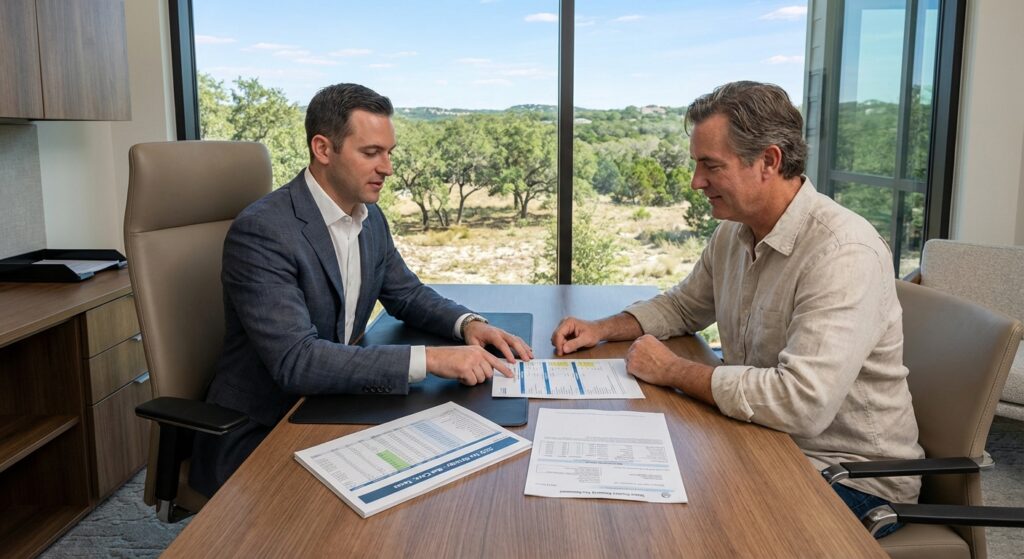
Complete Guide to Bee Cave Texas Tax Preparation for 2025: Maximize Your Refund and Minimize Your Tax Bill
For the 2025 tax year, Bee Cave, Texas residents face an evolving tax landscape. The federal government enacted the One Big Beautiful Bill Act in July 2025, which fundamentally changed deductions, credits, and filing requirements for millions of Americans. Whether you own property in Bee Cave, run a business in Travis County, or invest in real estate, understanding these changes is critical to avoiding overpaying your taxes. This guide on Bee Cave Texas tax preparation explores the 2025 tax rules you need to know, helps you identify often-missed deductions and credits, and provides actionable strategies to file your return correctly and strategically.
Table of Contents
- Key Takeaways
- What Are the 2025 Standard Deduction Amounts for Texas Filers?
- How Does the New SALT Deduction Increase Affect Bee Cave Homeowners?
- Why Is Texas Tax Preparation Different? Understanding No State Income Tax
- Can You Deduct Charitable Contributions Without Itemizing in 2025?
- What Property Tax Strategies Should Bee Cave Residents Use?
- What Tax Credits Do Most Bee Cave Residents Miss?
- Uncle Kam in Action: Bee Cave Couple Discovers $18,700 in Tax Savings
- Next Steps
- Frequently Asked Questions
Key Takeaways
- The 2025 standard deduction is $15,750 for single filers and $31,500 for married couples filing jointly, providing a baseline deduction for all eligible filers.
- The SALT (state and local tax) deduction cap has increased to $40,000 for 2025, up from $10,000 previously, offering significant savings for high-earners in Texas.
- Texas has no state income tax, simplifying tax preparation but requiring focus on federal, local, and property taxes.
- Non-itemizers can now deduct up to $1,000 (single) or $2,000 (married filing jointly) in direct charitable donations for 2025.
- Professional Bee Cave tax preparation services help identify missed credits, optimize deductions, and ensure compliance with new 2025 requirements.
What Are the 2025 Standard Deduction Amounts for Texas Filers?
Quick Answer: For 2025, the standard deduction is $15,750 for single filers, $31,500 for married filing jointly, and $23,600 for heads of household.
The 2025 standard deduction represents the baseline tax deduction available to all eligible filers. This amount is adjusted annually for inflation. Understanding your standard deduction is the first critical step in Bee Cave Texas tax preparation.
For the 2025 tax year, most Texas residents benefit from simply taking the standard deduction rather than itemizing deductions individually. The IRS adjusted these amounts to reflect cost-of-living changes, providing meaningful tax relief to middle-income households.
2025 Standard Deduction by Filing Status
| Filing Status | 2025 Standard Deduction | 2024 Deduction | Change |
|---|---|---|---|
| Single | $15,750 | $14,600 | +$1,150 |
| Married Filing Jointly | $31,500 | $29,200 | +$2,300 |
| Head of Household | $23,600 | $21,900 | +$1,700 |
When you file your Form 1040, you’ll automatically receive your standard deduction unless you choose to itemize. Many Bee Cave residents don’t realize they should compare their standard deduction to potential itemized deductions to determine which approach saves the most money.
Who Should Itemize vs. Take the Standard Deduction?
Itemizing only makes sense if your total deductible expenses exceed your standard deduction. For example, a married couple with $28,000 in combined mortgage interest, property taxes, and charitable donations should take the $31,500 standard deduction instead of itemizing.
However, homeowners in Bee Cave with expensive properties may have qualifying deductions that exceed the standard deduction threshold. This is where professional tax preparation becomes critical to maximizing savings.
Pro Tip: Run two calculations before filing: one using the standard deduction and another with itemized deductions. Choose whichever approach produces the lower tax liability for your 2025 return.
How Does the New SALT Deduction Increase Affect Bee Cave Homeowners?
Quick Answer: The SALT cap increased from $10,000 to $40,000 for 2025, allowing homeowners to deduct significantly more property taxes and local fees using the new Schedule 1-A form.
This is one of the most significant changes in 2025 tax preparation for Bee Cave residents. The state and local tax (SALT) deduction cap has increased to $40,000, creating massive opportunities for property owners and high-earners.
What Qualifies Under the Expanded SALT Deduction?
The SALT deduction allows you to deduct state and local taxes paid during the year. For Texas residents, this includes:
- Property taxes on your primary residence and investment properties
- Local school district taxes and other municipal levies
- General sales taxes paid during the year (if exceeding income taxes)
- Business license taxes and local business fees
For Bee Cave homeowners with properties valued above $800,000, the increased $40,000 SALT cap could provide $10,000+ in additional tax savings compared to the 2024 limit of $10,000.
How to Claim the SALT Deduction on Schedule 1-A
Starting with your 2025 return filed in 2026, you’ll use the new Schedule 1-A form to claim SALT deductions. This replaces the previous method and requires specific documentation:
- Property tax statements from Travis County Appraisal District
- Local tax bills for municipal and school district taxes
- 1099-S forms if you sold property during the year
- Receipts for any estimated tax payments made to Travis County
Keep detailed records of all SALT payments throughout 2025. The deadline for claiming SALT deductions is April 15, 2026, when you file your 2025 return.
Did You Know? The SALT deduction increase to $40,000 was part of the One Big Beautiful Bill Act, signed into law July 4, 2025. This represents the largest increase to the SALT cap since 2017.
Why Is Texas Tax Preparation Different? Understanding No State Income Tax
Quick Answer: Texas has no state income tax, which simplifies your filing but shifts focus to federal taxes, property taxes, and local business taxes.
For Bee Cave Texas tax preparation, one critical advantage is that Texas does not impose a state income tax on individuals. This unique benefit has attracted thousands of high-earning professionals and business owners to relocate to Texas, making the Hill Country around Bee Cave one of the fastest-growing areas in the nation.
What Taxes Do Bee Cave Residents Pay Instead?
While Texas doesn’t tax income, residents still pay several other taxes:
- Property Taxes: Among the highest in the nation (averaging 1.47% of home value)
- Sales Taxes: Combined state and local sales tax rates vary by city (typically 8-9%)
- Federal Taxes: Income tax to the federal government on all income sources
- Business Taxes: Texas franchise tax for certain business entities
This tax structure means that even though Bee Cave residents don’t file state income tax returns, they face substantial property tax bills. A $1.5 million home in Bee Cave could generate $22,000+ in annual property taxes.
Optimizing Your Tax Strategy Without State Income Tax
The absence of state income tax doesn’t mean you ignore tax planning. Instead, focus your efforts on:
- Maximizing federal deductions and credits to reduce federal tax liability
- Strategically timing property improvements and maintenance deductions
- Exploring property tax exemptions available through Travis County
- Using professional Texas tax preparation services to identify deductions you might miss
Can You Deduct Charitable Contributions Without Itemizing in 2025?
Quick Answer: Yes! For 2025, non-itemizers can deduct up to $1,000 (single) or $2,000 (married filing jointly) in charitable donations while taking the standard deduction.
This is a major benefit introduced as part of 2025 tax law changes that benefits generous Bee Cave residents and charitable supporters. Previously, only taxpayers who itemized could deduct charitable contributions. Now, everyone can.
Who Benefits Most From the New Charitable Deduction?
The new charitable deduction is particularly valuable for:
- Middle-income families with $500-$750 in charitable donations
- Non-itemizers who want a tax deduction for charitable giving
- Retirees and seniors supporting churches and nonprofits
- Donors splitting contributions between itemizing and non-itemizing years
This deduction applies to “qualified charitable distributions” from donor-advised funds, as well as direct donations to eligible charities. You’ll report this deduction using Schedule 1-A along with your other 2025 tax forms.
What Property Tax Strategies Should Bee Cave Residents Use?
Quick Answer: Combine the expanded SALT deduction with property tax exemptions and appeals to minimize your total tax burden in Bee Cave.
Property taxes represent the largest tax burden for most Bee Cave homeowners. With homes regularly valued at $1 million-$3 million, strategic property tax management can save thousands annually.
Strategy 1: Leverage the Expanded SALT Deduction
With the SALT cap now at $40,000, Bee Cave residents can deduct the full amount of property taxes paid, up to the cap. For a homeowner with $38,000 in property taxes, this deduction directly reduces taxable income.
Strategy 2: File Property Tax Exemption Claims
Texas offers multiple property tax exemptions that directly reduce your tax bill. The Texas Comptroller’s office maintains information about:
- Homestead exemptions for primary residences
- Agricultural use exemptions (if applicable to your Bee Cave property)
- Senior and disabled person exemptions
- Business property exemptions for business owners
Strategy 3: Challenge Your Property Appraisal
If your property assessment seems too high, you have the right to protest. Travis County allows formal appeals through the county appraisal review board. Many Bee Cave residents discover their properties have been over-assessed, resulting in refunds and lower future taxes.
What Tax Credits Do Most Bee Cave Residents Miss?
Quick Answer: Most Bee Cave residents miss education credits, adoption tax credits, energy-efficient home improvement credits, and dependent care credits worth thousands in annual savings.
Tax credits reduce your tax liability dollar-for-dollar, making them more valuable than deductions. Yet taxpayers often overlook credits they qualify for, leaving money on the table.
The Adoption Tax Credit: Up to $17,280 for 2025
The Adoption Tax Credit increased to $17,280 per eligible child in 2025. If you finalized an adoption in 2025 or began the adoption process before January 1, 2025, you may qualify.
Qualifying expenses include legal fees, court costs, adoption agency fees, and home study costs. File Form 8839 with your 2025 tax return to claim this valuable credit.
Energy Efficient Home Improvement Credits
Bee Cave homeowners who installed solar panels, new HVAC systems, insulation, or energy-efficient windows in 2025 may claim energy credits. These credits can reach $1,200+ for major improvements.
Dependent Care Credits for Working Parents
If you paid for daycare, afterschool programs, or summer camps for dependents while you worked, you likely qualify for the Dependent Care Credit, worth up to $1,200 for families with one dependent or $2,400 for multiple dependents.
Uncle Kam in Action: Bee Cave Couple Discovers $18,700 in Tax Savings
Client Snapshot: David and Margaret, both age 48, live in Bee Cave with three children. David runs a consulting business earning $280,000 annually, while Margaret works as an architect earning $165,000. They invested in solar panels in 2025 and donated $3,200 to charities.
Financial Profile: Combined household income of $445,000, property valued at $1.8 million with property taxes of $26,400, and business deductions of $18,000.
The Challenge: David and Margaret were using a national tax preparation service that prepared basic returns without exploring optimization opportunities. They paid $82,000 in federal income taxes and didn’t think they could do better. They also weren’t aware that the new 2025 SALT deduction increase would dramatically change their filing strategy, nor did they realize they qualified for multiple tax credits.
The Uncle Kam Solution: This is just one example of how our proven tax strategies have helped clients achieve significant savings. Our team performed a comprehensive 2025 tax analysis:
- Utilized the expanded $40,000 SALT deduction for property taxes and local fees
- Claimed $4,100 in energy efficient home improvement credits for solar installation
- Optimized business deductions for David’s consulting practice to reduce self-employment tax
- Strategized charitable donations to maximize tax benefits across both federal and potential state returns
- Structured retirement contributions to reduce taxable income by $32,000
The Results:
- Tax Savings: $18,700 in total federal tax reduction for 2025
- Investment: A professional tax strategy fee of $3,500
- Return on Investment (ROI): 534% first-year return on their investment, plus $18,700 in cash staying in their pocket
By working with professional tax advisory services, David and Margaret transformed their routine tax filing into a comprehensive wealth-building strategy. They now have an extra $18,700 to invest in their children’s education, home improvements, or retirement savings.
Next Steps for Your 2025 Tax Preparation
Ready to optimize your 2025 Bee Cave tax filing? Follow these action steps before year-end:
- Gather all 2025 tax documents: property tax bills, charitable donation receipts, business expenses, and investment statements
- Make final charitable contributions before December 31 if you plan to claim itemized deductions for 2025
- Maximize retirement contributions ($23,500 for 401k, $7,000 for IRA) to reduce taxable income
- Schedule a consultation with a professional Bee Cave Texas tax preparation specialist to review your 2025 situation
- File your 2025 return by April 15, 2026, to avoid penalties and interest
Frequently Asked Questions
What is the deadline for filing 2025 taxes in Texas?
The deadline for filing your 2025 federal income tax return is April 15, 2026. Since Texas has no state income tax, you don’t file a separate state return. However, if you own a business, you may need to file a Texas Franchise Tax return by a specified deadline.
Can I deduct home office expenses as a Bee Cave business owner?
Yes. If you use part of your home exclusively for business, you can deduct either actual expenses or claim the simplified home office deduction of $5 per square foot (up to 300 square feet, or $1,500 maximum). Calculate which method provides the larger deduction, then claim it on Schedule C.
Should I itemize deductions or take the standard deduction for 2025?
Compare your likely itemized deductions (property taxes, mortgage interest, charitable donations) to the standard deduction ($31,500 for married filing jointly). If itemized deductions exceed the standard deduction, itemize. Otherwise, take the standard deduction. Many Bee Cave homeowners itemize due to high property taxes.
How much can I deduct for charitable contributions in 2025?
Non-itemizers can deduct up to $1,000 (single) or $2,000 (married filing jointly) in charitable donations for 2025. Itemizers can deduct qualifying charitable contributions without limit, subject to income-based percentage limitations. Report charitable deductions on Schedule A if itemizing.
What is the SALT deduction limit for 2025 in Texas?
The SALT (state and local tax) deduction limit increased to $40,000 for 2025, up from $10,000 in prior years. This includes property taxes, local school taxes, sales taxes, and business taxes. Report SALT deductions on Schedule 1-A with your 2025 return.
Do I need professional help with my 2025 Bee Cave tax return?
If you own real estate, operate a business, have complex investments, or expect to itemize deductions, professional tax preparation is highly recommended. The new 2025 SALT deduction increase and other rule changes make professional guidance valuable for optimizing your return and avoiding costly mistakes.
Can I use the $40,000 SALT deduction if I don’t itemize?
No. The SALT deduction is only available if you itemize your deductions on Schedule A. If you take the standard deduction, you cannot claim the SALT deduction. This is why comparing itemized deductions to the standard deduction is critical for high-property-tax areas like Bee Cave.
What credits am I missing as a Bee Cave homeowner?
Common missed credits include: energy efficient home improvement credits (solar, HVAC, insulation), adoption tax credits (up to $17,280), dependent care credits, education credits (American Opportunity, Lifetime Learning), and the energy efficient vehicle credit. A professional tax review can identify credits specific to your situation.
When should I start planning for my 2025 taxes?
The best time to plan is now, before the end of 2025. Strategic year-end moves like maximizing retirement contributions, timing charitable donations, and accelerating business expenses can save thousands. December is the last opportunity to implement 2025 tax strategies. Don’t wait until April 2026 when it’s too late.
Related Resources
- Comprehensive Tax Strategy Services for High Earners
- Professional 2025 Tax Preparation and Filing Services
- IRS Form 1040: Official Federal Income Tax Return
- Texas Comptroller Property Tax Information and Exemptions
- Advanced Tax Planning for High-Net-Worth Individuals
Last updated: December, 2025
This information is current as of 12/18/2025. Tax laws change frequently. Verify updates with the IRS or consult a tax professional if reading this after February 2026.

