
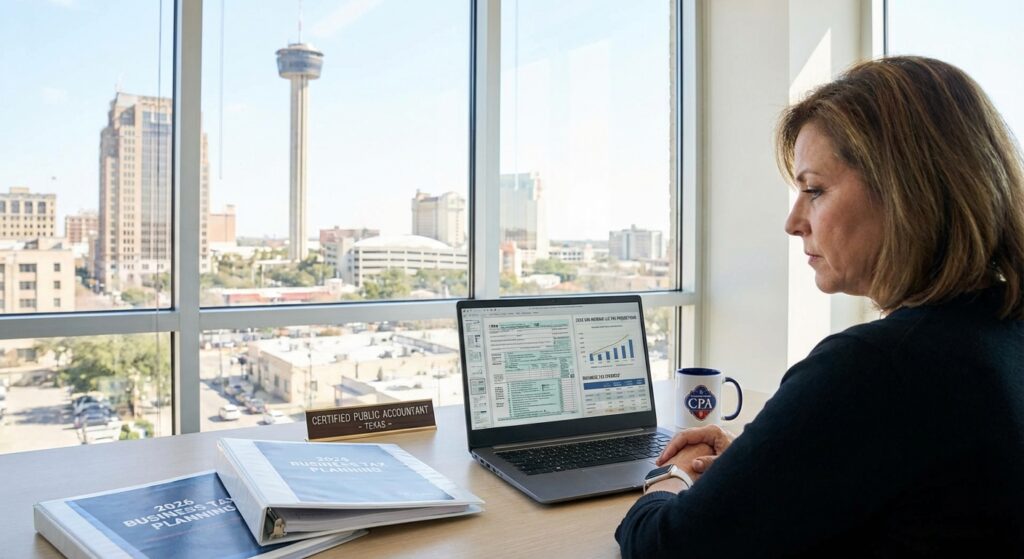
San Antonio LLC Taxes 2026: Complete Guide to Tax Planning & Deductions
For the 2026 tax year, San Antonio LLC owners face important filing deadlines and exciting new tax deduction opportunities. The One Big Beautiful Bill Act, signed into law in July 2025, introduces significant changes that can reduce your overall tax burden. This guide covers everything you need to know about san antonio llc taxes, including federal obligations, new deductions, and practical strategies for maximizing savings.
Table of Contents
- Key Takeaways
- What Are the 2026 Filing Deadlines for San Antonio LLCs?
- How Are San Antonio LLCs Taxed?
- What New Deductions Are Available in 2026?
- What Are the 2026 Standard Deduction Amounts?
- How Can You Maximize Deductions for Your San Antonio LLC?
- What Is the Qualified Business Income (QBI) Deduction?
- What Are the Penalties for Late Filing in 2026?
- Uncle Kam in Action: Success Story
- Next Steps
- Frequently Asked Questions
- Related Resources
Key Takeaways
- April 15, 2026 is the federal deadline for filing individual tax returns including LLC owner income.
- Texas has no state income tax, making San Antonio an advantageous location for LLC owners.
- New 2026 deductions include $6,000 senior deduction, $10,000 auto loan interest deduction, and expanded SALT deduction cap of $40,000.
- LLC owners can deduct up to $12,500 in qualified overtime pay or $25,000 in tips annually.
- The QBI deduction allows eligible LLC owners to deduct 20% of qualified business income.
What Are the 2026 Filing Deadlines for San Antonio LLCs?
Quick Answer: The primary filing deadline for 2026 is April 15 for individual returns. Partnership and S corp returns have a March 16 deadline. No state deadline exists in Texas since there is no state income tax.
For 2026, San Antonio LLC owners must navigate federal tax deadlines established by the IRS. The most critical date is April 15, 2026, which applies to individual tax returns filed by LLC owners reporting their share of business income. This deadline applies whether you filed a Form 1040 or another individual return format.
If your LLC is classified as an S corporation, the deadline shifts to March 16, 2026 for filing Form 1120-S with the IRS. Partnership returns (Form 1065) also follow the March 16 deadline if your LLC is multi-member and has elected partnership taxation.
Why Texas Location Matters for Your San Antonio LLC Taxes
Texas offers a significant tax advantage: there is no state income tax. Unlike states such as California, New York, or Illinois, San Antonio-based LLC owners avoid state-level income taxation entirely. This means your primary tax focus is federal compliance, reducing overall complexity and allowing more flexibility in tax planning strategies.
However, Texas does impose a franchise tax on LLCs in certain situations. Generally, LLCs with annual revenue exceeding specific thresholds must file a Texas Franchise Tax Report. Consult with professional tax advisors to determine if your San Antonio LLC meets these filing requirements, as the Texas Comptroller’s rules apply to businesses operating in the state.
Planning for the April 15, 2026 Deadline
You have three options as April 15, 2026 approaches: file by the deadline, request a six-month extension using Form 4868, or use professional tax preparation services. Many San Antonio LLC owners work with San Antonio tax preparation specialists to ensure accurate filing and maximize deductions before the deadline.
| 2026 Tax Deadline | Filing Type | Description |
|---|---|---|
| March 16, 2026 | Form 1120-S | S corp returns (LLC taxed as S corp) |
| March 16, 2026 | Form 1065 | Partnership returns (multi-member LLC) |
| April 15, 2026 | Form 1040 | Individual returns (sole proprietor LLC) |
Pro Tip: Request an extension if you need more time. File Form 4868 by April 15, 2026, to receive a six-month extension, pushing the deadline to October 15, 2026.
How Are San Antonio LLCs Taxed?
Quick Answer: By default, single-member LLCs are taxed as sole proprietorships, and multi-member LLCs are taxed as partnerships. You can elect S corp or C corp taxation for greater tax planning flexibility.
San Antonio LLC owners have significant flexibility in how their business is taxed. The IRS uses a “default” tax classification based on the number of members, but you can elect a different classification to optimize your tax situation for 2026.
Default Tax Classification for San Antonio LLCs
If you have not made an election, your LLC is automatically taxed as follows: A sole-member LLC is treated as a self-employed sole proprietorship, requiring you to file Schedule C with your individual Form 1040. A multi-member LLC is treated as a partnership, requiring the filing of Form 1065 with each member receiving a Schedule K-1 showing their share of income and deductions.
Both default classifications allow you to pass business income through to your personal tax return. This pass-through structure means the LLC itself does not pay income tax; instead, you report your share on your individual return and pay tax at your personal rate.
Electing S Corp Taxation for Greater Tax Savings
Many San Antonio LLC owners strategically elect S corporation taxation using Form 2553. This election allows you to reduce self-employment tax liability. Under S corp rules, you must pay yourself “reasonable compensation” as a W-2 salary, but profits beyond that salary can be distributed as dividends, avoiding the 15.3% self-employment tax on that portion.
For example, if your LLC earns $120,000 in profit, you might pay yourself $70,000 in W-2 wages (subject to payroll taxes) and distribute $50,000 in dividends (not subject to self-employment tax), saving approximately $7,500 in self-employment taxes annually for the 2026 tax year.
Did You Know? The IRS closely scrutinizes S corp reasonable compensation. Your W-2 salary must reflect what someone in your position would be paid in the industry. Uncle Kam’s tax strategists help San Antonio business owners optimize this balance for maximum compliance and savings in 2026.
What New Deductions Are Available in 2026?
Quick Answer: The One Big Beautiful Bill Act introduced four major new deductions for 2026: a senior deduction of $6,000, auto loan interest deduction of $10,000, overtime pay deduction of $12,500 (or $25,000 for joint filers), and tips income deduction of $25,000.
The One Big Beautiful Bill Act, signed into law in July 2025, dramatically expanded available deductions for the 2026 tax year. These new deductions apply to individuals, but understanding them is critical for LLC owners who may qualify personally or who employ team members who benefit from these incentives.
Senior Deduction: $6,000 for Taxpayers 65 and Older
If you are 65 or older in 2026, you can claim an additional $6,000 deduction on top of your standard deduction. Married couples filing jointly can each claim the deduction, totaling $12,000. The deduction applies to your entire income, not just Social Security, providing significant tax relief for senior business owners in San Antonio.
This deduction is available through the 2028 tax year and phases out for higher-income earners: single filers with modified adjusted gross income over $75,000 or married filing jointly with income over $150,000 begin losing eligibility.
Auto Loan Interest Deduction: Up to $10,000 for US-Assembled Vehicles
For 2026, you can deduct up to $10,000 in interest paid on loans used to purchase new, US-assembled vehicles. This deduction only applies to vehicles assembled in the United States. To verify your vehicle’s eligibility, check the 17-digit Vehicle Identification Number (VIN) using the NHTSA VIN decoder to confirm US manufacturing.
This deduction can be claimed in addition to your standard deduction. If you financed a Tesla, Ford F-150, or other US-manufactured vehicle in 2025 and paid interest in 2026, this deduction may apply.
Overtime Pay Deduction: $12,500 Per Return ($25,000 Joint)
Workers who earned qualified overtime pay in 2026 can deduct up to $12,500 per individual return, or $25,000 for married couples filing jointly. This deduction phases out for higher-income taxpayers, making it most valuable for middle-class workers. If your employees received overtime compensation in 2026, they can now reduce their taxable income through this new deduction.
Tips and No-Tax-On-Tips Deduction: Up to $25,000 Annually
Tipped workers in San Antonio (servers, bartenders, delivery drivers) can deduct up to $25,000 in tips earned in 2026 from federal income tax. This deduction only applies to certain types of employment where tipping is customary. If you operate a restaurant, bar, or service business, inform employees about this valuable new deduction.
| 2026 New Deduction | Maximum Amount | Eligibility |
|---|---|---|
| Senior Deduction | $6,000 ($12,000 MFJ) | Age 65+ (through 2028) |
| Auto Loan Interest | $10,000 | US-assembled vehicle loans |
| Overtime Pay | $12,500 ($25,000 MFJ) | Workers earning overtime |
| Tips Income | $25,000 | Tipped employees (eligible occupations) |
Pro Tip: To claim these new deductions on your 2026 tax return, you’ll need the newly created Schedule 1-A. This form allows you to document your eligibility for senior, overtime, and tips deductions separately from your main tax return.
What Are the 2026 Standard Deduction Amounts?
Quick Answer: For the 2026 tax year, the standard deductions are $15,750 for single filers, $31,500 for married filing jointly, and $23,625 for heads of household—up from 2025 amounts due to inflation adjustments.
The IRS adjusts standard deductions annually for inflation. For 2026, all taxpayers receive significantly higher standard deductions compared to 2025. These increases mean many San Antonio LLC owners will reduce their taxable income substantially, even before applying business deductions.
Understanding standard deductions is essential for sole proprietors and those with minimal business deductions. When your standard deduction exceeds your itemized deductions (such as SALT, mortgage interest, or charitable contributions), claiming the standard deduction provides greater tax savings.
2026 Standard Deduction Breakdown by Filing Status
- Single Filers: $15,750 for the 2026 tax year
- Married Filing Jointly: $31,500 for the 2026 tax year
- Head of Household: $23,625 for the 2026 tax year
- Married Filing Separately: $15,750 for the 2026 tax year
Itemize or Take the Standard Deduction?
For 2026, the IRS temporarily raised the SALT (State and Local Tax) deduction cap to $40,000 (from $10,000). This expansion means high-income San Antonio residents with substantial property taxes may benefit from itemizing deductions. However, most llc owners find the standard deduction sufficient, especially with the 2026 increases and new deductions available.
Calculate both options: total your itemized deductions (SALT, mortgage interest, charitable donations) and compare to the standard deduction. Whichever amount is higher reduces your taxable income further.
How Can You Maximize Deductions for Your San Antonio LLC?
Quick Answer: Track all business expenses (home office, supplies, travel, utilities, professional fees), apply the QBI deduction (20% of qualified business income), and optimize your entity classification to maximize deductions and minimize taxes for 2026.
Maximizing LLC deductions requires systematic tracking and strategic planning. Unlike employees, business owners can deduct ordinary and necessary business expenses, reducing taxable income dollar-for-dollar. This creates substantial savings compared to earning the same income as a W-2 employee.
Core Business Deductions for 2026
All LLC owners can deduct legitimate business expenses. Common deductions include office rent or home office expenses (using the simplified method: $5 per square foot, maximum 300 square feet, or actual expense method), supplies and equipment under $2,500, internet and phone costs, professional services (accounting, legal, consulting), insurance premiums, vehicle and mileage expenses, and continuing education for business skills.
Track every expense meticulously. The IRS requires documentation supporting all deductions. For 2026, maintain receipts, invoices, and records proving business purpose and necessity. Digital expense tracking tools make this process manageable year-round.
The Home Office Deduction: Two Methods Compared
If you operate your San Antonio LLC from a dedicated home office, claim either the simplified method or actual expense method. The simplified method allows $5 per square foot (maximum $1,500). If your office occupies 250 square feet, your deduction is $1,250 for 2026. The actual expense method requires calculating your home’s total expenses (utilities, mortgage interest, property tax, insurance, repairs) and applying the percentage of space dedicated to business. For a $20,000 annual home cost with a 10% business office, your deduction is $2,000.
Pro Tip: Choose the method that yields the higher deduction. The IRS Publication 587 on home office deductions provides detailed guidance. Many San Antonio LLC owners find the simplified method easier for compliance in 2026.
What Is the Qualified Business Income (QBI) Deduction?
Quick Answer: The QBI deduction allows eligible LLC owners to deduct 20% of qualified business income on top of standard deductions, subject to income phase-out limits. For 2026, married couples filing jointly with taxable income under $364,200 generally qualify.
Introduced by the Tax Cuts and Jobs Act and continuing through 2026, the Qualified Business Income (QBI) deduction provides a significant tax break for LLC owners. If your LLC qualifies, you can deduct 20% of your qualified business income, effectively reducing your taxable income substantially.
Example: Your San Antonio LLC generates $100,000 in taxable income for 2026. Your QBI deduction is 20% × $100,000 = $20,000. Your taxable income drops to $80,000, potentially saving $4,000-$7,500 in federal taxes (depending on your bracket).
QBI Eligibility Requirements for 2026
- Your LLC must be a “qualified business” (not investment activities or passive holdings).
- You must have qualified business income (net profit from active business operation).
- Taxable income must be below the phase-out threshold: $364,200 for married filing jointly or $182,100 for single filers.
- W-2 wage and property limitations apply to higher-income taxpayers above the phase-out threshold.
QBI Calculation Example for San Antonio LLC
Maria owns a consulting LLC in San Antonio with $150,000 net profit. Her taxable income is $150,000. Maria is below the phase-out threshold for 2026, so she qualifies for the full 20% QBI deduction: 20% × $150,000 = $30,000. Her deductible QBI amount is $30,000, reducing her taxable income to $120,000. At a 24% tax bracket, this saves her $7,200 in federal taxes.
What Are the Penalties for Late Filing in 2026?
Quick Answer: Late filing penalties for 2026 range from $60 (within 30 days late) to $680 (intentional disregard), assessed per return. Additional failure-to-pay penalties are 0.5% monthly, reaching 25% maximum.
Missing the April 15, 2026 deadline without filing an extension incurs significant penalties. The IRS imposes strict late-filing penalties that escalate based on timing and intent. For San Antonio LLC owners, understanding these penalties underscores the importance of meeting deadlines or requesting extensions timely.
2026 Late Filing Penalty Schedule
| Filing Timeliness | Penalty Per Return | Description |
|---|---|---|
| Within 30 days late | $60 | Filed after April 15 but by May 15, 2026 |
| 30+ days but before Aug 1 | $130 | Filed May 16 through July 31, 2026 |
| After August 1 | $340 | Filed August 1, 2026 or later |
| Intentional disregard | $680 | Deliberate failure to file (no maximum limit) |
Avoid Penalties: File on Time or Extend
To avoid penalties, meet the April 15, 2026 deadline or file Form 4868 requesting an extension by that date. Extensions grant six additional months (until October 15, 2026) to file without penalty. However, extensions do not extend the deadline for paying taxes owed. If you owe taxes, they remain due April 15, 2026, regardless of filing extension.
The IRS charges interest on unpaid taxes at the federal funds rate plus 3% annually. Late payment penalties also apply: 0.5% monthly on unpaid taxes (maximum 25%). These compounds quickly, making timely filing or extension critical.
Pro Tip: Even if you cannot pay immediately, file your return by April 15 (or request an extension). The failure-to-file penalty (5% per month) far exceeds the failure-to-pay penalty (0.5% per month). Professional tax preparation services can help you navigate payment plans with the IRS if needed.

Uncle Kam in Action: San Antonio LLC Owner Saves $28,400 Through Strategic Tax Planning
Client Snapshot: David is a 58-year-old technology consultant in San Antonio who operates a single-member LLC generating $180,000 in annual revenue.
Financial Profile: $180,000 annual LLC revenue, $120,000 net profit after business deductions, married filing jointly with combined household income of $220,000.
The Challenge: David was treating his LLC as a default pass-through entity and paying full self-employment tax (15.3%) on all $120,000 profit. He was also missing potential deductions and not optimizing his tax structure for 2026. His previous CPA had simply reported the income without strategic planning, costing him thousands annually in unnecessary taxes.
The Uncle Kam Solution: Our team conducted a comprehensive tax strategy analysis. We elected S corporation taxation for David’s LLC, requiring him to pay himself $75,000 in W-2 wages (reasonable for his consulting expertise) and distribute $45,000 as tax-free dividends. We maximized his home office deduction (verified 15% business use), documented $8,000 in vehicle mileage at $0.67 per mile, and identified $3,200 in overlooked professional development expenses. Additionally, David qualified for the full Qualified Business Income (QBI) deduction: 20% × $120,000 = $24,000 deductible benefit.
The Results:
- Tax Savings: $28,400 in first-year tax savings (self-employment tax reduction of $6,885 + S corp structure benefits + QBI deduction value of $21,515)
- Investment: $2,500 one-time consulting fee to implement the strategy and set up S corp election
- Return on Investment (ROI): 11.4x return on investment in the first 12 months alone
This is just one example of how our proven tax strategies have helped San Antonio business owners achieve significant savings and financial peace of mind. David now reinvests his tax savings into growing his LLC and building wealth.
Next Steps
Take these actions immediately to optimize your San Antonio LLC taxes for 2026:
- ☐ Review your current LLC tax classification (sole proprietor, partnership, S corp, or C corp) and determine if an election would save taxes.
- ☐ Organize all 2026 business expenses (receipts, invoices, mileage logs) to maximize deductions before April 15 tax deadline.
- ☐ Calculate your potential Qualified Business Income (QBI) deduction and confirm eligibility based on income thresholds.
- ☐ Verify if you qualify for any of the four new 2026 deductions (senior, auto loan interest, overtime, or tips).
- ☐ Schedule a consultation with San Antonio tax preparation specialists to develop a personalized 2026 tax strategy and ensure compliance before the April 15, 2026 deadline.
Frequently Asked Questions
When Is the Deadline to File San Antonio LLC Taxes for 2026?
The primary deadline is April 15, 2026, for individual returns. If you elected S corporation taxation, the deadline is March 16, 2026. You can file an extension by April 15 to extend the deadline six months (to October 15, 2026) without penalty, though taxes owed remain due April 15.
Does Texas Tax LLC Income?
No. Texas has no state income tax, so your LLC income is only subject to federal taxation. This makes San Antonio an advantageous location for business owners. However, Texas imposes a franchise tax on LLCs exceeding certain revenue thresholds. Consult a tax professional to confirm if your specific LLC meets Texas franchise tax filing requirements for 2026.
Can I Deduct My Home Office for My San Antonio LLC?
Yes. You can claim home office deductions using either the simplified method ($5 per square foot, max 300 sq ft = $1,500 max) or actual expense method. The simplified method requires less documentation, making it popular for 2026. You must have a dedicated space used exclusively for business to qualify.
What Is the QBI Deduction, and Do I Qualify for 2026?
The Qualified Business Income (QBI) deduction allows LLC owners to deduct 20% of qualified business income. You generally qualify for 2026 if your taxable income is below $364,200 (married filing jointly) or $182,100 (single). Above these thresholds, special wage and property limitations apply. Consult a tax advisor to confirm your specific situation.
Should I Elect S Corporation Taxation for My San Antonio LLC?
S corporation election can reduce self-employment tax significantly if your LLC generates substantial profit. You’ll pay W-2 wages (subject to payroll tax) on reasonable compensation, then distribute profits as dividends (avoiding 15.3% self-employment tax). However, this requires payroll processing and added compliance. For LLCs earning under $60,000 profit, the default pass-through structure often is more efficient. Consult a tax professional to analyze your specific scenario.
Are There New Deductions Available for 2026?
Yes. The One Big Beautiful Bill Act introduced four major new deductions for 2026: senior deduction ($6,000 for age 65+), auto loan interest ($10,000 for US-assembled vehicles), overtime pay ($12,500 or $25,000 joint), and tips income ($25,000). You claim these using the newly created Schedule 1-A form.
What Happens If I Miss the April 15, 2026 Tax Deadline?
Late filing penalties escalate: $60 within 30 days late, $130 after 30 days but before August 1, $340 after August 1, and $680 for intentional disregard. Additional failure-to-pay penalties of 0.5% monthly (max 25%) apply to unpaid taxes. File Form 4868 by April 15 to request a six-month extension penalty-free.
How Much Is Self-Employment Tax for LLC Owners in 2026?
Self-employment tax is 15.3% (12.4% Social Security + 2.9% Medicare) on net LLC profit. For example, $80,000 net profit generates approximately $11,304 in self-employment tax. You can deduct half ($5,652) above the line on your tax return. Electing S corporation taxation can reduce this significantly by splitting income into wages (subject to payroll tax) and distributions (avoiding self-employment tax).
Do I Need to File Federal and State Taxes for My San Antonio LLC?
You must file federal taxes (Form 1040, 1065, 1120-S, or 1120 depending on classification). Texas has no state income tax, so no state income tax return is required. However, you may need to file a Texas Franchise Tax Report if your LLC’s revenue exceeds certain thresholds. Check Texas Comptroller requirements or consult a tax professional to confirm obligations.
Related Resources
- Comprehensive Tax Strategy Services for San Antonio Business Owners
- LLC Entity Setup and Tax Classification Optimization
- Professional Tax Preparation and Filing Services
- IRS Small Business and Self-Employed Resources
- IRS Forms and Publications for 2026 Tax Year
This information is current as of 02/03/2026. Tax laws change frequently. Verify updates with the IRS (IRS.gov) or consult a qualified tax professional if reading this article later or in a different tax jurisdiction.
Last updated: February, 2026

