
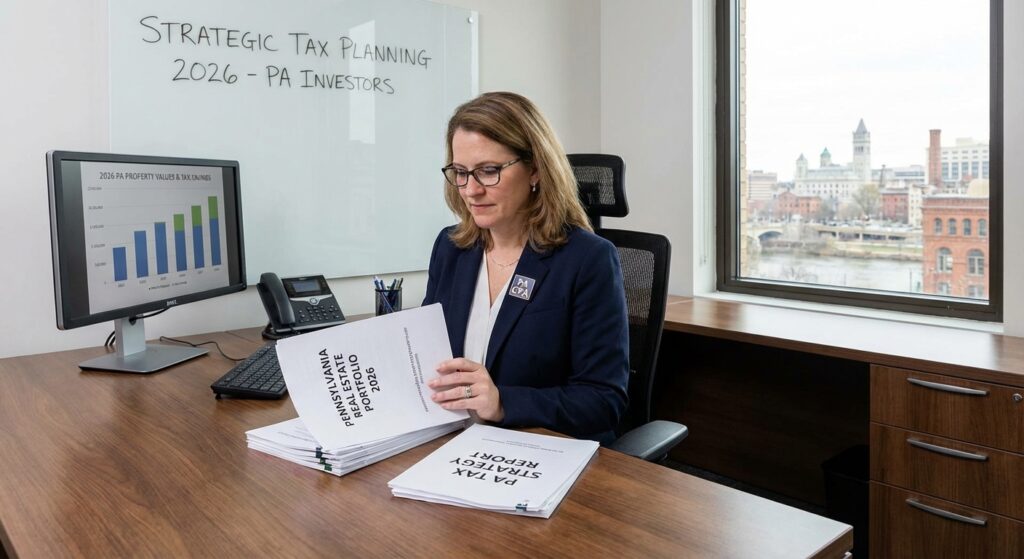
Real Estate CPA Cost in Pennsylvania: 2026 Tax Deductions & ROI Guide
Table of Contents
- Key Takeaways
- What Are CPA Fees and Why Do Real Estate Investors Need Them?
- Are Real Estate CPA Costs Tax Deductible?
- How Much Does a CPA Cost for Real Estate Investors?
- What Are Pennsylvania Real Estate Tax Benefits for Investors?
- Cost Segregation and Accelerated Depreciation Strategies
- Uncle Kam in Action
- Next Steps
- Frequently Asked Questions
Key Takeaways
- Real estate CPA fees are fully deductible as ordinary business expenses for rental properties in 2026.
- Pennsylvania investors can leverage SALT deduction increases up to $40,000 for significant tax savings.
- Cost segregation studies can accelerate depreciation and create immediate tax deductions.
- Professional CPA services typically pay for themselves multiple times over through tax optimization.
- Pennsylvania’s relative affordability makes real estate investing attractive but requires strategic tax planning.
What Are CPA Fees and Why Do Real Estate Investors Need Them?
Quick Answer: CPA (Certified Public Accountant) fees are professional charges for tax preparation, accounting services, and financial planning. Real estate investors need CPAs to maximize deductions, ensure compliance, and optimize their tax strategy for 2026.
Real estate investors in Pennsylvania face complex tax situations that go far beyond simple tax return filing. When you own rental properties, commercial buildings, or investment portfolios, the IRS requires detailed documentation, multiple forms, and strategic planning to minimize your tax liability legally.
A CPA specializing in real estate taxation brings expert knowledge about 2026 tax laws, Pennsylvania-specific regulations, and strategies to reduce your taxable income. They understand depreciation schedules, cost segregation analysis, and property expense categorization—critical elements that many real estate investors miss when trying to handle their taxes independently.
For rental property owners, a CPA becomes essential when your portfolio generates significant rental income, involves multiple properties, or qualifies for special real estate professional status. The complexity of tracking expenses, calculating depreciation correctly, and ensuring compliance with IRS regulations makes professional guidance invaluable in 2026.
Why Real Estate Investors Need CPA Services Beyond Basic Tax Filing
Real estate investing creates multiple tax situations that require specialized knowledge. You must track acquisition costs, improvements, repairs versus capital improvements, depreciation, passive loss limitations, and state-specific regulations. A CPA ensures every legitimate deduction is captured and properly documented for IRS audit defense.
Beyond tax return preparation, CPAs provide strategic planning—advising on entity structure selection (LLC, S-Corp, C-Corp), timing of property sales, 1031 exchange strategies, and multi-year tax planning. This forward-looking approach often saves far more in taxes than the CPA’s fee costs.
Common Services CPAs Provide for Real Estate Investors
- Tax return preparation (Form 1040 Schedule E, Form 1065, Form 1120-S)
- Depreciation scheduling and recapture calculations
- Cost segregation studies and analysis
- Quarterly estimated tax planning and management
- Entity structure optimization for tax efficiency
- Passive activity loss tracking and planning
- 1031 exchange documentation and reporting
Are Real Estate CPA Costs Tax Deductible?
Quick Answer: Yes. CPA fees for managing rental properties and preparing tax returns related to real estate business are fully deductible as ordinary and necessary business expenses under IRS Publication 334 for 2026.
The IRS treats CPA fees as legitimate business expenses when they directly relate to managing your rental property business. This means the portion of your CPA’s bill attributable to real estate tax preparation, accounting services, and consulting is fully deductible from your rental income.
For Schedule E rental property reporting, CPA fees are deducted as “professional fees” on the tax return itself, reducing your taxable rental income dollar-for-dollar. If you own a real estate business structured as an S-Corporation or partnership, these fees appear on your business return (Form 1120-S or Form 1065).
The key requirement is that the CPA services must be directly related to your rental property business. Personal tax planning unrelated to real estate or investment advisory services may have different treatment.
How to Document CPA Fees for Tax Deduction
Maintain detailed invoices from your CPA showing specific services rendered. Your invoice should itemize work such as “rental property tax return preparation,” “depreciation scheduling,” or “1031 exchange consultation.” Keep these receipts with your property documentation for at least seven years, as the IRS has broad statute of limitations for real estate transactions.
If your CPA bill includes personal tax planning unrelated to real estate, ask for an itemized invoice separating real estate professional fees from other services. Only the real estate portion is deductible.
How Much Does a CPA Cost for Real Estate Investors?
Quick Answer: CPA fees for real estate investors in Pennsylvania typically range from $1,500 to $5,000+ annually, depending on property count, complexity, and services required. Costs often pay for themselves through tax deductions and planning strategies.
Real estate CPA fees vary significantly based on several factors. Pennsylvania CPAs typically charge hourly rates between $150 and $400 per hour, or flat fees for specific services. Your total cost depends on the complexity of your situation.
Factors Affecting CPA Cost for Real Estate Investors
| Factor | Impact on CPA Fees |
| Number of Properties | 1-2 properties: $1,500-$2,500 | 3-5 properties: $2,500-$4,000 | 5+ properties: $4,000+ |
| Entity Type | Solo Schedule E: $1,500-$2,000 | LLC/Partnership: $2,500-$4,000 | S-Corp: $3,000-$5,000+ |
| Expense Complexity | Simple: $1,500-$2,000 | Complex (renovations, cost segregation): $3,000-$5,000+ |
| CPA Experience Level | General CPA: $1,500-$2,500 | Real estate specialist: $2,500-$5,000+ |
For Pennsylvania investors with 2-3 rental properties and straightforward income, expect to pay $2,000-$3,500 annually. This typically includes tax return preparation, depreciation scheduling, and basic tax planning.
Breaking Down Real Estate CPA Services and Their Costs
A typical engagement breakdown for a Pennsylvania real estate investor might include: tax return preparation ($800-$1,200), depreciation scheduling ($300-$500), estimated tax planning ($200-$400), and entity optimization consulting ($500-$1,000). Additional services like cost segregation studies add $2,000-$5,000 but provide multi-year tax benefits.
Many CPAs offer monthly retainer arrangements ($300-$600/month) for ongoing bookkeeping, tax planning, and quarterly estimated tax updates. This predictable fee structure works well for investors managing growing portfolios.
Pro Tip: A quality CPA typically saves investors 3-5x their fee through optimized deductions and tax planning. If your CPA costs $3,000 annually but saves $10,000+ in taxes, that’s an exceptional investment with an immediate 333% return.
What Are Pennsylvania Real Estate Tax Benefits for Investors?
Quick Answer: Pennsylvania real estate investors benefit from federal SALT deductions up to $40,000 in 2026, depreciation write-offs, and Pennsylvania-specific property tax relief programs that reduce overall investment costs.
Pennsylvania offers significant tax advantages for real estate investors beyond basic deductions. The state’s relative affordability compared to surrounding northeastern states creates excellent investment opportunities, and strategic tax planning amplifies these returns.
Major Tax Benefits for Pennsylvania Real Estate Investors in 2026
The expanded SALT (State and Local Tax) deduction represents the single largest benefit for Pennsylvania investors. For 2026, the SALT cap increased from $10,000 to $40,000, allowing high-income investors to deduct substantially more in property taxes, income taxes, and sales taxes on investment properties.
Pennsylvania real estate investors can claim depreciation deductions on rental properties, which write off the building cost (not land) over 27.5 years. This creates substantial tax deductions even when the property appreciates in value. A $300,000 residential rental building generates approximately $10,909 in annual depreciation deductions for 2026.
Investor deductions include all ordinary business expenses: property taxes, insurance, utilities, maintenance, repairs, advertising, property management fees, and mortgage interest. Pennsylvania investors can also deduct a home office if they manage their properties professionally.
Pennsylvania-Specific Programs and Incentives
Pennsylvania’s housing market remains affordable relative to other northeastern states, with median home prices significantly lower than New Jersey, New York, or Massachusetts. This affordability advantage means investment returns often exceed other states when combined with strategic tax planning.
The state offers various property-assessed clean energy (PACE) financing programs for commercial real estate improvements. These programs enable developers to finance energy-efficient upgrades creating tax deductions while reducing operating costs.
Cost Segregation and Accelerated Depreciation Strategies
Quick Answer: Cost segregation studies reclassify building components into shorter depreciation periods, accelerating deductions. For 2026, a $2 million property investment can generate $100,000+ in first-year deductions through proper cost segregation analysis.
Cost segregation represents one of the most powerful tax strategies available to real estate investors. By separating building components into specific categories, CPAs can depreciate certain elements over 5, 7, or 15 years instead of the standard 27.5 years for residential or 39 years for commercial properties.
Pennsylvania investors with significant real estate holdings benefit enormously from cost segregation. A $1 million property investment might include $100,000-$150,000 in personal property (fixtures, equipment, systems) and $50,000-$100,000 in land improvements both depreciable at accelerated rates.
How Cost Segregation Works for Pennsylvania Real Estate
A qualified CPA or cost segregation specialist conducts a detailed property analysis, identifying depreciable components. Fixtures like built-in shelving, lighting systems, and HVAC components depreciate over 5-7 years. Landscaping and site improvements depreciate over 15 years. This component breakdown creates accelerated depreciation schedules.
The benefit: Instead of spreading depreciation evenly over decades, investors capture larger deductions immediately. A $1 million property properly analyzed might generate $25,000-$40,000 in additional first-year deductions, directly reducing taxable income and potentially creating passive loss carryforwards.
Did You Know? Cost segregation studies typically cost $3,000-$8,000 but generate tax savings of $25,000-$100,000+ over the property holding period. Many investors recoup the study cost in the first year through accelerated depreciation deductions.

Uncle Kam in Action: Pennsylvania Real Estate Investor Saves $18,500 with Strategic CPA Guidance
Client Snapshot: Michael, a 38-year-old real estate investor in Pittsburgh, owned 4 rental properties generating $95,000 in annual rental income. He had been filing taxes independently for 5 years, missing deductions and managing his properties inefficiently.
Financial Profile: Annual rental income: $95,000 | Total property value: $1.8 million | Mortgage debt: $1.2 million | W-2 income: $60,000
The Challenge: Michael was paying approximately $18,000 in annual federal taxes on his rental income, thinking he had optimized his deductions. However, he was missing significant depreciation benefits, had never conducted a cost segregation study, and wasn’t leveraging Pennsylvania’s expanded SALT deduction for his property taxes.
The Uncle Kam Solution: Our team conducted a comprehensive tax analysis and cost segregation study on Michael’s 4 properties. We identified $8,500 in previously uncaptured depreciation deductions, structured his properties for maximum cost segregation benefits, and optimized his entity structure from individual ownership to an LLC. We also reviewed all property expenses, discovering an additional $4,200 in deductible maintenance costs he had incorrectly categorized as capital improvements.
The Results:
- Tax Savings: $18,500 in reduced federal tax liability in Year 1 through depreciation optimization and cost segregation
- Investment: A one-time investment of $5,200 for cost segregation study and first-year CPA services of $3,500
- Return on Investment (ROI): 223% return on investment in Year 1 alone, with continuing benefits in subsequent years
Michael’s continued relationship with our firm now provides ongoing tax optimization, estimated quarterly tax planning, and strategic advice as his portfolio grows. This is just one example of how professional real estate CPA guidance for real estate investors consistently delivers returns far exceeding the professional investment.
Next Steps
Now that you understand how real estate CPA costs work and the tax benefits available, take action to maximize your investment returns:
- Gather your property documentation: Collect all purchase agreements, mortgage statements, utility bills, maintenance receipts, and insurance documentation from 2025. This inventory ensures your CPA captures every deduction.
- Identify your entity structure: Review how your properties are currently owned (individual, LLC, partnership, or corporation). A CPA can evaluate whether your structure optimizes for Pennsylvania taxes in 2026.
- Evaluate cost segregation eligibility: If your properties are larger investments or recently acquired, a cost segregation analysis typically provides significant first-year deductions that pay for the study cost.
- Schedule a consultation: Meet with a real estate-focused CPA in your area to review your current tax situation. Many provide free initial consultations to evaluate potential savings.
- Implement quarterly tax planning: Set up regular tax planning meetings (quarterly or semi-annually) to track your estimated tax liability and adjust withholding appropriately for 2026.
Frequently Asked Questions
Can I deduct my CPA fees even if I use a self-directed IRA for real estate investing?
CPA fees for personally-owned real estate are deductible on your individual tax return. However, fees attributable to your self-directed IRA must be paid by the IRA itself (not deductible to you personally) under IRS regulations. Consult with your CPA about properly allocating fees between personal real estate and IRA-owned properties.
Are Pennsylvania state income tax fees for real estate also deductible on my federal return?
Yes. If a CPA bill includes fees for preparing your Pennsylvania state real estate tax return (PA-41), this portion is also deductible as a business expense. The SALT deduction cap of $40,000 for 2026 includes state income tax payments, so ensure your CPA accounts for this benefit when calculating total Pennsylvania tax liability.
What happens if I didn’t hire a CPA for previous years? Can I correct my tax returns?
Yes. You can file amended returns (Form 1040-X) for up to three prior years to claim missed deductions. A real estate CPA can help identify depreciation deductions, cost segregation opportunities, and business expense deductions from previous years. The statute of limitations typically allows recovery of substantial prior-year tax savings.
Does hiring a CPA guarantee I won’t be audited on my real estate taxes?
No, but a qualified CPA significantly reduces audit risk. CPAs use reasonable positions supported by IRS guidelines, maintain proper documentation, and calculate depreciation correctly. If audited, your CPA provides representation and documentation to defend your deductions. Many CPAs offer audit defense and representation services as part of their fees.
Can a CPA help me determine if I qualify for real estate professional status?
Absolutely. Real estate professional status (defined by IRS rules requiring material participation and specific hour requirements) unlocks significant passive loss deductions. A CPA evaluates your situation against IRS regulations and helps document your qualifying activities. If you qualify, this status can dramatically reduce your tax liability.
What’s the difference between a CPA and a tax preparer for real estate investment taxes?
A CPA (Certified Public Accountant) holds a professional license requiring specific education, testing, and experience. CPAs provide tax strategy, accounting, and audit representation. A tax preparer may be unlicensed or less experienced. For complex real estate situations, a CPA typically provides better deduction optimization and protection against audit challenges in 2026.
Related Resources
- Real Estate Investor Tax Solutions
- Entity Structuring for Maximum Tax Benefits
- Tax Advisory Services for Investors
- Comprehensive Tax Preparation and Filing
- IRS Publication 527: Residential Rental Property
This information is current as of February 2, 2026. Tax laws change frequently. Verify updates with the IRS or a tax professional if reading this later.
Last updated: February, 2026

