
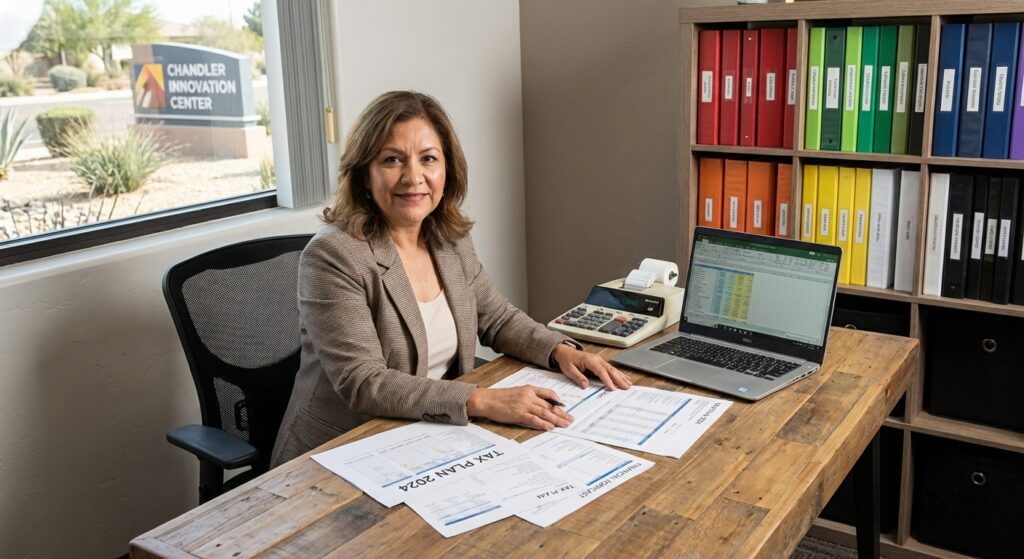
Complete Guide to Chandler Small Business Tax Planning for 2026
For the 2026 tax year, Chandler small business tax planning has become more strategic than ever. With the One Big Beautiful Bill Act reshaping federal tax incentives and Arizona introducing new personal property tax exemptions, business owners have access to unprecedented opportunities. Whether you’re a solopreneur, LLC owner, or multi-employee operation, understanding these 2026 tax changes—and how they apply specifically to your Chandler business—could save you thousands in unnecessary taxes. This guide walks you through the most impactful strategies, deadlines, and deductions available right now.
Table of Contents
- Key Takeaways
- What Are the New 2026 Federal Tax Deductions for Small Business?
- How Can Arizona Business Owners Leverage State Tax Benefits in 2026?
- What Entity Structure Will Save Your Chandler Business the Most Taxes?
- How Can You Maximize Home Office and Business Deductions in 2026?
- What Retirement Strategies Save Small Business Owners the Most on Taxes?
- What Are the Specific Tax Planning Considerations for Chandler Businesses?
- Uncle Kam in Action: Local Success Story
- Next Steps
- Frequently Asked Questions
Key Takeaways
- 2026 brings new deductions for overtime pay (up to $25,000 for joint filers) and tipped income ($25,000 annually).
- Arizona’s $500,000 personal property tax exemption (effective January 1, 2026) provides significant relief for small businesses.
- S-Corp election can save self-employed business owners 15.3% on self-employment tax through reasonable salary strategies.
- SALT deduction cap increased to $40,000 for 2026, benefiting high-earning Chandler business owners.
- Filing deadline for partnerships and S corporations is March 16, 2026; individual returns due April 15, 2026.
What Are the New 2026 Federal Tax Deductions for Small Business?
Quick Answer: The One Big Beautiful Bill Act created new deductions for overtime pay, tips, and social security income that could save eligible Chandler business owners significant tax liability in 2026.
The 2026 tax filing season marks the first year businesses can leverage deductions introduced under the One Big Beautiful Bill Act. These new tax provisions offer substantial savings for business owners who qualify, particularly those with fluctuating income or employees earning tips and overtime.
The qualified overtime pay deduction allows eligible workers to deduct up to $12,500 per return for single filers, or $25,000 for joint filers, with the benefit gradually phasing out at higher income levels. This deduction is particularly valuable for contractors, service businesses, and seasonal operations in the Chandler area that frequently require overtime labor.
New Schedule 1-A and Filing Requirements
To claim these new deductions in 2026, you must file the newly created Schedule 1-A with your tax return. This schedule has been specifically designed to handle overtime pay, tips, and social security income deductions. Understanding how to properly complete this form is critical for maximizing your deduction while maintaining IRS compliance.
The tips deduction allows tipped workers and business owners to deduct up to $25,000 annually. For restaurant owners, service businesses, and hospitality operations in Chandler, this deduction can meaningfully reduce taxable income. Business owners must maintain detailed records of all tip income and ensure proper documentation to support the deduction during IRS audit.
Pro Tip: Begin tracking overtime pay and tip income now. Create separate accounting categories in your bookkeeping system to capture this income separately. This meticulous documentation will make filing Schedule 1-A effortless and provide strong support if audited.
SALT Deduction Changes Impact on Arizona Businesses
The state and local tax (SALT) deduction cap has been temporarily increased from $10,000 to $40,000 for 2026. This change directly benefits Chandler small business owners who pay substantial Arizona business taxes, property taxes, and sales taxes. Higher-income business owners in Arizona can now deduct more of these state-level expenses against federal taxable income, creating significant tax savings.
How Can Arizona Business Owners Leverage State Tax Benefits in 2026?
Quick Answer: Arizona’s new $500,000 personal property tax exemption effective January 1, 2026, combined with annual inflation adjustments, provides unprecedented tax relief for Chandler-based businesses of all sizes.
Arizona has significantly expanded business tax relief. Senate Bill 1749 increased the personal property tax exemption from the previous $269,905 level to $500,000 effective January 1, 2026. Additionally, this exemption will increase annually with inflation, providing ongoing protection against rising personal property tax assessments.
This exemption applies to business owners, manufacturers, and equipment-intensive operations throughout Arizona, including those in Chandler. Whether you operate a construction company, manufacturing facility, or service business requiring substantial equipment, this expanded exemption could eliminate personal property tax liability entirely or reduce it dramatically.
Understanding the Personal Property Tax Exemption
The $500,000 exemption applies to the first $500,000 of business personal property value. Property exceeding this threshold is still subject to personal property tax at standard Arizona rates. For most Chandler small businesses with equipment valued under $500,000, this exemption essentially eliminates personal property tax obligations entirely.
Examples of personal property that qualify for exemption include manufacturing equipment, office equipment, vehicles used in business operations, and inventory. To claim this exemption, you must file with the Maricopa County Assessor’s office and provide documentation of your business property. Many Chandler business owners overlook this exemption entirely, leaving significant tax savings on the table.
Did You Know? Arizona’s inflation adjustment means your $500,000 exemption will grow each year. By 2030, the exemption could exceed $600,000, providing expanding tax protection for your Chandler business’s equipment and property.
What Entity Structure Will Save Your Chandler Business the Most Taxes?
Quick Answer: S-Corp election can save self-employed business owners up to 15.3% through strategic salary and distribution planning, especially when combined with professional tax planning.
Choosing the right business entity structure is one of the most impactful tax planning decisions for Chandler business owners. The difference between operating as a sole proprietorship, LLC, S-Corp, or C-Corp can amount to tens of thousands in annual tax savings. Our expert entity structuring guidance helps business owners evaluate which structure makes sense for their specific situation.
For self-employed business owners with net income exceeding $60,000 annually, S-Corp election often provides the most significant tax savings. This strategy involves electing to be taxed as an S-Corporation while maintaining LLC liability protection. The business owner then pays themselves a reasonable salary (subject to payroll taxes) and takes remaining profits as distributions (not subject to self-employment tax).
S-Corp Salary vs Distribution Strategy
Here’s how the math works: Self-employment tax is 15.3% (12.4% for Social Security plus 2.9% for Medicare). By splitting income into salary and distributions, you only pay self-employment tax on the salary portion. Distributions avoid the 15.3% tax entirely.
Example: A Chandler consulting business generates $150,000 in net profit. Using the S-Corp strategy, the owner might pay themselves $75,000 salary and take $75,000 as distributions. This saves approximately $11,475 in self-employment tax annually ($75,000 × 15.3%) compared to sole proprietorship taxation.
| Business Structure | Self-Employment Tax on $150K Income | Annual Savings with S-Corp |
|---|---|---|
| Sole Proprietorship | $21,450 | — |
| S-Corp Election | $9,975 | $11,475 |
Pro Tip: The IRS requires reasonable compensation for S-Corp owner-employees. Work with a tax professional to document your reasonable salary based on industry standards, experience, and comparable wages in the Chandler market. This protects your S-Corp election from IRS challenge.
LLC vs Corporation Tax Treatment
Limited liability companies (LLCs) offer personal asset protection while providing flexibility in tax treatment. An LLC can be taxed as a sole proprietorship (single-member LLC), partnership (multi-member LLC), S-Corporation, or C-Corporation. This flexibility makes LLCs ideal for Chandler businesses seeking both liability protection and optimized tax planning.
How Can You Maximize Home Office and Business Deductions in 2026?
Quick Answer: Home-based businesses can deduct actual home office expenses or use the simplified $5 per square foot method for 2026.
Home office deductions remain one of the most commonly overlooked business tax deductions. Whether you operate a consulting practice, freelance service, or online business from your Chandler home, you can deduct legitimate business expenses including office space, utilities, and equipment.
The IRS allows two methods for calculating home office deductions. The simplified method allows $5 per square foot of dedicated office space (maximum 300 square feet, or $1,500 annually). The actual expense method requires tracking mortgage interest/rent, utilities, insurance, repairs, and depreciation allocated to the office space.
Common Deductible Home Office Expenses
- Office furniture (desks, chairs, filing cabinets)
- Computer equipment and software
- Phone and internet service (business portion)
- Office supplies and materials
- Utilities and insurance (allocated to office space)
- Professional services and subscriptions
Beyond home office expenses, Chandler business owners can deduct nearly all legitimate business expenses including vehicle mileage, client entertainment, professional development, and marketing costs. The key is maintaining meticulous records and ensuring expenses are ordinary and necessary for your specific business type.
What Retirement Strategies Save Small Business Owners the Most on Taxes?
Quick Answer: SEP-IRA and Solo 401k plans allow Chandler business owners to save $60,000+ annually in pre-tax contributions while reducing current year tax liability.
Retirement planning is one of the most powerful tax reduction tools available to business owners. Contributing to a qualified retirement plan is fully deductible, reducing your taxable income dollar-for-dollar while building retirement security. For 2026, the options available to Chandler business owners provide substantial deduction opportunities.
A Solo 401(k) is ideal for self-employed business owners without employees. This plan allows contributions up to 25% of business income (subject to IRS limits), with total annual contributions potentially exceeding $60,000 when combined with employee deferrals. A SEP-IRA (Simplified Employee Pension) allows similar contribution levels with simpler administration, making it attractive for smaller operations.
Did You Know? Business owners can make Solo 401k contributions through April 15, 2027 (with extension), allowing 2026 tax deduction flexibility well into the next year.
What Are the Specific Tax Planning Considerations for Chandler Businesses?
Quick Answer: Chandler’s growing business community faces unique considerations including water regulations, data center implications, and Maricopa County property assessment rules that directly impact tax planning.
Chandler’s business environment has unique characteristics that create tax planning opportunities and challenges. As Arizona’s fastest-growing city, Chandler attracts diverse business types—from high-tech companies to service providers to retail operations. Each faces different tax considerations.
Water-intensive businesses, data centers, and technology operations face specific regulatory and tax considerations. Recent city council decisions regarding water usage and environmental compliance can impact business deductions and tax planning strategies. Professional Chandler small business tax planning services account for these local factors when optimizing your tax position.
Maricopa County Property Assessment Rules
Arizona’s Rule B for setting limited value applies differently across county lines. In Maricopa County (where Chandler is located), the Rule B percentage for commercial property can significantly impact property tax assessments. Understanding these county-specific rules helps optimize business real estate planning.
When new construction, changes in use, or property splits occur, Rule B determines the limited value percentage. This percentage varies by county and property class. Working with tax professionals familiar with Chandler’s specific assessment methods ensures your property is assessed fairly and your tax liability is minimized.

Uncle Kam in Action: Chandler E-Commerce Business Saves $18,500 Annually with Strategic Tax Planning
Client Snapshot: Sarah operates a successful e-commerce business from her Chandler home, selling custom products online. Annual revenue reached $380,000, with net profit of approximately $95,000 before strategic tax planning.
Financial Profile: $380,000 annual revenue, $95,000 net profit, home-based operation, spouse with W-2 income of $65,000 annually.
The Challenge: Sarah had been filing as a sole proprietor, paying 15.3% self-employment tax on all net income. She wasn’t claiming home office deductions and had no retirement plan contributions. Her accountant simply filed her taxes each year without exploring optimization opportunities. Sarah knew other successful business owners were paying less in taxes and wanted to understand why.
The Uncle Kam Solution: We implemented a comprehensive tax strategy for 2026. First, we elected S-Corp taxation status, splitting Sarah’s $95,000 net income into $55,000 salary and $40,000 distributions. We established a Solo 401(k) plan, allowing $46,000 in tax-deductible contributions. We claimed home office deductions on the 400-square-foot dedicated office space ($2,000 annually using simplified method). Additionally, we documented the increased SALT deduction cap at $40,000, capturing additional Arizona business taxes and property taxes that were previously unused.
The Results:
- Self-Employment Tax Savings: $6,120 annually ($40,000 × 15.3% eliminated through S-Corp distributions)
- Solo 401(k) Contribution Savings: $13,380 in federal tax savings on $46,000 contribution (29% blended rate)
- Home Office and SALT Deduction Bonus: Additional $2,000 combined deductions
- Total Annual Tax Savings: $18,500 in year one
- Return on Investment: Uncle Kam’s fee was $3,500, resulting in a 5.3x ROI in the first year alone
This is just one example of how our proven tax strategies have helped clients achieve significant savings and financial peace of mind. Sarah now has a tax-efficient business structure, is building substantial retirement savings, and will continue saving thousands annually through 2026 and beyond.
Next Steps for Your Chandler Small Business Tax Planning
Don’t leave thousands of dollars in tax savings on the table. Here are your action items for 2026:
- Assess Your Current Entity Structure: Determine whether sole proprietorship, LLC, S-Corp, or other structure makes sense for your Chandler business. Calculate potential S-Corp savings using the formula: (50% of net business income) × 15.3%.
- Document Home Office and Personal Property: Measure dedicated office space and list all business equipment to claim 2026 deductions. Check Maricopa County Assessor website for property assessment information.
- Establish Retirement Plan: Contact a tax professional about Solo 401(k) or SEP-IRA eligibility. Contributions can be made through April 15, 2027 for 2026 tax year, so planning now is essential.
- Work With Local Expertise: Our comprehensive Chandler tax preparation services ensure you capture every deduction and benefit specific to your business and location.
- Schedule Strategy Session: Professional tax planning costs $2,000-5,000 upfront but typically saves $10,000-50,000+ annually for business owners, making it one of your best investments.
Frequently Asked Questions
What is the deadline for filing my 2026 business tax return if I’m based in Chandler?
Individual tax returns must be filed by April 15, 2026. However, partnerships and S corporations have an earlier deadline of March 16, 2026. You can request a six-month extension by filing Form 7004, but any taxes owed are still due by April 15, 2026 to avoid penalties and interest.
How much can I deduct for a home office in 2026?
You can use either the simplified method ($5 per square foot, maximum $1,500) or actual expense method. For a 400-square-foot office, simplified method gives $2,000 annually. The actual expense method allows you to deduct mortgage/rent, utilities, insurance, and depreciation allocated to office space, which is often larger if you own your home.
Should I elect S-Corp taxation for my LLC in Chandler?
S-Corp election typically makes sense when net business income exceeds $60,000-$80,000 annually. At that income level, the self-employment tax savings (15.3% on reasonable distributions) usually exceed the costs of payroll processing and additional tax filings. Have a professional analyze your specific situation before making this decision.
What is the Arizona personal property tax exemption and how do I claim it?
Arizona exempts the first $500,000 of business personal property from state property tax, effective January 1, 2026. This exemption applies to equipment, machinery, vehicles, and inventory used in business operations. You claim it by filing with the Maricopa County Assessor’s office and providing documentation of your business property values.
Can I deduct new business equipment purchased in 2026?
Yes, business equipment is deductible through either depreciation or Section 179 expensing. Section 179 allows immediate deduction of equipment purchases up to $1,160,000 in 2026 (subject to income limits), making it ideal for businesses investing in computers, furniture, vehicles, or machinery.
When should I establish a retirement plan for my Chandler business?
The earlier the better. You can establish a Solo 401(k) or SEP-IRA anytime before April 15, 2027 and make 2026 contributions. However, establishing the plan before December 31, 2026 is typically recommended to avoid complications. Contributions can be made through April 15, 2027 (with extension).
How does the increased SALT deduction cap affect my Chandler business taxes?
The SALT deduction cap increased from $10,000 to $40,000 for 2026, allowing you to deduct more Arizona business taxes, property taxes, and sales taxes. If you pay $30,000+ in state and local taxes, you likely weren’t capturing all your deductions previously. This could save high-earning business owners thousands annually.
What records should I maintain for business deductions in 2026?
Maintain receipts, invoices, bank statements, and mileage logs for all business expenses. For vehicle expenses, keep a mileage log showing business vs. personal miles. For home office, maintain documentation of square footage and photos. These records are essential if the IRS audits your return and questions your deductions.
Related Resources
- 2026 Tax Strategy Services for Small Business
- Expert Entity Structuring and S-Corp Setup
- Tax Planning for Business Owners
- The MERNA™ Method for Strategic Tax Planning
- IRS Home Office Deduction Guide
Last updated: February, 2026
This information is current as of 2/2/2026. Tax laws change frequently. Verify updates with the IRS or consult a tax professional if reading this after April 2026.

