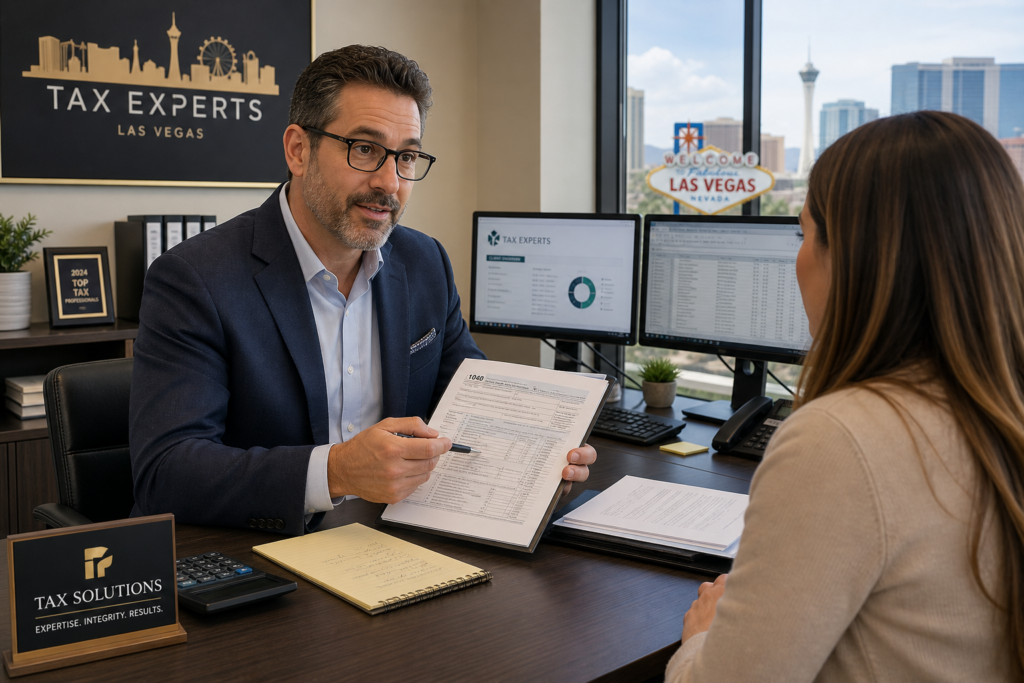
Best Tax Preparer in Las Vegas for 2026: Your Complete Credentialing & Selection Guide
Best Tax Preparer in Las Vegas for 2026: Your Complete Credentialing & Selection Guide
Finding the best tax preparer in Las Vegas requires more than checking Google reviews—it demands a clear understanding of credentials, vetting frameworks, and red flags that separate legitimate professionals from potential scams. For the 2026 tax year, Las Vegas residents face unique challenges: complex hospitality and gaming income, multi-state employment, real estate investment complexity, and heightened IRS enforcement due to a 27% agency workforce reduction. The right tax preparer becomes your advocate, tax strategist, and compliance shield rolled into one. This guide walks you through objective criteria, practical vetting steps, and how to match a preparer’s expertise to your specific tax situation, ensuring your 2026 return is accurate, optimized, and defensible.
Table of Contents
- Key Takeaways
- Why Your Choice of Tax Preparer Matters in Las Vegas for 2026
- What Credentials Define the Best Tax Preparer in Las Vegas?
- Step-by-Step: How to Vet a Tax Preparer in Las Vegas
- Red Flags and Recent Tax Fraud Cases: What to Avoid
- Matching the Best Preparer to Your Las Vegas Tax Situation
- Uncle Kam in Action: Las Vegas Small Business Owner Success
- Next Steps
- Frequently Asked Questions
Key Takeaways
- A Certified Public Accountant (CPA) or Enrolled Agent (EA) with a valid 2026 PTIN is your baseline for a credible Las Vegas tax preparer.
- Always verify credentials through the IRS (for EA/PTIN) and Nevada State Board of Accountancy (for CPA) before hiring.
- Avoid preparers promising “guaranteed large refunds,” basing fees on refund size, or pressuring you to sign blank returns.
- The 2026 IRS is smaller, more automated, and more enforcement-focused—choose a preparer who proactively plans for compliance and recent legislative changes.
Why Your Choice of Tax Preparer Matters in Las Vegas for 2026
Quick Answer: Finding the best tax preparer in Las Vegas protects you from costly audits, penalties, and fraud while ensuring you capture every legitimate deduction and credit for 2026.
The 2026 tax landscape is fundamentally different from prior years. The IRS reduced its workforce by 27% in 2025—from 102,000 to 74,000 employees—concentrating cuts in experienced enforcement and technical staff. The agency is responding by adopting a digital-first model and expanding AI and data analytics for enforcement. This shift creates both risk and opportunity. Risk: increased audit rates for self-prepared or poorly filed returns. Opportunity: a knowledgeable tax preparer can help you navigate complex rules, document deductions properly, and stay audit-proof.
For Las Vegas residents specifically, the stakes are higher. Nevada has no state income tax, a major advantage—but that advantage disappears if federal filing is inaccurate or incomplete. Hospitality workers, casino employees, self-employed contractors, and real estate investors often juggle multiple income sources, tips, rental properties, and 1099 income. A mediocre preparer misses deductions; a great one strategizes. Recent legislation like the Taxpayer Due Process Enhancement Act (H.R. 6506, passed by the House in May 2026) signals Congress recognizes taxpayer vulnerability and is reinforcing procedural rights. The right tax preparer in Las Vegas is your advocate in this increasingly complex environment.
Pro Tip: For the 2026 tax year, prioritize preparers who actively monitor IRS enforcement trends and stay current on recent legislation—not just those who file returns on time.
What Credentials Define the Best Tax Preparer in Las Vegas?
Quick Answer: The best credentials for a Las Vegas tax preparer are CPA (Certified Public Accountant), EA (Enrolled Agent), or tax attorney. All must hold a valid 2026 Preparer Tax Identification Number (PTIN) and clean disciplinary history.
CPA (Certified Public Accountant)
A CPA is a state-licensed professional who has passed the Uniform CPA Examination and met ongoing education requirements. In Nevada, CPAs are regulated by the Nevada State Board of Accountancy. CPAs can offer tax preparation, bookkeeping, audit services, and strategic tax planning. They are held to the highest ethical and professional standards under state law and IRS guidelines. For the 2026 tax year, a Nevada CPA typically brings the deepest expertise in complex business structures, real estate investments, and multi-state income situations—ideal for Las Vegas entrepreneurs and property investors. You can verify a CPA’s license status at the Nevada State Board of Accountancy website.
EA (Enrolled Agent)
An Enrolled Agent is a federally recognized tax expert certified by the IRS. EAs must pass three IRS exams covering individual income tax, business tax, and representation before the IRS. Unlike CPAs, EAs are not state-licensed but are regulated nationally by the IRS under Circular 230. EAs can represent clients before the IRS in audits, appeals, and collections matters. For many Las Vegas residents—particularly self-employed contractors, freelancers, and gig workers—an EA provides excellent tax expertise at lower cost than a CPA. You verify an EA’s credentials through the IRS Official Directory of Enrolled Agents and by requesting their current 2026 PTIN.
Tax Attorney
A tax attorney combines legal expertise with tax knowledge. They can represent you before the IRS, draft tax-related legal documents (trusts, entities, operating agreements), and provide privileged legal advice. Tax attorneys cost significantly more but are essential for high-complexity situations, disputes with the IRS, or multi-entity planning. For most Las Vegas taxpayers, a CPA or EA is sufficient; tax attorneys are reserved for specialized scenarios.
Preparer Tax Identification Number (PTIN)
Every tax preparer—CPA, EA, or otherwise—must display a valid 2026 PTIN issued by the IRS. The PTIN is a unique identifier that proves the preparer is registered with the IRS and authorized to prepare returns. A preparer lacking a PTIN is operating illegally. Always ask for the PTIN and verify it at the IRS official directory. This single step eliminates most fraudulent operators.
For complex small business and real estate tax planning for 2026, our Small Business Tax Calculator helps you estimate potential savings before meeting with a preparer.
Pro Tip: Request proof of continuing education. For 2026, the best tax preparers proactively track IRS enforcement priorities, legislative changes, and technological updates—all evidenced by recent continuing education credits.
Step-by-Step: How to Vet a Tax Preparer in Las Vegas
Quick Answer: Follow this five-step vetting process: verify credentials, check disciplinary history, review engagement terms, assess specialization, and confirm data security practices before hiring.
Vetting a tax preparer systematically eliminates fraud risk and ensures competence. Here is your actionable 5-step framework for 2026:
Step 1: Verify Current PTIN and License
Request the preparer’s 2026 PTIN and verify it at IRS.gov using the Official Directory of Enrolled Agents (for EAs) or the PTIN lookup tool. Ask for proof of current CPA license from the Nevada State Board of Accountancy if claiming CPA status. If the preparer hesitates or cannot provide proof, walk away immediately.
Step 2: Check Disciplinary History
Search the Nevada State Board of Accountancy website and IRS Office of Professional Responsibility for any complaints, disciplinary actions, or sanctions against the preparer. The IRS website also maintains records of tax practitioners sanctioned for incompetence or misconduct. A clean record is non-negotiable.
Step 3: Request and Review an Engagement Letter
A professional tax preparer provides a written engagement letter clearly spelling out scope of work, fees, payment terms, timeline, and confidentiality protections. The letter should state who signs the return (you, the taxpayer), what documents you must provide, and what happens if the IRS audits. Do not hire anyone who refuses a written engagement letter.
Step 4: Assess Years of Experience and Specialization
Ask how many years the preparer has worked in Las Vegas and whether they specialize in your type of return (W-2 employee, self-employed, real estate investor, business owner, etc.). A preparer with 10+ years and specific experience in your situation is a strong indicator of reliability. For 2026, ask directly whether they actively monitor changes in IRS enforcement and recent legislation affecting your tax situation.
Step 5: Confirm Data Security and Confidentiality Practices
Ask how the preparer stores tax documents, handles client data, and protects against identity theft. In 2026, with the IRS implementing improved identity-theft filters, your preparer should have robust cybersecurity, encrypted document transmission, and secure file storage. A legitimate firm will explain their data protection clearly.
When searching for a tax preparation service in Las Vegas, use this vetting checklist to ensure you are working with a credible professional aligned with 2026 standards.
Red Flags and Recent Tax Fraud Cases: What to Avoid
 Free Tax Write-Off Finder
Quick Answer: Walk away immediately if a tax preparer promises guaranteed large refunds, charges fees tied to refund size, pressures you to sign blank returns, or lacks a valid PTIN.
Tax fraud is rising, and preparers are complicit in many schemes. Understanding red flags protects you and your refund. Here are the definitive warning signs:
- “Guaranteed” large refunds: No preparer can promise a specific refund without auditing your full financial situation. This is an immediate red flag for fraud.
- Refund anticipation loans or advances: Some preparers offer to advance your refund (at high fees). Avoid this. The IRS files your return electronically; refunds come in 21 days or less. No legitimate reason to pay for an advance.
- Pressure to sign blank returns: You must review every line of your return before signing. A preparer pushing you to sign without review is cutting corners or hiding something.
- Fees based on refund size: Legitimate preparers charge flat fees, hourly rates, or percentage of income. Fees tied to your refund amount incentivize inflating deductions—a clear fraud indicator.
- No written engagement letter: A professional relationship requires written terms. Lack of a formal agreement signals unprofessionalism or intent to mislead.
- No PTIN or unwillingness to verify credentials: This is operating illegally. Report immediately to the IRS Office of Professional Responsibility.
- Requests for cash-only payment: Cash payments hide the transaction and make it impossible for you to verify the preparer’s identity later. Demand an invoice and traceable payment method.
- AI-generated or unverified tax advice: In 2026, the IRS and National Taxpayer Advocate have flagged risks of AI-generated tax advice lacking human review. A legitimate preparer uses AI as a tool but applies professional judgment to every return.
Pro Tip: If you suspect your current preparer committed fraud on your behalf, file Form 3115 (Application for Change in Accounting Method) or an amended return immediately, and report the preparer to the IRS Office of Professional Responsibility at the earliest opportunity.
Matching the Best Preparer to Your Las Vegas Tax Situation
Quick Answer: Match preparer expertise to your income type: W-2 employees need basic preparers; business owners need CPAs; investors need specialists in depreciation and 1031 exchanges.
Las Vegas has diverse taxpayer profiles. The “best” preparer for you depends on your specific situation. Here is a matching framework for 2026:
| Your Tax Situation | Recommended Preparer Type | Key Expertise Required |
|---|---|---|
| W-2 Employee (Single Income) | Tax Preparer or EA | Standard deductions, dependent credits, itemized deductions |
| Self-Employed / Freelancer (1099 Income) | EA or CPA | Schedule C, self-employment tax, quarterly estimated payments, deduction strategy |
| Small Business Owner (LLC, S-Corp, Partnership) | CPA Strongly Recommended | Entity taxation, reasonable compensation, profit allocation, business deductions, entity structuring |
| Real Estate Investor (Rental Property, STR) | CPA with Real Estate Specialization | Depreciation, cost segregation, 1031 exchanges, passive loss rules, short-term rental reporting |
| Multi-State Income or W-2 + 1099 Mix | CPA or Experienced EA | Multi-state filing, allocation rules, estimated payment coordination, entity planning |
| High Net Worth / Complex Investments | CPA or Tax Attorney | Investment taxation, alternative minimum tax (AMT), charitable planning, estate strategies |
Las Vegas-Specific Considerations for Your Tax Preparer Search
Las Vegas presents unique tax scenarios. When interviewing preparers, ask about experience with:
- Hospitality and casino employee income: Tips, commissions, shift bonuses, and gambling winnings require careful documentation and treatment.
- Short-term rental (Airbnb, VRBO) taxation: Las Vegas short-term rental income has specific depreciation and deduction rules.
- Multi-state performer income: Many entertainers and performers work across state lines; your preparer should understand allocation rules.
- Nevada residency advantages and pitfalls: While Nevada has no state income tax, improper residency declarations or multi-state claims trigger IRS scrutiny.

Uncle Kam in Action: Las Vegas Small Business Owner Success
Client Profile: Maria, a Las Vegas event planner and sole proprietor, was filing her own 1099 returns using basic tax software. Her 2024 tax year resulted in a $8,500 refund, but she was uncertain about deductions and feared an audit.
The Challenge: Maria’s event planning business involved multiple income streams (corporate events, weddings, vendor referrals), home office expenses, vehicle use, and equipment depreciation. She was itemizing deductions haphazardly, missing documented business expenses, and overpaying self-employment tax due to poor quarterly planning.
The Uncle Kam Solution: Maria hired a CPA specializing in small business taxation for Las Vegas entrepreneurs. The CPA conducted a comprehensive 2025 tax review, identified $12,400 in missed deductions, restructured her quarterly estimated payments for 2026, and recommended a potential S-Corp election for 2027. For the 2026 tax year, the CPA projected Maria’s tax liability reduction of $3,200 and put her on a compliant, strategic path forward.
The Results: Maria’s 2026 estimated tax liability dropped from a projected $14,500 to $11,300—a savings of $3,200 in the first year. The CPA’s engagement fee was $2,500, yielding a 1.28x return on investment in year one, plus multi-year audit protection and strategic planning. Maria discovered that the best tax preparer in Las Vegas isn’t the cheapest—it is the one who pays for themselves through optimization and compliance.
Next Steps
Now that you understand credentials, vetting steps, and red flags, here is your action plan for finding the best tax preparer in Las Vegas for 2026:
- Identify your tax profile: Use the matching table above to determine whether you need an EA, CPA, or tax attorney.
- Search credentialed preparers: Use the IRS Official Directory of Enrolled Agents or Nevada State Board of Accountancy website to find qualified professionals in Las Vegas.
- Run the 5-step vetting process: Verify credentials, check disciplinary history, request engagement letter, assess experience, and confirm data security.
- Schedule consultations: Meet with 2-3 qualified candidates to compare expertise, communication style, and fees before deciding.
- Start planning now: Do not wait until April 2027. The best tax preparers book quickly; contact candidates by September 2026 to secure a spot for 2026 year-end tax planning.
Frequently Asked Questions
Q: How much does a tax preparer in Las Vegas cost for 2026?
A: Costs vary widely based on complexity and credentials. A basic W-2 return: $150–$400. Self-employed with Schedule C: $400–$1,200. Small business owner (LLC, S-Corp): $800–$3,000+. Real estate investor with depreciation: $1,500–$5,000+. High-net-worth or multi-entity: $5,000–$10,000+. Always ask upfront for transparent fee quotes in writing and avoid any preparer basing fees on refund size.
Q: What is the difference between a CPA and an Enrolled Agent for 2026?
A: CPAs are state-licensed professionals regulated by the Nevada State Board of Accountancy. They can provide tax, audit, bookkeeping, and advisory services. Enrolled Agents are federally recognized by the IRS and can prepare returns and represent clients in IRS matters but are not state-licensed. CPAs typically cost more but offer broader services; EAs are excellent for focused tax preparation and IRS representation at lower cost. For 2026 complex business planning, choose a CPA. For straightforward self-employed returns, an EA is often sufficient.
Q: How do I know if a tax preparer is legitimate?
A: Verify their PTIN through the IRS, check for CPA license through Nevada State Board of Accountancy, request professional references, review an engagement letter, and confirm no disciplinary history. Legitimate preparers welcome credential verification and do not hesitate to provide proof of their qualifications.
Q: What should I bring to my first tax preparer appointment for 2026?
A: Bring W-2s, 1099s, K-1s, investment statements, rental property records, receipts for business expenses, mortgage interest statements, property tax records, charitable contribution records, vehicle mileage logs, and any prior-year tax returns. Organized documentation speeds up preparation and reduces fees. A professional preparer will provide a checklist before your appointment.
Q: Can a tax preparer help me if the IRS audits my 2026 return?
A: Yes—if they have representation authority. An EA or CPA can represent you before the IRS with proper Form 2848 (Power of Attorney) authorization. A basic tax preparer may not be authorized to represent you; verify representation rights in your engagement letter. For 2026, with the IRS increasingly automated and enforcement-focused, choosing a preparer who offers audit support is wise.
Q: When should I contact a tax preparer for 2026 tax planning?
A: Ideally by September or October 2026, while the year is still in progress. This allows time for year-end tax planning, estimated payment adjustments, deduction harvesting, and entity structure optimization. Waiting until March 2027 limits your options and forces reactive rather than proactive planning. Contact a preparer now to discuss 2026 strategy before year-end.
Q: What is the best way to find a tax preparer near me in Las Vegas?
A: Search the IRS Official Directory of Enrolled Agents (for EAs), the Nevada State Board of Accountancy website (for CPAs), or ask for referrals from your banker, business attorney, or accountant friends. Google reviews and Better Business Bureau ratings provide consumer insights but are not official credentials. Always verify qualifications independently before hiring. Professional referrals are often more reliable than online reviews.
Related Resources
- Tax Preparation Near Me in NEVADA
- Tax Strategy Services for Business Owners
- Tax Planning for Business Owners
- Self-Employed Tax Planning Guide
- Real Estate Investor Tax Strategies
This information is current as of 6/1/2026. Tax laws and IRS procedures change frequently. Verify updates with the IRS or a qualified tax professional if reading this after June 2026.
Last updated: June, 2026

