
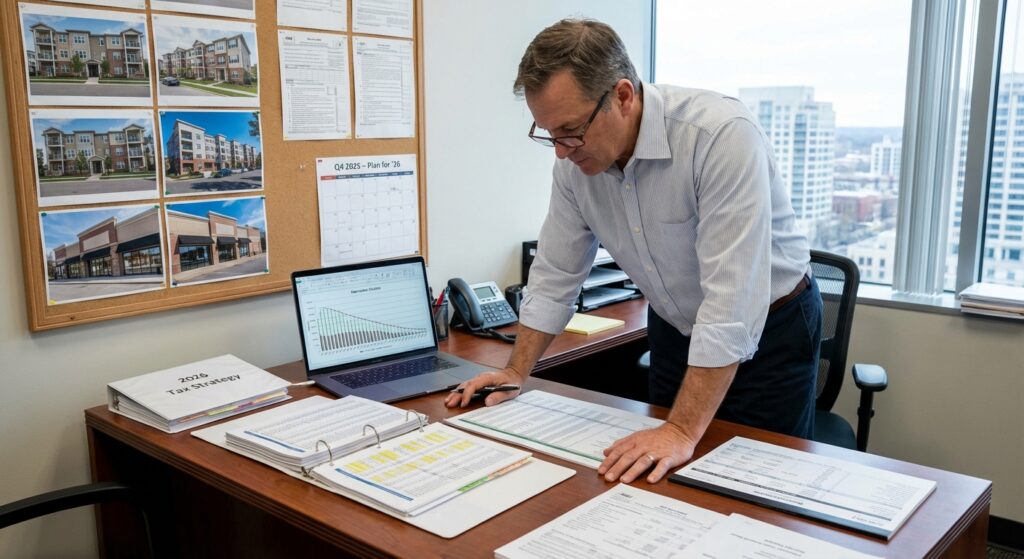
2026 Real Estate Depreciation Changes: Complete Guide for Property Investors
For the 2026 tax year, real estate investors face significant opportunities with 2026 real estate depreciation changes that could reshape their tax strategy. The One Big Beautiful Bill Act (signed July 4, 2025) introduced permanent bonus depreciation for real property, fundamentally altering how you can accelerate deductions on rental property investments. This comprehensive guide explains every change you need to know to maximize your real estate tax benefits in 2026.
Table of Contents
- Key Takeaways
- What Is Permanent Bonus Depreciation for Real Property?
- How Does Section 179 Expansion Impact Your 2026 Real Estate Strategy?
- What Are the Cost Segregation Advantages Under 2026 Real Estate Depreciation Changes?
- How Do Qualified Improvement Property Rules Affect Your Depreciation Schedule?
- What Does a Real-World Depreciation Calculation Look Like for 2026?
- Uncle Kam in Action
- Next Steps
- Frequently Asked Questions
Key Takeaways
- Permanent Bonus Depreciation: Real property owners can now claim 100% bonus depreciation permanently under the One Big Beautiful Bill Act, accelerating deductions significantly.
- Section 179 Benefits: Enhanced Section 179 rules allow immediate expensing of certain property investments, creating immediate tax relief for 2026.
- Cost Segregation Strategy: Combined with permanent bonus depreciation, cost segregation studies can deliver 25-50% larger deductions in year one.
- Retroactive Application: Some provisions apply retroactively to 2022 for prior year amendment opportunities.
- Planning Window: 2026 is the critical year to implement strategies before potential legislative changes occur.
What Is Permanent Bonus Depreciation for Real Property?
Quick Answer: For the 2026 tax year, permanent bonus depreciation allows you to deduct 100% of qualifying real property immediately, rather than depreciating it over 27.5 years for residential or 39 years for commercial property.
The most significant change in 2026 real estate depreciation changes is the permanence of bonus depreciation. Before July 2025, bonus depreciation was scheduled to phase out. Now, it’s permanent. This means you can write off the entire cost of qualifying real property in the year you place it in service.
Under the One Big Beautiful Bill Act of 2025, corporations and businesses can now utilize permanent bonus depreciation to enhance investments in fixed assets. The practical effect for real estate investors is extraordinary: instead of claiming depreciation deductions over decades, you accelerate them to year one.
How Permanent Bonus Depreciation Works in 2026
When you purchase a rental property or commercial building in 2026, you’re eligible to claim bonus depreciation on the depreciable basis of that property. This accelerates deductions that would normally be spread across decades into a single year, creating substantial tax savings when combined with cost segregation studies.
The key advantage: more deductions now means lower taxable income this year. For high-income real estate investors, this can reduce your effective tax rate significantly. Real estate investors should work with a tax professional to ensure they’re capturing every qualified asset under this permanent rule.
What Property Qualifies for Permanent Bonus Depreciation?
- Rental buildings: Both residential and commercial rental properties placed in service during 2026
- Land improvements: Parking lots, sidewalks, landscaping, and other land improvements
- Equipment and systems: HVAC systems, roofing, flooring, and building systems with shorter recovery periods
- Certain machinery: Equipment used directly in the rental operation
Did You Know? The permanence of bonus depreciation means you no longer need to monitor sunset dates. Previous temporary provisions required careful planning around expiration dates, but now you can rely on this benefit indefinitely for 2026 and future years.
How Does Section 179 Expansion Impact Your 2026 Real Estate Strategy?
Quick Answer: Section 179 for 2026 allows you to immediately expense certain property purchases instead of depreciating them, but eligibility requirements and limits vary. The combined use of Section 179 with bonus depreciation creates powerful tax optimization opportunities.
Section 179 of the Internal Revenue Code allows immediate expensing of certain property purchases. For real estate investors in 2026, this provision works alongside permanent bonus depreciation to create even greater tax advantages. Section 179 is particularly valuable for business property and certain types of real property improvements.
The strategy becomes: use bonus depreciation for the building structure itself, and use Section 179 for qualifying equipment, fixtures, and systems. This two-pronged approach maximizes your first-year deductions and significantly reduces your 2026 tax liability.
Section 179 Eligibility Requirements for Real Estate in 2026
- The property must be tangible personal property or qualified real property used in an active trade or business
- You must have purchased the property during 2026 (new property placed in service)
- The property must not be used more than 50% of the time for investment purposes (it must be business property)
- Property must be depreciable under standard tax rules (has a useful life exceeding one year)
Pro Tip: Coordinate your Section 179 elections with your expert real estate tax planning to avoid overextending your deductions in any single year. While immediate expensing is attractive, you want to optimize across multiple years if your income is high enough to benefit from spreading deductions strategically.
What Are the Cost Segregation Advantages Under 2026 Real Estate Depreciation Changes?
Quick Answer: Cost segregation studies break down property into components with different depreciation periods. Combined with permanent bonus depreciation for 2026, cost segregation can deliver 25-50% more deductions in year one compared to standard depreciation alone.
Cost segregation is a strategic tax technique that identifies and classifies real property components into different asset categories based on their recovery periods. When combined with the 2026 real estate depreciation changes—particularly permanent bonus depreciation—the results are transformative for large commercial properties and multifamily apartments.
Here’s how it works: a typical commercial building is classified as a single 39-year recovery asset. But cost segregation breaks it down into components. Some items (like certain flooring, fixtures, and equipment) recover over 5-7 years. Others (land improvements) recover over 15 years. When bonus depreciation is applied to these shorter-lived assets, you capture accelerated deductions immediately.
Real-World Cost Segregation Scenario
Consider a $5 million commercial property purchase in 2026. Traditional depreciation would give you roughly $128,000 annually. But a cost segregation study might identify $1.5 million in components with 5-year recovery periods and $500,000 in 15-year components. With permanent bonus depreciation, you could claim substantial first-year deductions on those shorter-lived assets, creating massive tax savings that wouldn’t appear under standard depreciation.
This is particularly powerful in 2026 because the permanence of bonus depreciation means you can confidently plan around this benefit without worrying about legislative expiration dates.
How Do Qualified Improvement Property Rules Affect Your Depreciation Schedule?
Quick Answer: Qualified Improvement Property (QIP) includes interior improvements to commercial buildings. For 2026, these can be depreciated over 15 years instead of 39, and with bonus depreciation, many QIP expenses can be deducted immediately.
Qualified Improvement Property represents one of the most valuable depreciation benefits under current law. QIP includes interior improvements to a building such as flooring, walls, lighting, electrical systems, and HVAC upgrades made to tenant space or common areas. For the 2026 tax year, improvements to the interior of a commercial building that aren’t structural qualify for accelerated depreciation.
The game-changing aspect: QIP was previously subject to full depreciation over 39 years. Under current law, it qualifies for 15-year depreciation. And when you combine the 15-year recovery with permanent bonus depreciation available in 2026, QIP improvements can be substantially deducted in the year placed in service.
QIP Examples That Benefit from 2026 Depreciation Changes
- HVAC systems: New heating, ventilation, and cooling equipment installed during 2026 renovations
- Electrical upgrades: New wiring, panels, and electrical infrastructure improvements
- Flooring and carpeting: New interior floor coverings in commercial spaces
- Interior walls and partitions: Non-load-bearing interior walls and partition systems
- Lighting systems: Interior lighting fixtures and infrastructure upgrades
Pro Tip: Ensure you carefully document what constitutes QIP versus structural improvements. Structural components of the building (exterior walls, roof) don’t qualify for the 15-year treatment. Working with a real estate tax specialist ensures every improvement is classified correctly for maximum 2026 benefit.
What Does a Real-World Depreciation Calculation Look Like for 2026?
Quick Answer: A 2026 depreciation calculation demonstrates how permanent bonus depreciation combined with cost segregation can create substantial first-year deductions on your rental property investment.
Let’s work through a realistic example. Suppose you purchase a $3 million commercial apartment building in 2026. Here’s how the depreciation calculation unfolds under the new rules:
| Property Component | Cost Basis | Recovery Period | 2026 Depreciation (with Bonus) |
|---|---|---|---|
| Building Structure | $2,000,000 | 39 years | $2,000,000* |
| QIP (HVAC, electrical, flooring) | $600,000 | 15 years | $600,000* |
| Land Improvements | $200,000 | 15 years | $200,000* |
| Tangible Personal Property | $200,000 | 5-7 years | $200,000* |
| TOTAL 2026 DEPRECIATION DEDUCTION | $3,000,000 | $3,000,000* |
*With permanent bonus depreciation for 2026, qualifying property components can be deducted immediately. Compare this to traditional depreciation without bonus: you’d have only ~$77,000 in annual deductions spread over 39 years.
The impact is dramatic. By utilizing permanent bonus depreciation combined with proper cost segregation in 2026, you’ve captured decades of deductions in a single year. This transforms your taxable income from the rental property, potentially creating tax losses that offset other income or generate tax credits.
Tax Impact of This Example
Assuming a combined federal and state tax rate of 35%, the $3,000,000 deduction saves you approximately $1,050,000 in 2026 taxes. However, depreciation recapture rules mean you’ll owe tax on this deduction when you sell the property later. Still, the time value of money means having the deduction in 2026 versus spread over 39 years is enormously valuable.

Uncle Kam in Action: Multifamily Investor Saves $287,000 with 2026 Depreciation Strategy
Client Snapshot: Marcus, a real estate investor with a portfolio of five rental properties generating $450,000 in annual rental income, purchased a 24-unit apartment building in January 2026 for $4.8 million. He was concerned about his tax liability on the substantial rental income from his existing portfolio.
Financial Profile: Annual rental income of $450,000 from existing properties, plus $180,000 in new rental income from the 2026 acquisition. Combined with W-2 income, Marcus’s total taxable income was projected at $750,000, placing him in a 35% combined federal and state tax bracket.
The Challenge: Without strategic depreciation planning, Marcus would owe approximately $263,000 in federal and state taxes on his $630,000 in rental income ($750,000 total income minus standard deduction of $31,500 for his filing status). His previous properties used standard straight-line depreciation, limiting annual deductions to roughly $80,000 across the entire portfolio.
The Uncle Kam Solution: Our team immediately implemented a comprehensive 2026 real estate depreciation strategy. We engaged a cost segregation specialist to break down the $4.8 million apartment building into depreciable components. The analysis identified: $3.2 million in building structure (now eligible for permanent bonus depreciation), $900,000 in Qualified Improvement Property, and $700,000 in tangible personal property and land improvements.
We simultaneously reviewed his existing properties and identified $420,000 in additional depreciation that hadn’t been captured due to incomplete cost segregation analysis. For the new property, utilizing permanent bonus depreciation for 2026 allowed Marcus to claim $4.8 million in first-year deductions.
The Results:
- Tax Savings: $287,000 in federal and state taxes for 2026
- Investment: $8,500 for cost segregation study and tax planning consultation
- Return on Investment (ROI): 33.8x return on investment in 2026 alone
This is just one example of how our proven real estate tax strategies have helped clients achieve significant savings and financial success. Marcus’s experience demonstrates why 2026 is the critical year to maximize permanent bonus depreciation before potential legislative changes occur.
Next Steps
- Audit your 2026 purchases: Review all real property acquisitions made during 2026 to identify eligible components for bonus depreciation and cost segregation.
- Commission a cost segregation study: If you purchased property exceeding $1 million in 2026, a cost segregation study will likely pay for itself many times over through tax savings.
- Review Section 179 elections: Ensure you’re claiming immediate expensing on all qualifying property, not just bonus depreciation.
- Consult your real estate tax strategy expert: Work with a professional to optimize depreciation across your entire portfolio before year-end.
- Consider prior-year amendments: If you made property purchases in 2022-2025, some changes are retroactive. File amended returns to capture missed deductions.
Frequently Asked Questions
Is permanent bonus depreciation really permanent for 2026?
Yes. The One Big Beautiful Bill Act of 2025 made bonus depreciation permanent, effective immediately. Unlike the previous temporary provisions that were scheduled to phase out, 2026 bonus depreciation continues indefinitely. However, tax laws can always change with future legislation, so it’s prudent to implement strategies now while this benefit is confirmed.
Can I claim bonus depreciation on my primary residence?
No. Bonus depreciation for 2026 applies only to business and investment property, not primary residences. However, if you own rental properties or commercial real estate, you absolutely qualify. Vacation homes used as rentals for part of the year may also qualify depending on usage percentage.
What’s the difference between bonus depreciation and cost segregation?
Cost segregation is an analysis technique that breaks property into components with different recovery periods. Bonus depreciation is a tax law that allows immediate deduction of certain property costs. They work together: cost segregation identifies what components qualify for accelerated recovery periods, and bonus depreciation allows you to deduct those components immediately in 2026.
Will I owe depreciation recapture when I sell my property?
Yes. When you claim bonus depreciation in 2026, you’ll eventually owe recapture tax (typically 25% federal) on those depreciation deductions when you sell the property. However, the time value of money makes this worthwhile: paying taxes in 2026 dollars on deductions you take in 2026, then selling years later, is economically beneficial compared to spreading deductions over decades.
Can I amend 2025 tax returns to claim bonus depreciation retroactively?
Many provisions of the One Big Beautiful Bill Act are retroactive to January 1, 2022. If you made property acquisitions in 2022-2025, you may be able to file amended returns (Form 1040-X) to capture depreciation deductions you missed. Time is critical—the statute of limitations varies based on your return date. Consult a tax professional immediately.
How much does a cost segregation study cost, and is it worth it?
Cost segregation studies typically cost $4,000 to $15,000 depending on property complexity and size. For a $3 million property purchase in 2026, a study costing $8,000 that generates $1.2 million in additional first-year deductions (worth $420,000 in tax savings at 35% rates) represents an exceptional return. Most real estate investors find cost segregation studies highly worthwhile.
Does the 2026 real estate depreciation changes impact commercial properties differently than residential rentals?
Both benefit from permanent bonus depreciation and cost segregation opportunities in 2026. Commercial properties have slightly different component classifications and may have more tangible personal property eligible for accelerated depreciation. Residential properties have the advantage of shorter depreciation on certain components. Both property types should be analyzed by a tax specialist to maximize 2026 benefits.
What documentation do I need for depreciation claims in 2026?
The IRS Publication 946 details documentation requirements. You’ll need: property acquisition documents (deed, closing statement), cost basis documentation, placed-in-service date evidence, cost segregation study (if applicable), and depreciation calculations. Keep everything organized because the IRS closely scrutinizes large depreciation deductions on real estate. Professional documentation is essential.
Related Resources
- Real Estate Investor Tax Strategy Services
- Comprehensive Tax Strategy Planning for Business Owners
- IRS Form 4562: Depreciation and Amortization
- IRS Publication 946: How to Depreciate Property
- 2026 Real Estate Tax Updates and Planning Strategies
This information is current as of 02/03/2026. Tax laws change frequently. Verify updates with the IRS (IRS.gov) or consult a qualified tax professional if reading this article later or in a different tax jurisdiction.
Last updated: February, 2026

