
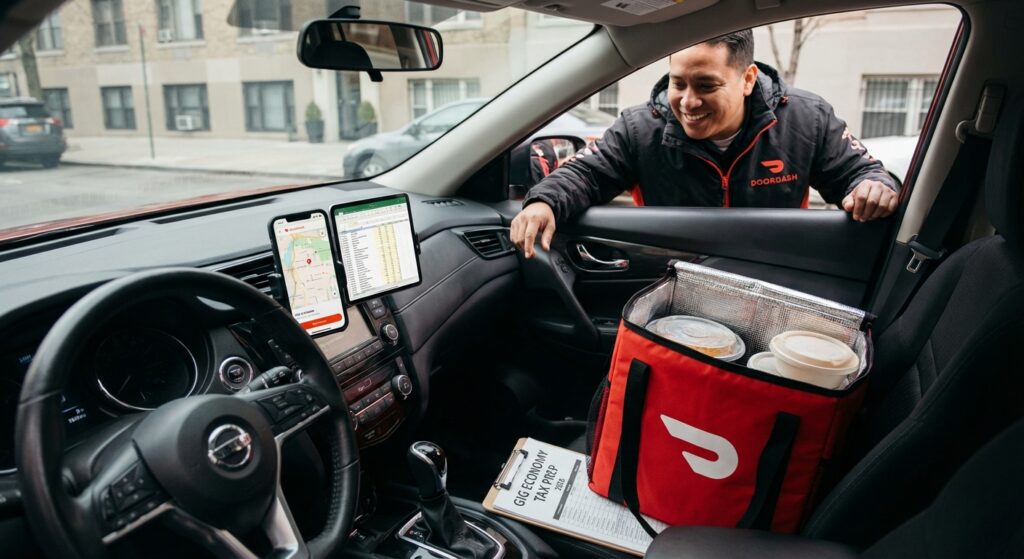
2026 DoorDash Tax Guide: Deductions, Self-Employment Tax, and Retirement Planning
For the 2026 tax year, DoorDash drivers face significant changes in how they report income and claim deductions. Understanding 2026 DoorDash tax obligations is critical for minimizing your tax burden and ensuring IRS compliance. New qualified tip deductions, self-employment tax rules, and enhanced retirement contribution limits mean that drivers who optimize their tax strategy can save thousands annually.
Table of Contents
- Key Takeaways
- Understanding DoorDash Self-Employment Income
- Self-Employment Tax Calculations for 2026
- New Qualified Tips Deduction in 2026
- Vehicle and Mileage Deductions
- Other Deductible Business Expenses
- Retirement Planning: Solo 401(k) Strategies
- Uncle Kam in Action
- Next Steps
- Frequently Asked Questions
Key Takeaways
- DoorDash drivers are self-employed and responsible for filing Schedule C income and business deductions.
- New 2026 qualified tips deduction allows up to $25,000 (MFJ) or $12,000 (Single) in federal income tax savings—not FICA taxes.
- Self-employment tax for 2026 remains 15.3% on net earnings (12.4% Social Security + 2.9% Medicare).
- Vehicle mileage deduction for 2026 is $0.67 per mile for delivery-related travel.
- Solo 401(k) contribution limit increases to $72,000 for 2026, enabling tax-deferred retirement savings.
Understanding DoorDash Self-Employment Income in 2026
Quick Answer: All DoorDash delivery income is self-employment income subject to income tax and self-employment tax. You must report this on Schedule C and pay both employer and employee portions of FICA taxes.
DoorDash drivers are independent contractors, not employees. This means you receive a Form 1099-NEC or 1099-K reporting your earnings but no taxes are withheld. For the 2026 tax year, every dollar earned delivering food is self-employment income requiring both federal income tax and self-employment tax.
DoorDash gross income includes delivery fees, promotions, and tips. However, you can deduct legitimate business expenses to reduce your taxable income. Understanding what qualifies as income versus deductible expense is essential for accurate 2026 tax filing.
How DoorDash Income Differs from W-2 Employment
As a 1099 contractor for DoorDash, you have different tax obligations than traditional W-2 employees. Unlike W-2 workers whose employers withhold taxes automatically, you must calculate quarterly estimated tax payments. For 2026, quarterly payments are due on April 15, June 17, September 15, and January 15, 2027.
Additionally, you’re responsible for both the employer and employee portions of Social Security and Medicare taxes—a combined 15.3% self-employment tax on net earnings above $400. This differs from W-2 employees, where employers cover half these costs.
Income Reporting: 1099-K vs. Actual Earnings
DoorDash reports your earnings through Form 1099-K for payment card transactions. For 2026, if your transactions exceed $5,000, DoorDash must file a 1099-K with the IRS. However, your actual income may differ from the 1099-K amount because it doesn’t account for business expenses you can deduct.
Keep detailed records of all earnings and expenses. The difference between your 1099-K gross income and your deductible expenses determines your net self-employment income, which is what’s subject to the 15.3% self-employment tax.
Pro Tip: Track income daily using DoorDash’s earnings summary feature or a dedicated accounting app. This ensures you have accurate records for quarterly estimated payments and year-end 2026 tax filing.
Self-Employment Tax Calculations for 2026
Quick Answer: For 2026, self-employment tax is 15.3% on net DoorDash earnings (12.4% for Social Security up to $168,600 of net income, plus 2.9% Medicare on all net earnings). You can deduct 50% of self-employment tax on your Form 1040.
Self-employment tax is the 2026 equivalent of Social Security and Medicare taxes paid by both employees and employers. Since you’re self-employed, you pay both portions. The calculation begins with your Schedule C net profit—gross income minus business expenses.
Here’s how 2026 self-employment tax works: If your net DoorDash income is $40,000 annually, your self-employment tax would be approximately $5,656 (calculated on 92.35% of net income due to the self-employment tax deduction). This amount is in addition to regular federal income tax.
2026 Self-Employment Tax Rate Breakdown
| Tax Component | 2026 Rate | Wage Base Limit |
|---|---|---|
| Social Security | 12.4% | $168,600 |
| Medicare (regular) | 2.9% | Unlimited |
| Medicare (additional) | 0.9% | Over $200,000 |
| Combined Rate | 15.3% | Base (increases with income) |
For 2026, if your net self-employment income exceeds $168,600, you’ll pay the full Social Security portion (12.4%) on the first $168,600, then only Medicare taxes (2.9% + 0.9% for high earners) on amounts above that threshold.
Quarterly Estimated Tax Payments in 2026
DoorDash doesn’t withhold taxes from your payments. Instead, you must make quarterly estimated tax payments directly to the IRS. For 2026, estimated payments are due:
- Q1 (January-March): April 15, 2026
- Q2 (April-May): June 17, 2026
- Q3 (July-September): September 15, 2026
- Q4 (October-December): January 18, 2027
Failure to make quarterly payments can result in underpayment penalties. For 2026, a safe harbor exists if you pay 100% of your prior year tax liability (or 110% if 2025 income exceeded $150,000).
Did You Know? Many DoorDash drivers underpay their 2026 quarterly taxes and face penalties at tax time. Setting aside 25-30% of net income for taxes prevents this costly mistake.
New Qualified Tips Deduction in 2026
Quick Answer: The 2026 Overtime, Benefits, and Better Bookkeeping Act (OBBBA) introduces a new federal income tax deduction for qualified tips. Caps are $25,000 for married couples filing jointly, $12,000 for single filers, and $18,500 for heads of household. This deduction applies to federal income tax only, not self-employment taxes.
Beginning in 2026, the qualified tips deduction represents a significant tax benefit for DoorDash delivery drivers. This allows you to deduct qualified tips from your federal taxable income, reducing your overall tax liability. However, understanding the limitations and requirements is critical for proper 2026 tax planning.
What Qualifies as Deductible Tips in 2026
For 2026, “qualified tips” generally means tips received in cash or electronically through the DoorDash app. Tips must be documented and substantiated. The IRS definition requires tips to be customary compensation for services rendered.
Both in-app tips and cash tips from customers count toward your 2026 qualified tips deduction, provided you maintain records. DoorDash provides tip summaries in your earnings history, making documentation straightforward. Cash tips should be recorded in a personal log with date, amount, and delivery reference.
Deduction Caps and Filing Status Impact
The 2026 qualified tips deduction has specific caps based on your filing status. These limits apply to federal income tax deductions only—they do not reduce your self-employment tax liability.
- Married Filing Jointly: Up to $25,000 in qualified tips per tax year
- Single or Unmarried: Up to $12,000 in qualified tips per tax year
- Head of Household: Up to $18,500 in qualified tips per tax year
- Married Filing Separately: Up to $12,500 per spouse per tax year
If you earn more than your filing status cap, you can only deduct up to the limit. For example, a single DoorDash driver with $15,000 in 2026 tips can only deduct $12,000, leaving $3,000 non-deductible.
Pro Tip: The 2026 qualified tips deduction doesn’t reduce self-employment taxes. If you’re optimizing taxes, prioritize maximizing your Solo 401(k) contributions and vehicle expense deductions for the greatest overall benefit.
Vehicle and Mileage Deductions for DoorDash Drivers in 2026
Quick Answer: For 2026, DoorDash delivery miles are deductible at $0.67 per mile using the standard mileage rate. Alternatively, you can deduct actual vehicle expenses (depreciation, gas, insurance, maintenance) if they exceed the standard mileage deduction. Only miles driven while actively delivering count.
Vehicle expenses represent your largest deductible business expense for 2026. DoorDash drivers can use either the standard mileage rate or actual expense method. The standard mileage method is simpler for most drivers, but calculating actual expenses may yield higher deductions if you have a newer, expensive vehicle.
Standard Mileage Method for 2026
The IRS standard mileage rate for 2026 is $0.67 per delivery-related mile. This rate includes depreciation, gas, repairs, and insurance. Simply multiply your annual delivery miles by $0.67 to calculate your deduction.
To track mileage, use a mileage log app (MileIQ, Stride Tax, or Everlance) that automatically records delivery-related miles. If you’re audited in 2026 or later, you’ll need documentation proving your mileage claims. Apps provide timestamped records admissible as evidence.
Example: If you drive 25,000 DoorDash miles in 2026, your mileage deduction is $16,750 (25,000 × $0.67). This reduces your net self-employment income, lowering your 15.3% self-employment tax burden.
Actual Expense Method Alternative
The actual expense method allows you to deduct real vehicle costs. These include depreciation, fuel, repairs, maintenance, registration, insurance, and tolls. You calculate the percentage of business use (DoorDash miles ÷ total miles) and deduct that percentage of expenses.
For 2026, if your actual vehicle expenses exceed the standard mileage deduction, choose the actual expense method. This requires meticulous record-keeping—maintain fuel receipts, service records, and insurance premium documentation. Many tax professionals recommend the actual expense method for newer vehicles with monthly payments over $500.
Did You Know? Many DoorDash drivers forget to track the drive to their first delivery and from their last delivery. These “deadhead” miles still count toward your 2026 deduction and shouldn’t be ignored.
Other Deductible Business Expenses for 2026
Quick Answer: Beyond vehicle expenses and tips, DoorDash drivers can deduct phone service, internet, delivery supplies, thermal bags, vehicle maintenance, parking fees, tolls, phone mounts, and professional tax preparation fees—all ordinary and necessary business expenses.
While vehicle mileage represents the largest deduction, numerous other expenses reduce your 2026 taxable DoorDash income. The IRS allows any expense that is “ordinary and necessary” for your delivery business. Tracking these secondary expenses often yields $2,000-$5,000 in additional annual deductions.
Deductible Phone, Internet, and Equipment Expenses
Your DoorDash app requires smartphone service. You can deduct a percentage of your phone bill and internet service proportional to business use. If you use your phone 80% for DoorDash delivery, deduct 80% of your monthly phone bill. For 2026, estimate $40-$80 monthly in phone expense deductions.
Equipment purchases also qualify. A phone mount for your car, thermal bag for food delivery, and portable phone charger all count as deductible business equipment. Keep receipts for these purchases. Small items under $1,000 are expensed immediately; larger equipment might require depreciation over multiple years.
Vehicle Maintenance and Parking Fees
If you use the actual expense method instead of standard mileage, vehicle maintenance (oil changes, repairs, tires) is directly deductible. If you use standard mileage, these are already included. Never double-deduct maintenance under both methods.
Parking fees and tolls are separately deductible under either method. If you park in a parking garage for deliveries or pay tolls on roads driven for deliveries, keep receipts. These typically add $100-$300 annually to your 2026 deduction.
Retirement Planning: Solo 401(k) Strategies for 2026
Quick Answer: For 2026, DoorDash drivers can contribute up to $72,000 to a Solo 401(k), combining employee deferrals (up to $23,500) and employer contributions based on net self-employment income. This is the most powerful tax reduction strategy available to high-earning delivery drivers.
The Solo 401(k) represents your best retirement savings and tax reduction tool for 2026. Unlike SEP-IRAs or traditional IRAs, Solo 401(k)s allow both employee and employer contributions, maximizing your tax-deductible savings. Our professional tax strategy services help DoorDash drivers structure Solo 401(k)s optimally.
2026 Solo 401(k) Contribution Limits
For 2026, the Solo 401(k) contribution limit increased to $72,000—up from $69,000 in 2025. This limit combines employee deferrals and employer contributions. If you’re age 50 or older, you can add a $7,500 catch-up contribution, bringing your total 2026 limit to $79,500.
Here’s how contributions break down: You can contribute up to 100% of compensation as employee deferrals (capped at $23,500 for 2026). Then add employer contributions of approximately 20% of net self-employment income (after self-employment tax adjustment). Together, these typically reach $72,000 for high-earning drivers.
Solo 401(k) Example Calculation for DoorDash Driver
Imagine you earn $100,000 in gross DoorDash income for 2026. After $25,000 in mileage and other deductions, your net self-employment income is $75,000. Here’s how to maximize your Solo 401(k) contributions:
- Employee Deferral: Contribute $23,500 (2026 limit)
- Employer Contribution: Approximately $15,615 (roughly 20% of adjusted net income)
- Total 2026 Contribution: $39,115 (reducing your taxable income)
- Tax Savings: Approximately $13,191 at 33.7% combined tax rate
This Solo 401(k) contribution strategy reduces your 2026 taxable income from $75,000 to $35,885, dramatically lowering federal income tax and self-employment tax liabilities.
Pro Tip: For DoorDash drivers with multiple income sources, establishing a Solo 401(k) by December 31, 2026 allows contributions through the tax filing deadline in 2027. High earners should fund this by April 15, 2027 (with extension).

Uncle Kam in Action: DoorDash Driver Saves $18,500 with 2026 Tax Strategy
Client Snapshot: Marcus, a full-time DoorDash delivery driver in California, earned approximately $85,000 in gross delivery income during 2026. He was concerned about his mounting self-employment tax liability and knew he wasn’t optimizing his business structure.
Financial Profile: Marcus completed approximately 2,200 deliveries in 2026, maintaining a 4.95-star rating. His annual gross income was $85,000, with roughly $22,000 in tips (mostly in-app). His operating costs included a vehicle payment, fuel, and insurance.
The Challenge: Marcus calculated his self-employment tax liability at approximately $12,000 for 2026, on top of regular federal and state income taxes. He was paying taxes on his full $85,000 income without accounting for deductible vehicle expenses or the new qualified tips deduction. Additionally, he had no retirement savings strategy.
The Uncle Kam Solution: Our tax strategy team implemented a comprehensive 2026 DoorDash tax optimization plan:
- Tracked 24,500 delivery miles at $0.67/mile = $16,415 deduction
- Documented $22,000 in qualified tips (capped at $12,000 for single filer)
- Identified $1,850 in phone service, equipment, and maintenance expenses
- Established a Solo 401(k) with $35,200 contribution ($23,500 employee + ~$11,700 employer)
- Implemented quarterly estimated tax payments to avoid underpayment penalties
The Results:
- Tax Savings: $18,500 in combined federal income and self-employment tax reduction
- Investment: One-time investment of $2,800 for comprehensive tax strategy and implementation
- Return on Investment (ROI): 660% first-year ROI ($18,500 savings ÷ $2,800 investment)
This is just one example of how our proven tax strategies have helped clients achieve significant savings and financial peace of mind. Marcus now has a structured approach to quarterly payments and is building retirement savings through his Solo 401(k).
Next Steps: Optimize Your 2026 DoorDash Taxes
Take these immediate actions to minimize your 2026 DoorDash tax liability:
- 1. Start tracking mileage today: Download a mileage app and log every delivery-related mile for the remainder of 2026. This deduction is worth $0.67 per mile.
- 2. Document qualified tips: Keep a running record of all tips (in-app and cash) to claim the new 2026 qualified tips deduction up to your filing status cap.
- 3. Establish a Solo 401(k): Open a Solo 401(k) by December 31, 2026 if you haven’t already. Contributions can be made through April 15, 2027 (or October 15 with extension).
- 4. Calculate quarterly estimated payments: For 2026, quarterly payments are due April 15, June 17, September 15, and January 15, 2027. Set aside 25-30% of income monthly.
- 5. Schedule a strategy review: Our tax advisory team provides personalized consultations ensuring you’re not leaving money on the table.
Frequently Asked Questions
Do I have to report DoorDash income if I earned under $5,000 in 2026?
Yes. If your net self-employment income is $400 or more, you must file Schedule SE and pay self-employment tax, regardless of whether DoorDash sends a 1099-K. Additionally, you must report all income on Schedule C, even if under $400.
Can I deduct my car payment for DoorDash in 2026?
Car payments are not directly deductible. However, depreciation on a financed vehicle is deductible under the actual expense method. Using the standard mileage rate ($0.67/mile in 2026) includes a depreciation component, making this the simpler option for most drivers.
How much self-employment tax will I owe on $50,000 DoorDash income in 2026?
On $50,000 net DoorDash income, you’ll owe approximately $7,065 in self-employment tax for 2026 (15.3% × 92.35% of net income). This is on top of regular federal and state income taxes. Deductions like mileage and the qualified tips deduction reduce the net income subject to this tax.
Does the qualified tips deduction reduce self-employment tax in 2026?
No. The 2026 qualified tips deduction reduces federal income tax only, not self-employment taxes. Tips are still included in your Schedule C net profit for self-employment tax calculation. The deduction provides savings on the federal income tax side, but self-employment tax continues to apply to all tips.
What happens if I don’t make quarterly estimated tax payments for 2026?
Skipping quarterly payments can result in underpayment penalties and interest assessed at tax filing time. The IRS charges approximately 8-10% annual interest on unpaid taxes. To avoid penalties, either make quarterly payments or ensure your 2026 final tax liability is covered by December 31. The safe harbor is 100% of your 2025 tax liability (or 110% if 2025 income exceeded $150,000).
Can I open a Solo 401(k) after December 31, 2026?
You must establish a Solo 401(k) by December 31, 2026 to make contributions to it for that tax year. However, you have until April 15, 2027 (or October 15 with an extension) to make actual contributions to a plan established by the December 31 deadline. If you miss the December 31 deadline, you cannot contribute to a 2026 Solo 401(k).
Should I use standard mileage or actual expense method for 2026?
Calculate both methods for 2026. Use standard mileage ($0.67/mile) if your tracked miles yield higher deductions than actual expenses. Use the actual expense method if your vehicle costs (depreciation, fuel, insurance, maintenance) exceed the standard mileage amount. Most DoorDash drivers benefit from standard mileage due to its simplicity and consistency.
This information is current as of 01/30/2026. Tax laws change frequently. Verify updates with the IRS (IRS.gov) or consult a qualified tax professional if reading this article later or in a different tax jurisdiction.
Last updated: January, 2026

