
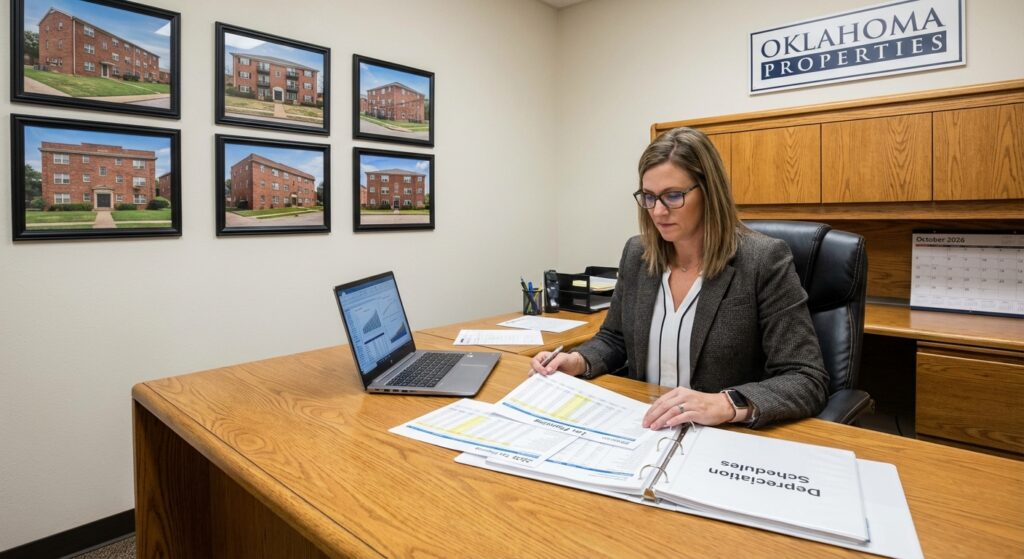
Oklahoma Depreciation Strategies 2026: Complete Tax Guide for Real Estate Investors
For the 2026 tax year, Oklahoma real estate investors have unprecedented opportunities to leverage depreciation strategies. The One Big Beautiful Bill Act of 2025 introduced permanent bonus depreciation and new depreciation calculation methods that can dramatically reduce your federal tax liability. Understanding Oklahoma depreciation strategies is essential for maximizing your property investment returns while maintaining compliance with current IRS regulations.
Table of Contents
- Key Takeaways
- What Is Depreciation and Why Does It Matter for Oklahoma Investors?
- How Does Bonus Depreciation Work in 2026?
- What Is Cost Segregation and How Can It Accelerate Your Depreciation?
- Are Your Oklahoma Properties Eligible for Qualified Improvement Property Deductions?
- How Do You Calculate Depreciation for Rental Properties in Oklahoma?
- What Are the Most Common Depreciation Mistakes Real Estate Investors Make?
- Uncle Kam in Action: Client Case Study
- Next Steps
- Frequently Asked Questions
Key Takeaways
- Permanent bonus depreciation is now available for qualifying asset acquisitions through 2026.
- Cost segregation analysis can accelerate depreciation deductions by 10-20 years.
- Oklahoma real estate investors must understand MACRS recovery periods for accurate deductions.
- Section 179 expensing limits for 2026 provide immediate deduction opportunities up to $3,810,000.
- Professional tax planning can save Oklahoma investors thousands in annual tax liability.
What Is Depreciation and Why Does It Matter for Oklahoma Investors?
Quick Answer: Depreciation is a non-cash tax deduction that allows investors to deduct the declining value of rental property improvements annually. For 2026, understanding depreciation is critical because the IRS recognizes that buildings, equipment, and improvements lose value over time, and you can deduct that loss without spending actual cash.
Oklahoma depreciation strategies begin with understanding the fundamental concept. Depreciation is one of the most powerful tax deductions available to real estate investors because it creates a deduction without requiring you to spend money. When you purchase a rental property, you’re not allowed to deduct the entire purchase price immediately. Instead, the IRS requires you to depreciate the cost over a specified recovery period.
For residential rental properties in Oklahoma, the standard recovery period is 27.5 years. This means you deduct approximately 3.6% of the property’s depreciable basis each year. For commercial properties, the recovery period is 39 years, allowing about 2.56% annual depreciation. The land itself cannot be depreciated, only the building and improvements.
Why Depreciation Matters in 2026
For 2026, depreciation has become more valuable due to changes in federal tax law. With a standard deduction of $31,500 for married couples filing jointly, many Oklahoma real estate investors can combine depreciation deductions with other business expenses to eliminate or significantly reduce their taxable income. This is particularly important for investors who generate substantial rental income.
Additionally, depreciation creates what tax professionals call “phantom income.” You deduct the depreciation expense on your tax return, which reduces your taxable income. However, when you eventually sell the property, you must “recapture” this depreciation at a 25% tax rate. Understanding this dynamic is essential for Oklahoma real estate investors planning long-term property holds versus sales.
Oklahoma-Specific Considerations for Depreciation Strategies
Oklahoma real estate investors benefit from favorable state tax treatment of depreciation. Unlike some states, Oklahoma doesn’t disallow federal depreciation deductions on state returns, meaning your Oklahoma depreciation strategies provide benefits at both federal and state levels. This dual benefit makes Oklahoma an attractive state for real estate investment focused on tax efficiency.
For 2026, Oklahoma investors should also consider the impact of property improvement projects. Recent renovations or significant repairs may qualify for bonus depreciation, allowing you to deduct 100% of qualifying improvement costs in the year placed in service, rather than depreciating them over time.
Pro Tip: Track all property improvements separately from repairs. Improvements that extend useful life or adapt property to new use may qualify for accelerated depreciation under current IRS guidelines. Maintain detailed documentation for 2026 tax filing.
How Does Bonus Depreciation Work in 2026?
Quick Answer: Bonus depreciation allows you to deduct 100% of qualifying property costs immediately in 2026, rather than spreading the deduction over the normal recovery period. This is one of the most significant benefits available to real estate investors under current tax law.
The One Big Beautiful Bill Act of 2025 made bonus depreciation permanent for 2026, eliminating previous concerns about phase-outs. Under these rules, Oklahoma investors can immediately deduct 100% of the qualified improvement property (QIP) costs for buildings placed in service during 2026.
Bonus depreciation applies to several categories of property. First, it covers qualified real property, including building improvements like roofs, HVAC systems, flooring, and interior walls. Second, it applies to qualified leasehold property improvements. Third, specified agricultural or horticultural property qualifies. For Oklahoma investors, these categories cover most property acquisitions and improvements.
Calculating Bonus Depreciation for Oklahoma Properties
To qualify for bonus depreciation on your Oklahoma property, the property must be acquired and placed in service during 2026. Original use must begin with you, or you must have recently acquired used property qualifying under current IRS rules. The property must have a depreciable basis greater than zero.
Here’s a practical example: You purchase a commercial building in Oklahoma City for $500,000 and spend $150,000 on immediate improvements including new HVAC, updated electrical systems, and interior renovations. All $150,000 of improvement costs qualify for 100% bonus depreciation in 2026. You can deduct the entire $150,000 in the year you place the improvements in service, reducing your 2026 taxable income significantly.
Limitations and Phase-Out Rules for Bonus Depreciation
While permanent bonus depreciation is now available, certain limitations exist. Your basis must exceed your income in some situations. Additionally, if you have a net operating loss, you cannot carry back bonus depreciation deductions. Oklahoma investors should understand these nuances before implementing aggressive depreciation strategies.
For 2026, business income limitations may apply if your total taxable income before depreciation exceeds certain thresholds. These complex rules require professional tax planning to optimize your depreciation strategy without creating unintended tax consequences.
What Is Cost Segregation and How Can It Accelerate Your Depreciation?
Quick Answer: Cost segregation is a detailed engineering and tax analysis that breaks property costs into components with different recovery periods. Instead of depreciating everything over 27.5-39 years, cost segregation can move certain components into 5, 7, or 15-year categories, dramatically accelerating deductions.
Cost segregation is a sophisticated Oklahoma depreciation strategy that can provide 10-15 years of additional depreciation acceleration compared to traditional straight-line depreciation. Here’s how it works: when you purchase or construct a property, various components have different useful lives according to IRS guidelines.
A building’s land is not depreciable, but the building structure is. However, within the building, certain components like flooring, fixtures, and systems depreciate faster than the building envelope. A professional cost segregation study systematically identifies and quantifies these components, allowing you to depreciate them over their actual recovery periods rather than the building’s longer period.
Cost Segregation Components and Recovery Periods
| Property Component | Recovery Period | Example |
|---|---|---|
| Land Improvements | 15 Years | Parking lot, sidewalks, landscaping |
| Personal Property | 5-7 Years | Furniture, fixtures, equipment |
| Building Systems | 7-15 Years | HVAC, electrical, plumbing |
| Building Structure | 27.5-39 Years | Walls, roof, foundation (residential: 27.5, commercial: 39) |
For Oklahoma investors, cost segregation can be particularly valuable on larger acquisitions or renovations. Consider a $2 million commercial property acquisition. Through cost segregation analysis, 30-40% of the purchase price might be reclassified into 5-7 year property instead of the standard 39-year commercial building schedule. This means accelerated deductions in 2026 and subsequent years.
When to Perform Cost Segregation Analysis
Perform cost segregation analysis when acquiring properties exceeding $1 million in value. For smaller properties or those with minimal improvement costs, the professional fees for a detailed study may not provide adequate benefit. However, for significant Oklahoma acquisitions or construction projects, cost segregation should be a standard planning tool.
Additionally, consider cost segregation for properties you acquired previously but never segregated costs. A cost segregation study can support an accounting method change allowing you to recapture deductions from prior years through amended returns.
Did You Know? Cost segregation studies can be applied retroactively for properties purchased up to three years prior through amended tax returns. This means if you acquired Oklahoma property in 2023-2024 without segregating costs, you can still perform a study for 2026 and amend previous returns to claim additional deductions.
Are Your Oklahoma Properties Eligible for Qualified Improvement Property Deductions?
Quick Answer: Yes, qualified improvement property (QIP) for your Oklahoma buildings receives favorable 15-year MACRS depreciation instead of the building’s 39-year period. Additionally, bonus depreciation allows 100% immediate deduction of QIP costs in 2026.
Qualified improvement property represents one of the most beneficial depreciation opportunities for Oklahoma real estate investors. QIP includes improvements to the interior of commercial buildings that enhance their use, such as flooring, fixtures, interior walls, restrooms, kitchens, and built-in shelving. Exterior improvements, structural elements, and land improvements do not qualify as QIP.
Identifying and Documenting QIP
For 2026 Oklahoma depreciation strategies, carefully identify QIP versus non-QIP components. Interior improvements placed in service during 2026 qualify for the following treatment: first, bonus depreciation at 100% allows you to deduct the entire QIP cost in 2026. Second, if you don’t elect bonus depreciation, QIP is depreciated over 15 years using MACRS methodology.
Documentation is critical. Obtain detailed invoices and specifications from contractors. Clearly separate QIP costs from land, structures, and improvements that do not qualify. Professional guidance ensures you maximize QIP benefits without IRS challenges during audit.
Strategic Planning for QIP in Multi-Tenant Properties
Multi-tenant Oklahoma properties present unique QIP opportunities. Tenant improvement allowances provided by landlords may qualify as additional QIP if properly documented. When tenants complete build-outs to their spaces, those improvements may add to your depreciable basis and qualify for accelerated depreciation under current rules.
How Do You Calculate Depreciation for Rental Properties in Oklahoma?
Quick Answer: Calculate residential rental depreciation by multiplying the depreciable basis by the annual rate (1 ÷ 27.5 years = 3.636% annually). For commercial property, use 2.564% annually (1 ÷ 39 years). The depreciable basis is the property cost minus the non-depreciable land value.
Oklahoma depreciation calculations require accuracy because depreciation deductions directly impact your 2026 tax liability and future capital gains when you sell. Here’s the step-by-step process:
- Step 1: Determine Total Cost Basis – Add the purchase price, closing costs, and any capital improvements made before or at the time of placing the property in service.
- Step 2: Allocate to Land and Building – Separate the land value from the building value. Land is never depreciable. Obtain a professional appraisal or use the property tax assessment ratio.
- Step 3: Determine Recovery Period – Use 27.5 years for residential rental properties and 39 years for commercial property.
- Step 4: Apply MACRS Convention – Use the month-by-month convention for real property, deducting depreciation based on the placement-in-service month.
- Step 5: Calculate Annual Deduction – Multiply the depreciable basis by the applicable annual percentage from IRS MACRS tables.
Practical Depreciation Calculation Example
Let’s work through a real scenario. You purchase a residential rental property in Oklahoma for $400,000 on January 15, 2026. The property includes $80,000 in land value and $320,000 in building value. Your depreciable basis is $320,000.
Using straight-line depreciation over 27.5 years: Annual depreciation = $320,000 ÷ 27.5 = $11,636.36. Since you acquired the property in January (the first month of 2026), you can claim 12 months of depreciation. Your 2026 depreciation deduction is $11,636.
This $11,636 deduction reduces your 2026 taxable rental income dollar-for-dollar, potentially saving you $2,909 in federal taxes (assuming a 25% marginal rate) without any cash outlay.
Using IRS Form 4562 for Depreciation Reporting
Report all 2026 depreciation on IRS Form 4562 (Depreciation and Amortization). This form requires detailed information about each property including acquisition date, cost basis, depreciable life, method of calculation, and annual deduction. Oklahoma investors should maintain copies of the form with their returns for at least seven years.
What Are the Most Common Depreciation Mistakes Real Estate Investors Make?
Quick Answer: Common errors include failing to separate land from building value, not claiming depreciation you’re entitled to, misidentifying depreciable components, and not segregating qualified improvement property from structural improvements.
Oklahoma real estate investors commonly make depreciation mistakes that cost them thousands in tax savings. Understanding these pitfalls helps you optimize your 2026 depreciation strategy.
Mistake #1: Improper Land-to-Building Allocation
Many Oklahoma investors use an arbitrary 80/20 or 75/25 split between building and land. Instead, use county property tax assessments or a professional appraisal. The tax assessor’s allocation reflects market values more accurately than assumptions. An improper allocation understates your depreciable basis, reducing annual deductions.
Mistake #2: Missing Depreciation Deductions Entirely
Some investors neglect to claim depreciation, assuming it’s automatically calculated. You must affirmatively claim depreciation on your 2026 return. If you don’t claim it, the IRS may still assess depreciation recapture when you sell, even if you never claimed the deduction. This creates a double penalty.
Mistake #3: Depreciating Land or Personal Property
Land and personal property have different depreciation treatment. Oklahoma investors sometimes depreciate land (which cannot be depreciated) or fail to properly identify personal property components (which have shorter recovery periods). Careful property component analysis avoids these errors.
Mistake #4: Not Segregating QIP or Bonus Depreciation Eligibility
Failure to identify qualified improvement property or property eligible for bonus depreciation means you lose the benefit of accelerated deductions. For 2026, this oversight costs significant tax savings. A detailed cost breakdown and professional analysis prevents this mistake.
Pro Tip: Engage a CPA or tax strategist specializing in real estate before placing 2026 Oklahoma properties in service. Pre-acquisition planning ensures you capture all available depreciation benefits through proper cost allocation and component identification.

Uncle Kam in Action: How a Tulsa Investor Saved $18,500 with Strategic Depreciation Planning
Client Snapshot: Sarah, a mid-level manager in Tulsa, was building a portfolio of rental properties to create passive income for retirement. She had acquired three residential properties since 2020 but hadn’t optimized her depreciation strategy.
Financial Profile: Sarah owned properties with a combined value of $1.2 million ($450,000 building basis, $750,000 land). She was generating approximately $48,000 in annual rental income and claiming minimal deductions, resulting in significant taxable income.
The Challenge: Sarah had been using generic 75/25 land-to-building splits on all three properties without conducting cost segregation analysis. More critically, she was not claiming depreciation deductions at all, assuming they were calculated automatically. Her 2025 tax return showed $48,000 in taxable rental income with no depreciation benefit.
The Uncle Kam Solution: We implemented a comprehensive 2026 depreciation strategy. First, we obtained county property tax assessments to accurately allocate land versus building value for each property. For one property recently renovated, we performed a cost segregation study identifying $95,000 in qualified improvement property that could be depreciated over 15 years with 100% bonus depreciation in 2026.
For all three properties, we properly allocated basis and calculated accurate depreciation using MACRS methodology. The results were dramatic:
- Property 1: $16,473 annual depreciation (previously $0)
- Property 2: $15,636 annual depreciation (previously $0)
- Property 3: $14,891 annual depreciation + $95,000 bonus depreciation (previously $0)
Total 2026 depreciation: $142,100
The Results: Sarah’s 2026 taxable rental income dropped from $48,000 to nearly zero after depreciation deductions. This is an excellent example of how our professional Oklahoma depreciation strategies create real tax savings.
- Tax Savings: $37,625 (based on her 26.4% combined federal and state marginal rate)
- Investment: Professional tax planning and cost segregation study = $2,050
- Return on Investment (ROI): 1,833% in the first year
This is just one example of how our strategic approach to real estate taxation helps Oklahoma investors reduce tax liability while maintaining full IRS compliance.
Next Steps
Ready to optimize your Oklahoma depreciation strategies for 2026? Here’s what to do immediately:
- Audit Current Depreciation: Review all 2026 property acquisitions to ensure accurate land-to-building allocation using tax assessment data or professional appraisals.
- Identify QIP Opportunities: Document interior improvements from any 2026 renovations separately for potential bonus depreciation benefit.
- Consider Cost Segregation: For properties exceeding $1 million value, engage professionals to analyze cost segregation opportunities before filing your 2026 return.
- Schedule Strategic Planning: Consult our Oklahoma tax preparation services to develop a customized depreciation strategy before year-end planning.
- Maintain Documentation: Keep detailed records of all property costs, invoices, and component specifications for audit protection.
Frequently Asked Questions
Can I Claim Depreciation on My Personal Residence in Oklahoma?
No. Depreciation deductions are only available for income-producing property such as rental homes, commercial buildings, or investment properties. Your primary residence does not qualify for depreciation. However, if you convert your home to a rental property, you can claim depreciation based on the fair market value at the conversion date.
What Happens to Depreciation When I Sell My Oklahoma Rental Property?
When you sell rental property, you must recapture all depreciation claimed at a 25% tax rate (or your ordinary income rate if higher). This means if you claimed $50,000 in depreciation over ownership and sell the property, you owe approximately $12,500 in recapture tax in addition to regular capital gains tax. Plan for this when calculating your sale economics.
Can I Depreciate a Property I Purchased at Auction for Below Fair Market Value?
Yes, your depreciable basis is the actual amount you paid, even if the purchase price is below fair market value. However, for land-to-building allocation, use the fair market value of each component as of the purchase date, not your purchase price. This ensures accurate depreciation for tax purposes.
Do Oklahoma State Taxes Recognize Depreciation Deductions?
Yes. Oklahoma follows federal depreciation treatment for state income tax purposes. Depreciation deductions you claim on your federal 2026 return also reduce your Oklahoma state taxable income. This dual benefit makes depreciation planning even more valuable for Oklahoma investors.
Can I Claim Depreciation on Equipment or Furniture in Rental Properties?
Yes. Equipment and furniture qualify as depreciable personal property (5-7 year recovery), not real property. Document these separately from building components. A furnished rental property generates accelerated depreciation on furniture and appliances compared to the building structure itself.
What Documentation Do I Need for Depreciation Deductions?
Maintain the following: purchase contract and closing statement, appraisal or tax assessor allocation data, invoices for improvements separated by component, IRS Form 4562 filed with your return, photos documenting property condition, and any cost segregation study reports. Keep these seven years from filing date for audit protection.
Can I Use Accelerated Depreciation Methods Instead of Straight-Line?
No. For residential and commercial real property placed in service after 1986, IRS rules mandate straight-line (MACRS) depreciation. You cannot elect accelerated depreciation methods. However, bonus depreciation provides immediate 100% deduction, which is more favorable than any accelerated method.
Should I Claim Depreciation if I Plan to Sell in a Few Years?
Yes. Depreciation recapture applies whether you claim the deduction or not. By claiming depreciation, you reduce current-year taxes and only pay recapture tax upon sale. If you don’t claim depreciation but the IRS assesses it, you owe both the deduction and recapture, creating double taxation without current tax benefit.
This information is current as of 2/2/2026. Tax laws change frequently. Verify updates with the IRS or professional tax advisors if reading this later.
Related Resources
- Real Estate Investor Tax Strategies
- Oklahoma Tax Preparation Services
- Entity Structuring for Real Estate Investments
- Comprehensive Tax Strategy Services
- IRS Publication 527: Residential Rental Property
Last updated: February, 2026

