
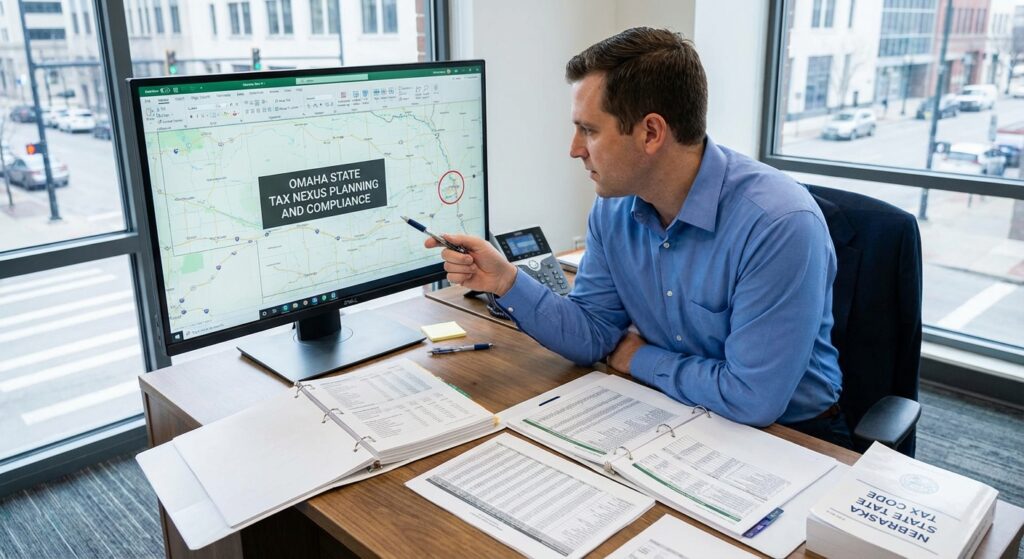
Understanding Omaha State Tax Nexus in 2026: A Complete Guide for Business Owners
For the 2026 tax year, understanding omaha state tax nexus is critical for business owners operating in or serving customers from Nebraska. Economic nexus rules determine when your business must collect and remit state sales taxes, and failing to comply can result in significant penalties. This guide covers everything you need to know about tax nexus in Omaha and how to position your business for success in 2026.
Table of Contents
- Key Takeaways
- What Is Economic Nexus and How Does It Affect Omaha Businesses in 2026?
- What Are the Current Nexus Thresholds for Omaha and Nebraska in 2026?
- What Types of Nexus Trigger Tax Obligations in Omaha?
- How Do You Calculate Whether Your Business Has Nexus in Nebraska?
- What Compliance Steps Must Omaha Businesses Take for 2026 Tax Nexus?
- Uncle Kam in Action
- Next Steps
- Frequently Asked Questions
- Related Resources
Key Takeaways
- Economic nexus means your business must collect sales taxes in Nebraska once you exceed specific sales or transaction thresholds, regardless of physical presence.
- For 2026, businesses should monitor their sales activity closely to determine if they trigger nexus obligations in Omaha and Douglas County.
- State-level trends show increased scrutiny on nexus exposure, with many states expanding tax bases and decoupling from federal code.
- Failing to register and collect taxes when nexus exists can trigger significant penalties, interest, and audit exposure for your business.
- Professional guidance ensures your omaha state tax nexus strategy aligns with current regulations and protects your bottom line.
What Is Economic Nexus and How Does It Affect Omaha Businesses in 2026?
Quick Answer: Economic nexus is when a business must collect sales taxes based on sales volume or transaction frequency, even without physical presence in a state.
The concept of economic nexus transformed state tax compliance after the 2018 South Dakota v. Wayfair Supreme Court decision. This ruling allowed states to require online and remote sellers to collect sales tax even when they have no physical location in the state. For Omaha businesses, understanding this shift is essential to determining your tax obligations in Nebraska.
Previously, only businesses with physical presence (like an office, warehouse, or employees) had to collect state taxes. Now, economic nexus is based on dollar thresholds or transaction counts. This means your remote business in another state might still owe Nebraska sales taxes if you exceed specified sales levels with Nebraska customers.
The Federal and State Shift Affecting Omaha Taxes
For 2026, state legislatures are likely to consider new revenue strategies including tax proposals and decoupling from federal code. This means Nebraska may adjust its nexus rules independently of federal tax changes. Businesses serving Omaha must stay vigilant about legislative updates that could expand what triggers tax obligations. Strategic tax planning helps you anticipate and manage these changes proactively.
The trend across states shows expansion of tax bases and increased scrutiny on remote sellers. Professional services, consulting, and e-commerce businesses are particularly exposed. States are also considering sales tax on services and new wealth taxes, signaling aggressive revenue collection postures in 2026 and beyond.
Why This Matters for Omaha Businesses
If you sell to Omaha or Douglas County customers from anywhere in the country, economic nexus rules determine your compliance obligations. Ignoring these rules exposes your business to audit assessments, penalties, and interest charges. Additionally, with federal tax law changes under the One Big Beautiful Bill Act of 2025, state-level adjustments are expected. Understanding your nexus position now puts you ahead of compliance deadlines and regulatory changes scheduled for 2026.
Pro Tip: Many Omaha businesses don’t realize they’ve triggered nexus. Conduct a nexus analysis quarterly to verify your position and adjust compliance accordingly.
What Are the Current Nexus Thresholds for Omaha and Nebraska in 2026?
Quick Answer: Nebraska follows federal economic nexus standards. Most states use $100,000 or 200 transactions annually as thresholds, though Nebraska’s specific thresholds may vary by transaction type.
The challenge with omaha state tax nexus is that thresholds differ by transaction category and can change year to year. For the 2026 tax year, businesses should monitor the Nebraska Department of Revenue for updated guidance on what constitutes nexus. The threshold-based system typically works like this: once your annual sales into Nebraska exceed a certain dollar amount (commonly $100,000 or $500,000) or you complete a certain number of transactions, you establish nexus.
Standard Thresholds in Use for 2026
Many states use the following framework for economic nexus:
- Sales Dollar Threshold: Typically $100,000-$500,000 in annual sales into the state.
- Transaction Count Threshold: Usually 100-200 separate transactions annually.
- Affiliate Nexus: Related entities’ combined sales count toward your threshold.
- Marketplace Facilitator Rule: Platforms like Amazon must collect taxes on your behalf if you meet thresholds.
For businesses targeting Omaha specifically, understanding Douglas County’s local tax rates becomes important. Omaha has additional sales tax on top of state rates, so your tax collection obligations depend on where the customer receives the product or service. Items delivered to Omaha addresses trigger both state and local tax liability.
Getting Current Threshold Information
Since tax laws change frequently, you should verify current thresholds directly from the Nebraska Department of Revenue official website. Additionally, working with a qualified tax advisory professional ensures you interpret threshold rules correctly for your specific business model and product types.
Did You Know? Many business owners don’t realize that Omaha’s local sales tax rate adds approximately 1.25% on top of the state 5.5% base rate, making total tax collection responsibility about 6.75% for Omaha deliveries.
What Types of Nexus Trigger Tax Obligations in Omaha?
Quick Answer: Multiple nexus types exist: physical (employees, offices), economic (sales volume), click-through (affiliate links), and affiliate nexus (related company sales).
Understanding all nexus types helps you determine your actual tax exposure. Many business owners focus only on economic nexus and miss other obligations. For Omaha businesses, nexus can arise from multiple sources simultaneously, compounding compliance requirements.
Physical Nexus (Traditional)
This is the oldest form of nexus. If your business has any physical presence in Nebraska—including employees, offices, warehouses, inventory, or equipment—you establish nexus. Even temporary presence like a trade show booth can create nexus obligations. For Omaha specifically, having any staff member or location in Douglas County creates immediate sales tax compliance requirements.
Economic Nexus (2026 Focus)
Economic nexus is the primary concern for online sellers and remote businesses. This nexus type depends entirely on your sales volume into Nebraska. Many businesses face surprise nexus obligations when they exceed thresholds during peak seasons or after successful marketing campaigns.
Affiliate and Click-Through Nexus
If you pay commissions to Omaha-based websites, bloggers, or influencers to promote your products, you may establish affiliate nexus. Similarly, if an Omaha resident clicks a link you provided, makes a purchase, and you pay them a commission, nexus may apply. These requirements vary by state, making Omaha’s specific rules critical to understand.
| Nexus Type | Triggered By | Example |
|---|---|---|
| Physical | Employees, offices, inventory in state | Omaha warehouse or sales office |
| Economic | Sales volume exceeding threshold | $250,000+ annual sales to Nebraska |
| Affiliate | Commission payments to state residents | Paying Omaha influencer for promotions |
| Marketplace | Sales through Amazon, eBay, Shopify | Using platform marketplace fulfillment |
How Do You Calculate Whether Your Business Has Nexus in Nebraska?
Quick Answer: Calculate total annual sales to Nebraska customers (including affiliate sales). If above threshold, you have economic nexus and must register for 2026.
Many businesses miss nexus by using incomplete sales calculations. Here’s the correct approach for determining your omaha state tax nexus position in 2026.
Step-by-Step Nexus Calculation Process
- Step 1: Review all sales records for Nebraska-shipped orders in the past 12 months. Include direct sales, wholesale, affiliate, and marketplace sales.
- Step 2: Add related entity sales (parent company, subsidiaries, etc.) to your total. Combined affiliate sales count toward thresholds.
- Step 3: Compare total to your state’s threshold. Most states use either $100,000 or $500,000 as primary thresholds.
- Step 4: If above threshold, register with Nebraska immediately and begin collecting sales tax.
- Step 5: Calculate back taxes if you’ve been above threshold for previous years. File amended returns and pay liabilities.
Example Calculation for Omaha Business
Suppose you own an online retailer based in Colorado selling to Nebraska customers. Your 2026 sales breakdown:
- Direct website sales to Nebraska: $275,000
- Amazon marketplace sales (shipped to Nebraska): $85,000
- Affiliate commission sales: $15,000
- Total: $375,000
If Nebraska’s threshold is $100,000, you clearly have economic nexus and must collect tax on all Nebraska sales. This includes going back to collect tax on previously untaxed orders if you’ve been above the threshold for multiple years.
Pro Tip: Use your merchant processor reports and tax software to pull accurate sales data automatically. Manual calculations often miss categorized transactions.
What Compliance Steps Must Omaha Businesses Take for 2026 Tax Nexus?
Quick Answer: Register for a sales tax permit, collect tax from customers, file monthly/quarterly returns, and remit taxes to Nebraska.
Once you determine you have omaha state tax nexus, immediate action is required. Delaying compliance creates back tax liability, penalties, and interest that compound quickly. For the 2026 tax year, you should complete these steps immediately upon discovering nexus.
Step 1: Register for Nebraska Sales Tax Permit
Visit the Nebraska Department of Revenue sales tax page and complete registration. You’ll receive a permit number, which you need on all returns. Registration typically takes 1-2 weeks. This is the legal requirement that establishes your authority to collect taxes.
Step 2: Update Your Pricing and Collection Systems
Integrate your tax software with shopping carts, invoicing systems, and payment processors. For 2026, most platforms support dynamic tax calculation based on delivery address. Configure systems to calculate Omaha-specific rates (including Douglas County local tax) for all orders shipped to that region.
Step 3: Establish Filing and Payment Schedules
Nebraska requires sales tax returns either monthly or quarterly based on your sales volume. Set calendar reminders for filing deadlines, usually 20 days after the period ends. Many tax services offer auto-filing to ensure compliance.
Step 4: Handle Past Liability
If you’ve been above the nexus threshold for previous tax years without collecting, file voluntary disclosure returns. This protects against larger penalties and shows good faith compliance. Calculate back taxes based on previous year sales, file amended returns, and pay current liability plus any applicable interest.
| Compliance Task | Timeline | Key Detail |
|---|---|---|
| Register for Sales Tax | Within 2-4 weeks | Required before collecting any taxes |
| Configure Tax Collection | Before first sale | Ensures accurate collection from first order |
| File First Return | By due date (20 days after period) | Late filing triggers penalties |
| Pay Back Tax Liability | As soon as possible | Interest accrues daily; file voluntary disclosure |
Pro Tip: Many businesses benefit from working with a business solutions provider to automate tax compliance. This reduces manual work and ensures consistent, accurate compliance throughout 2026.

Uncle Kam in Action: E-Commerce Retailer Identifies and Manages Omaha Tax Nexus
Client Snapshot: Sarah owned an online home goods retailer based in Kansas. She sold products nationwide through her website and Amazon. Her business was profitable, averaging $300,000 annually in revenue, with strong growth in the Midwest region including Nebraska.
Financial Profile: Annual revenue: $450,000 (2025-2026 projection). Target market: Direct-to-consumer online sales plus wholesale partnerships. Geographic concentration: 35% Midwest sales, with 12% specifically to Nebraska customers.
The Challenge: Sarah didn’t understand omaha state tax nexus requirements. She’d been collecting sales tax in some states but not others, creating inconsistent compliance. When a customer inquiry about an invoice raised tax questions, she realized she might owe back taxes in states where she exceeded thresholds. Specifically, her Nebraska sales had grown to approximately $125,000 annually, but she’d never registered or collected taxes there.
The Uncle Kam Solution: We conducted a nexus analysis across all states where she sold products. For Nebraska specifically, we identified that her direct website sales ($95,000) plus Amazon marketplace sales ($40,000) totaled $135,000—well above typical thresholds. We registered her for a Nebraska sales tax permit and calculated back tax liability for the prior 18 months. Using conservative estimates at 6.75% combined state and Omaha local rate, her back liability was approximately $13,500 plus interest.
Rather than face larger penalties and interest from an audit, Sarah filed a voluntary disclosure return for prior years. This approach significantly reduced her penalty exposure. We then configured her Shopify store to automatically calculate and collect Nebraska taxes, ensuring future compliance. For 2026, Sarah implemented systems to track sales by state, making annual nexus determinations simple.
The Results:
- Back Tax Liability: $13,500 (instead of $18,000+ with penalties)
- Investment: $4,500 in setup, registration, and compliance consulting
- Return on Investment: Avoided $4,500+ in additional penalties (a 1.0x breakeven) plus protected against future audit exposure worth thousands more. This is just one example of how our proven tax strategies have helped clients achieve significant savings and peace of mind.
Going forward, Sarah’s business automatically collects and remits taxes in 8 states where she has nexus, including Douglas County’s local tax for Omaha deliveries. Her compliance costs are minimal with automated systems, and she’s protected against future audit exposure.
Next Steps
- Review Your Sales History: Pull 12 months of sales data, broken down by state and customer address. Identify all Nebraska deliveries to calculate your nexus position accurately.
- Verify Nexus Thresholds: Check the current Nebraska threshold on the Department of Revenue website. Confirm whether your sales exceed any nexus triggers for 2026.
- Assess Back Tax Exposure: Calculate if you’ve been above threshold for prior years. Determine whether filing a voluntary disclosure return makes sense for your situation. Get professional guidance from a tax preparation service specializing in Omaha businesses to evaluate your specific circumstances and develop a recovery strategy.
- Implement Compliance Systems: Set up automated tax calculation and filing. Configure your sales platform to collect taxes at checkout and file returns on schedule.
- Monitor Regulatory Changes: Subscribe to Nebraska Department of Revenue updates. Laws can change quickly, especially during state legislative sessions when new tax proposals are debated.
Frequently Asked Questions
Can I be held liable for past taxes on sales made before I knew about nexus requirements?
Yes. Ignorance of nexus rules doesn’t provide legal protection. Once you establish nexus for 2026, you become liable for uncollected taxes from past periods when you were above threshold. However, filing a voluntary disclosure return can significantly reduce penalties. Many states offer amnesty or reduced penalties if you self-report and pay voluntarily, so action now is better than waiting for audit notice.
What if my business operates in multiple states? Do nexus rules apply differently?
Yes. Each state has its own nexus thresholds and rules. You may have nexus in some states but not others. You must calculate nexus for every state individually and comply with each state’s specific requirements. This is where comprehensive entity structuring and multi-state planning becomes valuable for managing complex compliance.
Does selling through marketplaces like Amazon or Etsy eliminate my nexus obligations?
Marketplace facilitators like Amazon, eBay, and Shopify are required to collect and remit taxes in most states. However, you’re still liable for calculating nexus because these marketplace sales count toward your threshold. If you sell through multiple channels (your website, Amazon, and direct wholesale), all sales combine to determine your nexus position.
What happens if I don’t comply with nexus rules? What are the penalties?
Non-compliance triggers multiple penalties: failure-to-register penalties, failure-to-file penalties, failure-to-pay penalties, and interest on unpaid taxes. Penalties can range from 5% to 25% of unpaid tax, with interest accruing daily. An audit can uncover several years of non-compliance, resulting in liability that far exceeds the original taxes owed.
When should I register with Nebraska for 2026 if I’m borderline on the nexus threshold?
Register immediately if you expect to exceed the threshold at any point during 2026. It’s better to register early and not need the permit than to miss the deadline and face audit exposure. Early registration demonstrates good faith intent to comply and provides documentation if disputes arise.
Are there safe harbor rules or grace periods for businesses that recently triggered nexus?
Most states don’t offer formal grace periods, but some provide safe harbor protection if you register within 30-60 days of triggering nexus. Nebraska may offer guidance on when liability begins. Professional consultation helps determine the safest approach for your specific situation and state policies.
How often should I review my nexus position? Is annual review enough for 2026?
Annual reviews are the minimum. However, businesses with significant seasonal variation should review quarterly to ensure you catch the moment you exceed thresholds. Many states consider when the threshold is crossed (not the anniversary date) as the trigger date for compliance obligations.
Can I deduct sales taxes I collected from my gross revenue for income tax purposes?
No. Sales taxes collected from customers don’t reduce your income tax liability. They’re held in trust for the state. However, you can deduct sales tax you paid on business purchases and expenses as part of your cost of goods sold or business expense deductions.
Related Resources
- Strategic Tax Planning Services for Business Optimization
- Resources and Guidance for Business Owners
- Entity Formation and Tax Structure Planning
- Professional Tax Preparation and Filing Services
- Comprehensive Business Solutions and Automation
This information is current as of 02/03/2026. Tax laws change frequently. Verify updates with the IRS (IRS.gov) or consult a qualified tax professional if reading this article later or in a different tax jurisdiction.
Last updated: February, 2026

