
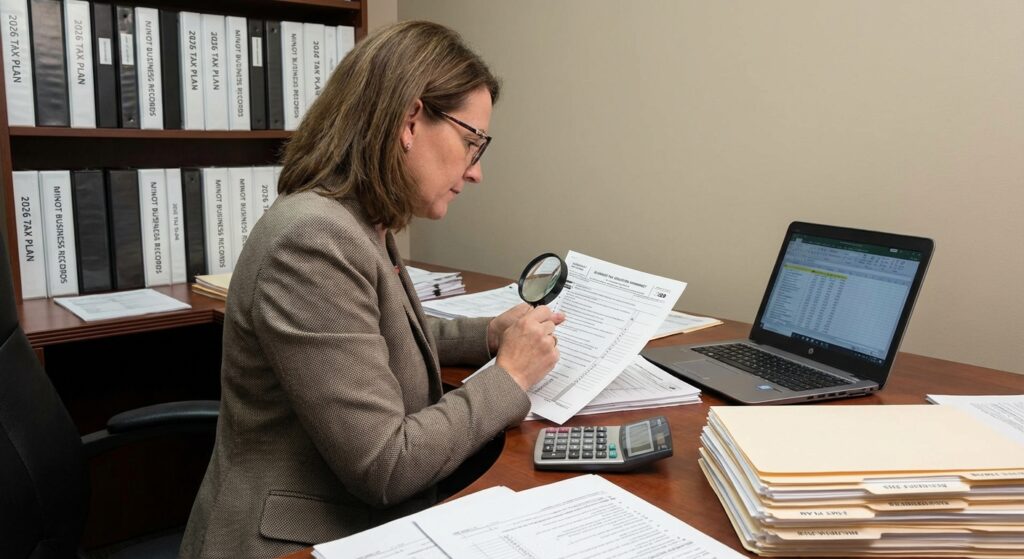
Complete Guide to Minot Business Tax Deductions for 2026: Maximize Your Deductible Expenses
For minot business tax deductions, 2026 brings significant opportunities to reduce your taxable income and put more money back in your pocket. Under the newly enacted One Big Beautiful Bill Act, business owners throughout North Dakota now have access to expanded deductions, higher standard deductions, and new tax breaks specifically designed to reward entrepreneurship. Whether you operate a sole proprietorship, LLC, or small corporation, understanding which minot business tax deductions you can claim is essential to optimizing your tax strategy.
Table of Contents
- Understanding Business Deductions and Schedule C Filing Requirements
- How 2026 Standard Deduction Increases Benefit Minot Business Owners
- Essential Business Expense Deductions You Cannot Afford to Miss
- Can You Deduct Your Home Office and Vehicle Expenses in 2026?
- How Equipment Depreciation and Section 179 Deductions Reduce Your Tax Bill
- Maximizing the Expanded SALT Deduction Cap for Minot Business Owners
- Next Steps
- Frequently Asked Questions
Key Takeaways
- For 2026, standard deductions increased to $15,750 (single), $31,500 (MFJ), and $23,625 (HOH).
- The SALT deduction cap temporarily increased to $40,000 through 2029.
- Qualified business income deductions remain valuable for reducing taxable business income.
- Minot business tax deductions for ordinary and necessary business expenses are fully deductible.
- Strategic tax planning with professional guidance maximizes deduction benefits.
Understanding Business Deductions and Schedule C Filing Requirements
Quick Answer: Minot business tax deductions reduce your taxable income through Schedule C (Form 1040), allowing you to deduct all ordinary and necessary business expenses while benefiting from 2026’s expanded deduction limits.
For minot business tax deductions, understanding the fundamentals is critical. If you operate a business as a sole proprietor or single-member LLC, you report business income and deductions on Schedule C. This form calculates your business profit or loss, which then flows to your individual tax return (Form 1040).
What Qualifies as an Ordinary and Necessary Business Expense?
The IRS defines deductible business expenses as ordinary and necessary. Ordinary means the expense is common for businesses in your industry. Necessary means it’s helpful and appropriate for your business operation. This broad definition covers hundreds of potential minot business tax deductions.
Common categories include supplies, utilities, professional services, advertising, insurance, and equipment. The key principle: if you incur the expense to generate business income, it’s typically deductible. Keep detailed records and receipts demonstrating the business purpose of each expense.
Recent Changes in 2026 Tax Law Affecting Business Deductions
The One Big Beautiful Bill Act, enacted in July 2025, significantly impacts minot business tax deductions for 2026. Standard deductions increased across all filing statuses, and the SALT deduction cap temporarily quadrupled. Additionally, business owners aged 65 and older now access new deductions of up to $6,000 annually.
These legislative changes mean strategic tax planning is more important than ever. Minot business owners should review all available deductions and adjust their tax strategy accordingly to maximize savings.
How 2026 Standard Deduction Increases Benefit Minot Business Owners
Quick Answer: For 2026, standard deductions increased to $15,750 (single), $31,500 (married filing jointly), and $23,625 (head of household), plus additional amounts for seniors aged 65 and older.
Understanding how standard deductions interact with minot business tax deductions is essential. For sole proprietors and business owners filing individual returns, the standard deduction represents a baseline reduction to taxable income before business deductions are even considered.
| Filing Status | 2026 Standard Deduction | Age 65+ Additional Deduction |
|---|---|---|
| Single | $15,750 | +$2,000 |
| Married Filing Jointly | $31,500 | +$3,200 (per spouse age 65+) |
| Head of Household | $23,625 | +$2,800 |
Comparing Standard vs. Itemized Deductions for Business Owners
Most minot business tax deductions are claimed on Schedule C and reduce business income before calculating adjusted gross income. However, some business expenses may be itemized on Schedule A instead. Business owners should calculate which approach yields greater tax savings.
Pro Tip: With the SALT cap temporarily increased to $40,000 for 2026, minot business owners in high-tax states may find itemizing more beneficial. Consult with a tax professional to determine your optimal strategy.
Essential Business Expense Deductions You Cannot Afford to Miss
Quick Answer: Minot business tax deductions include office supplies, professional services, advertising, insurance, utilities, licenses, and employee wages—essentially any ordinary and necessary expense directly tied to business operations.
Many minot business owners miss valuable deductions simply because they’re unaware these expenses qualify. A comprehensive approach to minot business tax deductions requires understanding common deductible categories and maintaining meticulous records.
Office Supplies, Materials, and Inventory
Every dollar spent on office supplies, raw materials, or inventory used in your business qualifies as minot business tax deductions. This includes paper, pens, software subscriptions, website hosting, and materials consumed in product production. The IRS allows full deductions for these items as they’re directly consumed in business operations.
Maintain an itemized list of all supplies and materials purchased throughout the year. Digital expense tracking through accounting software simplifies this process and provides organized documentation for audit purposes.
Professional Services and Contractor Payments
Fees paid to accountants, attorneys, consultants, and contractors constitute valuable minot business tax deductions. If you hire someone to perform services essential to your business operation, that expense reduces your taxable income. Be sure to issue 1099 forms to non-employee contractors as required by the IRS.
This category also includes business coaching, tax preparation services, and specialized consulting. These investments in professional expertise directly support your business success and qualify for full deductions.
Insurance, Licenses, and Permits
Business insurance premiums, professional licenses, and regulatory permits are fully deductible minot business tax deductions. This includes liability insurance, professional insurance, business permits, and regulatory fees specific to your industry.
Health insurance premiums for self-employed individuals also offer deduction benefits. The self-employed health insurance deduction allows eligible business owners to deduct health insurance premiums, providing another avenue for minot business tax deductions.
Can You Deduct Your Home Office and Vehicle Expenses in 2026?
Quick Answer: Yes. Home office deductions require regular and exclusive business use. Vehicle deductions use either actual expense method or standard mileage rate. Both significantly reduce taxable income for minot business owners.
Home office and vehicle expenses represent some of the largest minot business tax deductions available to entrepreneurs. Many business owners underutilize these deductions due to complexity or uncertainty about eligibility. However, with proper documentation and understanding of current rules, these deductions can substantially reduce your tax liability.
Home Office Deduction: Simplified vs. Regular Method
The IRS offers two methods for claiming home office minot business tax deductions. The simplified method allows $5 per square foot of dedicated office space, up to 300 square feet, for a maximum deduction of $1,500 annually. This requires minimal documentation.
The regular method calculates actual expenses including rent (or mortgage interest), utilities, insurance, and depreciation based on the percentage of your home used for business. While more complex, this typically yields larger minot business tax deductions. Use Form 8829 to report home office deductions and maintain careful records of qualifying expenses.
Vehicle Mileage and Transportation Deductions
Business vehicle use generates substantial minot business tax deductions through either the standard mileage method or actual expense method. The standard mileage rate for business use changes annually. Track all business mileage meticulously using a contemporaneous mileage log.
The actual expense method allows deduction of all vehicle operating costs including fuel, maintenance, insurance, and depreciation. Whichever method you choose, consistency matters. Document your business purpose for each trip and maintain receipts for all vehicle-related expenses.
Did You Know? Vehicle expenses for commuting from home to a regular business office don’t qualify for minot business tax deductions. However, travel between multiple business locations, client visits, and trips to acquire supplies are deductible.
How Equipment Depreciation and Section 179 Deductions Reduce Your Tax Bill
Quick Answer: Section 179 allows immediate deduction of eligible business property up to annual limits, accelerating minot business tax deductions while standard depreciation spreads deductions over the asset’s useful life.
Equipment, machinery, and property purchases offer significant minot business tax deductions through Section 179 expensing and depreciation. These provisions allow you to recover your investment in business assets while reducing your current year’s taxable income.
Understanding Section 179 Expensing
Section 179 expensing allows minot business owners to deduct the full cost of qualifying business property in a single year rather than depreciating it over multiple years. This aggressive deduction strategy accelerates tax savings and improves cash flow.
Qualifying property includes equipment, machinery, computers, software, and tangible business property. The annual Section 179 deduction limit changes with inflation. For businesses with significant equipment purchases, Section 179 represents one of the most valuable minot business tax deductions available.
Bonus Depreciation and Cost Recovery
Beyond Section 179, bonus depreciation allows additional first-year deductions for qualified property. Combining Section 179 with bonus depreciation maximizes early-year minot business tax deductions while spreading remaining costs over the asset’s useful life.
Standard depreciation applies to assets not claimed under Section 179 or bonus depreciation. Depreciation periods vary by asset type. Consult local tax preparation experts to optimize your equipment deduction strategy across multiple assets and tax years.
Maximizing the Expanded SALT Deduction Cap for Minot Business Owners
Quick Answer: The SALT (State and Local Tax) deduction cap temporarily increased to $40,000 for 2026-2029, allowing minot business owners to deduct far more in state and local taxes against federal income.
The expanded SALT deduction cap represents a temporary advantage for minot business owners in higher-tax states. Under prior law, the SALT deduction was limited to $10,000 annually. For 2026, the cap is temporarily raised to $40,000, though this increase expires after 2029.
Qualifying Expenses Within the SALT Deduction
The SALT deduction includes state and local income taxes, property taxes, and sales taxes. Business owners often overlook minot business tax deductions through SALT when they operate in multiple jurisdictions or pay significant state business taxes. The temporary increase to $40,000 creates a narrow window for strategic planning.
Calculate your total SALT liability including state income taxes, property taxes, and any local business taxes. Many minot business owners discover they can now deduct previously non-deductible amounts, making 2026-2029 critical years for tax planning.
| SALT Component | Example for Minot Business | Deduction Timing |
|---|---|---|
| State Income Taxes | North Dakota income tax on business earnings | When paid or accrued |
| Property Taxes | Real estate taxes on business property | When paid or accrued |
| Local Business Taxes | City or county business taxes | When paid or accrued |
Strategic Planning for the Temporary SALT Increase
Since the SALT cap increase expires after 2029, minot business owners should maximize this temporary advantage. Consider timing large estimated tax payments or property tax installments to optimize deductions during high-income years.
This temporary window creates planning opportunities not available under the previous $10,000 cap. Professional tax strategists recommend reviewing your multi-year tax picture to determine if bunching deductions or accelerating payments makes sense for your specific situation.

Uncle Kam in Action: A Minot Business Owner Captures $18,500 in Hidden Deductions
Client Profile: Sarah, a 52-year-old graphic design consultant in Minot, operated her business as a sole proprietor for five years, generating approximately $95,000 in annual revenue. Despite careful record-keeping, she was unaware of several deduction categories available under 2026 minot business tax deductions rules.
The Challenge: Sarah filed her own taxes using basic tax software, claiming only obvious deductions like supplies and internet. She didn’t realize her dedicated home office qualified for substantial deductions, didn’t track business miles for client meetings, and paid professional consultation fees without capturing them as business expenses. Additionally, she wasn’t maximizing the expanded SALT cap for state taxes.
The Uncle Kam Solution: Our team reviewed Sarah’s business operation comprehensively. We implemented the home office regular method deduction, which captured approximately $6,200 in annual rent allocation, utilities, and insurance. We established a business vehicle tracking system documenting client meeting miles, yielding $4,800 in annual mileage deductions. We also identified $3,500 in previously unclaimed professional development expenses and consulting fees. Finally, we optimized her state tax deduction by bunching property tax and state income tax payments to maximize the $40,000 SALT cap, capturing an additional $4,000 in deductions.
The Results: Sarah’s total minot business tax deductions increased from approximately $8,000 to $26,500—an increase of $18,500. Under 2026 tax rates, this translated to approximately $4,620 in annual tax savings. Sarah’s first-year investment of $1,995 in professional tax planning yielded a 2.3x return on investment while establishing systems to continue these savings indefinitely.
This is just one example of how our proven tax strategies have helped clients achieve significant savings. Sarah now maintains organized records throughout the year, tracks mileage automatically, and consults with us annually to optimize her minot business tax deductions as business circumstances evolve.
Next Steps
Now that you understand the breadth of minot business tax deductions available for 2026, take action to maximize your benefits:
- Audit your current business expense records to identify missed deduction categories.
- Implement vehicle mileage tracking and home office documentation systems.
- Calculate whether itemizing exceeds standard deduction with expanded SALT cap.
- Review Section 179 and depreciation opportunities for equipment purchased or planned.
- Consult with qualified tax professionals for customized deduction strategies specific to your situation.
Frequently Asked Questions
What’s the difference between Schedule C deductions and itemized deductions?
Schedule C deductions reduce your business income, which lowers both income tax and self-employment tax. Itemized deductions on Schedule A reduce taxable income but don’t affect self-employment tax. For minot business tax deductions, most business expenses go on Schedule C. Use Schedule A for non-business expenses like mortgage interest and charitable contributions. Many business owners benefit from Schedule C deductions first, then determine if additional itemization exceeds the standard deduction.
Can I deduct business expenses if I take the standard deduction?
Yes, absolutely. Business deductions on Schedule C are separate from the standard deduction. You claim minot business tax deductions on Schedule C regardless of whether you take the standard deduction or itemize. The standard deduction is a personal deduction applied to your overall taxable income after business income is calculated.
How much can I deduct for a home office if I’m self-employed?
Using the simplified method, you can deduct $5 per square foot of dedicated office space (maximum 300 square feet = $1,500). Using the regular method, you deduct the percentage of your home’s rent/mortgage interest, utilities, insurance, and depreciation based on office square footage. For a 200-square-foot office in a 2,000-square-foot home, you’d deduct 10% of home expenses. The regular method typically yields larger deductions for minot business tax deductions.
Are meal and entertainment expenses deductible in 2026?
Business meal expenses with clients, customers, or colleagues are generally 50% deductible as minot business tax deductions (100% for certain meals during travel). Entertainment expenses that directly precede or follow business discussions may qualify. However, meals where the primary purpose is social rather than business don’t qualify. Keep detailed notes documenting business purpose, attendees, and business outcomes for all meals claimed.
What documentation do I need for minot business tax deductions?
Maintain receipts, invoices, and supporting documents for all expenses. For vehicle mileage, keep a contemporaneous log showing date, destination, business purpose, and miles driven. For home office, document office dimensions and percentage of home use. For meals, note attendees and business purpose. The IRS may request substantiation up to three years after filing (six years for substantial underreporting). Digital record storage using accounting software provides organized documentation and audit protection.
How do Section 179 deductions and depreciation differ?
Section 179 allows immediate deduction of asset costs in a single year. Depreciation spreads deduction over the asset’s useful life (usually 3-7 years). Section 179 accelerates tax savings for businesses making significant equipment purchases. You choose which minot business tax deductions strategy maximizes current-year benefits. However, Section 179 has annual limits and income phase-outs, so not all assets or all amounts may qualify.
Should I hire a tax professional to maximize minot business tax deductions?
Professional tax guidance often pays for itself many times over through identified deductions you’d miss independently. Complex situations involving multiple deduction categories, equipment purchases, or SALT optimization particularly benefit from professional planning. A tax strategist reviews your complete financial picture and identifies deduction opportunities across all categories, often recovering investment within the first year through tax savings.
This information is current as of 2/2/2026. Tax laws change frequently. Verify updates with the IRS or consult a tax professional if reading this later.
Last updated: February, 2026

