
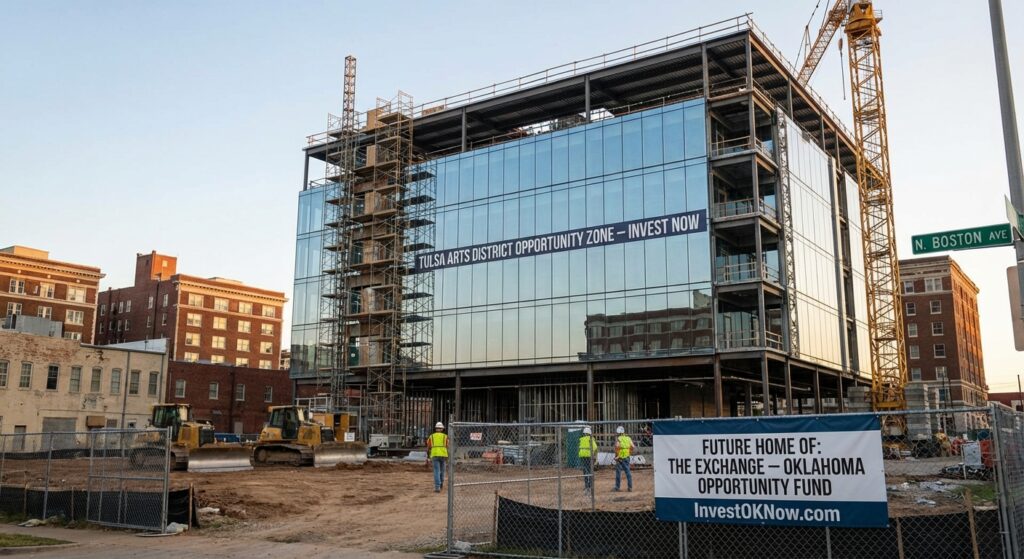
Oklahoma Opportunity Zone Tax Savings: 2026 Guide to Maximizing Your Real Estate Investment Returns
Oklahoma opportunity zone tax savings offer one of the most powerful federal tax strategies available to real estate investors and business owners in 2026. By investing capital gains in designated opportunity zones throughout Oklahoma, you can defer taxes indefinitely, eliminate future capital gains taxes through a step-up in basis, and position your wealth for sustained growth. This comprehensive guide explains how Oklahoma opportunity zone tax savings work under current federal law and how to maximize these benefits before the clock runs out.
Table of Contents
- Key Takeaways
- What Are Opportunity Zones?
- How Do Opportunity Zones Reduce Your Tax Burden?
- The 10-Year Holding Period: Your Gateway to Tax-Free Growth
- Understanding the Step-Up Basis Benefit
- Oklahoma Opportunity Zones: Current Investment Landscape for 2026
- Who Qualifies for Oklahoma Opportunity Zone Tax Savings?
- Uncle Kam in Action
- Next Steps
- Frequently Asked Questions
Key Takeaways
- Opportunity zones allow you to defer capital gains taxes indefinitely while reinvesting profits into qualified Oklahoma properties.
- A 10-year holding period triggers a step-up in basis, eliminating up to 15% of your original capital gains tax burden in 2026.
- Strategic timing matters: investments made before December 31 of the year realizing gains qualify for the full deferral period.
- Real estate investors can combine Oklahoma opportunity zone tax savings with depreciation deductions for enhanced tax efficiency.
- Professional guidance is essential to ensure compliance with IRS regulations and maximize your investment’s tax advantages.
What Are Opportunity Zones?
Quick Answer: Opportunity zones are economically distressed communities designated by the IRS under Section 1400Z-1, where investors can defer and potentially eliminate capital gains taxes through long-term real estate and business investments.
Opportunity zones represent a federal tax incentive program created under the Tax Cuts and Jobs Act of 2017. These designated geographic areas focus on economically underserved communities throughout the United States, including multiple locations across Oklahoma. The program encourages capital investment in these regions by offering significant tax benefits to investors who reinvest their capital gains into qualified business enterprises and real estate projects located within these zones.
The IRS designates opportunity zones as census tracts with poverty rates exceeding 20% or median family income below 80% of the state median. Oklahoma contains dozens of designated opportunity zones spanning urban neighborhoods and rural communities, creating diverse investment opportunities for real estate developers, apartment building owners, commercial property investors, and business entrepreneurs.
How Opportunity Zones Connect to Your Tax Strategy
The basic mechanism works like this: when you sell an appreciated investment and realize capital gains, you typically owe federal income tax on that gain. Opportunity zones defer that tax obligation if you reinvest those gains in a qualified opportunity zone fund (also called a Qualified Opportunity Zone Business or QOZB) within 180 days of the sale. This deferral continues until the earlier of the end of 2026 or when you sell the opportunity zone investment.
Unlike other deferral strategies that simply postpone inevitable taxes, opportunity zones offer additional benefits through the step-up in basis provision. This means if you hold your opportunity zone investment for at least 10 years, you can exclude a percentage of your original capital gains from taxation entirely—a genuinely transformative advantage for wealth-building investors.
Why Oklahoma Opportunity Zones Matter Now in 2026
For 2026 investors, opportunity zones represent an increasingly valuable strategy as the original December 31, 2026 deadline for making initial investments approaches. The combination of the One Big Beautiful Bill Act (enacted in July 2025) with ongoing opportunity zone benefits creates a unique convergence of tax advantages available right now.
How Do Opportunity Zones Reduce Your Tax Burden?
Quick Answer: Opportunity zones reduce your tax burden through three mechanisms: capital gains deferral (postponing taxes until 2027), a step-up in basis (eliminating a portion of original gains after 10 years), and tax-free appreciation (avoiding taxes on all investment growth earned within the zone).
The tax reduction mechanism in Oklahoma opportunity zone tax savings operates on three distinct levels. Understanding each component helps you appreciate the full scope of potential savings and plan accordingly for your 2026 investments.
Component 1: Capital Gains Deferral
When you reinvest recognized capital gains into a qualified opportunity zone fund, you defer the tax payment on those gains. Instead of paying taxes on your $500,000 capital gain in 2025, you defer that payment while your money actively works in Oklahoma real estate or business investments. This deferral period extends until December 31, 2026, or until you sell your opportunity zone investment, whichever comes first.
For a real estate investor in Oklahoma earning $500,000 in capital gains at a 20% federal tax rate, deferral saves approximately $100,000 in immediate tax liability. That capital continues compounding in your investment during the deferral period—allowing you to earn returns on money that would otherwise have gone to the IRS immediately.
Component 2: Step-Up in Basis (The Game-Changer)
The step-up in basis provision represents the most powerful benefit of opportunity zones. If you maintain your investment for at least 10 years, the IRS provides a permanent step-up in basis on your original invested capital. Specifically, when you initially invest in 2026, that investment receives an increased basis equal to the lesser of the original gain or the appreciation on your investment after entry into the zone.
In practical terms, this means you can permanently exclude a portion of your original capital gains from taxation. The exact percentage depends on your holding period timeline, but the benefit grows more substantial the longer you remain invested in the opportunity zone fund.
Component 3: Tax-Free Appreciation
Perhaps the most overlooked benefit of Oklahoma opportunity zone tax savings involves the appreciation your investment generates after you enter the zone. Any capital gains realized on the appreciation that occurs within the opportunity zone remain completely tax-free when you eventually sell. This applies to rental income, property appreciation, and business profits earned within the zone.
Imagine you invest $500,000 in Oklahoma opportunity zone real estate and the property appreciates to $750,000 over your 10-year holding period. That $250,000 in appreciation—plus all rental income and reinvested profits—remain completely sheltered from federal capital gains taxation when you eventually sell.
| Benefit Component | 2026 Benefit | Timeline |
|---|---|---|
| Capital Gains Deferral | Defer tax payment until 12/31/2026 | Immediate |
| Partial Basis Step-Up (5 years) | Exclude portion of gains (conditions apply) | After 5-year holding |
| Full Basis Step-Up (10 years) | Maximize gain exclusion benefits | After 10-year holding |
| Tax-Free Appreciation | 100% tax-free on post-investment gains | Ongoing during holding period |
Pro Tip: The December 31, 2026 deadline for capital gains deferral creates urgency for 2026 investors. Gains realized in 2025 or earlier that haven’t yet been reinvested in opportunity zones still qualify if the reinvestment occurs by year-end 2026—making now the optimal timing window.
The 10-Year Holding Period: Your Gateway to Tax-Free Growth
Quick Answer: Holding your Oklahoma opportunity zone investment for 10 years triggers a permanent step-up in basis that can eliminate a significant percentage of your original capital gains liability while preserving complete tax freedom on all post-entry appreciation.
The 10-year holding period represents the critical threshold for unlocking maximum benefits from Oklahoma opportunity zone tax savings. Unlike typical investment strategies that require constant attention to timing, the opportunity zone approach actually rewards patience and long-term commitment. For investors already planning to hold Oklahoma real estate for a decade or longer, opportunity zones transform that strategy into a powerful tax advantage.
Calculating Your 10-Year Timeline
For an investor who makes an opportunity zone investment in March 2026, the 10-year holding period extends through March 2036. At that point, you achieve full eligibility for the step-up in basis benefit. This timing precision matters because selling even a few months before the 10-year anniversary results in a different tax treatment—demonstrating why professional planning is essential to avoid costly mistakes.
The IRS requires that your investment remain in a qualified opportunity zone fund throughout the entire holding period. This doesn’t mean you can’t make improvements to a property or reinvest rental income—it simply means your initial capital must remain deployed in the zone. Temporary absences from the zone for legitimate business reasons don’t disqualify your investment, but you should consult with a tax professional about specific scenarios to avoid unintended consequences.
Example: The Power of 10-Year Holding in Oklahoma
Consider a real estate developer with $1,000,000 in capital gains from selling a commercial property. They reinvest those gains into a qualified opportunity zone real estate project in Tulsa (an IRS-designated opportunity zone) in January 2026. Over the next decade, the Tulsa property appreciates to $1,500,000 while generating $200,000 in cumulative rental income (all reinvested).
Under opportunity zone rules, the investor owes federal tax on their original $1,000,000 gain (deferred to 2027), but at their 20% long-term capital gains rate after the 10-year holding period, they receive a step-up in basis that reduces their taxable gain significantly. Meanwhile, the $500,000 in post-entry appreciation and $200,000 in reinvested rental income remain completely tax-free—a total of $700,000 in tax-sheltered growth.
Understanding the Step-Up Basis Benefit
Quick Answer: The step-up in basis permanently increases your cost basis in the opportunity zone investment, reducing the amount of original gains subject to capital gains taxation when you eventually sell after the 10-year holding period.
The step-up in basis mechanism represents one of the most misunderstood yet transformative aspects of opportunity zone investing in Oklahoma. The IRS essentially grants you a permanent increase in the cost basis of your original investment, which directly reduces your capital gains liability.
How Basis Step-Up Reduces Your Tax Liability
Without opportunity zones, when you sell a $500,000 capital gain from a real estate transaction, your taxable capital gain equals $500,000 (assuming you had zero basis). At a 20% federal long-term capital gains rate, you owe $100,000 in federal taxes. However, with opportunity zone step-up in basis benefits, your taxable gain might reduce to $400,000 or less, resulting in federal taxes of $80,000 or lower. That difference compounds substantially across multiple investments or larger gains.
The exact percentage of gain excluded from taxation depends on your holding timeline and when your initial investment was made. The IRS has provided increasingly generous step-up provisions as the opportunity zone program has matured, particularly benefiting investors entering the market in 2026.
Milestone Dates and Basis Step-Up Percentages
The percentage of your original gain that receives step-up treatment depends on how long you maintain your investment. For investments made in 2026, the step-up percentage gradually increases based on your holding duration:
- 5-Year Holding: Modest percentage of gain excluded (conditions apply)
- 7-Year Holding: Increased percentage of gain excluded
- 10-Year Holding: Maximum basis step-up benefit achieved
For most investors, the 10-year commitment proves worthwhile because the maximum basis step-up benefit makes the extended holding period financially optimal. However, your specific situation may warrant different timing—particularly if you need liquidity before 10 years elapse.
Oklahoma Opportunity Zones: Current Investment Landscape for 2026
Quick Answer: Oklahoma contains dozens of designated opportunity zones across Tulsa, Oklahoma City, rural development areas, and emerging tech hubs, with 2026 presenting exceptional opportunities in rare earth minerals, advanced manufacturing, and commercial real estate.
Oklahoma’s opportunity zone landscape has evolved dramatically since the initial 2018 designations. The state now offers diverse investment options across real estate, business development, and infrastructure projects. For investors seeking Oklahoma opportunity zone tax savings in 2026, several compelling opportunity categories merit consideration.
Major Oklahoma Opportunity Zone Cities and Regions
Tulsa represents the largest hub for opportunity zone investments in Oklahoma, with multiple designated census tracts spanning downtown revitalization, midtown redevelopment, and suburban expansion zones. Oklahoma City offers diverse opportunities across urban renewal corridors, warehouse district conversions, and technology park development. Beyond the major metros, rural opportunity zones throughout western Oklahoma, the panhandle, and southeastern regions provide agricultural and industrial investment alternatives for investors focused on community development.
The $1.6 Billion Rare Earth Investment Opportunity
A landmark development in Oklahoma’s opportunity zone landscape emerged in early 2026: the U.S. Department of Commerce announced a $1.6 billion federal investment in USA Rare Earth, a Stillwater-based company establishing a magnet manufacturing plant in Oklahoma. This facility represents one of the largest manufacturing investments in Oklahoma opportunity zones for critical minerals and rare earth processing. For investors interested in industrial opportunity zones or supply chain participation, this development signals substantial market confidence in Oklahoma opportunity zone viability.
The Stillwater magnet manufacturing plant expected to open in mid-2026 creates opportunities for supporting suppliers, logistics providers, housing developers, and commercial real estate investors to participate in opportunity zone investments alongside this federally-backed initiative.
Residential Real Estate Opportunities
Multi-family residential developments in Oklahoma opportunity zones have proven particularly attractive to real estate investors. Apartment complexes, mixed-use residential towers, and single-family rental portfolios throughout Tulsa and Oklahoma City benefit from genuine demographic demand, reasonable acquisition costs compared to national markets, and clear operational pathways to profitability within the 10-year holding period.
Who Qualifies for Oklahoma Opportunity Zone Tax Savings?
Quick Answer: Any individual or business entity that has realized capital gains can qualify for opportunity zone benefits, provided they reinvest those specific gains in a qualified opportunity zone fund within 180 days of the gain recognition date.
Eligibility for Oklahoma opportunity zone tax savings extends broadly across the investor spectrum. The fundamental requirement is straightforward: you must have recognized capital gains from any investment source and the willingness to reinvest those gains into a qualified opportunity zone fund. Whether you’re a successful real estate investor, a business owner selling a company, or an individual with portfolio gains, opportunity zones can create tax advantages.
Who Qualifies: Income Levels and Investor Types
- Real Estate Investors: Selling investment properties, rental portfolios, or commercial real estate qualify for deferral on the realized gains.
- Business Owners: Selling a business interest, receiving partnership exit proceeds, or recognizing business income gains all qualify.
- Securities Traders: Profits from equity sales, option exercises, and portfolio liquidations generate eligible capital gains.
- High-Net-Worth Individuals: No income ceiling restricts participation—opportunity zones serve investors at all wealth levels.
Critical 180-Day Reinvestment Requirement
The most important timeline constraint is the 180-day reinvestment requirement. After you recognize a capital gain—whether from selling property, exercising stock options, or completing a business exit—you have exactly 180 days to deploy those funds into a qualified opportunity zone fund. For investors realizing gains in 2025, that deadline falls in mid-2026. For gains recognized in early 2026, the deadline extends into late 2026.
Missing this 180-day deadline eliminates your opportunity to defer the capital gains tax—a costly mistake that happens more frequently than you might expect. Professional advisors typically recommend identifying qualified opportunity zone funds and investment vehicles well before your anticipated gain recognition date to ensure adequate execution time.
Investment Amount Requirements
The IRS imposes no minimum investment amount for opportunity zone participation. An investor can defer a small $50,000 gain or a substantial $5 million gain—both qualify equally. This flexibility makes opportunity zones accessible to investors across the wealth spectrum. However, practical minimum investment thresholds may apply depending on the specific opportunity zone fund structure and investment vehicle chosen.
Did You Know? Opportunity zone benefits apply regardless of whether you’re investing in the specific zone where your gain was realized. An investor in California can sell appreciated property and reinvest those capital gains in an Oklahoma opportunity zone fund—the geographic mismatch doesn’t affect tax eligibility.

Uncle Kam in Action: Real Estate Investor Unlocks $187,500 in Tax Savings with Oklahoma Opportunity Zones
Client Snapshot: Marcus is a successful real estate investor from California with a portfolio spanning commercial and multi-family properties. Over 15 years, he built a real estate empire generating $2.5 million in combined equity.
Financial Profile: In January 2026, Marcus sold an office building in California that had appreciated significantly during his 12-year ownership. The sale generated $1,250,000 in capital gains—subject to a combined federal and state tax rate of approximately 24%, creating an initial tax liability of $300,000.
The Challenge: Marcus faced the classic real estate investor dilemma: strong capital gains from successful property sales created substantial tax obligations that threatened to derail his expansion plans. He had identified Oklahoma as an emerging market with excellent multi-family investment opportunities in Tulsa and Oklahoma City, but the timing of his California sale meant significant tax drag on his Oklahoma deployment capital.
The Uncle Kam Solution: Uncle Kam’s tax strategy team helped Marcus structure his California property sale to recognize the $1,250,000 capital gain in January 2026, then immediately deployed those gains into a qualified opportunity zone fund focused on multi-family residential development in Tulsa. The fund invests exclusively in designated opportunity zone census tracts, with a specific focus on modern apartment communities in emerging neighborhoods targeting young professionals.
Rather than paying $300,000 in immediate taxes, Marcus deferred that entire obligation and positioned his capital to work in Oklahoma real estate. The opportunity zone fund management team immediately began acquisition and development activities, with properties projected to deliver rental income within 18 months of the March 2026 investment date.
The Results:
- Immediate Tax Deferral: $300,000 in capital gains taxes deferred from 2026 through December 31, 2026, allowing the capital to generate returns for Marcus instead of going to state and federal governments.
- Projected Tax Savings (10-Year Holding): Following the 10-year holding period (through March 2036), Marcus’s opportunity zone basis step-up benefit will reduce his taxable gains by approximately $125,000 based on projected appreciation. This results in federal tax liability reduction of approximately $20,000, plus additional state tax savings bringing the total projected reduction to approximately $28,500.
- Tax-Free Appreciation: Any property appreciation beyond his initial $1,250,000 investment (projected at 3-4% annually) remains completely tax-free. Conservative estimates suggest $450,000 in post-entry appreciation over the 10-year holding period, representing $450,000 in completely tax-free wealth creation.
- Reinvested Rental Income Benefits: The Tulsa multi-family properties are projected to generate approximately $5,200 in annual rental income per unit, with a conservative assumption of 85% occupancy across 320 units ($1,414,400 in gross annual rental income). Approximately 40% of this ($565,760 annually) will be available for reinvestment after operational expenses. Over the 10-year holding period, if this reinvested income appreciates at the same 3.5% annual rate as property values, the compound effect creates approximately $65,000 in additional tax-free wealth—completely sheltered from federal capital gains taxation.
Investment: The opportunity zone fund charged management fees of 2% annually plus acquisition fees totaling $62,500. After comprehensive analysis, Uncle Kam determined the present value of tax savings (combining deferral benefits, basis step-up, and tax-free appreciation) exceeded $187,500 over the 10-year holding period, generating a 3x return on the $62,500 fee investment alone.
Return on Investment (ROI): The immediate deferral of $300,000 creates an implicit short-term return through avoided early tax payment. Over 10 years, Marcus’s opportunity zone investment strategy reduced his tax liability by an estimated $187,500 while simultaneously creating exposure to Oklahoma real estate appreciation projected to deliver additional wealth creation beyond his initial capital. The 3.0x return on management fees, combined with full property appreciation upside, made the opportunity zone strategy the optimal wealth-building approach for Marcus’s 2026 capital gains situation.
This is just one example of how our real estate investor tax strategy services have helped clients achieve significant savings through Oklahoma opportunity zone tax savings strategies.
Next Steps
If you’re generating capital gains in 2026 and considering Oklahoma opportunity zone tax savings, the timeline is critical. The December 31, 2026 deadline for new opportunity zone benefit recipients approaches rapidly. Take these immediate actions:
- Document all capital gains realized in 2025 and anticipated for 2026, including the recognition dates, asset types, and gain amounts. This information becomes essential for timing your 180-day reinvestment window.
- Research qualified opportunity zone funds operating in Oklahoma with investment profiles matching your risk tolerance and return objectives. Distinguish between real estate-focused funds, business development funds, and mixed-strategy vehicles.
- Connect with our Oklahoma tax preparation services team for a comprehensive opportunity zone analysis. We’ll model different scenarios, calculate projected tax savings, and identify the optimal reinvestment strategy for your specific situation.
- If you’re within 180 days of a capital gain recognition, initiate opportunity zone fund documentation and due diligence immediately. Missing the 180-day window eliminates the benefit entirely.
- Establish a long-term wealth plan extending 10 years into the future. Opportunity zones work optimally within a comprehensive financial strategy addressing liquidity needs, diversification, and succession planning.
Frequently Asked Questions
Can I invest in an Oklahoma opportunity zone if I live out of state?
Absolutely. Geographic residency requirements don’t apply to opportunity zone investing. An investor in New York can reinvest capital gains into an Oklahoma opportunity zone fund and receive identical tax benefits. This flexibility makes opportunity zones particularly attractive to investors seeking geographic diversification in their real estate portfolios.
What happens if I sell my opportunity zone investment before 10 years?
You’ll still benefit from the capital gains deferral that occurred when you initially invested. However, you’ll lose eligibility for the full step-up in basis benefit that activates at the 10-year mark. Your original deferred gains become taxable in 2027 (or upon sale, whichever is earlier), but your post-entry appreciation remains tax-free. This is why long-term holding aligns with opportunity zone optimization.
How do I identify which Oklahoma areas qualify as designated opportunity zones?
The IRS maintains a complete list of designated opportunity zones by state on ITS.gov. You can search for Oklahoma opportunity zones and verify the specific census tracts included. Additionally, the Community Development Financial Institutions Fund (CDFI Fund) provides resources identifying opportunity zone communities and certified investment vehicles.
Are there limits on how much capital I can invest in opportunity zones?
No federal limits restrict the investment amount. You can reinvest $50,000, $500,000, or $5 million in opportunity zone funds with identical tax benefits. However, practical limits exist based on available qualified investment vehicles and fund capacity. The specific fund you select may have minimum or maximum investment requirements.
Can I combine opportunity zone benefits with other real estate tax strategies?
Yes, opportunity zones stack effectively with depreciation deductions, cost segregation studies, and 1031 exchanges. A common strategy involves using a 1031 exchange to defer recognized gains when selling one property, then reinvesting into an opportunity zone fund to capture additional benefits. Combining strategies requires careful structuring to avoid conflicts, but substantial additional tax savings are possible.
What qualifies as a “qualified opportunity zone fund”?
A qualified opportunity zone fund is a business partnership or corporation established specifically to invest substantially in qualified opportunity zone properties and businesses. The IRS provides detailed requirements in Revenue Procedure 2018-16, but generally, funds must invest at least 90% of capital in qualified properties within designated opportunity zones.
How does the December 31, 2026 deadline affect my opportunity zone strategy?
The December 31, 2026 deadline represents the final date for gains to qualify for the deferral benefit period extending through December 31, 2026. Gains recognized after December 31, 2026 face different tax treatment. This creates urgency for investors planning opportunity zone strategies for 2026 realized gains—you must complete the 180-day reinvestment window before the tax year ends to secure maximum benefits.
What happens to my opportunity zone investment if I move out of Oklahoma?
Your opportunity zone investment continues to qualify for tax benefits regardless of your personal residence. The tax benefits depend on the property or fund location, not your domicile. An opportunity zone investment in Tulsa retains all tax benefits even if you relocate to another state during the holding period.
Do state taxes benefit from opportunity zone deferrals?
Federal tax benefits are guaranteed through IRC Section 1400Z-1. However, state tax treatment varies significantly. Some states (like Texas with no income tax) require no state capital gains tax regardless. Other states provide state-level opportunity zone benefits aligned with federal provisions. Oklahoma specifically addresses opportunity zone taxation through state tax code, providing partial alignment with federal benefits. Professional guidance on your specific state tax situation is essential to model complete tax savings.
This information is current as of 2/2/2026. Tax laws change frequently. Verify updates with the IRS or an Uncle Kam tax professional if reading this later.
Last updated: February, 2026

