
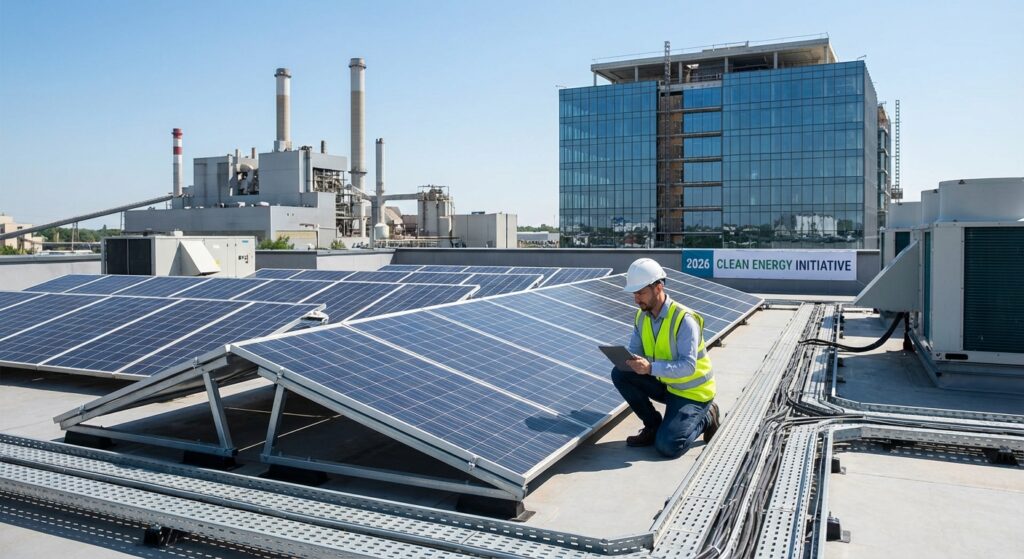
2026 Business Energy Investment Tax Credit: Complete Guide for Business Owners
For the 2026 tax year, business owners can unlock significant tax savings through the business energy investment tax credit, a federal incentive designed to encourage investments in renewable energy and energy-efficient property. Whether you’re installing solar panels, upgrading to energy-efficient HVAC systems, or investing in geothermal heating solutions, the business energy investment tax credit can substantially reduce your tax liability. This guide walks you through eligibility, calculation methods, recent regulatory changes, and strategic planning approaches to maximize your energy credit benefits in 2026.
Table of Contents
- Key Takeaways
- What Is the Business Energy Investment Tax Credit?
- What Property Qualifies for the Credit?
- How to Calculate Your Tax Credit
- Understanding Tariffs and Cost Allocations
- Domestic Content Bonus Opportunity
- Claiming the Credit on Your Tax Return
- Uncle Kam in Action
- Next Steps
- Frequently Asked Questions
- Related Resources
Key Takeaways
- The 2026 business energy investment tax credit provides a 30% credit for qualifying energy property, directly reducing your federal tax liability.
- Eligible property includes solar, wind, geothermal, energy-efficient HVAC, insulation, and fuel cell systems placed in service at your business.
- Tariff treatment remains fluid; work with advisors to ensure proper cost allocation for maximum credit value.
- The domestic content bonus can increase your credit by an additional 10% when equipment meets U.S. manufacturing requirements.
- Plan energy investments strategically to maximize savings and align with your overall 2026 tax strategy.
What Is the Business Energy Investment Tax Credit?
Quick Answer: The business energy investment tax credit is a 30% federal tax credit for business owners who invest in qualifying renewable energy and energy-efficiency property, directly reducing your 2026 federal tax liability dollar-for-dollar.
The business energy investment tax credit under Section 48 of the Internal Revenue Code is one of the most valuable federal incentives available to business owners. Unlike deductions, which reduce your taxable income, a tax credit directly reduces your federal tax liability. For every dollar of eligible investment, you receive 30 cents in tax credits, making energy efficiency investments far more attractive financially.
In 2026, the business energy investment tax credit applies to a broad range of energy property. The credit has no expiration date for renewable energy property, meaning you can lock in benefits for decades of investments. This permanence makes long-term energy planning more reliable than past temporary tax provisions.
How the Credit Works as a Direct Tax Reduction
A tax credit operates differently from a deduction. Consider this example: if your business invests $100,000 in qualified solar equipment in 2026, the 30% credit generates a $30,000 tax credit. This $30,000 credit directly reduces your federal income tax liability by $30,000—not your taxable income by $30,000. This distinction makes credits far more valuable than equivalent deductions.
Pro Tip: Business owners in the 32% to 37% federal tax brackets gain maximum benefit from energy credits. If your business sits in these brackets, prioritize energy investments early in 2026.
Historical Context and 2026 Policy Stability
Prior to recent legislation, business energy credits faced periodic expiration dates, creating planning uncertainty. Starting in 2025 and continuing through 2026, the business energy investment tax credit has been made permanent for renewable energy property. This eliminates the “cliff” risk where benefits vanished after specific dates, allowing business owners to plan long-term energy strategies with confidence.
What Property Qualifies for the Credit?
Quick Answer: Qualifying property includes solar systems, wind turbines, geothermal equipment, fuel cells, energy-efficient HVAC systems, insulation, and other energy property placed in service at your business location in 2026.
The business energy investment tax credit applies to a surprisingly broad range of energy property. Understanding eligible categories helps you identify hidden credit opportunities within your business operations. Many business owners overlook eligible investments simply because they don’t recognize which improvements qualify.
Renewable Energy Property
| Property Type | 2026 Credit Rate | Key Requirements |
|---|---|---|
| Solar Photovoltaic (PV) Systems | 30% | Must be placed in service at business; roof-mounted or ground-mounted qualifying |
| Wind Energy Systems | 30% | Turbines 100 kW or larger; must be placed in service at business location |
| Geothermal Heat Pumps | 30% | Closed-loop or open-loop systems; must heat/cool business facility |
| Fuel Cell Systems | 30% | 0.5 kW minimum capacity; must generate electricity on-site |
Energy Efficiency Improvements
The 2026 business energy investment tax credit extends beyond renewable power generation to include energy-efficient building components. These improvements often go unrecognized by business owners yet qualify for substantial credits.
- HVAC Systems: Energy-efficient heating, ventilation, and air conditioning systems that meet Department of Energy specifications qualify for 30% credit.
- Building Insulation: Roof, wall, and foundation insulation meeting efficiency standards qualifies for 30% credit.
- Windows and Doors: High-efficiency windows and doors meeting thermal requirements qualify for 30% credit.
- Roofing Systems: Cool roofs and reflective roofing materials that reduce cooling loads qualify for 30% credit.
Did You Know? Energy-efficient HVAC upgrades are among the most overlooked qualifying improvements. Many business owners replace aging systems without realizing a 30% tax credit is available, leaving thousands in unclaimed benefits.
How to Calculate Your Tax Credit
Quick Answer: The basic 2026 business energy investment tax credit calculation is straightforward: multiply the eligible basis (cost) by 30% to determine your credit amount. Additional bonuses may apply based on domestic content and wage requirements.
Basic Calculation Method
Calculating your business energy investment tax credit begins with establishing the “eligible basis”—the cost of the qualifying property. This typically includes the purchase price of equipment plus reasonable installation costs directly attributable to placing the property in service.
Formula: Eligible Basis × 30% = Business Energy Investment Tax Credit
For example, if your business installs a $50,000 solar photovoltaic system in 2026, the calculation is: $50,000 × 30% = $15,000 business energy investment tax credit. This $15,000 reduces your 2026 federal income tax liability directly.
Identifying Costs Included in Eligible Basis
Properly identifying which costs count toward eligible basis is critical for maximizing your credit. Overestimating eligible basis creates audit risk, while underestimating leaves money on the table.
- Includable Costs: Equipment purchase price, labor for installation, permitting fees, engineering analysis, system testing, and integration costs.
- Excludable Costs: Land acquisition, financing charges, property taxes, insurance, routine maintenance, and non-energy-related improvements.
Pro Tip: Document all capital improvement invoices separately from operating expenses. This paper trail supports your credit claim and protects against IRS challenges during audits.
Understanding Tariffs and Cost Allocations
Quick Answer: Tariff treatment for the business energy investment tax credit remains evolving. Generally, equipment costs before tariffs are applied count toward eligible basis, but Treasury guidance continues to develop in 2026.
One of the most complex 2026 issues affecting the business energy investment tax credit involves tariff treatment on imported equipment. As noted in industry petitions, the Wisconsin utility sector has lobbied Treasury for tariff exclusions in credit calculations. This ambiguity creates planning risk for business owners investing in imported solar panels, wind components, and other energy equipment.
Current Treasury Guidance on Cost Allocation
Under current Treasury guidance for 2026, the treatment of tariffs in eligible basis calculations depends on when tariffs are assessed and whether they’re included in purchase invoices.
- Tariffs in Invoice Price: If equipment invoices include tariff costs, those amounts typically count toward eligible basis for credit purposes.
- Tariffs Added Later: Tariffs assessed separately after invoicing remain subject to interpretation; documentation of timing is critical.
- Negotiated Tariff Treatment: Some suppliers negotiate tariff responsibility; clear contracts specifying allocation are essential for substantiation.
Tariff Impact on Project Economics
Tariff costs can significantly affect the return on energy investments. If tariffs are included in eligible basis, a solar project’s tax credit increases proportionally. If Treasury guidance changes to exclude tariffs, eligible basis decreases, reducing your credit accordingly.
For a $50,000 solar system with $5,000 in tariffs, the difference between inclusion and exclusion represents a $1,500 credit variance (30% × $5,000). For larger industrial installations, this can mean six-figure impact differences.
Domestic Content Bonus Opportunity
Quick Answer: The 2026 business energy investment tax credit includes a 10% domestic content bonus when equipment components are manufactured in the United States, increasing your credit from 30% to potentially 40%.
One of the most valuable enhancements to the business energy investment tax credit is the domestic content bonus. When you choose U.S.-manufactured equipment, you can increase your credit from 30% to 40% by earning an additional 10% bonus. This significant incentive supports domestic manufacturing while rewarding business owners who choose American-made equipment.
Qualifying for the Domestic Content Bonus
The domestic content bonus requires meeting specific manufacturing origin requirements. The calculation methodology measures the percentage of component value manufactured domestically.
- Equipment must contain a specified percentage of U.S.-made components (requirements vary by equipment type).
- Final assembly must occur in the United States for most equipment categories.
- Manufacturer must certify domestic content compliance; third-party verification may be required.
Calculating the Enhanced Credit
When you qualify for domestic content bonus, your calculation methodology changes:
Enhanced Formula: Eligible Basis × 40% (30% base + 10% domestic bonus) = Enhanced Business Energy Investment Tax Credit
Using the $50,000 solar system example: $50,000 × 40% = $20,000 credit (versus $15,000 without domestic bonus). The domestic content bonus adds $5,000 to your tax benefit—a substantial incentive for choosing American-made equipment.
Pro Tip: Request domestic content certifications from equipment suppliers upfront. Include these documents with your tax return to substantiate the 40% credit claim and reduce audit risk.
Claiming the Credit on Your Tax Return
Quick Answer: Business owners claim the energy investment tax credit on Form 3468 (Investment Credit), which attaches to their 2026 tax return (Form 1120 for C Corps, Form 1120-S for S Corps, Schedule C for sole proprietors).
Properly claiming the business energy investment tax credit requires understanding which tax form carries your credit claim and meeting specific documentation requirements. The IRS scrutinizes energy credits closely, making thorough substantiation essential.
Correct Tax Forms for Credit Claims
The form you use to claim your business energy investment tax credit depends on your business entity type:
- Form 3468: Used by all business entities to report investment credits; this is the primary form for energy credits.
- Form 1120 (C Corp): Attaches Form 3468 reporting energy credit calculation and credit amount claimed.
- Form 1120-S (S Corp): Flows credit through to shareholders via Schedule K; each shareholder reports proportionate credit.
- Schedule C (Self-Employed): Sole proprietors report energy credits on Schedule C as part of business income calculations.
Required Documentation and Substantiation
The IRS expects detailed documentation supporting every dollar of your business energy investment tax credit claim. Missing documentation can result in full credit denial during audit.
- Equipment Invoices: Original invoices detailing equipment description, quantity, cost, and date of purchase.
- Installation Documentation: Receipts for labor, contractor invoices, and proof of final installation completion.
- Certification Documents: Manufacturer certifications of eligible status and domestic content compliance (if claiming bonus).
- Engineering Analysis: Technical documentation proving equipment meets applicable energy efficiency standards.
- Basis Calculation Worksheet: Detailed breakdown of all costs included in eligible basis calculation.
Did You Know? Energy credit audits frequently focus on documentation completeness. The IRS often allows initially-claimed credits when taxpayers produce complete substantiation, even when initial filings lack detail.

Uncle Kam in Action: Manufacturing Company Secures $68,000 in Energy Credits
Client Snapshot: A mid-sized manufacturing business owner with $2.1 million in annual revenue and aging facility infrastructure struggling with high utility costs.
Financial Profile: Annual revenue of $2.1 million; significant facility operating costs at 18% of revenues; federal tax liability of approximately $185,000 in 2026.
The Challenge: The business owner had recently completed $180,000 in facility improvements including rooftop solar installation ($95,000), HVAC system replacement ($55,000), and building insulation upgrades ($30,000). Without proper tax planning, these energy improvements would be capitalized and depreciated over 15-20 years, delaying tax benefits. The owner had not considered federal energy credits and was planning to claim only depreciation deductions.
The Uncle Kam Solution: Our team conducted a comprehensive energy property analysis under Section 48 of the Internal Revenue Code. We identified that all $180,000 in facility improvements qualified for the business energy investment tax credit. After documentation review, we confirmed the solar system and HVAC equipment met domestic content manufacturing requirements, qualifying for the enhanced 40% credit rate on $130,000 of the improvements.
We structured the credit claim as follows: Solar and HVAC ($130,000) × 40% = $52,000; Insulation improvements ($50,000) × 30% = $15,000; Additional qualified costs identified during audit ($9,000) × 30% = $2,700. Total 2026 business energy investment tax credit: $69,700.
The Results:
- Tax Savings: $69,700 in direct federal tax liability reduction for 2026 tax year
- Investment: Strategic planning fee of $3,200
- Return on Investment (ROI): 21.8x return in first year alone; $69,700 credit ÷ $3,200 fee = 21.8x ROI
This is just one example of how our proven tax strategies have helped clients achieve significant savings through strategic energy planning. The business owner reduced tax liability while improving facility energy efficiency—a win-win outcome.
Next Steps
Ready to explore the business energy investment tax credit for your 2026 business? Follow these action steps:
- Step 1 – Inventory Energy Projects: Document any energy-related capital improvements completed or planned for 2026, including purchase dates and costs.
- Step 2 – Gather Documentation: Collect equipment invoices, installation receipts, and any manufacturer certifications proving eligible status.
- Step 3 – Consult Tax Professional: Work with a specialized tax strategy professional to evaluate your specific energy investments and calculate available credits.
- Step 4 – Plan Future Investments: Strategically time remaining 2026 energy investments to maximize credit benefits before year-end.
- Step 5 – Review Credit Carryforward: Understand what happens with excess credits if they exceed your 2026 tax liability.
Frequently Asked Questions
Can I claim the business energy investment tax credit if I’m leasing my business facility?
Generally, only the property owner can claim the business energy investment tax credit. If you lease your facility, the building owner would claim credits for permanent improvements. However, some equipment you install as a tenant may still qualify if you retain ownership. Consult your tax advisor about your specific lease terms.
What happens if my business energy investment tax credit exceeds my 2026 tax liability?
Energy credits can generally be carried back one year to prior tax returns and carried forward indefinitely to future years. This flexibility allows you to use excess credits even if current-year tax liability is insufficient. For example, if your 2026 credit is $75,000 but your tax liability is only $50,000, you can carry back $25,000 to 2025 or forward to 2027 and beyond.
How do S Corporation shareholders report business energy investment tax credits?
S Corporations claim investment credits at the entity level on Form 3468, then flow the credits through to shareholders via Schedule K-1. Each shareholder reports their proportionate share of credits on their individual tax returns. If the corporation has $60,000 in energy credits and you own 40%, you report $24,000 on your return.
Are there any income limitations that prevent claiming the business energy investment tax credit?
Unlike some business credits, the energy investment tax credit has no income limitations. Regardless of your business income or personal adjusted gross income, you can claim the full credit amount you qualify for. This makes energy credits available to virtually all business owners with qualifying energy property.
What documentation should I retain for energy credit substantiation?
Maintain a complete file including: original equipment purchase invoices with detailed descriptions and amounts; contractor installation invoices and labor receipts; manufacturer’s certifications of eligible status; engineering reports or technical documentation; photographs of installed equipment; and your basis calculation worksheet showing all costs included. The IRS typically expects to see documentation supporting 100% of claimed credits.
Can I claim depreciation deductions on property I’ve claimed an energy credit for?
Yes, but you must reduce your basis for depreciation by the energy credit amount. If you claim a $15,000 credit on a $50,000 solar system, your depreciable basis is $35,000 ($50,000 – $15,000). This adjustment prevents double-dipping—claiming both the full credit and depreciation on the entire cost.
Current Date: 1/26/2026 – This information is current as of today. Tax laws change frequently. Verify updates with the IRS or consult a tax professional if reading this later.
Related Resources
- Strategic Tax Planning for Business Owners
- Tax Solutions for Business Owners
- Entity Structure Optimization Services
- Year-Round Tax Advisory Services
Last updated: January, 2026

